What Is Positioning in GTM? A Beginner’s Explanation
Positioning in GTM (go-to-market) is the work of defining the unique place your product occupies in a customer’s mind compared to every other option they could choose instead. It answers who the product is for, what problem it solves, and why it beats the alternatives. Good positioning shapes your messaging, pricing, and sales motion.
If you’ve ever sat in a meeting where sales, marketing, and product all describe your product differently, you’ve already felt what happens when positioning is missing. It’s not a branding exercise. It’s the foundation everything else in your go-to-market plan gets built on.
What does “positioning” actually mean in GTM?
Go-to-market (GTM) is the overall plan for how a company brings a product to market and gets it in front of the right buyers. Positioning is one piece of that plan, and it’s arguably the most foundational one.
At its core, positioning defines the unique space your product occupies in the customer’s mind relative to other options they’re weighing. It’s not a tagline or a slogan. It’s the underlying logic that explains why someone should pick you over the alternative, whether that alternative is a competitor, a manual process, or doing nothing at all.
April Dunford, one of the most cited voices on this topic, describes positioning as the context-setting work that makes it obvious what your company does and what value it offers to your ideal customers. Her own definition is more specific: positioning explains how your product is the best in the world at delivering some kind of value that a clearly defined group of customers cares a lot about. That’s a mouthful, and she’s the first to admit it, but it’s precise for a reason. Vague positioning invites vague buying decisions.
The concept itself isn’t new. Positioning as a formal idea traces back to a 1981 book by Al Ries and Jack Trout, though later work (Dunford’s especially) turned it into a repeatable process rather than just a theory.
Why does positioning matter for your GTM strategy?
Here’s the blunt version: if your positioning sounds like every other vendor in your category, buyers have no compelling reason to pick you. That’s not a marketing problem you can copywrite your way out of. It’s a strategy problem.
A positioning statement sits at the core of your go-to-market strategy, and everything downstream (your messaging, your sales pitch, your onboarding, even your pricing page) gets built from it. When it’s solid, your whole team can explain what you do and why it matters in the same way, whether that’s a rep on a discovery call or a support agent onboarding a new account.
When it’s missing or muddy, you get a familiar mess: reps improvising their own pitch, marketing running campaigns that don’t match what sales actually says, and buyers who can’t figure out why you’re different from the three other tools they’re evaluating. Honestly, most “messaging problems” companies bring to us aren’t messaging problems at all. They’re unresolved positioning problems wearing a messaging costume.
Positioning also matters because it should inform how you actually sell, not just what you say. A product positioned for fast, self-serve adoption needs a different [[GTM motion]** than one positioned as a high-touch, enterprise-grade solution, and mismatching the two is one of the more common (and expensive) GTM mistakes we see. If you’re still deciding between a sales-led approach and a self-serve one, it’s worth reading our breakdown of GTM motion types before you lock in your positioning, since the two decisions really do influence each other.
How is positioning different from messaging and branding?
This trips up a lot of new founders, so let’s separate the three plainly.
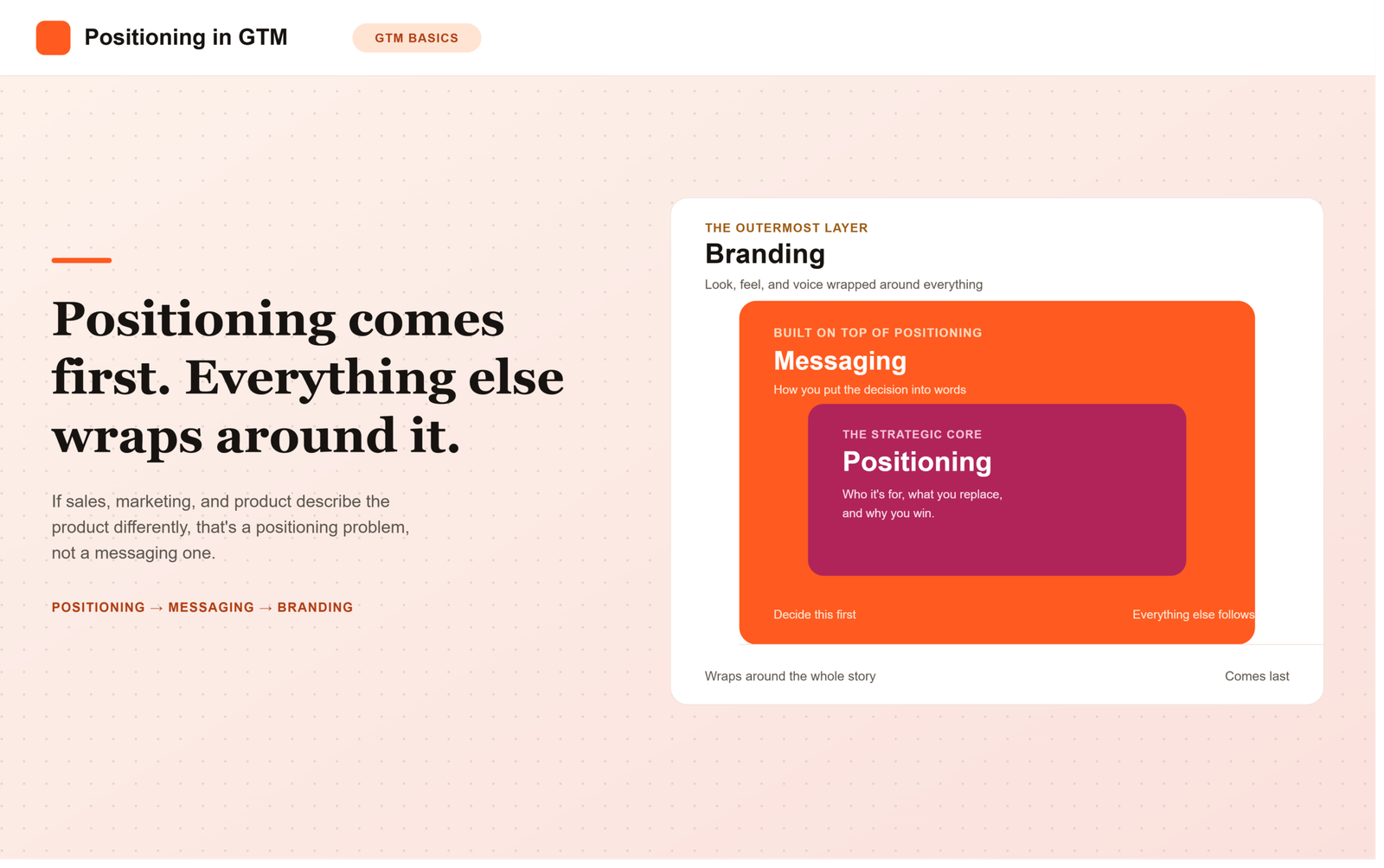
- Positioning is the strategic decision: who this is for, what alternative you’re replacing, and what makes you the obviously better choice for that specific group.
- Messaging is how you put that decision into words: the promise you make, how you deliver it, and why it matters to the buyer.
- Branding is the look, feel, and voice wrapped around all of it.
Positioning comes first. Messaging is built on top of it. Branding wraps around both. Skip the positioning step and jump straight to writing taglines, and you’ll end up with copy that sounds nice but doesn’t actually tell anyone why they should care.
How do you actually build product positioning?
There’s no single official template, but the process most practitioners (Dunford included) point to follows a similar pattern. Here’s a simplified version you can run through with your team:
- List the real alternatives. What would your customer do if your product didn’t exist? Include direct competitors and “do nothing” or manual workarounds.
- Identify what’s genuinely unique. What features or capabilities do you have that those alternatives don’t?
- Turn features into value. For each unique attribute, ask: so what does that actually let the customer do or achieve?
- Define who cares most. Not everyone will value that outcome equally. Narrow in on the segment that cares the most.
- Pick your market category. Choose the frame of reference that makes your value obvious to that specific segment, since the same product can be framed several different ways depending on the category you claim.
Pro tip: run this exercise with sales, product, and leadership in the room, not just marketing. A lot of positioning failures aren’t actually positioning failures, they’re alignment failures, where the founder has the story right but the rest of the leadership team isn’t telling it the same way.
Once your positioning is set, you’ll notice it shapes decisions well outside the marketing team. It influences how a product-led company designs its free trial, for instance. If you’re exploring a self-serve approach.
What happens when positioning goes wrong?
Weak positioning tends to show up as a pattern, not a single mistake. Products that read like every other tool in the category give buyers no compelling reason to choose them over the alternatives. You’ll also see it in a mismatched sales motion: an enterprise-style sales process bolted onto a product that should be self-serve, or vice versa. And you’ll see it in the classic cross-functional mess, where sales, marketing, and product each describe the product a little differently because no one agreed on the underlying story.
FAQ
Is positioning the same thing as a value proposition?
No, though they’re closely related. Positioning is the broader strategic frame (who you’re for and why you beat the alternatives), and your value proposition is a specific, named statement that spells out the customer, the problem, and the differentiated solution.
Who should own positioning inside a company?
Product marketing often drives the process, but positioning shouldn’t live in one department. It needs input from the founder, sales, and product leadership, otherwise you end up with a story that marketing believes but no one else actually uses.
Do early-stage startups need formal positioning, or is that a later-stage problem?
Early stage is exactly when you need it most. Founders often get the story right instinctively through early customer conversations, but that instinct rarely survives the jump to a bigger team unless it’s written down and agreed on.
How often should we revisit our positioning?
Whenever something big shifts: new competitors enter, your market matures, or you move upmarket or downmarket. Positioning isn’t a one-time doc you file away after a launch.
Can good positioning fix a weak sales motion?
Not on its own. Positioning and your GTM motion need to match each other. Great positioning paired with the wrong sales process still creates friction for buyers.
Leave a Reply