Australian B2B SaaS companies sell into one of the more demanding go-to-market environments in the world: a small domestic market that forces early international expansion, usually into the US and APAC simultaneously, across time zones that overlap awkwardly with both. That combination makes strong RevOps services less of a nice-to-have and more of a survival requirement once a company passes its first few million in ARR.
This guide covers what to look for in a RevOps services partner if you’re an Australian B2B SaaS revenue leader, and how the local market context should shape your evaluation.
Why Australian B2B SaaS Teams Have a Unique RevOps Problem
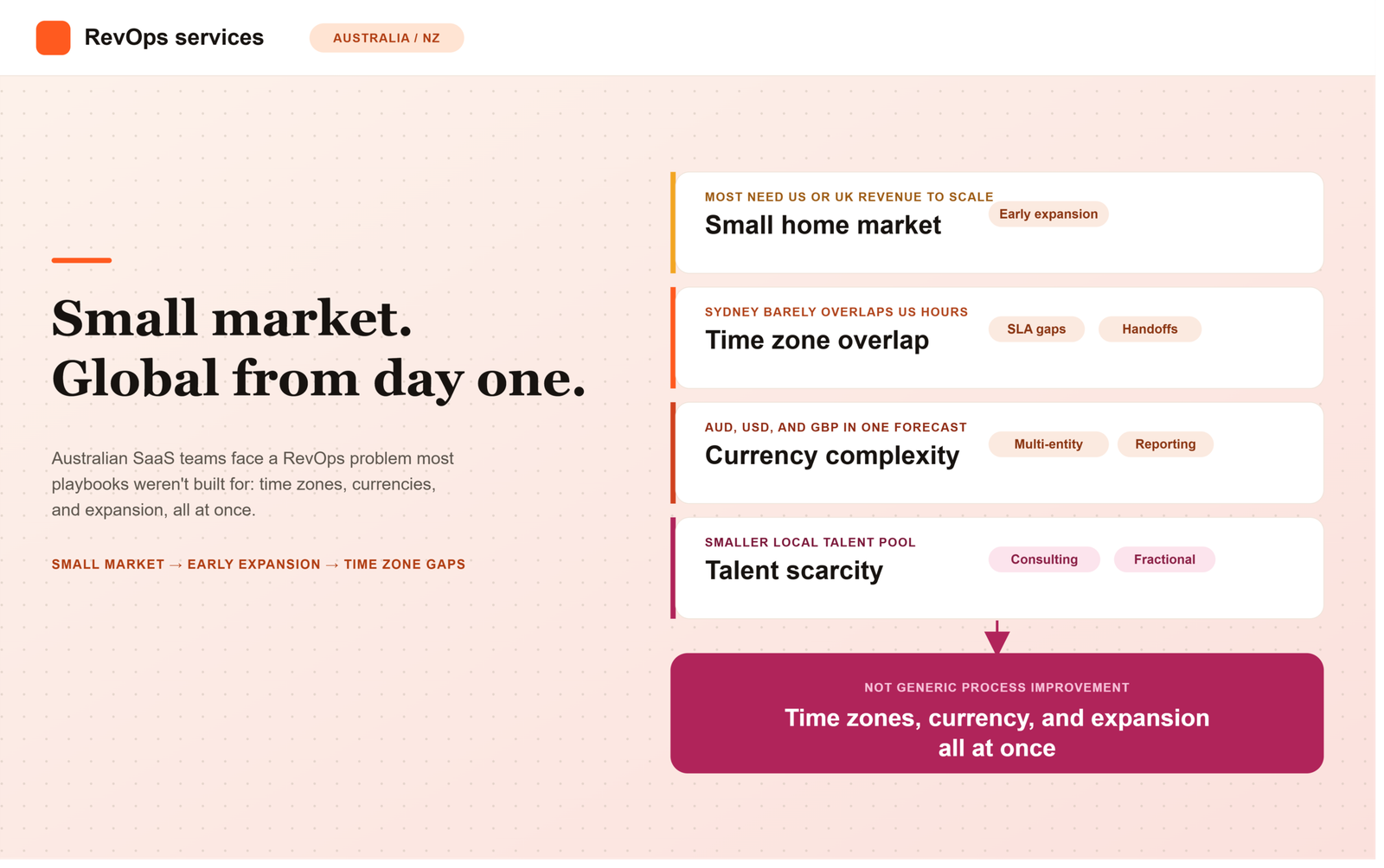
- Small home market, early internationalization. Most Australian SaaS companies need US or UK revenue to hit venture-scale outcomes, often starting international expansion earlier than comparable companies in larger domestic markets.
- Awkward time zone overlap. Sydney/Melbourne business hours barely overlap with US business hours, which creates real handoff and SLA problems between marketing, SDRs, and closing reps across regions.
- Currency and reporting complexity. Multi-currency deals and ANZ-specific compliance and invoicing norms add friction that generic RevOps playbooks don’t account for.
- Talent scarcity. The local RevOps talent pool is smaller than in the US or UK, which is a major reason Australian SaaS companies lean on consulting partners rather than building large in-house teams early.
What Good RevOps Services Look Like for This Market
1. Explicit Time Zone and Handoff Design
A partner worth hiring should be able to describe, concretely, how they design SLAs and lead routing so a lead generated during Sydney business hours doesn’t sit for 10+ hours before a US-based rep sees it and vice versa.
2. Multi-Currency and Multi-Entity Reporting
If you’re billing in AUD, USD, and potentially GBP, your RevOps partner needs experience building forecasting and pipeline reporting that rolls up cleanly across currencies without manual reconciliation every board cycle.
3. Sales and Marketing Alignment That Survives Time Zone Handoffs
Alignment is harder to maintain when your marketing team, SDR team, and closing reps are spread across three time zones. Look for partners who build closed-loop attribution and shared lead definitions that hold up even when teams rarely overlap in real time.
4. Familiarity With the ANZ-to-Global Expansion Playbook
Ask any prospective partner how many Australian SaaS clients they’ve helped expand into the US specifically, this is a well-worn but specific playbook, and experience with it should be easy for them to demonstrate with real examples.
Evaluation Checklist
| Criteria | What to Look For |
|---|---|
| Time zone design | Concrete SLA and routing rules across ANZ/US/APAC hours |
| Currency handling | Multi-currency forecasting and reporting experience |
| Expansion track record | Prior work with Australian SaaS companies expanding into the US or UK |
| Alignment tooling | Ability to keep sales/marketing aligned across distributed teams |
| Engagement flexibility | Comfortable working async and outside standard AU business hours |
Fractional vs. Project Engagements
Many Australian SaaS companies start with a project-based engagement, typically a CRM re-architecture or lead routing overhaul timed to a US expansion push, before moving to fractional, ongoing RevOps support once the international motion stabilizes. Given the smaller local talent pool, fractional support is often more cost-effective than trying to hire a full in-house RevOps function too early.
Frequently Asked Questions
What makes RevOps different for Australian SaaS companies?
The core process work, forecasting, lead routing, CRM hygiene, is the same everywhere. What’s different is the operating environment: a small home market that forces early international expansion, time zones that barely overlap with the US, and multi-currency reporting that most generic RevOps playbooks aren’t built to handle.
How much does RevOps consulting cost in Australia?
Project-based engagements, such as a CRM re-architecture ahead of a US launch, are usually quoted as a fixed fee for a defined scope. Fractional support is typically billed monthly. Because the local talent pool is smaller, fractional consulting is often more cost-effective than hiring a full-time in-house RevOps lead too early.
Should we hire a local Australian RevOps partner or one based in the US?
What matters more than location is whether the partner has direct experience with the ANZ-to-US or ANZ-to-UK expansion playbook, including time zone handoff design and multi-currency reporting. A partner who understands Sydney-to-US SLA gaps firsthand is more valuable than one who only knows a single region well, regardless of where they’re headquartered.
When should an Australian SaaS company invest in RevOps services?
Most teams feel the need once they pass their first few million in ARR and start hiring SDRs or reps outside Australia. The clearest trigger is usually the moment leads generated in Sydney hours start sitting unworked for most of a US business day, that handoff gap is exactly what a RevOps partner should be brought in to fix.
What’s the most common RevOps mistake Australian SaaS teams make when expanding overseas?
Treating the expansion as a hiring problem rather than a systems problem. Adding US-based reps without first fixing lead routing, SLA rules across time zones, and multi-currency reporting just moves the same handoff gaps into a bigger, more expensive team.
Is fractional or project-based RevOps better for a scaling ANZ SaaS company?
Project-based work fits a defined, time-boxed problem, like rebuilding lead routing ahead of a US launch. Fractional support fits the stretch after that, when the international motion is live but still evolving and needs an ongoing owner. Many Australian companies use a project engagement to prepare for expansion, then shift to fractional support once they’re actually operating across regions.
The Bottom Line
For Australian B2B SaaS teams, the value of a RevOps services partner isn’t generic process improvement, it’s specifically solving the time zone, currency, and international expansion problems that come with building a global GTM motion from a small home base. Evaluate partners on that specific experience, not just general RevOps credentials.
Leave a Reply