Category: GTM Basics

  • How a company acquires, converts, retains, and expands customers

    How a company acquires, converts, retains, and expands customers

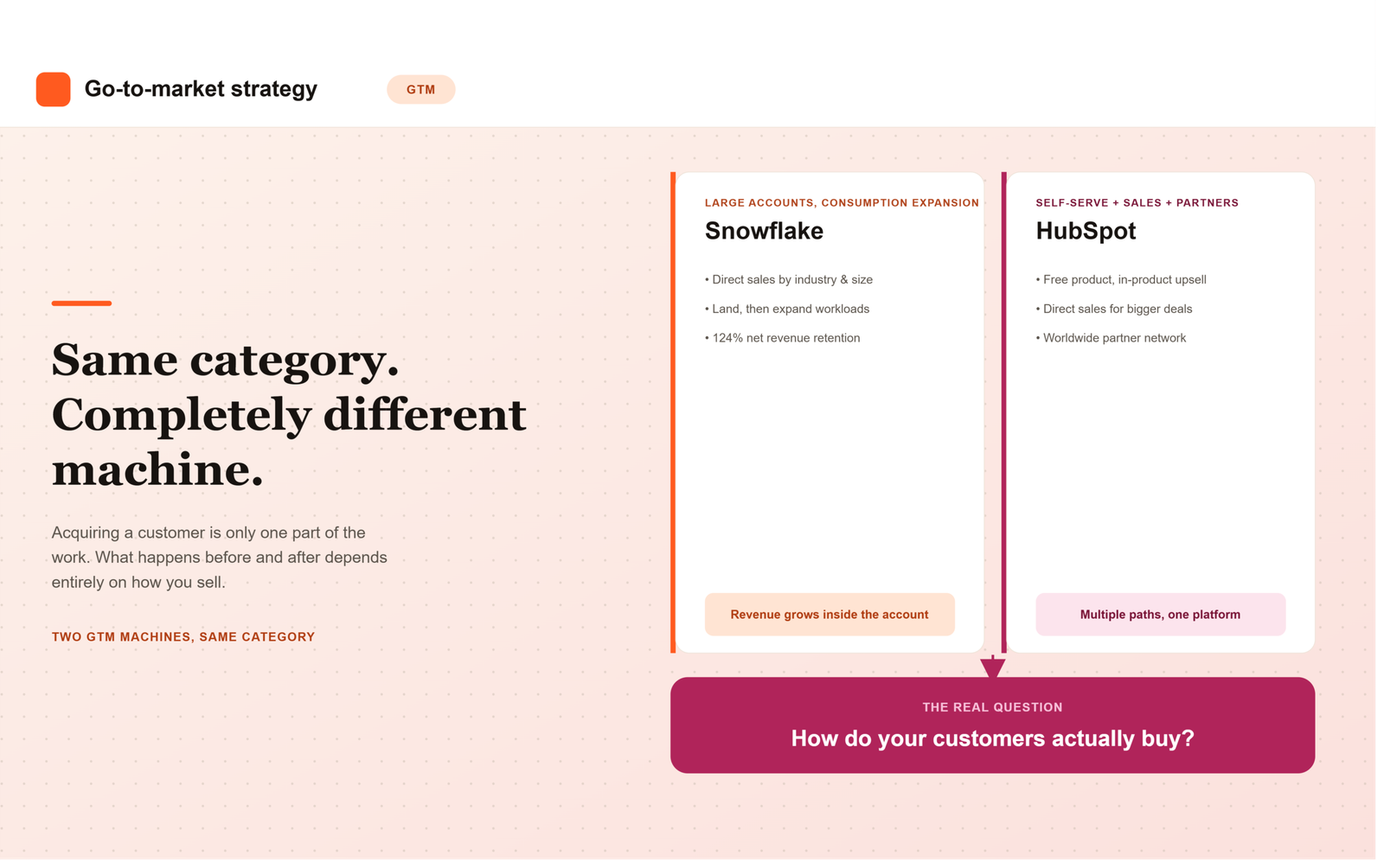
    Snowflake and HubSpot both sell business software. A description at that level makes their commercial models sound similar. Their own filings tell a different story.

    Snowflake concentrates its selling effort on large organizations, using a direct sales force divided by industry, size, and geography. After a customer starts using the platform, Snowflake works to move additional workloads onto it, which increases consumption and revenue. HubSpot serves companies with between 2 and 2,000 employees through a mix of direct sales, free products customers adopt themselves, in-product offers, and a worldwide partner network. Some customers buy with little or no interaction with a salesperson.

    Both companies need customers to discover a product, decide to use it, pay for it, and eventually spend more. The machinery through which that happens is quite different, and that machinery is the subject of go-to-market strategy. GTM determines which customers a company intends to serve, how those customers encounter and buy the product, and how the relationship develops afterward. Acquiring a customer is only one part of the work.

    Before a company acquires anyone, it has already made several GTM choices

    A sales team cannot pursue “the market.” It has to pursue particular customers. Companies that grow opportunistically, one seller finds a hospital, marketing discovers a segment responds well, end up with a customer base that reflects what the organization happened to win rather than a deliberate choice about where it has an advantage. Scott Edinger framed this in Harvard Business Review as asking whether a company is selling what it intends to sell, to the customers it intends to serve, or simply accepting whatever its sales organization can win.

    Different customers create very different commercial requirements. A small company buying a $50 monthly tool can research it online and self-serve. A global bank evaluating a multimillion-dollar system needs months of meetings, security review, procurement, legal, and executive approval, all for a related product category. This is why segmentation, by size, industry, geography, or buying behavior, sits near the beginning of GTM design. Snowflake segments by industry, size, and region toward large organizations; Freshworks serves a broader range through user-led adoption, sales coverage, and partners. These choices ripple into channels, pricing, sales-cycle length, and how much a company can afford to spend winning each account.

    Acquisition is really a question of how customers enter the company’s world

    Companies often summarize acquisition with a single number, leads or new accounts, but the paths producing those customers may have little in common: advertising, search, outbound email, a conference, a partner, a free product, or a referral. Each path places work in a different part of the organization. HubSpot runs several acquisition systems at once: direct sales, free products, a partner network, and years of inbound content. Freshworks blends user-driven adoption, free trials, sales activity, and partners, designed to reduce friction for new users while keeping sales coverage for larger opportunities.

    None of these channels is inherently superior; the economics have to fit the customer and the purchase. Sending a field seller after a $100 annual product makes no sense, and neither does expecting a major bank to buy complex infrastructure through a checkout screen. A 2026 Harvard Business Review article notes that companies increasingly run multiple GTM models at once, citing Microsoft serving small customers digitally while using account teams for large enterprises. The real challenge is deciding which customer enters which path.

    Interest has to become a purchase

    Acquisition creates attention, not revenue. A person can try a product and disappear; an enterprise buyer can evaluate for months and choose a competitor. Conversion is where interest has to survive the buying process. For simple products, this happens inside the product itself: a user hits a limit, picks a plan, and pays. The questions become familiar to product-led businesses, how fast does a new user reach value, where do people abandon onboarding, which free users eventually pay.

    As purchases grow more complicated, salespeople help buyers build an internal case, involve stakeholders, and negotiate terms, though not always in a clean sequence. Amplitude describes combining direct field and inside sales, product-led growth, marketing, and solution consultants, with salespeople working both new accounts and expansion in existing ones. PLG and sales-led motion increasingly operate inside the same customer journey: product creates evidence of demand, and sales becomes useful once the purchase exceeds what self-service can handle. Poor conversion often traces back to the offer itself, confusing pricing, risky commitment terms, painful implementation, not just weak selling.

    What happens immediately after the sale affects the GTM model

    A signed contract feels like completion, but the customer has only begun trying to receive what it purchased. Recurring-revenue businesses depend on customers continuing to see enough value to remain, which makes the handoff after purchase part of GTM design: who welcomes the customer, what has to be implemented, what commitments made during sales need to reach delivery or Customer Success.

    A company can become efficient at winning customers it subsequently loses. Add 1,000 customers in a year and lose 800 existing ones, and the business barely moves while looking busy. Freshworks defines net dollar retention as the revenue change within an existing customer group after upsells, cross-sells, renewals, contraction, and attrition, a measure that forces growth to be viewed through the installed base, not just new logos. Retention problems usually start earlier: a poor-fit sale, an implementation that took too long, features nobody adopted, which is why retention responsibility spreads across Product, Sales, Customer Success, and Support.

    Expansion changes the economics of customer acquisition

    The first transaction is often only the opening value of a relationship. Snowflake makes this visible through its consumption model: as customers find new use cases and consume more compute and storage, account revenue grows, reporting 124 percent net revenue retention as of April 2025. The mechanism differs elsewhere, a seat-based company expands as headcount grows, a multi-product company cross-sells, a marketplace earns more as participants transact more. Shopify describes revenue from merchants who stay historically growing enough to offset revenue lost from those who leave.

    Expansion changes what a company can rationally spend to acquire a customer. Two businesses each spending $1,000 to win an account produce very different economics if one customer pays $1,200 and leaves while the other grows to $5,000 annually over several years. Same acquisition cost, completely different relationship quality, which is why sophisticated GTM organizations spend so much time on customer fit rather than just close rate.

    One company can operate several GTM motions

    Large companies rarely enforce a single motion everywhere. A small customer and a global enterprise need different channels, sales processes, and economics even on the same platform. Freshworks combines product-led adoption with sales assistance and partners; Atlassian pairs easy product adoption with enterprise cloud as a strategic priority, reporting more than 300,000 cloud customers and 120 percent cloud net revenue retention in fiscal 2025.

    A customer can also change motions mid-relationship: a ten-person team’s self-service purchase spreads to 200 employees, IT gets involved, procurement wants a contract, and a product-led account becomes an enterprise opportunity. Missing that transition either leaves expansion revenue on the table or sends expensive sellers after every small signup, destroying the economics that made self-service work in the first place. GTM design has to define the thresholds for when a salesperson, a Customer Success Manager, or a partner gets involved.

    GTM strategy is visible in the way resources are allocated

    Strategy becomes real once money and people get assigned. “Enterprise healthcare is a priority” means something only once the company hires sellers who understand healthcare, builds the compliance capability buyers expect, and adjusts territories. Otherwise it stays a sentence in a slide deck. The same applies to PLG: a free trial alone doesn’t create product-led growth without accessible onboarding, thoughtful pricing, and product analytics that show when free usage signals willingness to pay. McKinsey frames GTM design in similarly economic terms, deciding whom to sell to, which channels to use, and what coverage each transaction deserves. Resource allocation is what turns GTM from an idea into an operating model.

    The funnel is useful, but incomplete

    The sales funnel shows that many prospects enter and fewer eventually buy, but it distorts thinking in three ways: customers rarely travel in a straight line, the funnel usually ends at purchase even though much of the value happens afterward, and it makes every prospect look like it’s moving through the same machine, which is increasingly untrue. A lifecycle view captures more of what’s actually happening:

    Stage Commercial Question
    Market choice Which customers are attractive enough to pursue?
    Acquisition How do those customers discover or enter the company?
    Conversion What enables them to move from interest or usage to a purchase?
    Onboarding and adoption How do new customers begin receiving the value they expected?
    Retention What makes the commercial relationship continue?
    Expansion What causes an existing customer to spend more?
    Advocacy Do successful customers help create future demand through references, reviews, referrals, or ecosystem effects?

    These rows are connected: poor market selection creates retention problems later, weak onboarding damages expansion, and strong outcomes lower future acquisition costs through referrals. A GTM system behaves differently once these interactions become visible.

    GTM is partly a set of economic trade-offs

    There is no free acquisition channel. Organic demand looks inexpensive, but brand, content, and time created it. Direct sales adds headcount cost for control and insight. Partners extend reach but take economics and some control. Free products lower the barrier to adoption while creating large populations who may never pay. Each choice carries a cost structure, which is why customer lifetime economics matter alongside growth rate: what it costs to acquire and serve a customer against what that relationship is expected to create. The math is rarely precise enough to dictate strategy alone, but it rules out impossible combinations, an expensive field-sales model can’t indefinitely chase customers whose lifetime value barely covers the seller’s cost.

    Go-to-market strategy does not remain fixed

    A company’s GTM system changes as the company, product, and market develop. Early on, founders sell directly, hearing objections and adjusting the pitch themselves. A repeatable process appears only once that uncertainty decreases, after which companies add specialist sellers, territories, demand generation, and partners. A self-service company can move into enterprise; an enterprise company can build a digital channel for smaller customers. A June 2026 Harvard Business Review piece argues companies increasingly run multiple GTM models and need distinct digital strategies for each, but the underlying reason predates AI: customers simply differ in how they want to buy, and a good GTM system keeps learning from that rather than assuming the process built three years ago should stay permanent.

    What RevOps sees when it looks at GTM

    For Revenue Operations, GTM strategy becomes a set of operating assumptions: how many account executives are needed, how many accounts each can cover, how much pipeline is required and where it originates, what conversion rate makes the plan plausible, and how many implementation or Customer Success resources new customers will need. Those assumptions connect the revenue target to the organization expected to deliver it.

    HubSpot’s mixed model requires RevOps to see direct sales, freemium conversion, partner-sourced business, and expansion together. Snowflake’s model requires monitoring consumption expansion inside the installed base. A services company needs to connect sales demand with available delivery capacity. This is why copying another company’s GTM dashboard rarely works, the measures that matter come from the specific economics of that model.

    A Working Definition

    Go-to-market strategy describes how a company turns a chosen market into customers and then develops those relationships economically over time: whom to serve, what channels create demand, how customers evaluate and buy, how they begin using what they purchased, and the mechanisms that support renewal and expansion. Marketing, Sales, Customer Success, Product, Partners, and RevOps all participate, with their relative importance shifting by model. For a self-service product, Product and Marketing carry most of the burden; for an enterprise purchase, Sales dominates; for a consumption business, usage drives expansion.

    The most revealing GTM question is therefore rarely “are we sales-led or product-led?” A company can be both. The useful discussion is about the customers a company wants, how those customers actually buy and receive value, and whether the commercial system built around them can produce attractive economics repeatedly. That is the work behind go-to-market strategy.

    Frequently Asked Questions

    What’s the difference between go-to-market strategy and a sales funnel?

    A funnel visualizes how prospects narrow toward a purchase. GTM strategy is broader, covering which customers to serve, how they buy, and how the relationship grows afterward through retention and expansion, well past where a funnel typically ends.

    Can a company use more than one GTM motion at once?

    Yes, and most established companies do. HubSpot combines direct sales, a free product, and partners; Freshworks blends self-serve adoption with sales coverage for larger deals. A single customer can even move between motions as the account grows.

    Why does net revenue retention matter to GTM strategy?

    It shows whether existing customer revenue is growing or shrinking after upsells, renewals, and churn. That number changes what a company can rationally spend to acquire new customers, a business where accounts expand significantly, like Snowflake’s, can justify higher acquisition cost than one where customers rarely grow.

    How does GTM strategy relate to RevOps?

    RevOps translates GTM strategy into operating assumptions: seller headcount, pipeline requirements, conversion rates, and Customer Success resourcing. Different GTM models produce different operating requirements, which is why borrowing another company’s dashboard rarely fits without adapting it first.

    When should a self-serve or PLG account get handed to a salesperson?

    Common signals include a product spreading to far more users, IT or security asking questions, or procurement requesting a formal contract. Missing that transition either leaves expansion revenue on the table or destroys the low-cost economics that made self-service work.

    Why doesn’t copying another company’s GTM dashboard work?

    Because the metrics that matter depend on a company’s specific economics. A consumption business tracks workload expansion, a mixed-motion company needs visibility across sales, freemium, and partner channels, and a services company tracks demand against delivery capacity. Borrowing a dashboard built for a different model usually means tracking the wrong things.
  • What Is Positioning in GTM? A Beginner’s Guide

    What Is Positioning in GTM? A Beginner’s Guide

    What Is Positioning in GTM? A Beginner’s Explanation

    Positioning in GTM (go-to-market) is the work of defining the unique place your product occupies in a customer’s mind compared to every other option they could choose instead. It answers who the product is for, what problem it solves, and why it beats the alternatives. Good positioning shapes your messaging, pricing, and sales motion.

    If you’ve ever sat in a meeting where sales, marketing, and product all describe your product differently, you’ve already felt what happens when positioning is missing. It’s not a branding exercise. It’s the foundation everything else in your go-to-market plan gets built on.

    What does “positioning” actually mean in GTM?

    Go-to-market (GTM) is the overall plan for how a company brings a product to market and gets it in front of the right buyers. Positioning is one piece of that plan, and it’s arguably the most foundational one.

    At its core, positioning defines the unique space your product occupies in the customer’s mind relative to other options they’re weighing. It’s not a tagline or a slogan. It’s the underlying logic that explains why someone should pick you over the alternative, whether that alternative is a competitor, a manual process, or doing nothing at all.

    April Dunford, one of the most cited voices on this topic, describes positioning as the context-setting work that makes it obvious what your company does and what value it offers to your ideal customers. Her own definition is more specific: positioning explains how your product is the best in the world at delivering some kind of value that a clearly defined group of customers cares a lot about. That’s a mouthful, and she’s the first to admit it, but it’s precise for a reason. Vague positioning invites vague buying decisions.

    The concept itself isn’t new. Positioning as a formal idea traces back to a 1981 book by Al Ries and Jack Trout, though later work (Dunford’s especially) turned it into a repeatable process rather than just a theory.

    Why does positioning matter for your GTM strategy?

    Here’s the blunt version: if your positioning sounds like every other vendor in your category, buyers have no compelling reason to pick you. That’s not a marketing problem you can copywrite your way out of. It’s a strategy problem.

    A positioning statement sits at the core of your go-to-market strategy, and everything downstream (your messaging, your sales pitch, your onboarding, even your pricing page) gets built from it. When it’s solid, your whole team can explain what you do and why it matters in the same way, whether that’s a rep on a discovery call or a support agent onboarding a new account.

    When it’s missing or muddy, you get a familiar mess: reps improvising their own pitch, marketing running campaigns that don’t match what sales actually says, and buyers who can’t figure out why you’re different from the three other tools they’re evaluating. Honestly, most “messaging problems” companies bring to us aren’t messaging problems at all. They’re unresolved positioning problems wearing a messaging costume.

    Positioning also matters because it should inform how you actually sell, not just what you say. A product positioned for fast, self-serve adoption needs a different [[GTM motion]** than one positioned as a high-touch, enterprise-grade solution, and mismatching the two is one of the more common (and expensive) GTM mistakes we see. If you’re still deciding between a sales-led approach and a self-serve one, it’s worth reading our breakdown of GTM motion types before you lock in your positioning, since the two decisions really do influence each other.

    How is positioning different from messaging and branding?

    This trips up a lot of new founders, so let’s separate the three plainly.

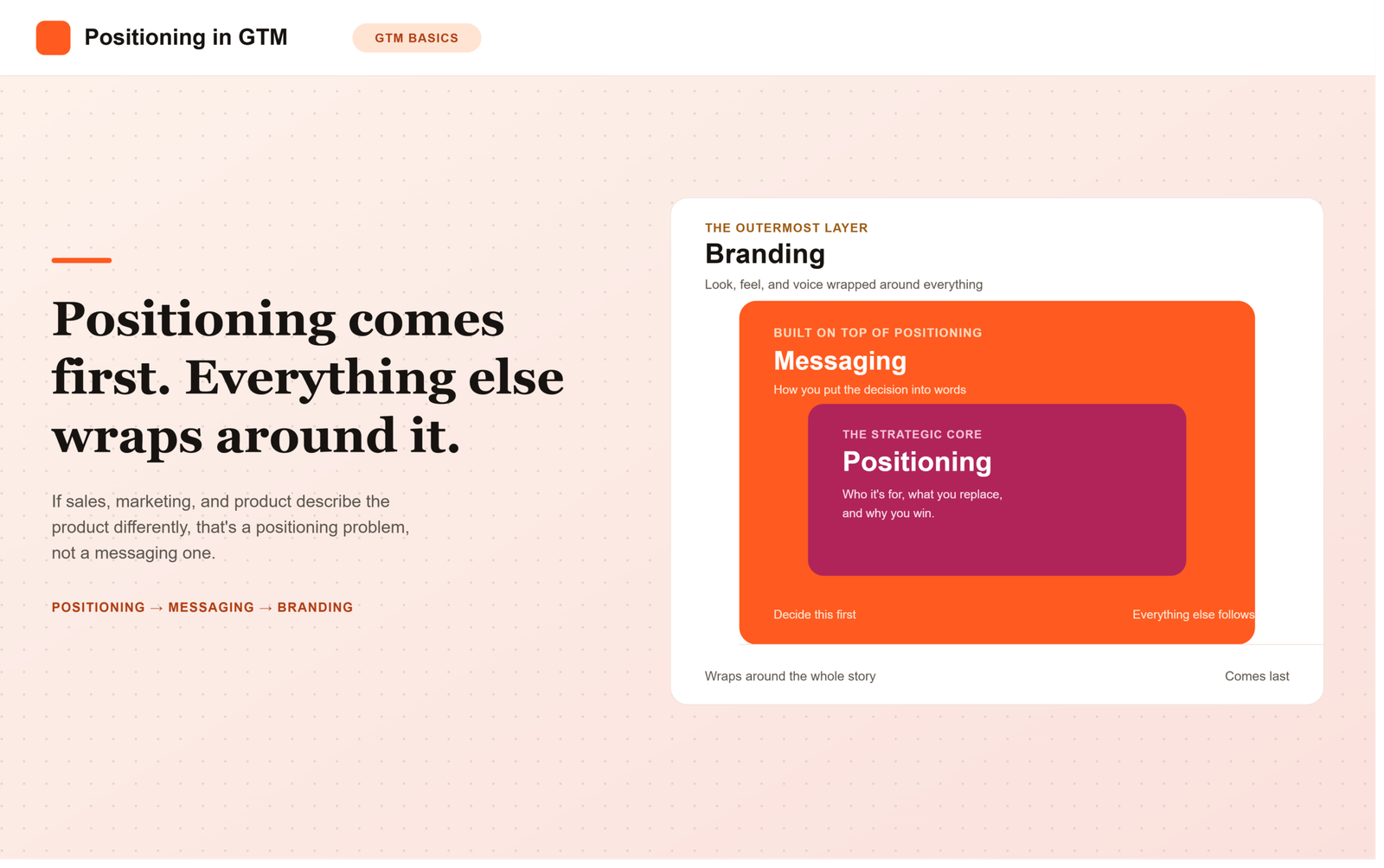
    • Positioning is the strategic decision: who this is for, what alternative you’re replacing, and what makes you the obviously better choice for that specific group.
    • Messaging is how you put that decision into words: the promise you make, how you deliver it, and why it matters to the buyer.
    • Branding is the look, feel, and voice wrapped around all of it.

    Positioning comes first. Messaging is built on top of it. Branding wraps around both. Skip the positioning step and jump straight to writing taglines, and you’ll end up with copy that sounds nice but doesn’t actually tell anyone why they should care.

    How do you actually build product positioning?

    There’s no single official template, but the process most practitioners (Dunford included) point to follows a similar pattern. Here’s a simplified version you can run through with your team:

    1. List the real alternatives. What would your customer do if your product didn’t exist? Include direct competitors and “do nothing” or manual workarounds.
    2. Identify what’s genuinely unique. What features or capabilities do you have that those alternatives don’t?
    3. Turn features into value. For each unique attribute, ask: so what does that actually let the customer do or achieve?
    4. Define who cares most. Not everyone will value that outcome equally. Narrow in on the segment that cares the most.
    5. Pick your market category. Choose the frame of reference that makes your value obvious to that specific segment, since the same product can be framed several different ways depending on the category you claim.

    Pro tip: run this exercise with sales, product, and leadership in the room, not just marketing. A lot of positioning failures aren’t actually positioning failures, they’re alignment failures, where the founder has the story right but the rest of the leadership team isn’t telling it the same way.

    Once your positioning is set, you’ll notice it shapes decisions well outside the marketing team. It influences how a product-led company designs its free trial, for instance. If you’re exploring a self-serve approach.

    What happens when positioning goes wrong?

    Weak positioning tends to show up as a pattern, not a single mistake. Products that read like every other tool in the category give buyers no compelling reason to choose them over the alternatives. You’ll also see it in a mismatched sales motion: an enterprise-style sales process bolted onto a product that should be self-serve, or vice versa. And you’ll see it in the classic cross-functional mess, where sales, marketing, and product each describe the product a little differently because no one agreed on the underlying story.

    FAQ

    Is positioning the same thing as a value proposition?
    No, though they’re closely related. Positioning is the broader strategic frame (who you’re for and why you beat the alternatives), and your value proposition is a specific, named statement that spells out the customer, the problem, and the differentiated solution.

    Who should own positioning inside a company?
    Product marketing often drives the process, but positioning shouldn’t live in one department. It needs input from the founder, sales, and product leadership, otherwise you end up with a story that marketing believes but no one else actually uses.

    Do early-stage startups need formal positioning, or is that a later-stage problem?
    Early stage is exactly when you need it most. Founders often get the story right instinctively through early customer conversations, but that instinct rarely survives the jump to a bigger team unless it’s written down and agreed on.

    How often should we revisit our positioning?
    Whenever something big shifts: new competitors enter, your market matures, or you move upmarket or downmarket. Positioning isn’t a one-time doc you file away after a launch.

    Can good positioning fix a weak sales motion?
    Not on its own. Positioning and your GTM motion need to match each other. Great positioning paired with the wrong sales process still creates friction for buyers.

  • What Is a Go-to-Market Launch Plan? Checklist

    What Is a Go-to-Market Launch Plan? Checklist

    What Is a Go-to-Market Launch Plan? A Beginner’s Checklist

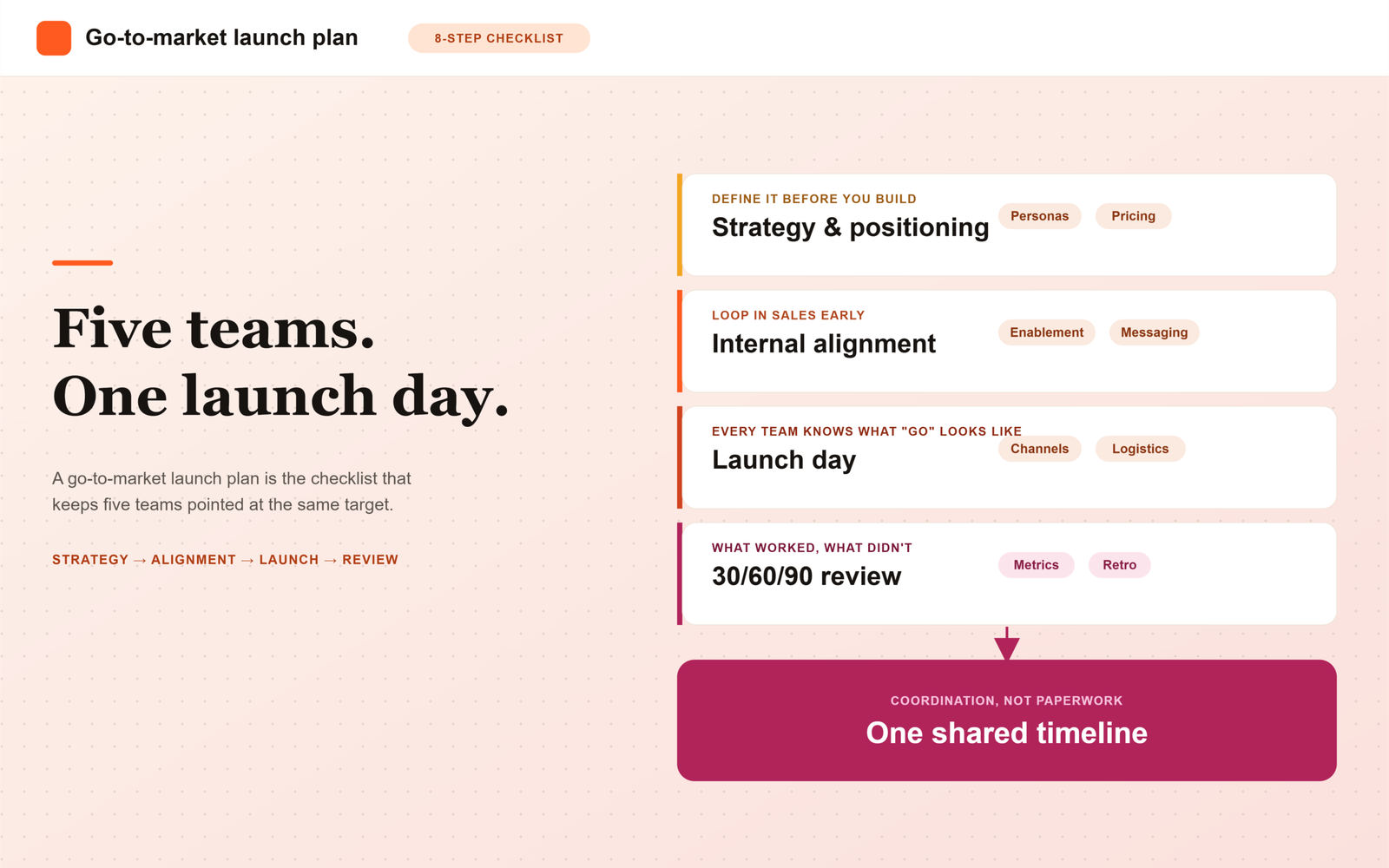
    A go-to-market (GTM) launch plan is the detailed roadmap your team follows to introduce a new product, feature, or market to customers. It covers your target audience, positioning, pricing, channels, sales enablement, and launch-day logistics, aligning every team around one shared timeline and goal.

    If you’ve ever watched a launch go sideways, sales pushing one message while marketing pushes another, support fielding questions nobody prepped them for, you already know why this document exists. A launch plan isn’t paperwork for its own sake. It’s the thing that keeps five different teams pointed at the same target on the same day.

    This post breaks down what actually belongs in a go-to-market launch plan, why skipping it costs you more than it saves, and gives you a checklist you can start filling in today.

    What Is a Go-to-Market Launch Plan?

    A go-to-market strategy is the broader plan for how your company turns a product into revenue. It’s the thinking behind who you’re selling to and why they’d buy. A go-to-market launch plan is narrower: it’s the operational, dated, task-level version of that strategy for one specific launch event.

    One source describes it simply as the planning and preparation for introducing a new product or service to a market, something that puts you in a position to actually reach product-market fit instead of just shipping and hoping. Another way to think about it: a go-to-market strategy is the map, and the launch plan is the turn-by-turn directions with a departure time.

    A solid launch plan usually answers these questions before day one:

    • Who exactly are we launching to?
    • What problem does this solve for them, in their words?
    • How is this priced and packaged?
    • Which channels will carry the message?
    • Is sales actually ready to sell it?
    • What happens in the first 30, 60, and 90 days after launch?

    If you’re still fuzzy on who your buyer even is, it’s worth backing up to define your ideal customer profile before you build the rest of the plan around a guess.

    Why Does a Go-to-Market Launch Plan Matter?

    Here’s the problem with launching without one: every team ends up improvising, and improvised launches tend to look inconsistent from the outside. A go-to-market plan is meant to deliver a cohesive customer experience across sales, marketing, and support, rather than a scattered set of one-off efforts that happen to share a launch date.

    Without a documented plan, teams tend to drift into their own silos: marketing chases one audience, sales chases another, and product keeps shipping features that don’t map to either. That disconnect doesn’t just look messy internally, it burns through budget and confuses the exact customers you’re trying to win over.

    Honestly, most launch failures we see aren’t a product problem. They’re a coordination problem dressed up as a product problem. The features work fine. Nobody agreed on who they were for, or who was supposed to say what to whom, by when.

    How Do You Build a Go-to-Market Launch Plan? (Step-by-Step)

    Most frameworks converge on a similar sequence, even if the exact number of steps varies by source. Here’s a practical version you can adapt regardless of company size.

    1. Define your target market and buyer personas. Get specific about industry, company size, and the roles of the people who’ll actually buy and use the product. Buyer personas are simply a representation of what your ideal buyer looks like, including the roles they hold and the problems they’re trying to solve.
    2. Nail your positioning and messaging. What makes this different, and why should a buyer care right now? This is also where understanding your GTM motion (PLG, sales-led, or a hybrid of the two) shapes how that message actually reaches people.
    3. Set pricing and packaging. Decide this before launch day, not during a sales call. Pricing decisions ripple into everything from messaging to sales scripts.
    4. Choose your channels deliberately. Great launch plans mix channels that work together toward the same goals, dictated by your audience and metrics, rather than trying to be everywhere at once.
    5. Get internal alignment first. The launch process touches nearly every team in the company, so it matters that everyone understands the purpose of the launch and their specific role in it before execution starts.
    6. Brief and enable sales early. Sales teams need to be briefed well ahead of launch day so they aren’t improvising their pitch in front of a prospect.
    7. Plan launch day logistics. Content goes live, campaigns kick off, and every team should know exactly what “go” looks like for their piece of it.
    8. Build in a post-launch review. A plan doesn’t end at launch. Post-launch evaluation is part of the process too, so you can see what worked and adjust the next one.

    Go-to-Market Launch Plan Checklist

    Use this as a working list, not a rigid script. Adapt it to your team’s size and launch type.

    • [ ] Target market and firmographics defined
    • [ ] Buyer personas documented, including roles and pain points
    • [ ] Core positioning statement written and agreed on
    • [ ] Pricing and packaging finalized
    • [ ] Channel mix selected and tied to specific goals
    • [ ] Internal alignment meeting held across product, marketing, sales, and support
    • [ ] Sales enablement materials built and reps trained
    • [ ] Launch day timeline with named owners per task
    • [ ] Post-launch metrics defined (what “success” actually looks like)
    • [ ] 30/60/90-day review scheduled

    One more thing worth knowing: research cited by product marketing teams suggests a typical B2B buying group can include six to ten decision-makers, including influencers and gatekeepers who can slow or block approval. That’s a strong argument for making sure your messaging and sales materials address more than just the person who signed up for the demo.

    Summary

    A go-to-market launch plan is the operational, dated version of your broader GTM strategy, built specifically for one launch event. It answers who you’re launching to, what problem it solves for them, how it’s priced, which channels carry the message, whether sales is actually ready, and what happens in the first 30, 60, and 90 days after go-live.

    Skipping this document doesn’t usually show up as a product failure, it shows up as a coordination failure: sales, marketing, and support each improvising their own version of the story. The eight-step process, target market and personas, positioning, pricing, channels, internal alignment, sales enablement, launch-day logistics, and a post-launch review, gives every team the same shared timeline. Bring sales into the room during positioning, not just before launch day, and remember that a typical B2B buying group has six to ten decision-makers, so the plan needs to speak to more than just the person who booked the demo.

    Frequently Asked Questions

    Is a go-to-market launch plan the same as a go-to-market strategy?

    Not quite. The strategy is the bigger-picture thinking, your target market, positioning, and business case. The launch plan is the execution layer: dates, owners, tasks, and channels for one specific launch.

    Who should own the go-to-market launch plan?

    It varies by company, but product marketing often drives the document while pulling in sales, customer success, and product leadership as contributors. Someone still needs final ownership, otherwise tasks fall through the cracks between teams.

    How far in advance should we start building the plan?

    There’s no single universal number, but sales needs to be briefed well before launch day so reps aren’t caught unprepared, which means the plan itself needs to start taking shape weeks earlier than that.

    What happens if we skip the launch plan and just wing it?

    You can. Plenty of teams do. But without alignment, you tend to get mixed messaging, wasted spend, and a sales team improvising in front of prospects, which is a rough way to find out your pricing page and your sales deck don’t agree with each other.

    Does a launch plan work the same way for a small feature update as it does for a brand-new product?

    No, scale it down. A feature update might only need messaging, a couple of channels, and a quick sales briefing. A brand-new product or market entry usually needs the full checklist, including deeper buyer research and a longer post-launch review window.

  • GTM Motion Types Explained: PLG vs Sales-Led vs Hybrid

    GTM Motion Types Explained: PLG vs Sales-Led vs Hybrid

    What Is a GTM Motion? PLG vs. Sales-Led vs. Hybrid Explained

    If you’ve spent any time around SaaS founders or investors, you’ve probably heard someone say “what’s your GTM motion?” like it’s obvious. It isn’t, especially if you’re building your first company or your first revenue team.

    The term sounds more complicated than it is. Once you see the three main flavors side by side, picking one (or blending two) gets a lot less scary.

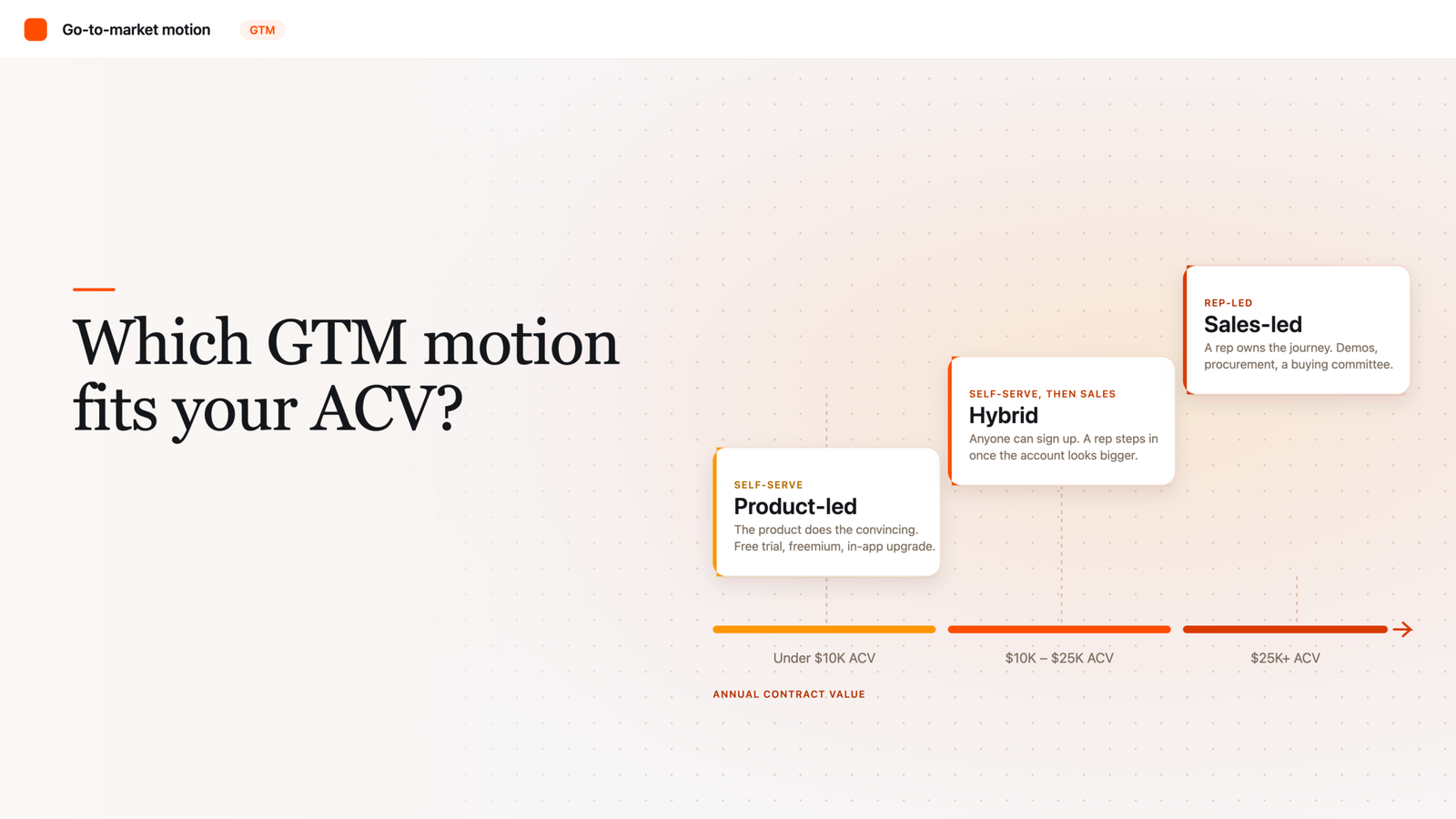
    A GTM (go-to-market) motion is the repeatable way a company gets its product in front of buyers and turns them into paying customers. The three core types are product-led (the product sells itself through self-serve trials), sales-led (reps drive the deal), and hybrid, which blends both depending on deal size and buyer type.

    What Is a GTM Motion, Exactly?

    A go-to-market motion is basically your company’s answer to three questions: who buys, how do they find out about you, and who actually closes the deal. Not a marketing plan, not a sales script, but the underlying operating model that shapes both.

    Most early-stage founders don’t choose a motion on purpose. They copy whatever the last company they worked at did, or whatever’s trending on LinkedIn that week. That’s a mistake, because the wrong motion for your price point and buyer type can quietly stall growth for years.

    What Is a Product-Led Growth (PLG) Motion?

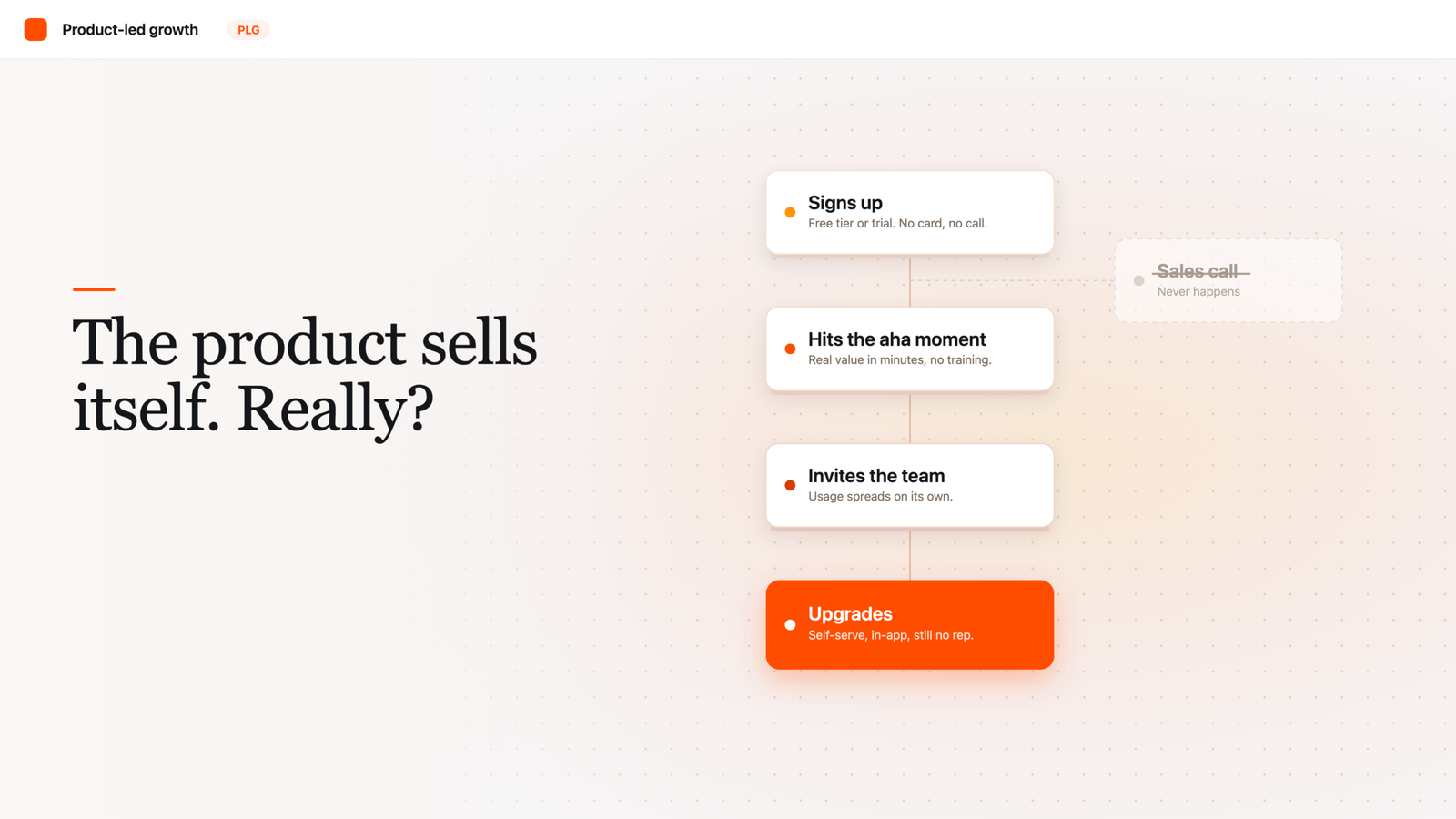
    Product-led growth is a go-to-market strategy where the product itself is the primary driver of acquisition, activation, and expansion, not a salesperson. Users try the product themselves, usually through a free trial or a freemium plan (a free, limited version of the product), experience value, and then upgrade or expand on their own.

    The term was coined by Blake Bartlett at OpenView back in 2016, and it’s since become an umbrella for tactics like freemium models, self-guided product tours, and in-app upgrade prompts. Think Slack or Dropbox: you didn’t sit through a sales pitch before you started using them. You just signed up and started working.

    One reason PLG caught on so fast is cost efficiency. A product-led strategy can reduce customer acquisition cost by taking pressure off the sales team, since the product itself is doing a lot of the convincing. OpenView has also found that leading product-led growth companies grow significantly faster year over year than traditional SaaS companies relying purely on sales.

    But PLG isn’t free. It only works if the product delivers value fast, with little to no setup, and if a single user can get real benefit without needing five other people to sign off.

    What Is a Sales-Led GTM Motion?

    Sales-led growth flips the model: a human being, usually an account executive or sales development rep, owns most of the buyer’s journey. Instead of a free trial doing the convincing, sales and marketing create the need for the product and then walk a prospect through demos, proposals, and negotiation.

    This motion tends to fit complex products with higher price tags and multiple decision-makers. Industry benchmarks generally put sales-led growth as the better fit for deals above roughly $25,000 in annual contract value (ACV, the yearly revenue a customer contract is worth), especially when a buying committee, not just one person, has to approve the purchase.

    If you’re selling something that touches security reviews, procurement, or multiple departments, a self-serve trial usually can’t close that deal on its own. That’s where a rep earns their keep.

    What Is a Hybrid GTM Motion, and Why Is It So Common Now?

    A hybrid motion pairs sales-led and product-led strategies into a single go-to-market approach, aiming to capture the efficiency of self-serve while still being able to land larger, more complex accounts. In practice, that often means self-serve signup for smaller customers and a sales team stepping in once an account shows signs of being a bigger opportunity.

    This isn’t a niche approach anymore. Research from McKinsey points out that the lines between PLG and sales-led are already blurring: pure-play PLG companies are hiring sales teams to serve enterprise accounts, while traditional sales-led companies are building product-led experiences to win over smaller customers. Companies that pull off this blend well can see genuinely differentiated returns compared to sticking with one motion alone.

    Honestly, most companies that claim to be “pure PLG” past a certain size aren’t. Once you’re closing six-figure enterprise deals, somebody in a sales seat is involved somewhere in that process, even if the first touch was self-serve.

    How Do You Pick the Right GTM Motion for Your Business?

    There’s no universal right answer here, but there is a fairly reliable way to work through the decision. Run through these steps before you commit to a motion:

    1. Know your buyer, not just your market. Before anything else, get specific about who you’re actually selling to. This is your ICP (ideal customer profile), and if you haven’t nailed it down yet, it’s worth reading through what an ICP is and why it matters before you go further.
    2. Check your average contract value. Lower ACV products (roughly under $10K annually) tend to favor product-led motions. Higher ACV, complex deals tend to need sales involvement.
    3. Map the buying process. Is this a single-user decision, or does it need sign-off from IT, finance, and a department head? More stakeholders usually means more need for a human guiding the deal.
    4. Measure time-to-value. Can a user get real value in minutes, or does it take weeks of setup and training? Fast time-to-value supports self-serve; slow time-to-value usually needs sales-assisted onboarding.
    5. Size the addressable market for each segment. Understanding your TAM, SAM, and SOM (the total, serviceable, and obtainable market) helps you see whether your best opportunity sits in a high-volume, lower-price segment or a smaller, higher-price one, which points you toward PLG, sales-led, or a hybrid split between them.
    6. Validate with real usage data, not opinions. If self-serve signups are converting on their own, don’t force a sales layer on top of something that’s already working.

    Pro tip: don’t pick a motion because it sounds modern. Pick it because your ACV, buyer complexity, and time-to-value point you there, then adjust as you scale.

    FAQ

    Is PLG always cheaper than sales-led growth?
    Usually, yes, on a per-customer basis, since acquisition costs in a PLG motion don’t scale up proportionally with each new customer the way sales headcount does. But cheap doesn’t always mean better if your product needs a human to close bigger deals.

    Can a small startup run a hybrid motion from day one?
    Technically yes, but it’s rarely a good idea. Most companies start with one motion, prove it works, and layer in the second once they see a clear signal (like inbound signups from larger accounts) that justifies adding sales or self-serve on top.

    Does a hybrid motion mean I need two separate teams?
    Not necessarily two full teams, but you do need clear rules for handoffs. Segment by company size or by buying signal, and make sure everyone agrees on when a self-serve user gets routed to a rep.

    What’s the difference between a GTM motion and a GTM strategy?
    A GTM strategy is the bigger picture: your positioning, pricing, and target market. A GTM motion is the operational engine underneath it, specifically how deals actually get sourced and closed.

    How do I know if my GTM motion is broken?
    Watch for declining win rates, rising customer acquisition costs, or a sales team spending most of its time on deals too small to justify the effort. Any of those are signs it’s time to revisit the motion, not just the tactics underneath it.

  • What Is Product-Led Growth (PLG)? A Beginner’s Guide

    What Is Product-Led Growth (PLG)? A Beginner’s Guide

    Product-led growth (PLG) is a go-to-market strategy where your product itself, not a salesperson or an ad campaign, does the work of getting people to try, adopt, and pay for what you sell. Users experience value firsthand, often through a free trial or freemium version, before anyone in sales ever talks to them.

    If you’ve ever signed up for a tool, poked around for ten minutes, and started using it without a single call with a rep, you’ve already lived through PLG. It’s not a buzzword invented to sound fancy. It’s a real shift in how software companies grow, and it’s worth understanding even if you’re not planning to rebuild your GTM (go-to-market, meaning how a company brings a product to customers) motion around it tomorrow.

    What Is Product-Led Growth, Exactly?

    At its core, product-led growth is a business strategy that relies on product usage as the main way to acquire, engage, and retain customers, rather than leaning on a sales team to do the convincing. Instead of a rep walking a prospect through slides and a demo, the prospect just opens the product and figures out the value themselves.

    The term didn’t come out of nowhere. It was originally coined in 2016 by Blake Bartlett at OpenView, a venture capital firm, although the underlying tactics had already been floating around software companies before that. Companies were experimenting with freemium models (a free, limited version of the product) and self-guided product tours to grow while staying profitable, which used to be seen as a tradeoff you couldn’t avoid.

    Here’s the plain version: instead of hiring more salespeople to close more deals, you invest in making the product so good that it sells itself, or at least does most of the early legwork.

    How Is PLG Different From Sales-Led Growth?

    Sales-led growth (SLG) is the model most people picture when they think of enterprise software: a rep reaches out, books a demo, negotiates a contract, and eventually closes a deal. This approach tends to work well for complex products that need customization, hands-on onboarding, or in-depth explanation, which is part of why companies like Salesforce and Oracle still lean heavily on it.

    PLG flips that. Customers can purchase solutions and complete onboarding without ever coming into contact with a salesperson, because the product is built to explain and prove its own value. Companies like Slack, Shopify, and Zoom are frequently pointed to as strong examples of this in action.

    Neither model is objectively “better.” Honestly, most companies that claim to be pure PLG or pure sales-led are oversimplifying. A lot of successful B2B companies end up blending both: a self-serve product that lets small teams get started free, with a sales team that steps in once an account starts looking like a bigger opportunity.

    Why Does PLG Matter for B2B Founders?

    A few reasons founders and revenue leaders keep paying attention to this model:

    It can lower your cost of acquiring customers. PLG typically reduces sales friction and can lead to shorter sales cycles, lower customer acquisition costs, and higher revenue per employee, since the product is doing work that would otherwise require a headcount-heavy sales org.

    It scales without scaling headcount at the same rate. As a company grows, a 1:1 human-to-human support and sales model becomes harder to sustain, and PLG helps by automating onboarding, support, and parts of the sales motion so people can focus on more strategic work.

    The adoption numbers back this up too. According to one industry benchmarks report, almost 60% of surveyed SaaS companies had already implemented a product-led growth motion. And on the cost side, PLG companies report a median CAC (customer acquisition cost) payback period of about 15 months, compared to 29 months for sales-led companies, according to OpenView Partners research.

    That’s not a small gap. If you’re spending money to acquire customers, cutting your payback period nearly in half is the kind of thing that changes your whole financial picture.

    What Does PLG Actually Look Like Day to Day?

    It’s easier to picture with real examples. Companies such as Atlassian, Calendly, and Pinterest have used PLG to drive ongoing growth and customer loyalty, largely by getting users to a meaningful “aha moment” fast, without a sales conversation getting in the way.

    A simple example: someone signs up for a free trial of a project management tool on a Tuesday afternoon, invites two coworkers by Wednesday, and by the following week their whole team is using it daily. Nobody from sales called them. The product convinced them, and then their own usage convinced their teammates.

    How Do You Know If PLG Might Be Right for You?

    Before you decide PLG is (or isn’t) for your company, run through this quick checklist:

    1. Can a new user get real value from your product within minutes, without training? If it takes a two-hour onboarding call just to see the point, PLG will be an uphill climb.
    2. Is your product simple enough to try without heavy customization or implementation work?
    3. Can you offer a free trial or freemium tier without giving away your entire business model?
    4. Do your product, marketing, and support teams talk to each other regularly, or do they operate in silos? PLG needs cross-functional alignment to work.
    5. Are you set up to track in-product usage data, not just website visits and form fills?

    Pro tip: don’t try to flip a switch from fully sales-led to fully product-led overnight. Start by adding a free trial or limited free tier to one product line, watch how people actually use it, and build your sales process around what the data tells you, not the other way around.

    What Is a PQL, and Why Does It Come Up in PLG Conversations?

    Once you’re running a PLG motion, you’ll start hearing the term PQL, or product qualified lead. A product qualified lead is a user whose in-product behavior signals they’re ready to become a paying customer, as opposed to someone who just downloaded a whitepaper or filled out a form.

    FAQ

    Is product-led growth only for SaaS companies?
    Most of the well-known examples are SaaS, since software makes it easy to offer free trials and track usage data. But the underlying idea (let the product prove its value before you ask for money) can apply more broadly, it’s just harder to pull off outside software.

    Does PLG mean I don’t need a sales team?
    No. PLG is not a substitute for human support and sales, it’s a complement to it. Most companies running PLG still have a sales team, they just focus that team on the accounts and moments where a human conversation actually adds value.

    What’s the biggest mistake companies make when trying PLG?
    Treating it as a marketing tactic instead of a company-wide strategy. If your product, support, and sales teams aren’t aligned on what a good user experience looks like, a free trial alone won’t save you.

    How long does it take to see results from a PLG motion?
    There’s no universal timeline, and honestly anyone who gives you an exact number is guessing. It depends on how fast users reach real value in your product and how quickly your team can turn usage data into a working PQL definition.

    Can a company be both sales-led and product-led?
    Yes, and many successful B2B companies are. A self-serve free tier paired with a sales team for larger accounts is a common and practical setup.


  • What Is Market Segmentation? A Beginner’s GTM Guide

    What Is Market Segmentation? A Beginner’s GTM Guide

    What Is Market Segmentation? (And Why Your GTM Strategy Needs It)

    Market segmentation is the process of dividing your total market into smaller groups of prospects who share similar traits, needs, or behaviors, so you can target each group with tailored messaging, pricing, and outreach instead of one generic pitch for everyone. For B2B teams, this usually means grouping companies by industry, size, or buying behavior rather than blasting the same message to every lead in your CRM.

    If you’ve ever sent the same cold email to a 5-person startup and a 5,000-person enterprise, you already know why this matters. One of them probably ignored it. Market segmentation is how you stop guessing and start building a go-to-market (GTM) strategy, meaning your overall plan for reaching and winning customers, around who your buyers actually are.

    This post breaks down what market segmentation means, the main ways to slice up a market, and why it’s one of the first things you should nail down before you build out sales playbooks or marketing campaigns.

    What Is Market Segmentation, Exactly?

    At its core, market segmentation is the process of breaking up a large market into smaller groups of customers with similar needs, traits, or ways of behaving. Instead of treating your entire addressable market as one big, undifferentiated blob, you split it into segments that respond similarly to the same offer, message, or price point.

    Knowing your segments helps you target your product, sales, and marketing efforts more precisely instead of spreading budget thin across everyone. It’s a simple idea, but most early-stage companies skip it because it feels like a “marketing thing” rather than a revenue thing. Honestly, that’s backwards. Segmentation shapes who your sales team calls, what your website says, and even what features your product team builds next.

    The Main Types of Market Segmentation

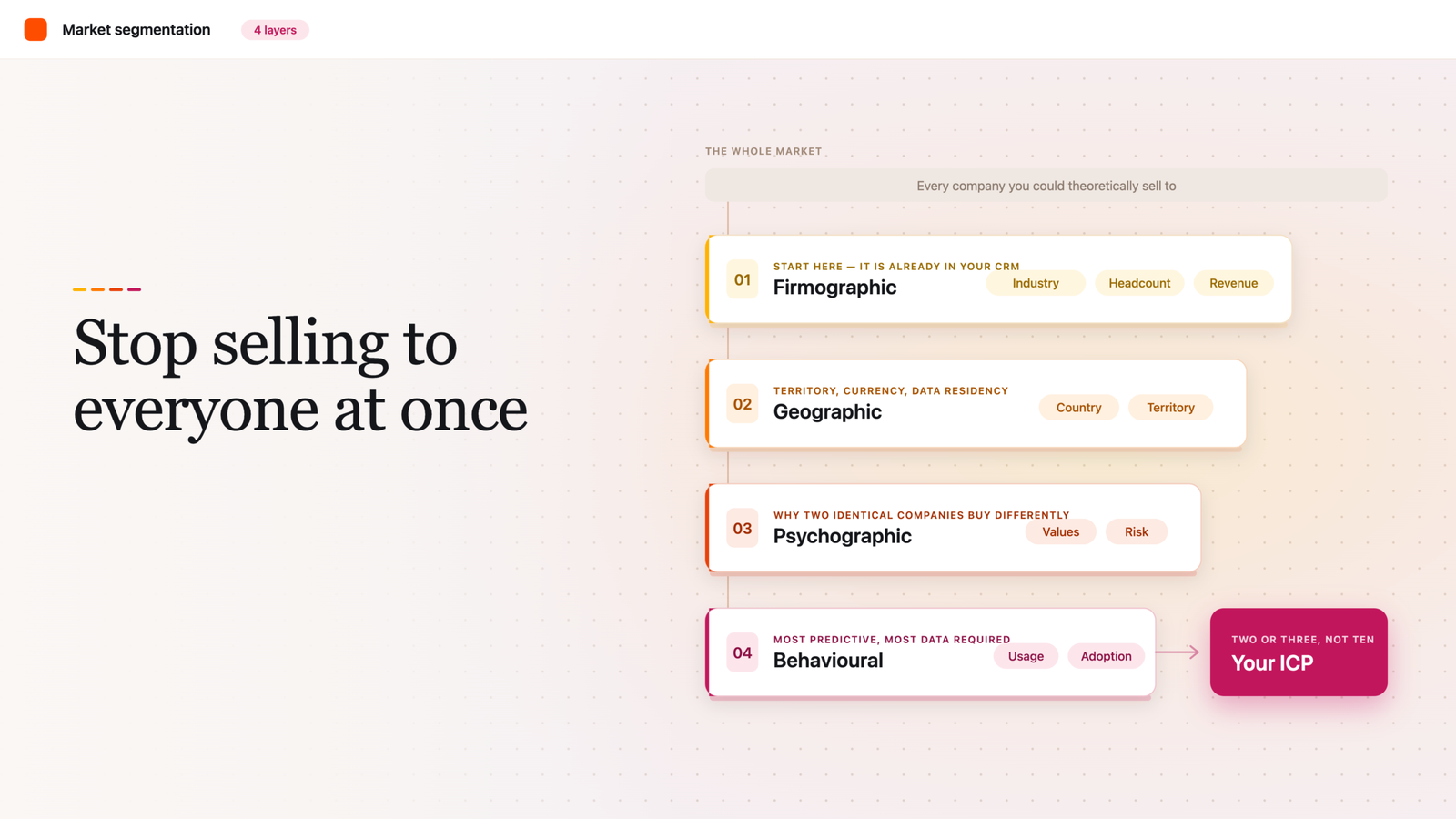
    Most frameworks point to four core ways to segment a market: demographic, geographic, psychographic, and behavioral. Each one looks at a different slice of who your buyer is or how they act.

    Demographic (or firmographic, for B2B). In consumer markets, this means age, income, or occupation. In B2B, you swap demographics for firmographics: grouping companies by traits such as industry, employee count, annual revenue, growth stage, or technology stack. This is usually the easiest segmentation to start with because the data (company size, industry code, revenue band) is often already sitting in your CRM.

    Geographic. This groups customers by where they’re located, since needs and interests often vary according to geographic location, climate, and region. For B2B, this might mean segmenting by country because of data residency laws, currency, or which sales rep owns the territory.

    Psychographic. This looks at attitudes, values, priorities, and how a buyer thinks about risk or innovation. It’s harder to measure than firmographics but often explains why two companies of the same size and industry buy completely differently.

    Behavioral. This groups people by what they actually do rather than who they are, looking at things like product usage, feature adoption, and the benefits customers seek. In B2B SaaS specifically, the most effective segmentation stacks these layers: firmographic first because it’s easy to identify, then technographic (what tools a prospect already uses), then behavioral, which is the most predictive but needs the most data to pull off well.

    Why Market Segmentation Matters for Your GTM Strategy

    Here’s the problem with skipping segmentation: your sales team ends up chasing everyone and closing almost no one efficiently. B2B firms have long treated segmentation as a cornerstone of good industrial marketing, and for good reason: success comes from identifying and serving the best-fit prospects for your offering, not everyone who fills out a form.

    The data backs this up at the GTM level too. Companies exceeding their revenue targets are 5.3 times more likely to have an advanced go-to-market strategy where the total addressable market is clearly defined and sales and marketing are aligned around it. Separately, companies with a clear GTM strategy have been shown to achieve roughly 30% higher revenue growth and 30% higher profitability than peers without one.

    Segmentation is also what makes account-based marketing (ABM), personalized outbound, and even basic lead scoring possible. Without defined segments, your “ideal customer profile” is really just a guess dressed up in a slide deck.

    How to Build a Basic Segmentation for Your GTM Plan

    You don’t need a data science team to get started. Here’s a simple sequence:

    1. Pull your firmographic data first. Export what you already have in your CRM: industry, employee count, revenue range, and location for existing customers and closed-lost deals.
    2. Layer in technographic and behavioral signals. Look at what tools your best customers already use and how they engage with your product or content before buying.
    3. Group companies into 2-3 high-impact segments. Resist the urge to create ten micro-segments. Focus on two or three segments instead of trying to cover every possible customer type, since more segments than your team can realistically act on just adds noise.
    4. Write one sentence per segment describing its core need. If you can’t summarize why this group buys in one sentence, the segment probably isn’t well-defined yet.
    5. Review it quarterly, rebuild it annually. Markets shift, your product evolves, and your customer base changes, so a segmentation model built 18 months ago may no longer reflect reality.

    Pro tip: don’t let sales and marketing build separate segmentation models. If your sales team’s territory logic and your marketing team’s audience segments don’t match, your messaging and your pipeline data will quietly drift apart, and nobody will notice until quota season.

    Market Segmentation vs. Ideal Customer Profile (ICP)

    People mix these up constantly. Segmentation is the broader map of all the meaningful groups in your market. Your ICP is the specific segment (or two) you’ve decided is most worth chasing right now, based on deal size, win rate, or retention. Think of segmentation as the full menu and your ICP as the dish you’re actually ordering.

    FAQ

    What’s the difference between market segmentation and market targeting?
    Segmentation is the analysis step: identifying the distinct groups in your market. Targeting is the decision step: choosing which of those groups you’ll actually pursue with dedicated sales and marketing effort.

    How many market segments should a B2B company track?
    Keep it tight. Most practical guidance points to focusing on two to three high-impact segments rather than spreading resources across every possible customer type.

    Is market segmentation still relevant with AI-driven personalization?
    Yes, if anything it matters more. AI and predictive models still need a segmentation structure to learn from; they just make it easier to score and prioritize accounts within your defined segments.

    How often should we update our segmentation?
    Plan on a quick review each quarter and a full rebuild once a year, since customer bases and markets shift faster than most teams expect.

    Does segmentation replace the need for an ICP?
    No. Segmentation gives you the full picture of your market; your ICP is the specific slice of that picture you’ve chosen to go after first.


  • TAM, SAM, SOM Explained for First-Time Founders

    TAM, SAM, SOM Explained for First-Time Founders

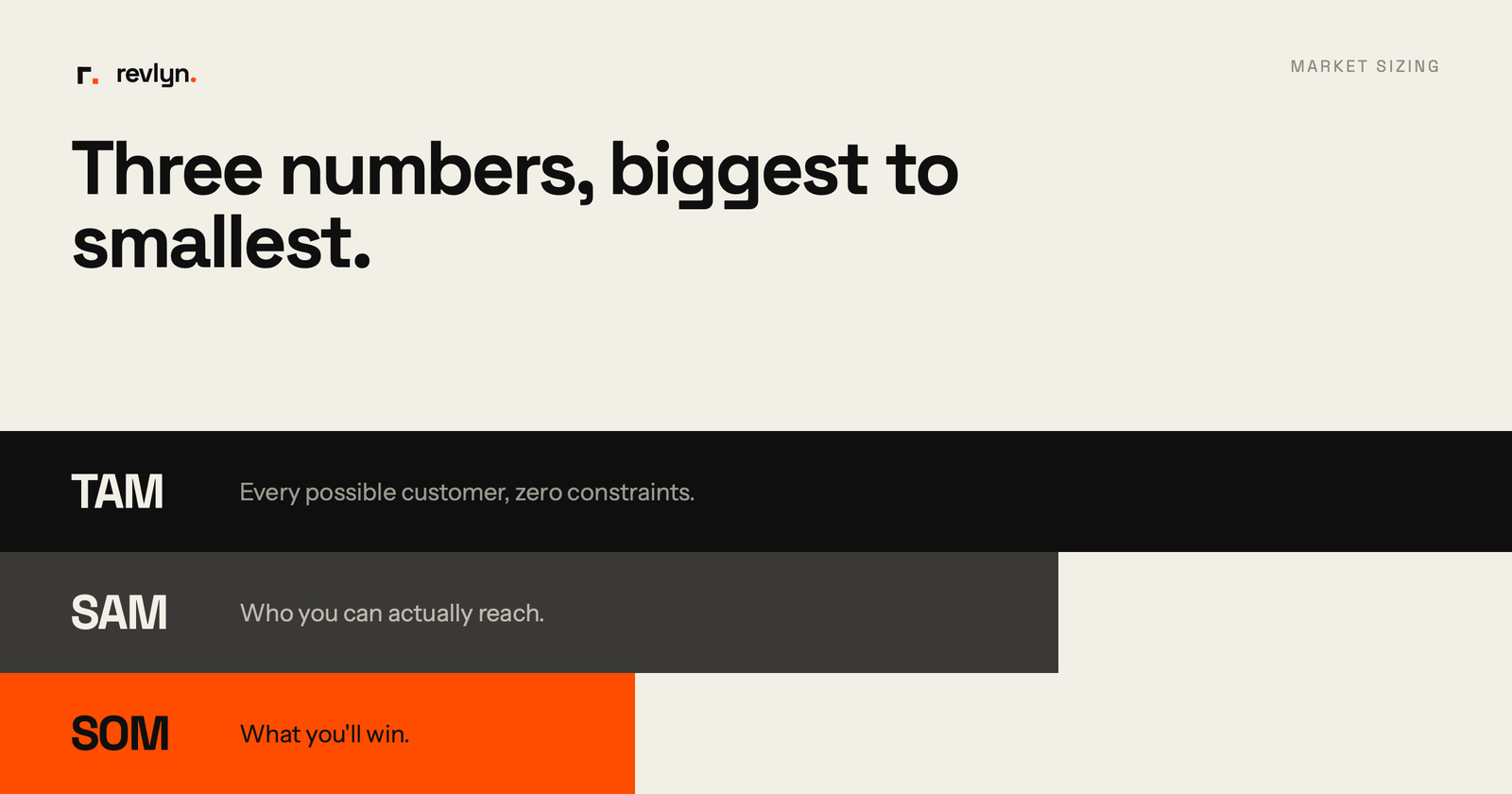
    TAM, SAM, and SOM are three numbers that describe how big your market is, from biggest to smallest. TAM (Total Addressable Market) is the whole market if you had 100% share. SAM (Serviceable Addressable Market) is the slice you can actually reach. SOM (Serviceable Obtainable Market) is what you can realistically win in the near term.

    If you’ve ever sat in a pitch meeting and heard someone throw out a number like “this is a $50 billion market,” you’ve seen TAM in action. But that number alone tells you almost nothing about whether a specific startup can actually make money in it.

    That’s the gap TAM, SAM, and SOM are built to close. They’re not just fundraising slides. They’re a way to force yourself to answer a much harder question: who, specifically, is going to buy this, and how much of that group can you realistically get to?

    What do TAM, SAM, and SOM actually mean?

    Let’s take these one at a time, because each one narrows the picture a bit further.

    TAM (Total Addressable Market) is the total revenue opportunity for your product or service if you captured every single possible customer. Think of it as the ceiling, the theoretical maximum with zero competition and zero constraints.

    SAM (Serviceable Addressable Market) is the part of that TAM your actual business model can reach. This is where geography, pricing, product capability, and who you can legally or practically sell to start cutting the number down. As HubSpot puts it, SAM is the size of the TAM you can reasonably target as you build your audience.

    SOM (Serviceable Obtainable Market) is the realistic slice of SAM you can capture given your competitive position, team size, and go-to-market capacity right now. This is the number that should actually show up in your near-term revenue plan.

    A cybersecurity example makes this concrete: if you’ve built a security product for financial institutions, your TAM might be the entire global cybersecurity market. Your SAM narrows to cybersecurity spend by financial institutions in the regions where you can actually operate, and your SOM is the portion of that spend you can realistically win given your current team and competitive position.

    Why does this matter for a first-time founder?

    Honestly, most founders don’t skip TAM, SAM, SOM because they think it’s unimportant. They skip it because it feels like a fundraising formality instead of a tool they’ll actually use. That’s a mistake.

    Getting these numbers right (or at least directionally right) shapes your product roadmap, your hiring plan, and your sales targets, not just your pitch deck. A market sizing exercise done well helps you set realistic goals and avoid overextending your team into a segment that was never going to work.

    It also matters because investors read TAM as a signal of ambition and SOM as a signal of realism. A large and growing market can indicate a business has real upside, but only if the SAM and SOM show you actually understand how you’ll capture a piece of it.

    Here’s the problem most first-timers run into: they build a huge, impressive TAM slide and then have no credible story for how they get from zero to their first hundred customers. That gap is exactly what SAM and SOM exist to fill in.

    How do you calculate TAM, SAM, and SOM?

    There are two common approaches, and you’ll likely use both.

    Top-down starts with industry reports and analyst data (think Gartner or Statista) and narrows down from there. It’s fast, but it leans on assumptions from outside your business.

    Bottom-up starts with your own numbers: your average sale price multiplied by the number of realistic customers you could sell to. This method is slower to build but far more credible to investors, because it’s grounded in how your business actually operates rather than someone else’s market report.

    Here’s a simple step-by-step you can follow:

    1. Define your customer and your offer. Get specific about who you’re selling to (industry, company size, geography) and what exactly you’re selling before you touch a single number.
    2. Estimate TAM. Multiply your average annual contract value by the total number of potential customers who fit your definition, or use a trusted industry report as a sanity check.
    3. Narrow to SAM. Filter TAM by the constraints that are actually true for your business right now: geography you can service, product capabilities, pricing tier, regulatory or licensing barriers.
    4. Narrow to SOM. Filter SAM again based on your competitive position, brand awareness, sales capacity, and marketing budget. This is your realistic near-term target.
    5. Sanity-check against your current revenue. If your SOM is wildly disconnected from what your team could plausibly sell in a year, go back and tighten your assumptions.

    A quick example: imagine a startup selling kitchen storage products to U.S. households earning more than $50,000 a year. If there are 40 million such households spending an average of $100 a year on kitchen storage, that puts TAM around $4 billion. From there, you’d filter down to the households you can actually reach through your channels (SAM), then to the share you can realistically win in year one given your marketing budget and competition (SOM).

    Common mistakes founders make with TAM, SAM, SOM

    Most of the market sizing mistakes we see aren’t math errors. They’re judgment errors.

    • Sizing TAM too big. Strategy teams and founders spend a lot of time on market sizing, and most of them get it wrong in the same direction: too large. A $50 billion TAM sounds great until someone asks how you get your first 50 customers.
    • Using stale or mismatched data. Markets shift fast, and combining figures from different years or sources creates projections that mislead you and everyone reading your numbers.
    • Ignoring real-world constraints. Calculating TAM off pure demographics while ignoring regulatory barriers, entrenched competitors, or realistic sales-cycle length tends to produce products nobody actually buys.
    • Skipping market validation entirely. According to CB Insights, roughly 42% of startups fail because there’s no real market need for their product. TAM, SAM, SOM won’t save you from a bad idea, but it forces the kind of questioning that can catch one early.

    Pro tip: if your SOM is only two or three times your current revenue, treat that as a warning sign that you’re nearing saturation in your current segment, not a reason to celebrate a “strong” number.

    A quick checklist before you present your numbers

    • Have you defined your customer specifically enough (industry, size, geography, use case)?
    • Did you build your numbers bottom-up, not just pulled from an analyst report?
    • Have you accounted for competitors who already hold market share?
    • Is your SOM something your current team could plausibly sell in the next 12 months?
    • Are all three numbers using data from the same time period?

    FAQ

    Is SAM just a smaller version of TAM?
    Not exactly. SAM applies real filters to TAM, like geography, pricing, and product fit, so it’s a meaningfully narrower and more useful number for planning.

    What’s a good TAM size for a VC-backed startup?
    A strong TAM for a VC-backed startup generally falls between $10 million and $300 million, large enough to signal growth potential without looking unmanageable or overly saturated.

    Should I use top-down or bottom-up to calculate these numbers?
    Use both if you can, but lean on bottom-up when talking to investors. It’s grounded in your own sales data rather than someone else’s assumptions, which makes it far more credible.

    How often should I revisit my TAM, SAM, SOM numbers?
    At least once a year, or any time your product, pricing, or target segment changes meaningfully. Stale numbers built on old data lead to bad decisions later.

    Do I need fancy market research tools to do this?
    No. A spreadsheet, a clear customer definition, and honest assumptions get you most of the way there. Fancy data platforms can sharpen the SAM calculation later, but they’re not a prerequisite for getting started.

    If you’re still early in mapping out your go-to-market strategy, sign up for the Revlyn newsletter and we’ll send you a simple TAM/SAM/SOM worksheet you can fill in with your own numbers.