Blog

  • What Revenue Operations Actually Is

    What Revenue Operations Actually Is

    Scope, purpose, responsibilities, and why RevOps exists

    In 2025, Pearson made an organizational change that received far less attention than its investments in artificial intelligence or new products. The company brought several teams together under a dedicated Revenue Operations unit. Pearson said the change was intended to standardize sales processes, strengthen pipeline management, unify data sources, and make decision-making clearer and faster.

    The decision is interesting because Pearson already had the functions one would normally associate with producing revenue. It had sales teams, marketing teams, customer-facing groups, finance professionals, technology, and management. Creating Revenue Operations therefore raises a basic organizational question: what was missing?

    The answer is found in the way companies divide work.

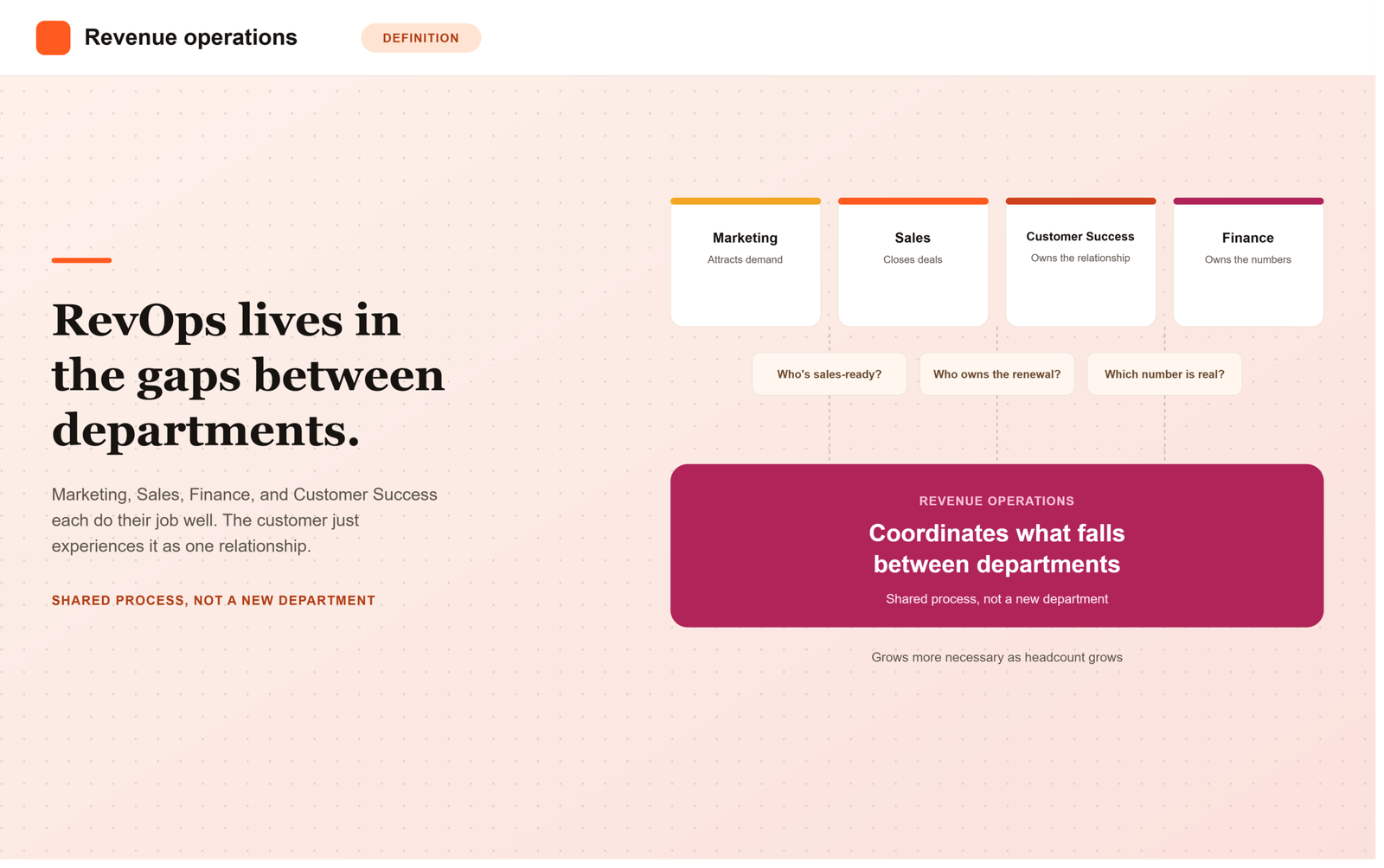
    A business usually organizes people according to expertise. Marketing attracts and develops potential customers. Sales manages commercial conversations and closes business. Finance deals with the financial consequences. Customer Success, service, implementation, or account-management teams take responsibility after the sale. Specialization makes each of these groups better at its own work.

    Customers do not move through a company in the same way that boxes appear on its organization chart. Their experience passes through several of those groups, often without knowing where one department ends and another begins. A person may respond to an advertisement, speak to a salesperson, negotiate a contract, receive an invoice, begin using a service, ask for support, and eventually renew. To the customer, it is one relationship.

    Inside the company, it can be six different processes.

    Revenue Operations grew out of that gap.

    The awkward spaces between departments

    Consider something as ordinary as a new sales inquiry. Marketing has to decide when a person’s interest is strong enough to justify a salesperson’s time. Sales then needs to know who should receive the opportunity. That may depend on geography, company size, product, existing relationships, or the salesperson’s capacity.

    None of this is especially difficult when a business has ten employees. People can talk to each other. Exceptions are remembered. A founder may know the history of every important account.

    The same arrangements become fragile when a company has several sales teams, thousands of customers, multiple products and several information systems. One region develops a different definition of a qualified opportunity. Another keeps a spreadsheet because the central system does not quite fit its needs. Marketing believes it has produced a strong pipeline; Sales believes much of it is unusable. Both can support their position with data.

    The problem continues further down the customer journey. A salesperson may agree to a special contract term without realizing how difficult it will be to administer. Information discussed during the sale may never reach the implementation team. Nobody starts work on a renewal because Sales believes Customer Success owns it and Customer Success believes the account manager owns it.

    Most of these failures are unremarkable when seen individually. One lead waits too long. One field is missing. One account is assigned to the wrong person. One contract takes four additional days to approve. Over time, the accumulated cost can be substantial, and much of it sits between conventional departmental responsibilities.

    Research firms have come to describe RevOps in similar terms. Gartner frames it as an end-to-end operating model spanning go-to-market functions, with shared processes and information across the revenue cycle. Forrester emphasizes the coordination of data, processes, technology, and people across the customer lifecycle.

    Those definitions are useful, although they can make the subject sound more abstract than it needs to be. RevOps deals with the practical consequences of having several departments participate in the same commercial relationship.

    What people in RevOps spend their time doing

    The work is often surprisingly ordinary.

    A RevOps team may decide how accounts are assigned to salespeople. It may define the stages in a sales process and determine what information is required before an opportunity can move from one stage to the next. It may establish rules for discounts or approvals. It can maintain the systems through which sales and customer information flows, build the process used for forecasting, or investigate why Marketing and Sales report different numbers for what appears to be the same activity.

    Some teams also work on renewals, sales compensation, territories, capacity planning, pricing processes, and customer handoffs. The precise list changes considerably from one company to another.

    A recent Zoom Revenue Operations role gives a sense of that range. Its responsibilities cover the path from demand generation and pipeline management through forecasting, quoting, billing, renewals, and expansion. The role also works with Sales, Marketing, Finance, IT, Legal, and customer-facing operations.

    A job description should not be mistaken for a universal definition of RevOps. It does reveal why the function can be difficult to explain. Many of its activities already existed somewhere in the company before anyone used the name Revenue Operations.

    Sales Operations, for instance, has long handled territories, forecasts, sales systems, quotas and sales-process design. Marketing Operations manages important parts of the marketing process and its supporting technology. Customer Success Operations performs similar work after a customer has purchased. Finance has always cared about pricing, contracts, forecasts and revenue.

    RevOps changes the field of view. An issue can begin in Marketing and show up later as a Sales problem. A sales decision can create a billing problem months afterward. A weak handoff at the time of purchase may later appear in customer-retention figures. Looking at each function separately makes these connections harder to see.

    This broader view is also where the boundaries of RevOps become less tidy. There is no universal organization chart that every company should copy. Some firms place Marketing Operations, Sales Operations and Customer Success Operations under one leader. Others keep those teams separate and use RevOps as a smaller coordinating group. In some businesses the function reports to the Chief Revenue Officer; elsewhere it may sit closer to Finance or the Chief Operating Officer.

    The practical arrangement depends on the company’s business model and history. A recurring-revenue software business faces different operating questions from an industrial manufacturer working through distributors. The former may devote considerable attention to renewals and account expansion. The latter may care more about channel ownership, pricing, inventory commitments, or dealer relationships.

    This variation is sometimes treated as evidence that RevOps lacks a clear definition. It may simply reflect the fact that operating problems differ.

    Why the function tends to appear during growth

    The need for RevOps often becomes noticeable after a company has already succeeded.

    Early growth can be held together by people. A strong sales manager remembers exceptions. A founder resolves disputes. Finance knows which unusual contracts need attention. Employees develop informal habits that compensate for gaps in the formal process.

    Headcount then increases. A second region opens. A new product line requires different expertise. One customer system is joined by another. People who designed the original process leave and their replacements inherit pieces of it without the original context.

    At some point, coordination that depended on familiarity has to become explicit.

    Pearson’s description of its own change is revealing here. The company placed Revenue Operations under a broader effort to create “execution synergies” and described the consolidation alongside work on operational systems and customer-centric execution. Elsewhere in the same report, Pearson says the new Revenue Operations team is intended to improve coordination between marketing, sales, and customer success operations.

    There is a familiar pattern behind this. Growing organizations acquire complexity in small increments. A new approval is introduced because a previous deal went wrong. A new field is added because management wants another report. A region creates its own process because the global one does not fit a local need. Another software product is purchased to solve a problem in the existing software.

    No single decision creates the complexity. A few years later, employees may need five systems and several manual workarounds to complete a task that once required an email.

    Revenue Operations can provide a place to examine that accumulation. Sometimes the answer is a new process. Sometimes an old process needs to be removed. The second outcome receives less attention, although it is often more valuable.

    Revenue targets eventually become operating questions

    Senior management may set a goal such as increasing revenue by 15 percent. The goal itself says little about how the additional revenue will appear.

    Perhaps the company needs many more new customers. Perhaps existing customers could purchase more. Perhaps customer losses are high enough that improving retention would have a larger effect than increasing new sales. The business may already have sufficient demand and lack enough sales capacity to handle it.

    Once the goal reaches the operating level, it produces a series of questions. How many credible sales opportunities are required? How long does a typical deal take? Does the company have enough people to work those opportunities? Which customer segments convert well? Are current renewal rates sufficient? Where are deals slowing down? What happens to margins as discounting increases?

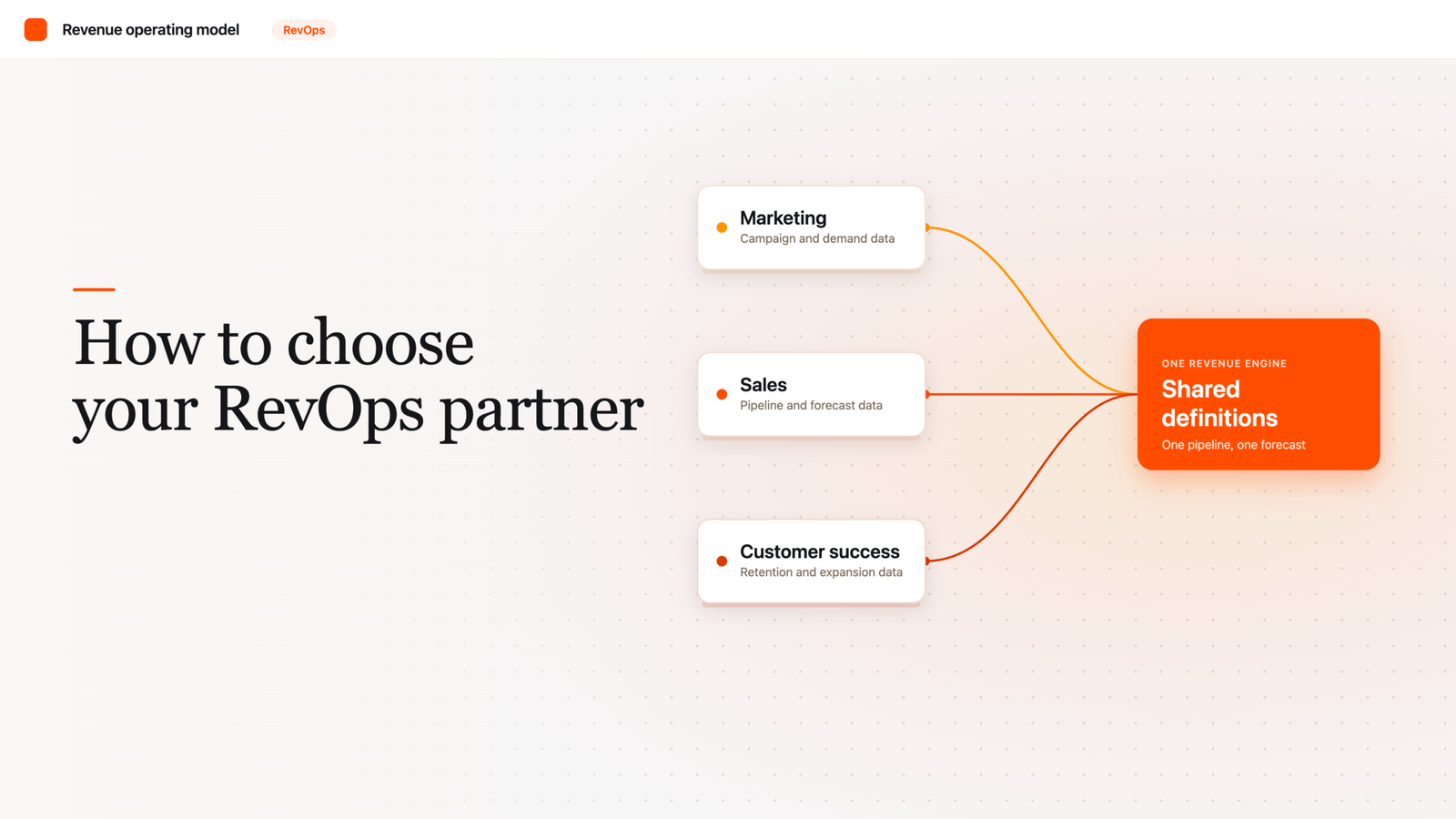
    These questions cut across the information held by several departments. Marketing knows something about demand. Sales knows something about the active pipeline. Customer teams know something about retention and expansion. Finance has the financial view. RevOps often becomes the place where those pieces are assembled into a usable operating picture.

    Forecasting provides a good example. A forecast is easy to think of as a Sales responsibility because salespeople know the deals currently under discussion. Yet future revenue in many companies also depends on renewals, new demand entering the system, available selling capacity, pricing decisions, and the reliability of the stages used to classify opportunities.

    The mechanics of forecasting are therefore closely related to the mechanics of the commercial process itself. A beautifully designed forecasting model will still produce weak information when opportunities are poorly defined or updated inconsistently.

    The same is true of dashboards. Management teams sometimes respond to disagreement about numbers by asking for another report. RevOps is more useful when it traces the disagreement backward. Two dashboards may differ because teams use different definitions, because systems are not synchronized, or because one part of the organization has created a parallel process. Fixing the report leaves the cause untouched.

    Where RevOps can go wrong

    The function has its own failure modes.

    One is administrative expansion. A RevOps team adds fields, rules, approvals and required steps because each one appears reasonable in isolation. Salespeople gradually spend more time maintaining the process. Managers compensate by allowing workarounds. Data quality then worsens because employees no longer regard the official process as useful.

    Another is excessive attention to technology. Revenue teams now have access to a large market of customer-management, forecasting, sales-engagement, analytics, automation and artificial-intelligence products. These tools can remove significant amounts of manual work. They can also give organizations a sophisticated way to run a badly designed process.

    There is also a subtler risk. A RevOps team can become distant from the work it is organizing. A routing rule that looks efficient in a spreadsheet may create strange incentives for salespeople. A required field may appear essential to an analyst and feel meaningless to the employee expected to enter it fifty times a week. A centralized process may remove exactly the flexibility that made a particular local team effective.

    Good operations requires contact with operating reality. That means sitting with the people who use the process, watching where they work around it, and being willing to discover that the formal rule is causing the problem.

    This is one reason the quality of RevOps cannot be judged from the sophistication of its dashboards or the number of systems it manages.

    A useful test is much more mundane. When a good customer expresses interest, does that interest reach the right person? Can the salesperson find the information needed to act? Can a sensible deal move through approvals without unnecessary delay? Does the next team know what happened before the sale? Can managers understand likely revenue without spending half the meeting reconciling spreadsheets?

    These are ordinary questions. They are also close to the economic purpose of the function.

    The economic case is mostly about wasted motion

    Revenue growth receives attention because it is visible. Operational leakage is harder to see.

    A company spends money generating interest and then responds slowly. Salespeople pursue accounts that were never a good fit. Managers spend hours preparing reports that disagree. A customer enters implementation with expectations the delivery team did not know about. An avoidable pricing exception creates months of billing work.

    Every example consumes resources that have already been paid for.

    The cost is distributed across departments, which makes it difficult to recognize. Marketing sees campaign spending. Sales sees seller capacity. Finance sees discounts and billing. Customer Success sees churn. The connection between them may appear only after someone follows the customer or the revenue process from beginning to end.

    This explains some of the interest in RevOps among companies looking for more predictable growth. Gartner, for example, links the model with efficiency, reduced revenue leakage, and greater predictability across the customer lifecycle.

    Still, expectations should remain modest. Revenue Operations cannot compensate for a weak product, an unattractive market, poor sales leadership, or customers who simply do not want to buy. Its influence is on the quality with which the commercial organization turns opportunity into revenue and manages the customer relationship afterward.

    That quality matters more as the organization becomes difficult to coordinate by personal effort alone.

    A working definition

    The term Revenue Operations now covers enough activities that a definition can become either vague or excessively elaborate. For practical purposes, I would describe it this way:

    Revenue Operations is the function that designs and improves the shared operating processes through which a company finds customers, sells to them, and manages the commercial relationship over time.

    “Shared” carries much of the meaning. RevOps becomes relevant when several groups depend on the same information, when work passes from one team to another, or when a decision made in one function changes the economics or workload of another.

    This also explains why Sales Operations can remain perfectly useful inside a company that has RevOps. Sales still has operating problems that belong specifically to Sales. Marketing has its own. So does Customer Success. Centralizing every operating decision would simply create a new bottleneck.

    The distinctive contribution of RevOps lies in the areas where local optimization stops being enough.

    There are several ways to organize that work, and companies will continue to use the title inconsistently. That is not unusual for a relatively young management function. The more useful question is whether somebody has responsibility for understanding how the pieces of the commercial process interact.

    Pearson’s reorganization offers one answer. Another company may arrive at a different structure. What both are responding to is an old problem in management: specialization creates expertise, and expertise creates boundaries that then have to be coordinated.

    Revenue Operations is one contemporary way of doing that coordination for revenue.

    Frequently Asked Questions

    What is Revenue Operations (RevOps) in simple terms?

    Revenue Operations is the function that designs and improves the shared processes through which a company finds customers, sells to them, and manages the relationship afterward. It exists because a customer’s experience crosses Marketing, Sales, Customer Success, and Finance as one relationship, even though each department runs its own separate process internally.

    Why would a company create a RevOps team if it already has sales, marketing, and finance?

    Because those teams are organized around expertise, not around the customer’s actual journey. A lead can wait too long between Marketing and Sales, a special contract term can create billing problems Finance never anticipated, or a renewal can fall through because Sales and Customer Success each assume the other owns it. RevOps exists to manage those handoffs, not to duplicate the work each department already does well.

    Is RevOps the same thing as Sales Operations?

    No. Sales Operations handles problems that belong specifically to Sales, such as territories, quotas, and sales-process design. RevOps takes a broader view across Marketing, Sales, Customer Success, and often Finance, focusing on the shared processes and handoffs between those functions. Sales Operations continues to be useful even inside a company that also has RevOps.

    When does a company typically need to introduce RevOps?

    The need usually becomes noticeable during growth, not at launch. Early on, a small team can coordinate informally, a founder remembers exceptions and a manager resolves disputes directly. As headcount grows, new regions open, more systems get added, and that informal coordination stops working. At that point, the coordination that depended on people knowing each other has to become an explicit, designed process.

    Who does RevOps typically report to?

    There is no single standard. In some companies RevOps reports to the Chief Revenue Officer, in others it sits closer to Finance or the Chief Operating Officer. The right structure depends on the company’s business model, for example a recurring-revenue software business tends to focus RevOps heavily on renewals and expansion, while a company selling through distributors may focus it more on channel and pricing questions.

    What are the most common ways RevOps goes wrong?

    Three failure modes show up repeatedly: administrative expansion, where fields, rules, and approvals pile up until reps spend more time maintaining the process than selling; over-reliance on technology, where a sophisticated tool stack is used to run a badly designed process instead of fixing it; and distance from operating reality, where rules that look efficient on a spreadsheet create bad incentives for the people actually doing the work.
  • Best RevOps Services for Australian B2B SaaS

    Best RevOps Services for Australian B2B SaaS

    Australian B2B SaaS companies sell into one of the more demanding go-to-market environments in the world: a small domestic market that forces early international expansion, usually into the US and APAC simultaneously, across time zones that overlap awkwardly with both. That combination makes strong RevOps services less of a nice-to-have and more of a survival requirement once a company passes its first few million in ARR.

    This guide covers what to look for in a RevOps services partner if you’re an Australian B2B SaaS revenue leader, and how the local market context should shape your evaluation.

    Why Australian B2B SaaS Teams Have a Unique RevOps Problem

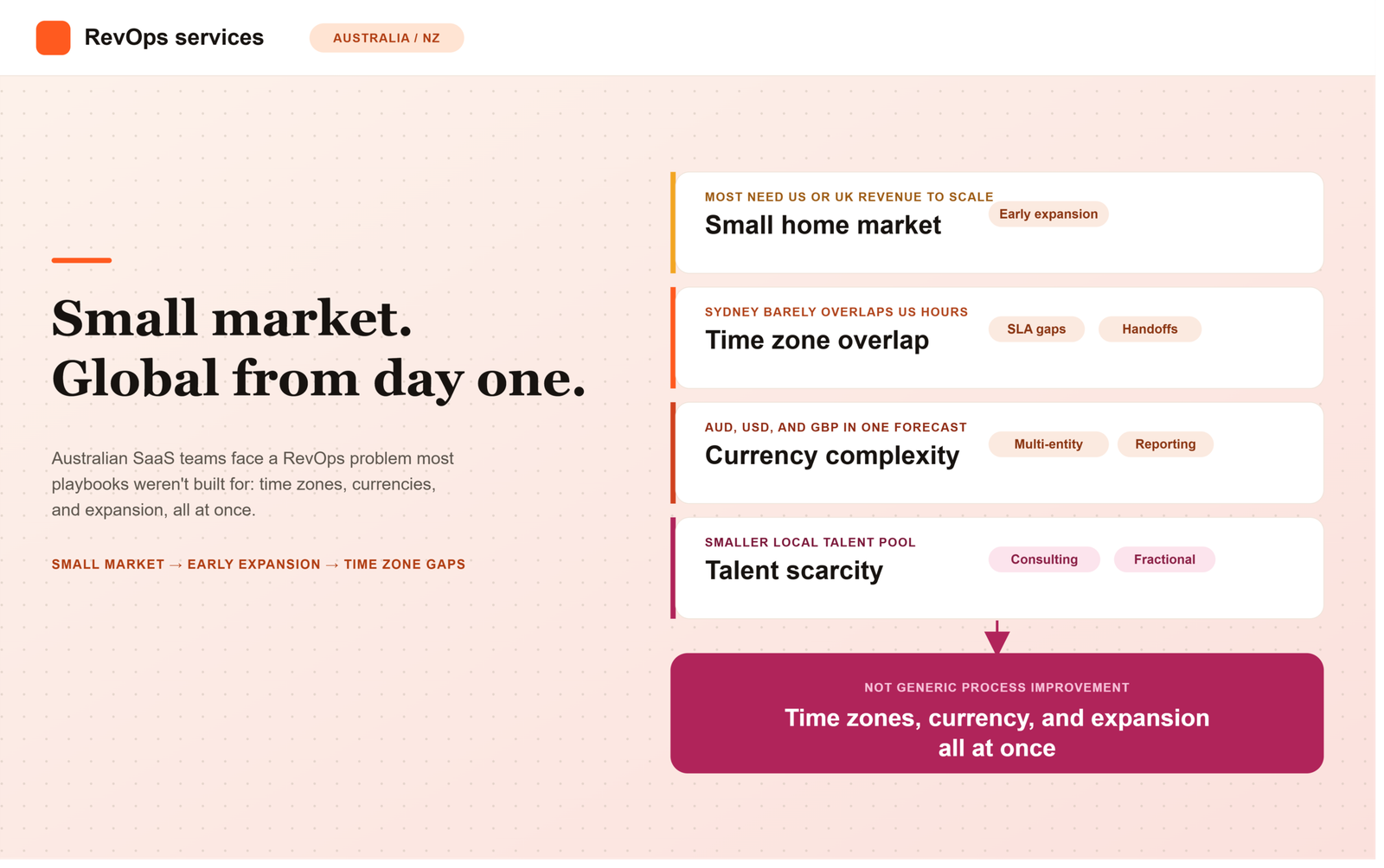
    • Small home market, early internationalization. Most Australian SaaS companies need US or UK revenue to hit venture-scale outcomes, often starting international expansion earlier than comparable companies in larger domestic markets.
    • Awkward time zone overlap. Sydney/Melbourne business hours barely overlap with US business hours, which creates real handoff and SLA problems between marketing, SDRs, and closing reps across regions.
    • Currency and reporting complexity. Multi-currency deals and ANZ-specific compliance and invoicing norms add friction that generic RevOps playbooks don’t account for.
    • Talent scarcity. The local RevOps talent pool is smaller than in the US or UK, which is a major reason Australian SaaS companies lean on consulting partners rather than building large in-house teams early.

    What Good RevOps Services Look Like for This Market

    1. Explicit Time Zone and Handoff Design

    A partner worth hiring should be able to describe, concretely, how they design SLAs and lead routing so a lead generated during Sydney business hours doesn’t sit for 10+ hours before a US-based rep sees it and vice versa.

    2. Multi-Currency and Multi-Entity Reporting

    If you’re billing in AUD, USD, and potentially GBP, your RevOps partner needs experience building forecasting and pipeline reporting that rolls up cleanly across currencies without manual reconciliation every board cycle.

    3. Sales and Marketing Alignment That Survives Time Zone Handoffs

    Alignment is harder to maintain when your marketing team, SDR team, and closing reps are spread across three time zones. Look for partners who build closed-loop attribution and shared lead definitions that hold up even when teams rarely overlap in real time.

    4. Familiarity With the ANZ-to-Global Expansion Playbook

    Ask any prospective partner how many Australian SaaS clients they’ve helped expand into the US specifically, this is a well-worn but specific playbook, and experience with it should be easy for them to demonstrate with real examples.

    Evaluation Checklist

    Criteria What to Look For
    Time zone design Concrete SLA and routing rules across ANZ/US/APAC hours
    Currency handling Multi-currency forecasting and reporting experience
    Expansion track record Prior work with Australian SaaS companies expanding into the US or UK
    Alignment tooling Ability to keep sales/marketing aligned across distributed teams
    Engagement flexibility Comfortable working async and outside standard AU business hours

    Fractional vs. Project Engagements

    Many Australian SaaS companies start with a project-based engagement, typically a CRM re-architecture or lead routing overhaul timed to a US expansion push, before moving to fractional, ongoing RevOps support once the international motion stabilizes. Given the smaller local talent pool, fractional support is often more cost-effective than trying to hire a full in-house RevOps function too early.

    Frequently Asked Questions

    What makes RevOps different for Australian SaaS companies?

    The core process work, forecasting, lead routing, CRM hygiene, is the same everywhere. What’s different is the operating environment: a small home market that forces early international expansion, time zones that barely overlap with the US, and multi-currency reporting that most generic RevOps playbooks aren’t built to handle.

    How much does RevOps consulting cost in Australia?

    Project-based engagements, such as a CRM re-architecture ahead of a US launch, are usually quoted as a fixed fee for a defined scope. Fractional support is typically billed monthly. Because the local talent pool is smaller, fractional consulting is often more cost-effective than hiring a full-time in-house RevOps lead too early.

    Should we hire a local Australian RevOps partner or one based in the US?

    What matters more than location is whether the partner has direct experience with the ANZ-to-US or ANZ-to-UK expansion playbook, including time zone handoff design and multi-currency reporting. A partner who understands Sydney-to-US SLA gaps firsthand is more valuable than one who only knows a single region well, regardless of where they’re headquartered.

    When should an Australian SaaS company invest in RevOps services?

    Most teams feel the need once they pass their first few million in ARR and start hiring SDRs or reps outside Australia. The clearest trigger is usually the moment leads generated in Sydney hours start sitting unworked for most of a US business day, that handoff gap is exactly what a RevOps partner should be brought in to fix.

    What’s the most common RevOps mistake Australian SaaS teams make when expanding overseas?

    Treating the expansion as a hiring problem rather than a systems problem. Adding US-based reps without first fixing lead routing, SLA rules across time zones, and multi-currency reporting just moves the same handoff gaps into a bigger, more expensive team.

    Is fractional or project-based RevOps better for a scaling ANZ SaaS company?

    Project-based work fits a defined, time-boxed problem, like rebuilding lead routing ahead of a US launch. Fractional support fits the stretch after that, when the international motion is live but still evolving and needs an ongoing owner. Many Australian companies use a project engagement to prepare for expansion, then shift to fractional support once they’re actually operating across regions.

    The Bottom Line

    For Australian B2B SaaS teams, the value of a RevOps services partner isn’t generic process improvement, it’s specifically solving the time zone, currency, and international expansion problems that come with building a global GTM motion from a small home base. Evaluate partners on that specific experience, not just general RevOps credentials.


  • What Is Positioning in GTM? A Beginner’s Guide

    What Is Positioning in GTM? A Beginner’s Guide

    What Is Positioning in GTM? A Beginner’s Explanation

    Positioning in GTM (go-to-market) is the work of defining the unique place your product occupies in a customer’s mind compared to every other option they could choose instead. It answers who the product is for, what problem it solves, and why it beats the alternatives. Good positioning shapes your messaging, pricing, and sales motion.

    If you’ve ever sat in a meeting where sales, marketing, and product all describe your product differently, you’ve already felt what happens when positioning is missing. It’s not a branding exercise. It’s the foundation everything else in your go-to-market plan gets built on.

    What does “positioning” actually mean in GTM?

    Go-to-market (GTM) is the overall plan for how a company brings a product to market and gets it in front of the right buyers. Positioning is one piece of that plan, and it’s arguably the most foundational one.

    At its core, positioning defines the unique space your product occupies in the customer’s mind relative to other options they’re weighing. It’s not a tagline or a slogan. It’s the underlying logic that explains why someone should pick you over the alternative, whether that alternative is a competitor, a manual process, or doing nothing at all.

    April Dunford, one of the most cited voices on this topic, describes positioning as the context-setting work that makes it obvious what your company does and what value it offers to your ideal customers. Her own definition is more specific: positioning explains how your product is the best in the world at delivering some kind of value that a clearly defined group of customers cares a lot about. That’s a mouthful, and she’s the first to admit it, but it’s precise for a reason. Vague positioning invites vague buying decisions.

    The concept itself isn’t new. Positioning as a formal idea traces back to a 1981 book by Al Ries and Jack Trout, though later work (Dunford’s especially) turned it into a repeatable process rather than just a theory.

    Why does positioning matter for your GTM strategy?

    Here’s the blunt version: if your positioning sounds like every other vendor in your category, buyers have no compelling reason to pick you. That’s not a marketing problem you can copywrite your way out of. It’s a strategy problem.

    A positioning statement sits at the core of your go-to-market strategy, and everything downstream (your messaging, your sales pitch, your onboarding, even your pricing page) gets built from it. When it’s solid, your whole team can explain what you do and why it matters in the same way, whether that’s a rep on a discovery call or a support agent onboarding a new account.

    When it’s missing or muddy, you get a familiar mess: reps improvising their own pitch, marketing running campaigns that don’t match what sales actually says, and buyers who can’t figure out why you’re different from the three other tools they’re evaluating. Honestly, most “messaging problems” companies bring to us aren’t messaging problems at all. They’re unresolved positioning problems wearing a messaging costume.

    Positioning also matters because it should inform how you actually sell, not just what you say. A product positioned for fast, self-serve adoption needs a different [[GTM motion]** than one positioned as a high-touch, enterprise-grade solution, and mismatching the two is one of the more common (and expensive) GTM mistakes we see. If you’re still deciding between a sales-led approach and a self-serve one, it’s worth reading our breakdown of GTM motion types before you lock in your positioning, since the two decisions really do influence each other.

    How is positioning different from messaging and branding?

    This trips up a lot of new founders, so let’s separate the three plainly.

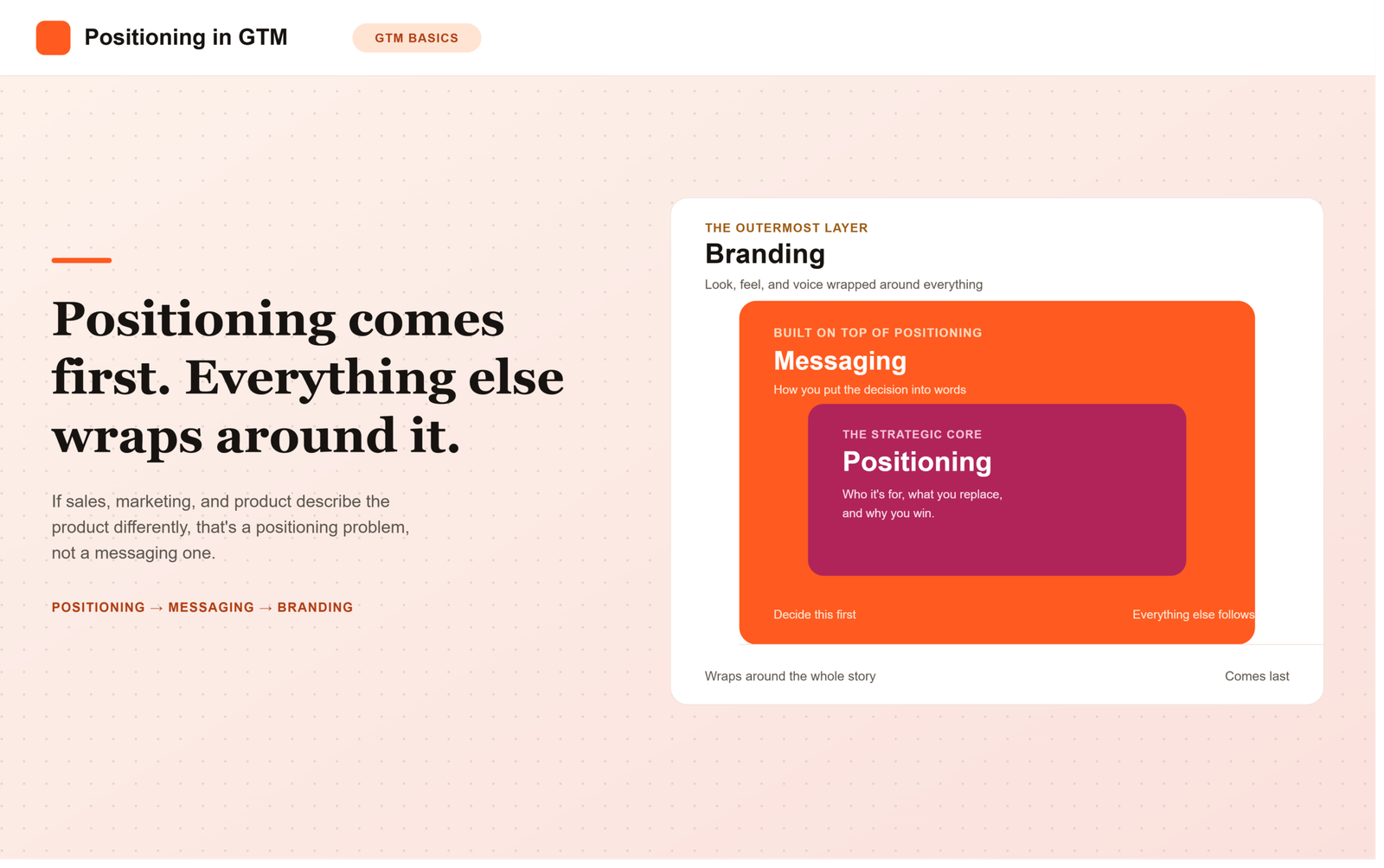
    • Positioning is the strategic decision: who this is for, what alternative you’re replacing, and what makes you the obviously better choice for that specific group.
    • Messaging is how you put that decision into words: the promise you make, how you deliver it, and why it matters to the buyer.
    • Branding is the look, feel, and voice wrapped around all of it.

    Positioning comes first. Messaging is built on top of it. Branding wraps around both. Skip the positioning step and jump straight to writing taglines, and you’ll end up with copy that sounds nice but doesn’t actually tell anyone why they should care.

    How do you actually build product positioning?

    There’s no single official template, but the process most practitioners (Dunford included) point to follows a similar pattern. Here’s a simplified version you can run through with your team:

    1. List the real alternatives. What would your customer do if your product didn’t exist? Include direct competitors and “do nothing” or manual workarounds.
    2. Identify what’s genuinely unique. What features or capabilities do you have that those alternatives don’t?
    3. Turn features into value. For each unique attribute, ask: so what does that actually let the customer do or achieve?
    4. Define who cares most. Not everyone will value that outcome equally. Narrow in on the segment that cares the most.
    5. Pick your market category. Choose the frame of reference that makes your value obvious to that specific segment, since the same product can be framed several different ways depending on the category you claim.

    Pro tip: run this exercise with sales, product, and leadership in the room, not just marketing. A lot of positioning failures aren’t actually positioning failures, they’re alignment failures, where the founder has the story right but the rest of the leadership team isn’t telling it the same way.

    Once your positioning is set, you’ll notice it shapes decisions well outside the marketing team. It influences how a product-led company designs its free trial, for instance. If you’re exploring a self-serve approach.

    What happens when positioning goes wrong?

    Weak positioning tends to show up as a pattern, not a single mistake. Products that read like every other tool in the category give buyers no compelling reason to choose them over the alternatives. You’ll also see it in a mismatched sales motion: an enterprise-style sales process bolted onto a product that should be self-serve, or vice versa. And you’ll see it in the classic cross-functional mess, where sales, marketing, and product each describe the product a little differently because no one agreed on the underlying story.

    FAQ

    Is positioning the same thing as a value proposition?
    No, though they’re closely related. Positioning is the broader strategic frame (who you’re for and why you beat the alternatives), and your value proposition is a specific, named statement that spells out the customer, the problem, and the differentiated solution.

    Who should own positioning inside a company?
    Product marketing often drives the process, but positioning shouldn’t live in one department. It needs input from the founder, sales, and product leadership, otherwise you end up with a story that marketing believes but no one else actually uses.

    Do early-stage startups need formal positioning, or is that a later-stage problem?
    Early stage is exactly when you need it most. Founders often get the story right instinctively through early customer conversations, but that instinct rarely survives the jump to a bigger team unless it’s written down and agreed on.

    How often should we revisit our positioning?
    Whenever something big shifts: new competitors enter, your market matures, or you move upmarket or downmarket. Positioning isn’t a one-time doc you file away after a launch.

    Can good positioning fix a weak sales motion?
    Not on its own. Positioning and your GTM motion need to match each other. Great positioning paired with the wrong sales process still creates friction for buyers.

  • Best RevOps Consulting Services for B2B SaaS

    Best RevOps Consulting Services for B2B SaaS

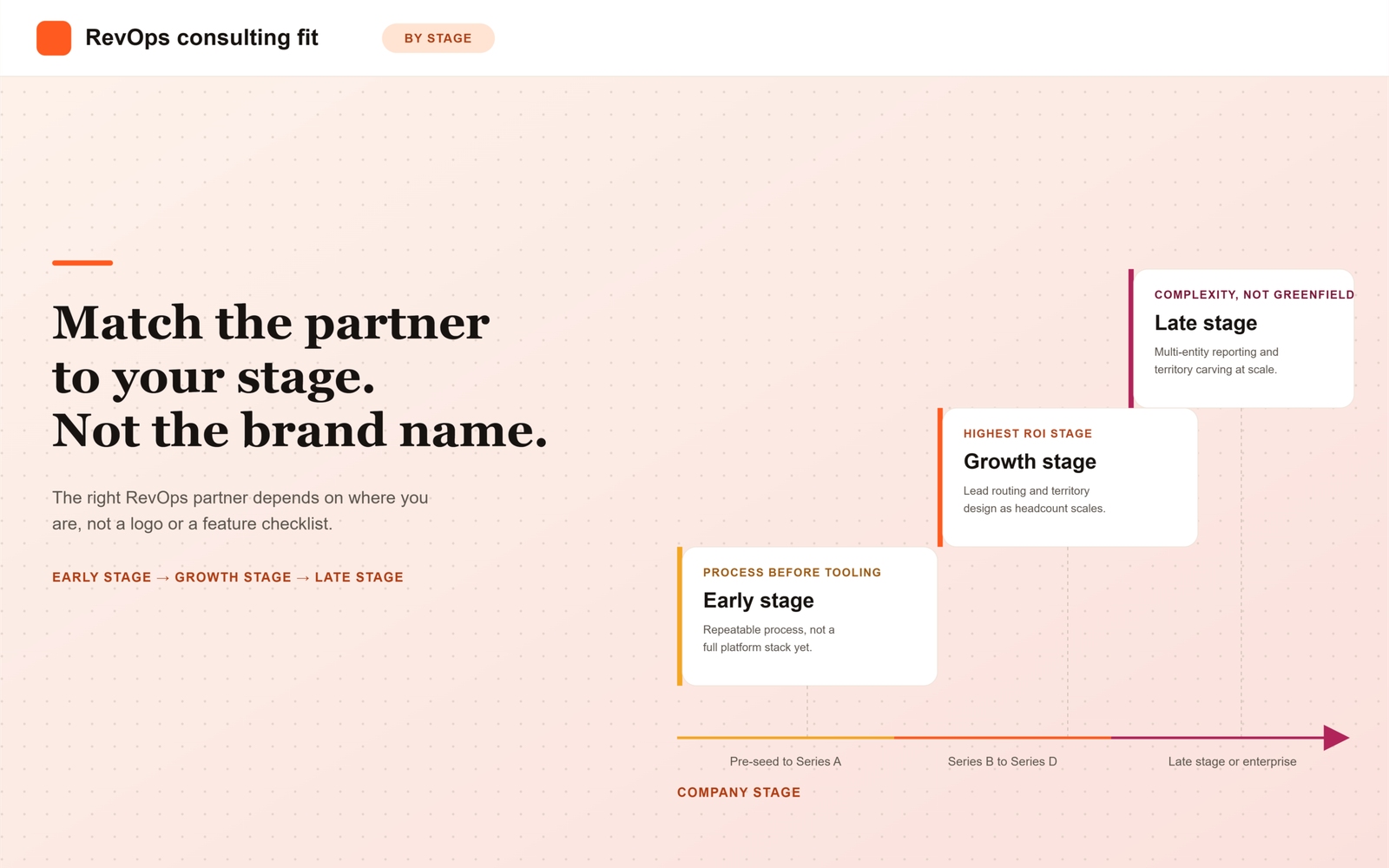
    Most comparisons of RevOps consulting services treat every B2B SaaS company as if it needs the same thing. It doesn’t. What a seed-stage company with five reps needs from a RevOps partner looks almost nothing like what a 300-person, multi-product SaaS company needs. The right way to evaluate consulting services isn’t by brand name or feature checklist, it’s by matching the partner’s model to your company’s actual stage of growth.

    Why Stage Matters More Than Almost Anything Else

    A RevOps consulting engagement that’s perfect for a company doing $2M ARR can be actively wrong for a company doing $20M ARR, and vice versa. Company stage determines:

    • How much process needs to exist before tooling makes sense
    • Whether you need strategic diagnosis or hands-on execution capacity
    • Whether a fractional or project-based model fits better
    • How much of the engagement should focus on people/process versus systems

    What to Look For by Stage

    Early Stage (Pre-Seed to Series A)

    At this stage, most companies don’t need a full RevOps build-out, they need someone to help define a repeatable sales process and basic CRM hygiene before scaling spend on tooling. Look for consultants who explicitly say “you might not need everything yet” rather than upselling a full platform stack. The best early-stage engagements are short, focused, and leave you with lightweight, repeatable processes rather than a heavy system.

    Growth Stage (Series B to Series D)

    This is where dedicated RevOps consulting delivers the most obvious ROI. Pipeline is growing faster than process, sales and marketing are starting to trip over each other, and forecasting needs to hold up for board meetings. Good partners at this stage focus on:

    • Lead routing, scoring, and SLA design between marketing and sales
    • Territory and comp plan structure as headcount scales
    • Forecasting infrastructure that’s accurate enough to bet the business on

    Late Stage / Enterprise SaaS

    At scale, the problem shifts from “build the process” to “manage complexity across multiple products, regions, and go-to-market motions.” Consultants here need experience with multi-entity reporting, complex territory carving, and change management across large, established teams, not just greenfield process design.

    Core Evaluation Criteria That Apply at Every Stage

    Criteria What to Look For
    Stage fit Case studies from companies at a comparable ARR and headcount, not just “SaaS experience”
    Sales-marketing alignment Concrete deliverables around shared lead definitions and closed-loop reporting
    Right-sized scope Willingness to recommend less, not just sell more services
    Execution capability Hands-on CRM/systems expertise, not strategy-only advice
    Exit plan Clear plan for handing off ownership to an internal team eventually

    Fractional vs. Project-Based: Which Fits Your Stage?

    Early-stage and enterprise companies tend to prefer project-based engagements, a defined problem with a start and end date. Growth-stage companies scaling quickly often get more value from fractional RevOps support, where a consultant effectively acts as an interim RevOps leader across several months while the internal function matures.

    Questions That Reveal Whether a Partner Understands Your Stage

    1. What would you NOT recommend we do right now, given where we are?
    2. Can you show me an engagement with a company at a similar ARR and headcount to ours?
    3. How does your approach change for a 20-person sales team versus a 5-person one?
    4. What does success look like in 90 days versus 12 months?

    Frequently Asked Questions

    How much does RevOps consulting cost?

    Pricing typically depends on the engagement model. Project-based engagements are often quoted as a fixed fee for a defined scope, while fractional RevOps support is usually billed monthly, similar to a part-time hire. Expect the price to scale with company stage and the number of systems involved, not just the number of hours.

    What is the difference between fractional and project-based RevOps consulting?

    A project-based engagement solves one defined problem within a set timeline, then ends. Fractional RevOps means the consultant acts as an interim RevOps leader over several months, staying involved as priorities shift. Growth-stage companies often prefer fractional support because their needs keep changing faster than a single project can capture.

    When should a SaaS company hire a RevOps consultant?

    The clearest signal is when process gaps start showing up in the numbers: forecasts that don’t hold up, leads that stall between marketing and sales, or reporting that takes days to reconcile. Waiting until Series B or later is common, but even earlier-stage teams benefit from a short engagement that sets up clean CRM habits before scaling.

    How is RevOps consulting different from hiring an in-house RevOps person?

    An in-house hire owns the function long term and lives inside the company’s day-to-day priorities. A consultant brings pattern recognition from many companies at a similar stage and is often used to build the initial system, then hand it off. Many companies use a consultant first and hire in-house once the role’s scope is clear.

    How long does a typical RevOps consulting engagement last?

    Early-stage and enterprise engagements are often project-based and run four to twelve weeks. Growth-stage fractional engagements commonly run three to nine months, long enough to build lasting infrastructure, but scoped to end once an internal hire can take over.

    What should be included in a RevOps consulting proposal?

    Look for a clear problem statement specific to your stage, defined deliverables rather than vague strategy sessions, a stated timeline, and an explicit exit plan for handing ownership back to your team. A proposal that can’t describe what “done” looks like is a warning sign.

    Match the Partner to the Problem You Actually Have

    The best RevOps consulting relationships aren’t built on the most impressive platform certifications or the biggest brand name, they’re built on a partner who correctly diagnoses what stage you’re at and resists the urge to sell you a bigger engagement than you need. Ask every prospective partner to tell you what they wouldn’t recommend, not just what they would.


  • Sales Pipeline vs. Sales Funnel: What’s the Difference?

    Sales Pipeline vs. Sales Funnel: What’s the Difference?

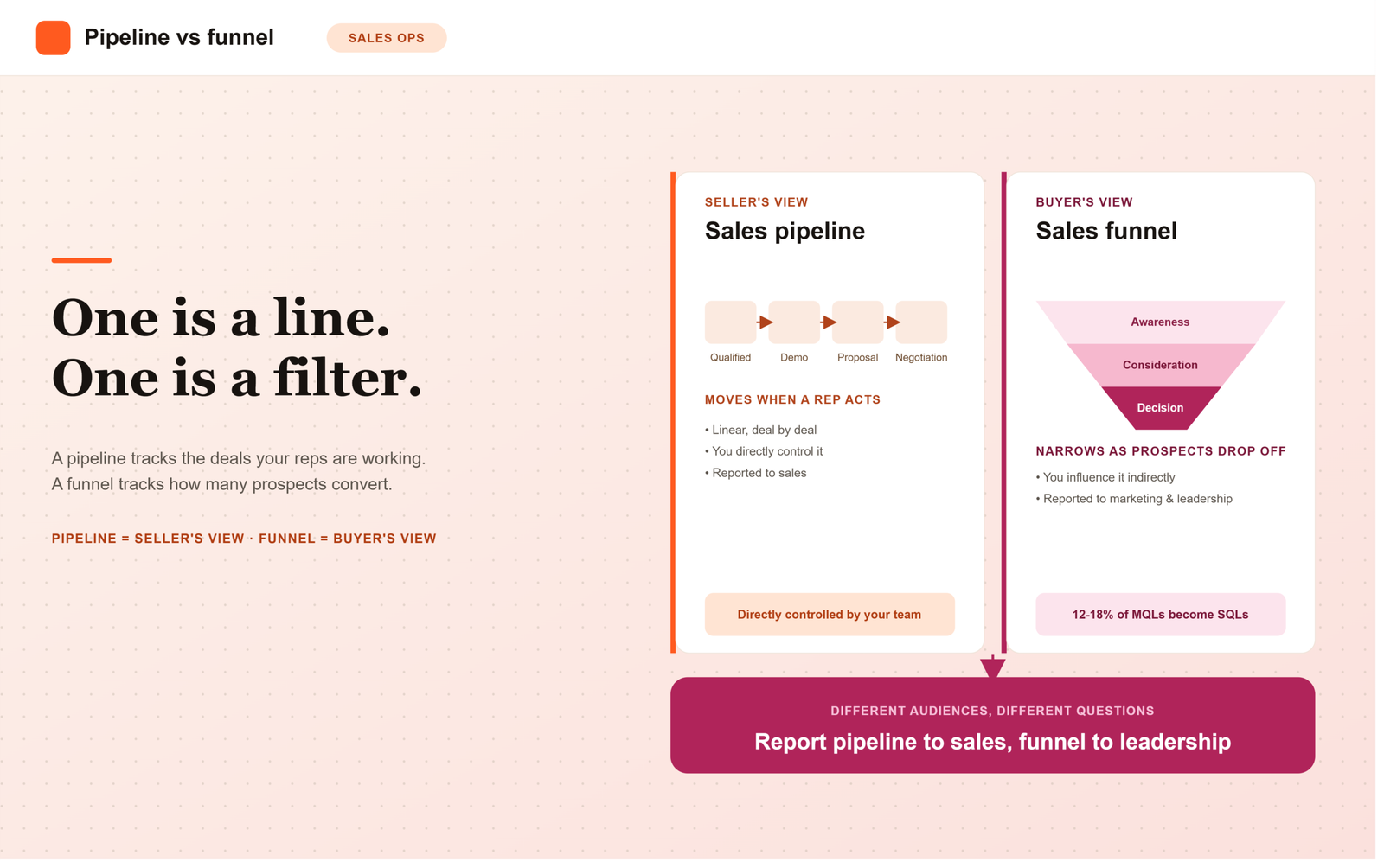
    A sales pipeline tracks the specific deals your sales team is working and the actions reps take to move each one forward. A sales funnel tracks the broader flow of prospects and measures what percentage convert at each stage of the buyer’s journey. One is about your team’s activity; the other is about volume and conversion rates.

    If you’ve ever sat in a pipeline review and someone said “pipeline” when they meant “funnel” (or vice versa), you’re not alone. The two terms get used interchangeably all the time, even by people who’ve been in sales for years.

    But they’re not the same thing, and mixing them up can cost you. If you’re reporting funnel conversion numbers when your VP actually wants pipeline health, you’re going to have an awkward meeting.

    What is a sales pipeline?

    A sales pipeline is your sales team’s internal view of every active deal, organized by stage. Think of it as a dashboard showing exactly where each opportunity stands in your sales process, from first contact to closed won or closed lost.

    Each deal in your pipeline sits in a stage like “Qualified,” “Demo Scheduled,” “Proposal Sent,” or “Negotiation.” A sales pipeline outlines the steps that a sales team takes to turn prospects into paying customers, and it’s built around internal processes and actions, not the buyer’s mindset.

    That’s an important distinction. A pipeline stage moves forward because a rep did something (sent a proposal, booked a demo) or because the buyer took a specific, observable action, not because someone “felt good” about the call.

    What is a sales funnel?

    A sales funnel is a visual representation of your potential customers moving through various stages in their decision-making process, from the moment they become aware of your product to the moment they buy.

    While pipeline stages track individual deals, the funnel is volume-focused. It shows how your potential customer base narrows down as people drop off at each stage. Picture 1,000 leads entering at the top; by the time you get to signed contracts, you might have 8. That drop-off, stage by stage, is exactly what the funnel shows.

    Most funnels follow a simple structure: awareness, consideration, and decision, though many teams add more granular stages depending on their sales motion.

    Sales pipeline vs. sales funnel: what’s actually different?

    Here’s the plain version. The pipeline focuses on the specific actions and stages a salesperson takes to move a deal forward (what the seller does), while the funnel represents the journey from the customer’s point of view, measuring conversion rates at each stage (what the buyer does).

    A few more ways to think about it:

    • Perspective: Pipeline = seller’s view. Funnel = buyer’s view.
    • Focus: Pipeline = individual deals and rep activity. Funnel = aggregate volume and conversion rates.
    • Shape: A pipeline is roughly linear (deals move stage to stage). A funnel narrows, because most leads drop off before they buy.
    • What you control: You can directly change your pipeline by adding or modifying sales tasks, but you can only influence your funnel indirectly, by improving lead quality and rep effectiveness.

    Honestly, most teams that struggle with forecasting aren’t struggling because they lack data. They’re struggling because they’re tracking pipeline activity but reporting it as if it tells them funnel-level conversion truth, and those are two different questions.

    Why does this distinction actually matter?

    It’s not just semantics. Pipeline data and funnel data answer different questions, and if you use the wrong one, you’ll draw the wrong conclusion.

    Say your VP asks why revenue is down this quarter. If you only look at the pipeline, you might see plenty of deals sitting in “Proposal Sent” and assume things are fine. But if you look at the funnel, you might notice conversion from lead to qualified opportunity has quietly dropped 30% over two months. That’s a top-of-funnel lead quality problem, not a closing problem, and you’d never catch it by staring at deal stages alone.

    This is also where the MQL-to-SQL handoff tends to break down. The biggest drop-off typically happens at the marketing-qualified-lead to sales-qualified-lead stage, where only 12 to 18% of MQLs actually become SQLs. If you’re not tracking that conversion rate specifically (a funnel metric), you won’t see the leak until it shows up as a pipeline shortage weeks later.

    Getting your pipeline stages right in the first place also feeds directly into forecasting accuracy, which is a topic we cover in more depth in our beginner’s guide to sales forecasting. And once your pipeline is clean, it’s worth checking whether you actually have enough of it. That’s where a pipeline coverage ratio comes in.

    How to use both without confusing your team

    Here’s a simple checklist for keeping the two straight:

    1. Name your pipeline stages around buyer actions, not seller effort. “Demo completed” is a better stage than “followed up.”
    2. Track funnel conversion rates separately from pipeline volume. Know your lead-to-MQL rate and MQL-to-SQL rate as distinct numbers.
    3. Report pipeline health to sales; report funnel conversion to marketing and leadership. Different audiences, different questions.
    4. Review both weekly. A healthy pipeline with a shrinking funnel is a warning sign your future pipeline is about to dry up.
    5. Keep your CRM as the single source of truth for both, so stage definitions don’t drift between what marketing calls a “lead” and what sales calls a “prospect.”

    Pro tip: if two people on your team can’t agree on what counts as an “opportunity” moving into the pipeline, fix that definition before you build any funnel or pipeline report. Every number downstream depends on it.

    FAQ

    Are sales pipeline and sales funnel the same thing?
    No. They describe the same general process (turning a prospect into a customer) but from different angles: the pipeline is the seller’s view of deal stages, and the funnel is the buyer’s view of conversion volume.

    Which one should I use for forecasting?
    Your pipeline is the primary input for forecasting, since it tracks the dollar value and stage of every open deal. The funnel helps you sanity-check that forecast by showing whether enough new opportunities are entering the top to sustain it.

    Can a small sales team skip the funnel and just track the pipeline?
    You can, but you’ll be flying a bit blind on lead quality. Even a rough funnel view (how many leads turn into qualified opportunities) helps you catch problems before they hit your pipeline.

    Do pipeline stages have to match funnel stages?
    Not exactly. The stages can overlap, but the pipeline is about what the deal needs next, while the funnel is about how many prospects are dropping off between stages. Some teams map them side by side, and that’s fine as long as everyone knows which report answers which question.

    What CRM feature actually shows the difference?
    Most CRMs display pipeline as a deal-stage board or Kanban view, and funnel data as a conversion report or drop-off chart. If your CRM only shows one of these, you’re missing half the picture.

  • Best AI Platforms for SaaS Revenue Workflows in 2026

    Best AI Platforms for SaaS Revenue Workflows in 2026

    Which AI tools actually help B2B SaaS companies automate revenue workflows?

    The honest answer in 2026 is a specific short list, Clari and Aviso for forecasting, Gong and Chorus for conversation intelligence, LeanData for lead routing, and a handful of others, each solving one workflow well rather than one platform solving everything. That distinction matters more than it sounds, because Salesloft’s 2026 Revenue Benchmark found every surveyed revenue organization already uses AI somewhere in the revenue process, yet only 20.6% describe their deployment as production-ready with measurable outcomes, with the gap traced back to CRM data hygiene and deal visibility, not a lack of access to tools. This guide looks at the AI platforms genuinely changing how SaaS revenue teams forecast, prioritize, and sell, organized by the specific workflow each one improves, and maps named tools to concrete use cases so you’re not left guessing which one fits your stack.

    Where AI Is Actually Delivering Value in Revenue Workflows

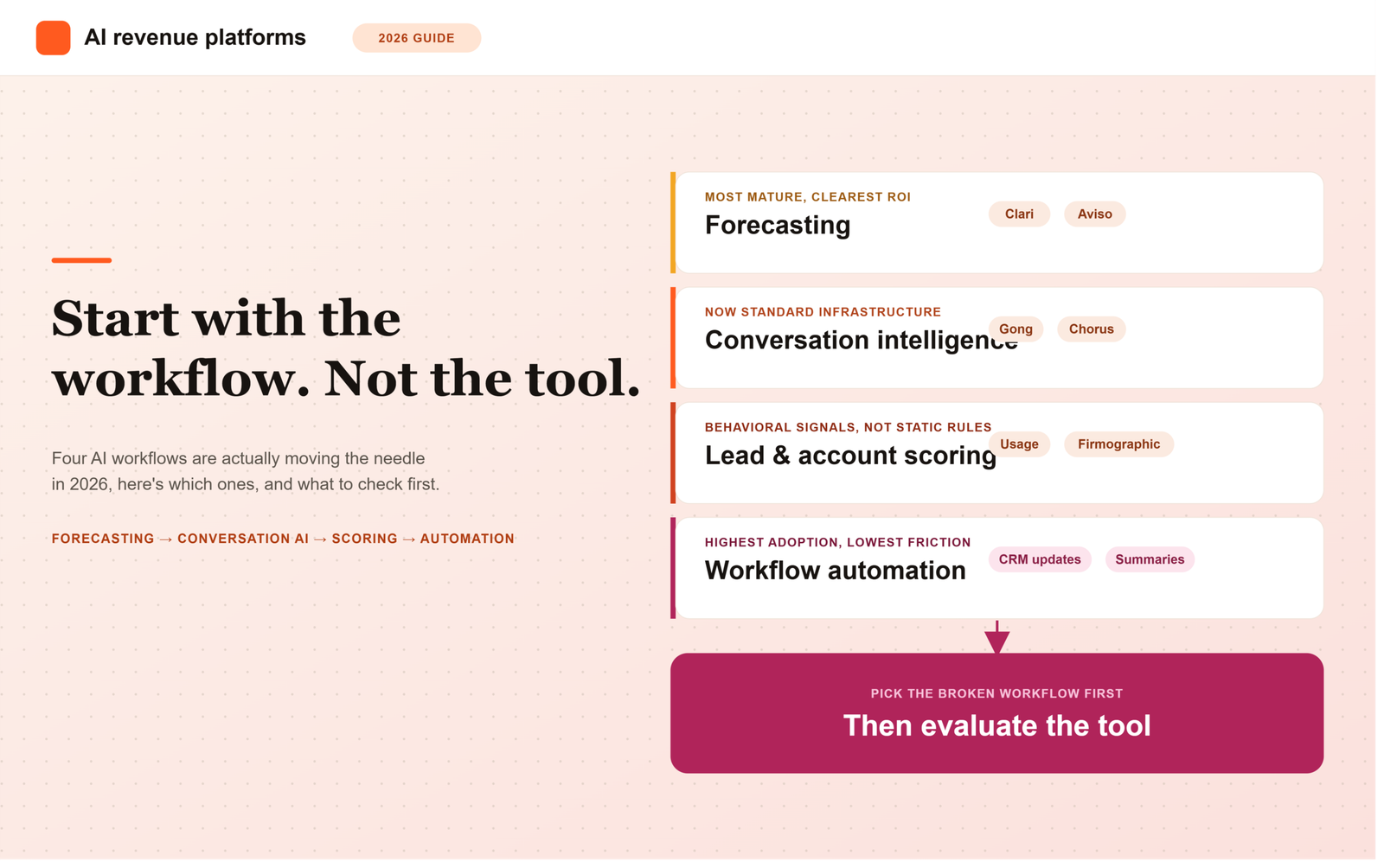
    Not every part of the revenue process benefits equally from AI. The clearest wins in 2026 cluster around four workflows:

    • Forecasting: predictive models that reduce reliance on rep-reported deal confidence
    • Conversation intelligence: analyzing sales calls for risk signals, competitor mentions, and coaching opportunities
    • Lead and account prioritization: scoring based on behavioral and firmographic signals rather than static rules
    • Workflow automation: drafting follow-ups, updating CRM fields, and summarizing account activity automatically

    Tool Comparison: Which Platform Fits Which Team

    The table below compares eight of the most commonly evaluated platforms across the workflows above, so you can see fit and tradeoffs side by side before reading the workflow breakdowns that follow.

    Tool Primary Workflow Best-Fit Team Size CRM Integration Pricing Model Main Limitation
    Clari Forecasting and revenue intelligence Mid-market to enterprise Native, deep Salesforce integration Per-user annual license Significant setup effort; less cost-effective below a few dozen reps
    Gong Conversation intelligence Mid-market to enterprise Native with Salesforce, HubSpot, and major CRMs Per-user annual license Cost scales quickly with headcount; needs call volume to justify spend
    HubSpot (Breeze AI) CRM-native AI across forecasting, scoring, and admin automation SMB to mid-market Native, built into the CRM itself Tiered subscription, AI features bundled or add-on by tier Less specialized and configurable than standalone tools in any one workflow
    Salesforce (Einstein / Agentforce) CRM-native AI across forecasting, scoring, and admin automation Mid-market to enterprise Native, built into the CRM itself Tiered subscription, often a paid add-on above core license Requires admin expertise to configure well; add-on cost adds up
    LeanData Lead and account routing Mid-market to enterprise Deep, primarily Salesforce-centric Per-user or platform license Weaker fit for HubSpot-only stacks without a Salesforce backbone
    Syncari Data unification and CRM data quality Mid-market to enterprise Connects across CRMs, data warehouses, and point tools Usage-based platform pricing Solves the data layer, not rep-facing workflow directly; needs technical setup
    Outreach Outbound sales engagement automation Mid-market to enterprise Native with Salesforce and HubSpot Per-user annual license Built for sequencing and engagement, not a forecasting or CI replacement
    Apollo Data enrichment and outbound automation SMB to mid-market Integrates with major CRMs Per-user or credit-based pricing Enrichment data quality varies by region and industry; lighter analytics than dedicated CI tools

    Forecasting: Where AI Has Matured the Most

    AI-driven forecasting tools (Clari, Aviso, and similar platforms) now pull signal from CRM activity, email and calendar engagement, and historical win-rate patterns to produce forecasts that are frequently more accurate than manager roll-ups based purely on rep judgment. For revenue leaders reporting to a board, this category delivers some of the clearest ROI of any AI investment in the stack.

    Conversation Intelligence: From Nice-to-Have to Standard

    Tools like Gong and Chorus have moved from “premium add-on” to close to standard infrastructure for any team running more than a handful of reps. The real value in 2026 isn’t just call recording. It’s automated risk flagging (competitor mentions, pricing objections, stalled momentum) surfaced directly into deal records without a manager having to listen to every call.

    Lead and Account Scoring: Behavioral Signals Over Static Rules

    Older lead scoring models relied on static point systems (job title +10, company size +5). AI-driven scoring now weighs actual behavioral patterns, such as which pages someone visited or how usage compares to accounts that historically converted or expanded, producing meaningfully better prioritization for both sales and customer success teams.

    Workflow Automation: Time Given Back to Reps

    AI-assisted CRM updates, meeting summaries, and follow-up drafting have quietly become one of the highest-adoption AI use cases, simply because they save reps hours per week on administrative work without requiring a change in how they sell.

    Which AI Tools Fit Each Revenue Workflow

    The four workflows above map to specific tools worth shortlisting, and two additional workflows, lead routing and data enrichment, are common enough at B2B SaaS companies that they deserve their own breakdown.

    Forecasting

    Clari and Aviso remain the two most commonly shortlisted standalone forecasting platforms, both pulling from CRM activity and engagement signals to produce a probability-weighted forecast. HubSpot and Salesforce both offer native forecasting AI (Breeze and Einstein respectively) that works reasonably well for simpler, single-motion sales processes, but teams running multiple segments or a hybrid PLG-plus-sales motion tend to outgrow the native version and move to a standalone tool.

    Conversation Intelligence

    Gong and Chorus dominate this category, and the choice between them usually comes down to CRM integration depth and existing contract relationships rather than a meaningful capability gap. Teams under roughly ten reps rarely see proportional ROI here, since a manager can often still listen to most calls directly at that volume.

    Lead Routing

    LeanData is the most established standalone tool here, particularly for Salesforce-centric stacks needing complex routing logic across territories, product lines, or partner channels. Teams on HubSpot alone can often get sufficient routing logic from HubSpot’s native workflow automation without adding a separate tool, unless the routing rules involve genuinely complex, multi-variable logic.

    Data Enrichment

    Apollo combines enrichment with outbound engagement in one platform, which suits smaller teams wanting a single tool rather than a stitched stack. Syncari sits a layer deeper, focused on unifying and cleaning data across multiple systems rather than enriching individual contact records, which matters more once a company is running several connected tools that all need to agree on the same customer data.

    Outbound Automation

    Outreach remains the more enterprise-oriented sequencing platform, with deeper reporting and native integration into larger CRM deployments. Apollo tends to fit smaller or mid-market teams better, since it bundles enrichment and outbound sequencing together at a lower overall cost than running Outreach alongside a separate enrichment tool.

    CRM Admin Automation

    This is where native CRM AI genuinely competes with standalone tools. HubSpot’s Breeze and Salesforce’s Einstein and Agentforce both handle CRM field updates, meeting summaries, and follow-up drafting reasonably well without adding a separate vendor to the stack, which is often the more sensible starting point before evaluating a standalone workflow automation tool.

    Evaluation Framework for AI Revenue Platforms

    Criteria What to Look For
    Data foundation Does it require clean CRM data to work, or can it function with messy inputs?
    Explainability Can it show why it made a prediction, not just the output?
    Integration depth Does it read and write back to your CRM natively, or require manual syncing?
    Adoption friction Does it change how reps work day-to-day, or fit into existing habits?
    Proven ROI Can the vendor show a measurable before/after from a comparable customer?

    Common Mistakes When Adopting AI Revenue Tools

    • Buying a forecasting AI tool before CRM data hygiene is good enough for it to learn from
    • Rolling out conversation intelligence without a clear coaching process to act on the insights
    • Treating AI scoring as a replacement for, rather than an input to, sales judgment
    • Adding tools faster than the team can actually adopt them into daily workflow

    Start With the Workflow, Not the Tool

    The SaaS teams getting the most value from AI in 2026 didn’t start by shopping for “an AI platform.” They started by identifying a specific workflow, such as forecast accuracy, call coaching, or lead prioritization, that was clearly broken, and then evaluated AI tools specifically against fixing that problem. Platform-first shopping tends to produce expensive tools that never get fully adopted.

    Frequently Asked Questions

    What AI tools are best for RevOps teams?

    It depends on which workflow is broken. Clari or Aviso for forecasting, Gong or Chorus for conversation intelligence, and LeanData for lead routing are the most commonly shortlisted standalone tools, while Syncari fits teams whose core problem is fragmented or inconsistent CRM data rather than any single front-line workflow.

    Do these tools work with HubSpot or Salesforce?

    Most of the platforms covered here, Clari, Gong, Outreach, and Apollo among them, offer native integrations with both HubSpot and Salesforce. LeanData is the exception worth flagging, since its routing logic is built primarily around Salesforce and tends to be a weaker fit for HubSpot-only stacks.

    Should B2B SaaS teams buy one platform or multiple tools?

    Most established teams end up with multiple specialized tools rather than one platform doing everything, since a standalone tool built for one workflow, like Gong for conversation intelligence, typically outperforms a CRM’s native version of that same feature. The exception is CRM admin automation, where HubSpot’s Breeze or Salesforce’s Einstein often cover enough ground natively that adding a separate tool isn’t worth the cost until the team hits real limitations.

    What’s the difference between an AI CRM feature and a standalone AI revenue platform?

    AI CRM features are built directly into your existing CRM tier, handling basics like lead scoring or simple forecasting. Standalone AI revenue platforms (Clari, Gong, Chorus, and similar tools) sit alongside the CRM and go deeper into one specific workflow, like forecasting or conversation intelligence, usually with more accuracy and configurability than the CRM’s native version.

    Do we need clean CRM data before adopting AI forecasting tools?

    Yes. AI forecasting models learn from historical CRM activity and win-rate patterns, so messy or inconsistent data produces unreliable predictions. Most teams should prioritize basic data hygiene before investing in AI forecasting, or the tool will simply automate bad guesses faster.

    Is conversation intelligence worth it for a small sales team?

    It depends on team size and deal complexity. Conversation intelligence tends to deliver the most value once a team has enough reps and call volume that a manager can no longer realistically listen to every call. Very small teams may get more immediate value from forecasting or workflow automation tools first.

    How is AI-driven lead scoring different from traditional lead scoring?

    Traditional lead scoring uses static rules, such as fixed points for job title or company size. AI-driven scoring instead weighs actual behavioral signals, like page visits or product usage patterns, compared against accounts that historically converted or expanded, which typically produces more accurate prioritization.

    What’s the biggest risk when adopting AI revenue tools too quickly?

    Adopting tools faster than the team can actually integrate them into daily workflow. A forecasting tool, a conversation intelligence platform, and a scoring engine added all at once, without a clear process for acting on each one’s output, often leads to low adoption and wasted spend rather than better decisions.

    Should AI scoring replace sales judgment entirely?

    No. AI scoring works best as an input to sales judgment, not a replacement for it. Reps and managers still bring context that behavioral and firmographic data alone can’t capture, so the most effective teams treat AI scores as a prioritization aid rather than a final decision-maker.

  • What Is a Go-to-Market Launch Plan? Checklist

    What Is a Go-to-Market Launch Plan? Checklist

    What Is a Go-to-Market Launch Plan? A Beginner’s Checklist

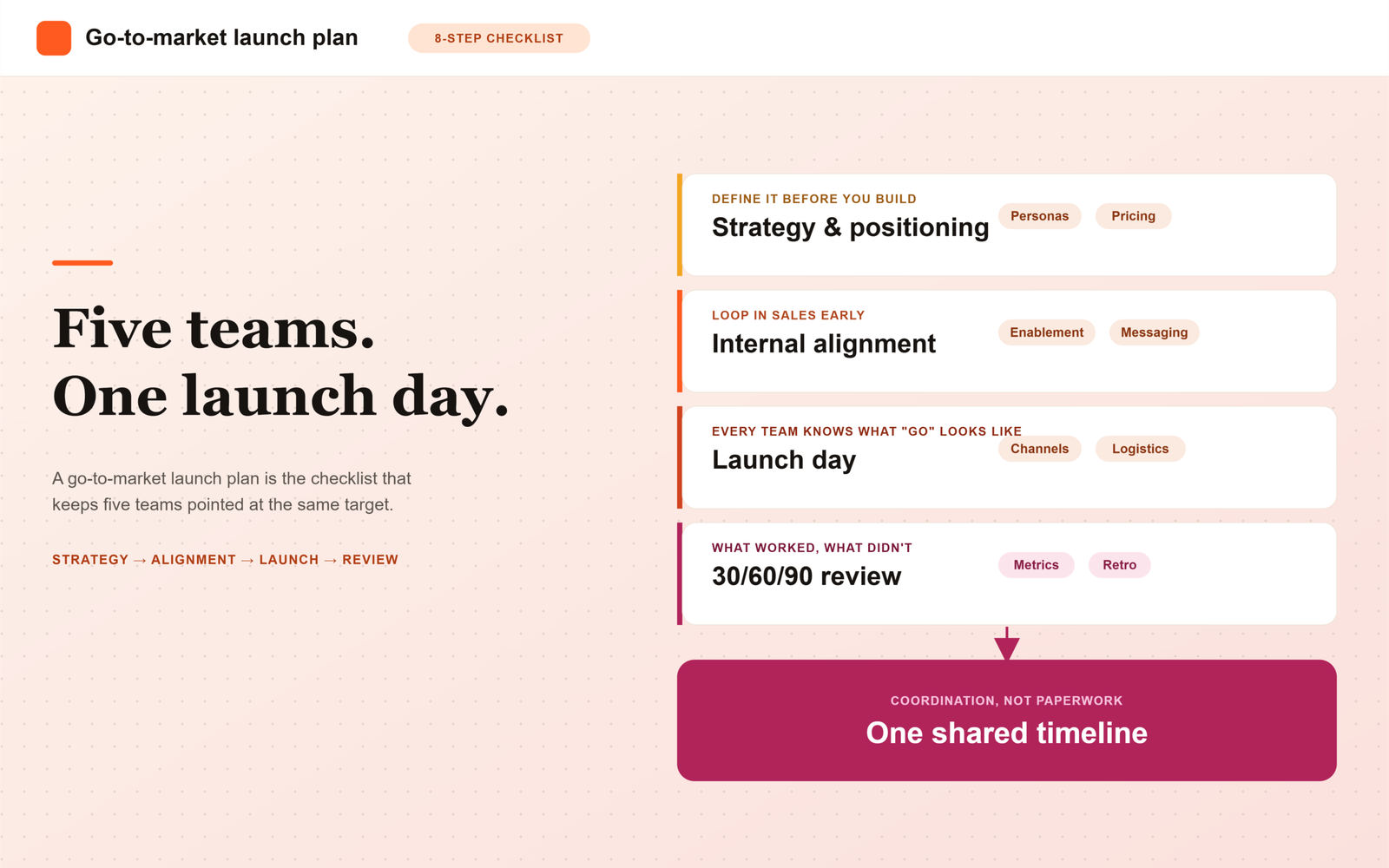
    A go-to-market (GTM) launch plan is the detailed roadmap your team follows to introduce a new product, feature, or market to customers. It covers your target audience, positioning, pricing, channels, sales enablement, and launch-day logistics, aligning every team around one shared timeline and goal.

    If you’ve ever watched a launch go sideways, sales pushing one message while marketing pushes another, support fielding questions nobody prepped them for, you already know why this document exists. A launch plan isn’t paperwork for its own sake. It’s the thing that keeps five different teams pointed at the same target on the same day.

    This post breaks down what actually belongs in a go-to-market launch plan, why skipping it costs you more than it saves, and gives you a checklist you can start filling in today.

    What Is a Go-to-Market Launch Plan?

    A go-to-market strategy is the broader plan for how your company turns a product into revenue. It’s the thinking behind who you’re selling to and why they’d buy. A go-to-market launch plan is narrower: it’s the operational, dated, task-level version of that strategy for one specific launch event.

    One source describes it simply as the planning and preparation for introducing a new product or service to a market, something that puts you in a position to actually reach product-market fit instead of just shipping and hoping. Another way to think about it: a go-to-market strategy is the map, and the launch plan is the turn-by-turn directions with a departure time.

    A solid launch plan usually answers these questions before day one:

    • Who exactly are we launching to?
    • What problem does this solve for them, in their words?
    • How is this priced and packaged?
    • Which channels will carry the message?
    • Is sales actually ready to sell it?
    • What happens in the first 30, 60, and 90 days after launch?

    If you’re still fuzzy on who your buyer even is, it’s worth backing up to define your ideal customer profile before you build the rest of the plan around a guess.

    Why Does a Go-to-Market Launch Plan Matter?

    Here’s the problem with launching without one: every team ends up improvising, and improvised launches tend to look inconsistent from the outside. A go-to-market plan is meant to deliver a cohesive customer experience across sales, marketing, and support, rather than a scattered set of one-off efforts that happen to share a launch date.

    Without a documented plan, teams tend to drift into their own silos: marketing chases one audience, sales chases another, and product keeps shipping features that don’t map to either. That disconnect doesn’t just look messy internally, it burns through budget and confuses the exact customers you’re trying to win over.

    Honestly, most launch failures we see aren’t a product problem. They’re a coordination problem dressed up as a product problem. The features work fine. Nobody agreed on who they were for, or who was supposed to say what to whom, by when.

    How Do You Build a Go-to-Market Launch Plan? (Step-by-Step)

    Most frameworks converge on a similar sequence, even if the exact number of steps varies by source. Here’s a practical version you can adapt regardless of company size.

    1. Define your target market and buyer personas. Get specific about industry, company size, and the roles of the people who’ll actually buy and use the product. Buyer personas are simply a representation of what your ideal buyer looks like, including the roles they hold and the problems they’re trying to solve.
    2. Nail your positioning and messaging. What makes this different, and why should a buyer care right now? This is also where understanding your GTM motion (PLG, sales-led, or a hybrid of the two) shapes how that message actually reaches people.
    3. Set pricing and packaging. Decide this before launch day, not during a sales call. Pricing decisions ripple into everything from messaging to sales scripts.
    4. Choose your channels deliberately. Great launch plans mix channels that work together toward the same goals, dictated by your audience and metrics, rather than trying to be everywhere at once.
    5. Get internal alignment first. The launch process touches nearly every team in the company, so it matters that everyone understands the purpose of the launch and their specific role in it before execution starts.
    6. Brief and enable sales early. Sales teams need to be briefed well ahead of launch day so they aren’t improvising their pitch in front of a prospect.
    7. Plan launch day logistics. Content goes live, campaigns kick off, and every team should know exactly what “go” looks like for their piece of it.
    8. Build in a post-launch review. A plan doesn’t end at launch. Post-launch evaluation is part of the process too, so you can see what worked and adjust the next one.

    Go-to-Market Launch Plan Checklist

    Use this as a working list, not a rigid script. Adapt it to your team’s size and launch type.

    • [ ] Target market and firmographics defined
    • [ ] Buyer personas documented, including roles and pain points
    • [ ] Core positioning statement written and agreed on
    • [ ] Pricing and packaging finalized
    • [ ] Channel mix selected and tied to specific goals
    • [ ] Internal alignment meeting held across product, marketing, sales, and support
    • [ ] Sales enablement materials built and reps trained
    • [ ] Launch day timeline with named owners per task
    • [ ] Post-launch metrics defined (what “success” actually looks like)
    • [ ] 30/60/90-day review scheduled

    One more thing worth knowing: research cited by product marketing teams suggests a typical B2B buying group can include six to ten decision-makers, including influencers and gatekeepers who can slow or block approval. That’s a strong argument for making sure your messaging and sales materials address more than just the person who signed up for the demo.

    Summary

    A go-to-market launch plan is the operational, dated version of your broader GTM strategy, built specifically for one launch event. It answers who you’re launching to, what problem it solves for them, how it’s priced, which channels carry the message, whether sales is actually ready, and what happens in the first 30, 60, and 90 days after go-live.

    Skipping this document doesn’t usually show up as a product failure, it shows up as a coordination failure: sales, marketing, and support each improvising their own version of the story. The eight-step process, target market and personas, positioning, pricing, channels, internal alignment, sales enablement, launch-day logistics, and a post-launch review, gives every team the same shared timeline. Bring sales into the room during positioning, not just before launch day, and remember that a typical B2B buying group has six to ten decision-makers, so the plan needs to speak to more than just the person who booked the demo.

    Frequently Asked Questions

    Is a go-to-market launch plan the same as a go-to-market strategy?

    Not quite. The strategy is the bigger-picture thinking, your target market, positioning, and business case. The launch plan is the execution layer: dates, owners, tasks, and channels for one specific launch.

    Who should own the go-to-market launch plan?

    It varies by company, but product marketing often drives the document while pulling in sales, customer success, and product leadership as contributors. Someone still needs final ownership, otherwise tasks fall through the cracks between teams.

    How far in advance should we start building the plan?

    There’s no single universal number, but sales needs to be briefed well before launch day so reps aren’t caught unprepared, which means the plan itself needs to start taking shape weeks earlier than that.

    What happens if we skip the launch plan and just wing it?

    You can. Plenty of teams do. But without alignment, you tend to get mixed messaging, wasted spend, and a sales team improvising in front of prospects, which is a rough way to find out your pricing page and your sales deck don’t agree with each other.

    Does a launch plan work the same way for a small feature update as it does for a brand-new product?

    No, scale it down. A feature update might only need messaging, a couple of channels, and a quick sales briefing. A brand-new product or market entry usually needs the full checklist, including deeper buyer research and a longer post-launch review window.

  • Best CRM and RevOps Platforms for SaaS in 2026

    Best CRM and RevOps Platforms for SaaS in 2026

    Choosing a CRM used to be a single decision. In 2026, it’s rarely just one platform anymore: most SaaS revenue teams are stitching together a core CRM, a RevOps/operations layer, and one or more AI-driven analytics or forecasting tools. Getting this stack right matters more than ever, because the cost of getting it wrong now compounds across every downstream system it touches.

    This guide breaks down the CRM and RevOps platforms SaaS teams are actually standardizing on in 2026, how the category has shifted, and how to match a platform combination to your company’s growth stage.

    What Changed in the CRM and RevOps Platform Market for 2026

    Three shifts define the current landscape:

    • AI moved from add-on to default. Lead scoring, forecast modeling, and deal-risk flagging are now built into core CRM tiers rather than sold as separate modules.
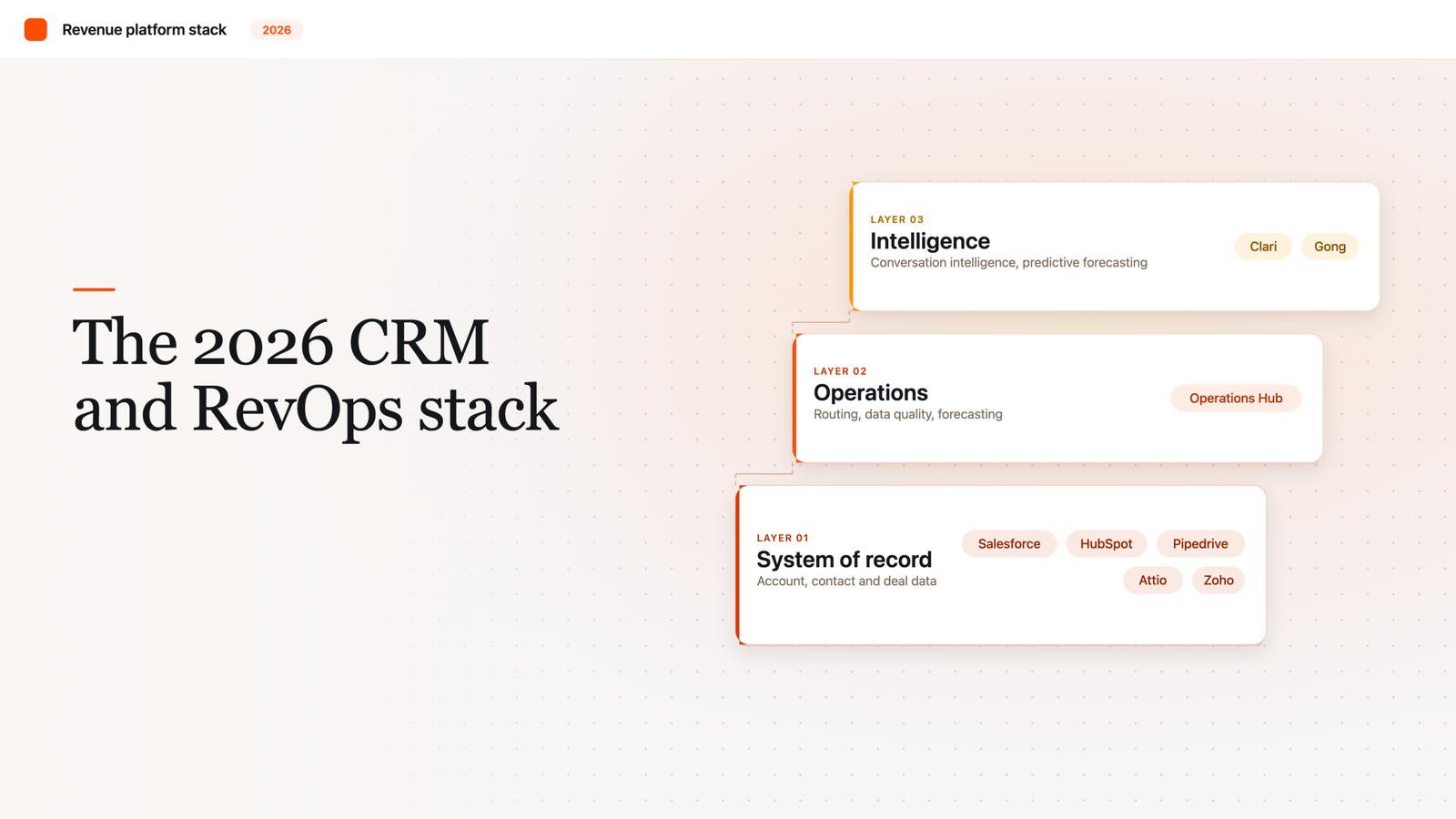
    • The “RevOps layer” became its own category. Tools like Clari, Gong, and HubSpot’s Operations Hub now sit on top of or alongside the CRM, handling forecasting, conversation intelligence, and data hygiene as dedicated functions.
    • Buyers consolidated vendors. After years of tool sprawl, SaaS RevOps leaders are actively cutting point solutions in favor of platforms that cover more of the revenue workflow natively.

    The Three Layers You’re Actually Choosing Between

    When people say “CRM platform,” they’re usually describing a stack with three distinct layers:

    1. System of record: the core CRM (Salesforce, HubSpot, Pipedrive, Attio, Zoho) that stores account, contact, and deal data.
    2. Operations layer: tools that sit on top to manage routing, data quality, forecasting, and workflow automation.
    3. Intelligence layer: AI-driven tools for conversation intelligence, signal-based selling, and predictive forecasting.

    Most vendors now compete to own more than one layer, which is why platform comparisons have gotten more complex than a simple feature checklist.

    Platform Comparison at a Glance

    Platform Best For Watch Out For
    Salesforce Complex, multi-product enterprises needing deep customization Implementation cost and admin overhead
    HubSpot Mid-market SaaS wanting CRM + marketing + ops in one suite Costs scale quickly as contact volume grows
    Pipedrive / Attio Lean sales-led teams wanting speed over depth Fewer native RevOps and forecasting features
    Zoho Cost-conscious teams needing broad functionality Less polished UX, smaller partner ecosystem
    Clari / Gong (layered on CRM) Teams that need forecasting and conversation intelligence, not a CRM replacement Additional cost and integration overhead

    How to Match a Platform to Your Growth Stage

    The right stack depends less on brand reputation and more on where your revenue team actually is:

    • Pre-Series A: A lightweight CRM (Pipedrive, Attio, or HubSpot’s free/starter tier) is usually enough. Don’t buy a RevOps layer before you have repeatable process to operationalize.
    • Series A to B, scaling GTM: This is where most teams add an operations layer. Lead routing, forecasting, and reporting typically outgrow spreadsheets and native CRM reporting around this stage.
    • Series C and beyond: Multi-product, multi-region GTM usually justifies Salesforce’s customization depth, paired with dedicated intelligence-layer tools.

    Questions to Ask Before You Commit

    1. Which layer (system of record, operations, or intelligence) is this actually solving for, and do we already own a tool that covers it?
    2. What does data migration and integration actually cost, in time and dollars, not just license price?
    3. Will this platform still fit at 3x our current headcount, or are we buying for today’s team size only?
    4. Who owns admin and configuration internally, and do they have the bandwidth to maintain it?

    The Platform Is Only as Good as the Operating Model Around It

    No CRM or RevOps platform fixes misalignment between sales and marketing on its own. It just gives you the infrastructure to enforce alignment once you’ve defined it. The teams getting the most value from their 2026 stack are the ones who nailed process and definitions first, then chose tooling to support it, rather than the reverse.

    Frequently Asked Questions

    What’s the difference between a CRM and a RevOps platform?

    A CRM is the system of record: it stores account, contact, and deal data. A RevOps platform (or RevOps layer) sits on top of or alongside the CRM to handle lead routing, forecasting, reporting, and data hygiene across sales, marketing, and customer success. Many teams need both, not one instead of the other.

    Do I need a separate RevOps layer if I already have a CRM?

    Not always. Early-stage teams with simple, low-volume pipelines can often rely on native CRM reporting and manual process. A dedicated RevOps layer typically becomes worth the investment once lead volume, headcount, or reporting complexity outgrows what the CRM handles natively, usually around Series A to B.

    Which CRM is best for early-stage SaaS companies?

    Lightweight, fast-to-implement tools like Pipedrive, Attio, or HubSpot’s starter tier are usually the right fit pre-Series A. The priority at this stage is speed and low overhead, not deep customization or a full RevOps layer.

    How much does implementing a RevOps stack typically cost?

    Costs vary widely based on team size, data volume, and how many systems need to integrate, but license price is rarely the biggest cost. Implementation time, data migration, and ongoing admin work usually add up to more than the subscription fee itself, which is why total cost of ownership matters more than sticker price when comparing platforms.

    When should a SaaS company move from HubSpot to Salesforce?

    This shift usually makes sense when a company moves into multi-product or multi-region go-to-market motions that require deeper customization than HubSpot supports, or when contact volume growth makes HubSpot’s pricing model less cost-effective than Salesforce’s structure. It’s rarely worth making the switch before that complexity actually exists.

    What’s the biggest mistake SaaS teams make when choosing a CRM or RevOps stack?

    Buying tooling before defining process. A platform can’t fix misaligned sales and marketing definitions or an undefined lead lifecycle on its own. Teams that get the most value from their stack define their process and shared definitions first, then choose tools to support it, rather than expecting the software to create alignment for them.

  • What Is a HubSpot Workflow? A Beginner’s Guide

    What Is a HubSpot Workflow? A Beginner’s Guide

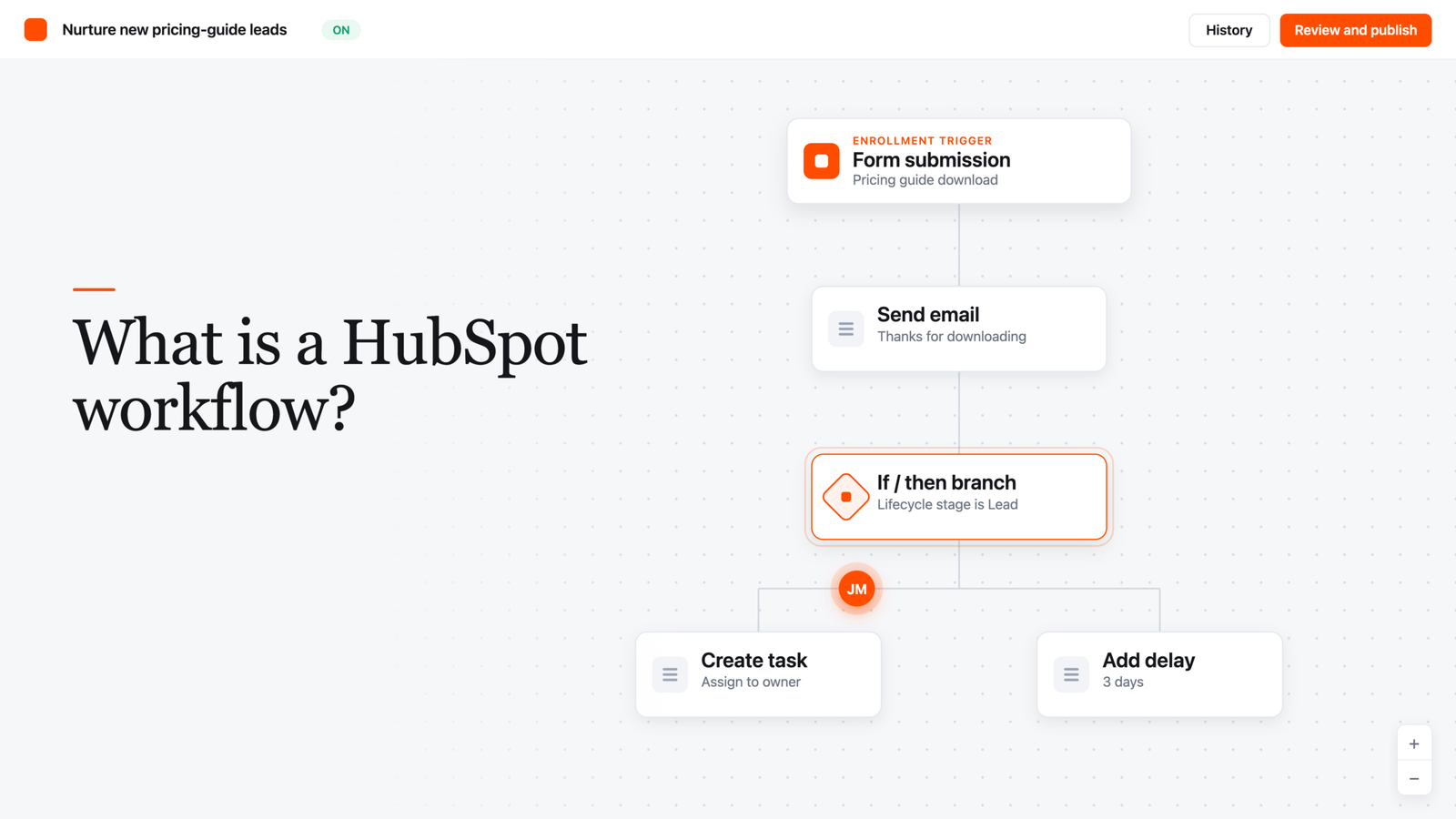
    A HubSpot workflow is an automated set of actions that runs on its own when a specific trigger happens, like a form submission, a property change, or a scheduled date. Instead of a person manually sending an email or updating a record, HubSpot does it for you based on rules you set once.

    If you’re setting up HubSpot for the first time, “workflow” is one of those words that gets thrown around constantly in onboarding calls and YouTube tutorials. Nobody stops to explain it in plain terms. So let’s fix that.

    What is a HubSpot workflow, exactly?

    At the simplest level, a workflow is an “if this happens, then do that” instruction you build inside HubSpot. It’s an automated sequence of actions that you can trigger based on specific criteria, such as contact properties, behaviors, or lifecycle stages.

    Say a prospect fills out a form to download a pricing guide. A workflow can automatically send them a thank-you email, create a follow-up task for a sales rep, and drop them into a nurture sequence, all without anyone touching a keyboard.

    That’s the whole point. You set the logic up once, and HubSpot repeats it every single time the trigger condition is met, whether that’s once a day or a thousand times a day.

    How does a HubSpot workflow actually work?

    Every workflow has two core pieces: a trigger (HubSpot calls this an “enrollment trigger”) and a set of actions.

    The enrollment trigger decides which records get pulled into the workflow and when. There are a few different trigger types you’ll run into:

    • Event-based triggers: fire when something happens, like a form submission or a page view.
    • Filter-based (list) triggers: fire when a record matches certain criteria, like “lifecycle stage is Customer.”
    • Schedule-based triggers: run on a set frequency, such as an annual birthday email based on a contact’s birthday property.
    • Webhook triggers: enroll a record when HubSpot receives a signal from an outside tool (this one requires Data Hub Professional or Enterprise).

    Once a record (a contact, company, deal, or ticket) is enrolled, the workflow moves it through a series of actions. Those actions can send an email, update a CRM property, create a task, assign an owner, add a delay, or branch the record down a different path depending on how it answers a yes/no condition.

    Here’s the part beginners miss: workflows aren’t just for contacts. HubSpot lets you build workflows around companies, deals, tickets, quotes, and a handful of other object types, so the same logic applies whether you’re nurturing a lead or routing a support ticket to the right rep.

    Why does this matter for a growing GTM team?

    Honestly, most teams don’t get burned by a lack of workflows, they get burned by workflows nobody understands or maintains. But used well, workflows solve a real problem: manual follow-up doesn’t scale.

    When your lead volume is small, a rep can eyeball every new form fill and respond by hand. Once you’re getting dozens of leads a day across multiple channels, that falls apart fast. Workflows let you automate the qualification and distribution of leads, so high-priority prospects get attention immediately instead of sitting in an inbox.

    They’re also how HubSpot keeps CRM data from turning into a mess as you scale. A workflow can automatically update a lifecycle stage, log an activity, or flag a record for cleanup the moment a condition is met, instead of relying on someone to remember to do it.

    Workflows vs. sequences: what’s the difference?

    This trips up a lot of new HubSpot users, so it’s worth a quick clarification. Sequences are built for one-to-one sales outreach: a rep enrolls a specific contact into a series of personalized emails and task reminders, and it’s designed to preserve a human touch.

    Workflows are the fully automated version that runs across marketing, sales, and service at scale, updating properties, assigning tasks, routing tickets, and handling branching logic without a rep manually enrolling each record. If a sequence is a rep working a list by hand with some automation assist, a workflow is the machine running in the background regardless of who’s watching it.

    What HubSpot plan do you need for workflows?

    This is where a lot of people get tripped up during setup, and it’s worth checking before you build your first one. The full workflow builder, with branching logic and multi-step automation, is a Professional and Enterprise tier feature. Starter subscriptions only include simple, single-step automations in specific tools like forms, not the full drag-and-drop workflow editor.

    If you’re still figuring out which HubSpot tier your team actually needs, it’s worth reading through HubSpot Free vs. Starter vs. Professional: Which Tier Do You Actually Need? before you commit to a plan based on workflow access alone.

    A simple checklist before you build your first workflow

    Pro tip: don’t open the workflow builder until you can answer these questions on paper. A workflow built without a clear trigger and end state is how you end up with duplicate emails and confused prospects.

    1. What specific event or condition should start this workflow? (Form fill, property change, date, list membership.)
    2. Which record type does it apply to? (Contact, company, deal, ticket.)
    3. What should happen, step by step, once a record enrolls?
    4. Should records be allowed to re-enroll, or only run through once?
    5. What condition should remove a record from the workflow early?
    6. Who on your team needs to be notified if something breaks?

    Getting these six answers down before you touch the builder will save you from the classic beginner mistake: building a workflow that technically runs, but does the wrong thing to the wrong people.

    FAQ

    Is a HubSpot workflow the same as an automation?
    Pretty much, yes. “Workflow” is just HubSpot’s specific name for its automation tool. Other platforms might call the same concept a “flow” or an “automation recipe,” but the underlying idea (trigger plus actions) is the same.

    Can I use workflows on HubSpot’s free plan?
    No. The full workflow builder requires Marketing Hub, Sales Hub, Service Hub, or Operations Hub Professional or Enterprise. Free and Starter accounts get simple, single-action automations in specific tools, not the visual multi-step builder.

    Do workflows only send emails?
    No, and this is a common misconception. While email automation is the most visible use case, workflows can also update CRM records, create internal tasks, notify team members, route support tickets, and connect to external systems through webhooks and integrations.

    What happens if a contact meets a workflow’s trigger twice?
    It depends on your re-enrollment setting. You can configure whether a record re-enrolls each time it meets the trigger criteria again, or only runs through the workflow once, ever.

    Do I need coding skills to build a workflow?
    No. Workflows are built through a visual, drag-and-drop editor that lets you set up branching “if this, then that” logic without writing code. HubSpot has also added an AI assistant that can suggest triggers and actions based on a plain-language prompt.

  • Best RevOps Consulting Services for India SaaS Teams.

    Best RevOps Consulting Services for India SaaS Teams.

    Indian B2B SaaS companies are scaling faster than ever, but many hit the same wall on the way to $10M+ ARR: sales, marketing, and customer success stop moving in the same direction. Pipeline data lives in one system, campaign data in another, and forecasts become guesswork. This is where revenue operations consulting earns its keep it’s the discipline that aligns people, process, and platforms around a single revenue engine.

    If you’re a RevOps leader evaluating outside help, this guide breaks down what good revenue operations services actually look like, the criteria that separate a strong partner from a mediocre one, and how to shortlist consultants who understand the realities of Indian B2B growth teams selling into global markets.

    Why RevOps Matters More for Indian SaaS Teams Right Now

    Indian SaaS companies operate under a specific set of pressures that make revenue operations consulting especially valuable:

    • Multi-timezone go-to-market motions. Many Indian SaaS teams sell into the US, EMEA, and APAC simultaneously, which means sales and marketing handoffs need to work across time zones without losing momentum.
    • Capital efficiency expectations. Post-2022, Indian SaaS investors have pushed harder on efficient growth metrics CAC payback, net revenue retention, and pipeline conversion all of which depend on clean, aligned revenue data.
    • Rapid tool sprawl. Fast-growing teams often accumulate a patchwork of CRM, marketing automation, and customer success tools before anyone designs how they should talk to each other.
    • Thin RevOps benches. Many Indian SaaS companies are hiring their first dedicated RevOps person around Series A or B, which means there’s rarely internal precedent for how to structure the function.

    A consulting partner that understands these dynamics can shortcut months of trial and error but only if they’re evaluated against the right criteria.

    What Good RevOps Consulting Actually Looks Like

    Not all revenue operations services are built the same. Some consultancies specialize narrowly in CRM administration; others focus on high-level GTM strategy without ever touching your tech stack. For most India-based B2B growth teams, the most valuable partners sit in the middle combining strategic thinking with hands-on systems work.

    1. Sales and Marketing Alignment as a Core Deliverable

    The single biggest sign of a strong RevOps partner is whether sales and marketing alignment is treated as a first-class deliverable, not an afterthought. Look for consultants who:

    • Build a shared definition of a Marketing Qualified Lead (MQL) and Sales Qualified Lead (SQL) that both teams actually agree on.
    • Design lead routing and SLA rules so leads don’t sit untouched between systems.
    • Set up closed-loop reporting so marketing can see which campaigns actually influenced closed-won revenue, not just form fills.
    • Facilitate regular pipeline review cadences that bring sales and marketing leadership into the same room.

    If a consultant can’t describe how they’ll get your CRM and marketing automation platform talking to each other in the first conversation, that’s a red flag.

    2. A Clear, Phased Go-To-Market Strategy Framework

    Strong partners don’t jump straight into system configuration. They start by mapping your go-to-market strategy your ideal customer profile, buying committee, sales motion (PLG, sales-led, or hybrid), and expansion strategy before recommending any process or tooling change. Ask prospective consultants to walk you through:

    • How they diagnose gaps in your current GTM motion.
    • Whether they differentiate their recommendations for new logo acquisition versus expansion and renewal revenue.
    • How they sequence quick wins (things you can fix in 30 days) against longer structural changes (territory design, comp plan redesign, multi-quarter roadmaps).

    3. Deep, Practical CRM and Tech Stack Expertise

    Strategy without execution capability isn’t RevOps it’s just consulting. The best firms bring certified, hands-on expertise in the platforms Indian SaaS teams actually run: Salesforce, HubSpot, Pipedrive, Zoho, and the marketing automation and CS platforms that sit alongside them. Evaluate this by asking for:

    • Specific examples of CRM migrations or re-architectures they’ve led.
    • Their approach to data hygiene and deduplication a chronic problem for fast-growing teams.
    • How they handle integrations between CRM, marketing automation, billing, and customer success tools.

    4. Metrics and Reporting Built for Investor and Board Conversations

    For Indian SaaS companies raising subsequent rounds, RevOps consulting should produce reporting infrastructure that holds up in board meetings pipeline coverage ratios, CAC payback, magic number, NRR, and forecast accuracy. A good partner builds dashboards your CFO and CEO will actually trust, not vanity metrics that look good but don’t inform decisions.

    5. Experience With Cross-Border, Multi-Timezone Teams

    Because so much Indian SaaS revenue comes from outside India, ask any prospective partner how they’ve handled:

    • Territory and comp design across US, EMEA, and India-based sales reps.
    • Marketing attribution when demand generation spans multiple regions and currencies.
    • Handoffs between an India-based SDR team and a US-based closing team, or vice versa.

    Evaluation Criteria: A Practical Scorecard

    When comparing revenue operations consulting firms, score each on the following dimensions before making a decision:

    Criteria What to Look For
    Alignment focus Explicit sales-marketing alignment deliverables, not just CRM cleanup
    Strategic depth Ability to diagnose GTM strategy gaps, not just execute tickets
    Technical fluency Hands-on certifications and migration case studies in your CRM/MAP stack
    Reporting rigor Board-ready dashboards tied to revenue outcomes, not activity metrics
    Cross-border experience Track record with multi-timezone, multi-currency GTM motions
    Engagement model Fixed-scope project vs. ongoing fractional RevOps support — match to your stage
    References Willingness to connect you with similarly-sized Indian SaaS clients

    Fractional vs. Project-Based RevOps Consulting

    Two common engagement models show up across business growth consulting firms serving SaaS:

    • Project-based engagements are best when you have a defined problem a CRM migration, a lead scoring rebuild, or a comp plan redesign with a clear start and end date.
    • Fractional RevOps support works well for earlier-stage companies that need ongoing strategic and operational leadership but aren’t ready to hire a full-time VP of RevOps yet.

    Many B2B growth teams in India start with a project engagement to solve an urgent problem, then transition into fractional support as the relationship proves out and the function matures internally.

    Questions to Ask Before You Sign

    Before committing to a RevOps consulting partner, get clear answers to:

    1. What does the first 30/60/90 days of the engagement actually look like?
    2. Who on their team will be doing the hands-on work is it the person in the sales pitch, or a more junior team member?
    3. Can they show a before/after example of sales and marketing alignment improving pipeline conversion for a comparable client?
    4. How do they measure success, and will they commit to specific outcomes or KPIs?
    5. What happens to documentation, process ownership, and system access when the engagement ends?

    Getting Alignment Right Is the Whole Point

    Revenue operations consulting isn’t about buying another tool or adding another process layer it’s about making sure your sales, marketing, and customer success teams are pulling in the same direction, with data everyone trusts. For Indian SaaS teams competing for global budgets against well-resourced competitors, that alignment is often the difference between a forecast you can bet the business on and one that falls apart every quarter.

    Whether you’re evaluating your first RevOps partner or replacing one that never quite delivered, the criteria above alignment focus, strategic depth, technical fluency, reporting rigor, cross-border experience, and the right engagement model give you a concrete way to compare options instead of choosing on brand name alone.