Blog

  • GTM Motion Types Explained: PLG vs Sales-Led vs Hybrid

    GTM Motion Types Explained: PLG vs Sales-Led vs Hybrid

    What Is a GTM Motion? PLG vs. Sales-Led vs. Hybrid Explained

    If you’ve spent any time around SaaS founders or investors, you’ve probably heard someone say “what’s your GTM motion?” like it’s obvious. It isn’t, especially if you’re building your first company or your first revenue team.

    The term sounds more complicated than it is. Once you see the three main flavors side by side, picking one (or blending two) gets a lot less scary.

    A GTM (go-to-market) motion is the repeatable way a company gets its product in front of buyers and turns them into paying customers. The three core types are product-led (the product sells itself through self-serve trials), sales-led (reps drive the deal), and hybrid, which blends both depending on deal size and buyer type.

    What Is a GTM Motion, Exactly?

    A go-to-market motion is basically your company’s answer to three questions: who buys, how do they find out about you, and who actually closes the deal. Not a marketing plan, not a sales script, but the underlying operating model that shapes both.

    Most early-stage founders don’t choose a motion on purpose. They copy whatever the last company they worked at did, or whatever’s trending on LinkedIn that week. That’s a mistake, because the wrong motion for your price point and buyer type can quietly stall growth for years.

    What Is a Product-Led Growth (PLG) Motion?

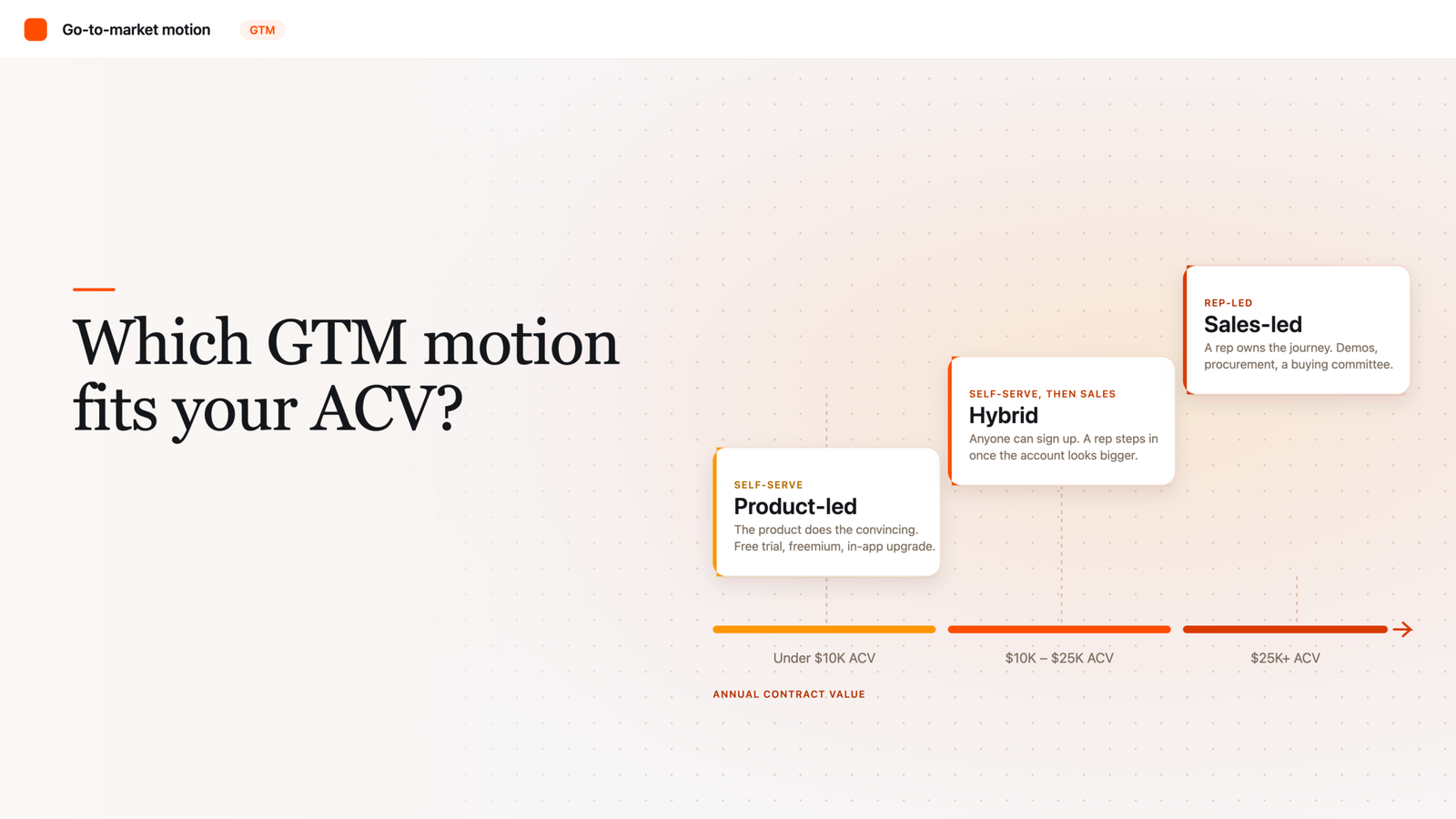
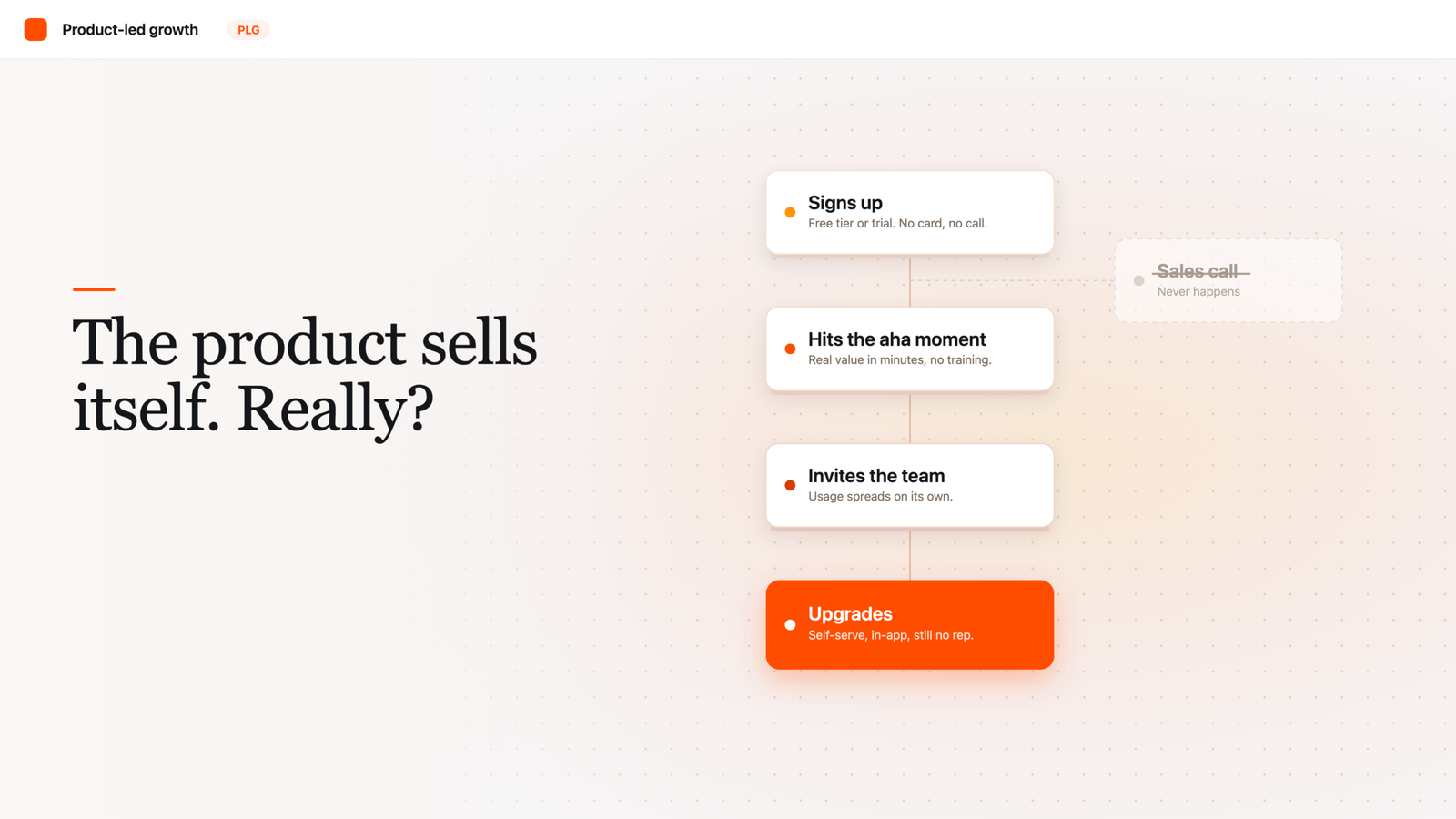
    Product-led growth is a go-to-market strategy where the product itself is the primary driver of acquisition, activation, and expansion, not a salesperson. Users try the product themselves, usually through a free trial or a freemium plan (a free, limited version of the product), experience value, and then upgrade or expand on their own.

    The term was coined by Blake Bartlett at OpenView back in 2016, and it’s since become an umbrella for tactics like freemium models, self-guided product tours, and in-app upgrade prompts. Think Slack or Dropbox: you didn’t sit through a sales pitch before you started using them. You just signed up and started working.

    One reason PLG caught on so fast is cost efficiency. A product-led strategy can reduce customer acquisition cost by taking pressure off the sales team, since the product itself is doing a lot of the convincing. OpenView has also found that leading product-led growth companies grow significantly faster year over year than traditional SaaS companies relying purely on sales.

    But PLG isn’t free. It only works if the product delivers value fast, with little to no setup, and if a single user can get real benefit without needing five other people to sign off.

    What Is a Sales-Led GTM Motion?

    Sales-led growth flips the model: a human being, usually an account executive or sales development rep, owns most of the buyer’s journey. Instead of a free trial doing the convincing, sales and marketing create the need for the product and then walk a prospect through demos, proposals, and negotiation.

    This motion tends to fit complex products with higher price tags and multiple decision-makers. Industry benchmarks generally put sales-led growth as the better fit for deals above roughly $25,000 in annual contract value (ACV, the yearly revenue a customer contract is worth), especially when a buying committee, not just one person, has to approve the purchase.

    If you’re selling something that touches security reviews, procurement, or multiple departments, a self-serve trial usually can’t close that deal on its own. That’s where a rep earns their keep.

    What Is a Hybrid GTM Motion, and Why Is It So Common Now?

    A hybrid motion pairs sales-led and product-led strategies into a single go-to-market approach, aiming to capture the efficiency of self-serve while still being able to land larger, more complex accounts. In practice, that often means self-serve signup for smaller customers and a sales team stepping in once an account shows signs of being a bigger opportunity.

    This isn’t a niche approach anymore. Research from McKinsey points out that the lines between PLG and sales-led are already blurring: pure-play PLG companies are hiring sales teams to serve enterprise accounts, while traditional sales-led companies are building product-led experiences to win over smaller customers. Companies that pull off this blend well can see genuinely differentiated returns compared to sticking with one motion alone.

    Honestly, most companies that claim to be “pure PLG” past a certain size aren’t. Once you’re closing six-figure enterprise deals, somebody in a sales seat is involved somewhere in that process, even if the first touch was self-serve.

    How Do You Pick the Right GTM Motion for Your Business?

    There’s no universal right answer here, but there is a fairly reliable way to work through the decision. Run through these steps before you commit to a motion:

    1. Know your buyer, not just your market. Before anything else, get specific about who you’re actually selling to. This is your ICP (ideal customer profile), and if you haven’t nailed it down yet, it’s worth reading through what an ICP is and why it matters before you go further.
    2. Check your average contract value. Lower ACV products (roughly under $10K annually) tend to favor product-led motions. Higher ACV, complex deals tend to need sales involvement.
    3. Map the buying process. Is this a single-user decision, or does it need sign-off from IT, finance, and a department head? More stakeholders usually means more need for a human guiding the deal.
    4. Measure time-to-value. Can a user get real value in minutes, or does it take weeks of setup and training? Fast time-to-value supports self-serve; slow time-to-value usually needs sales-assisted onboarding.
    5. Size the addressable market for each segment. Understanding your TAM, SAM, and SOM (the total, serviceable, and obtainable market) helps you see whether your best opportunity sits in a high-volume, lower-price segment or a smaller, higher-price one, which points you toward PLG, sales-led, or a hybrid split between them.
    6. Validate with real usage data, not opinions. If self-serve signups are converting on their own, don’t force a sales layer on top of something that’s already working.

    Pro tip: don’t pick a motion because it sounds modern. Pick it because your ACV, buyer complexity, and time-to-value point you there, then adjust as you scale.

    FAQ

    Is PLG always cheaper than sales-led growth?
    Usually, yes, on a per-customer basis, since acquisition costs in a PLG motion don’t scale up proportionally with each new customer the way sales headcount does. But cheap doesn’t always mean better if your product needs a human to close bigger deals.

    Can a small startup run a hybrid motion from day one?
    Technically yes, but it’s rarely a good idea. Most companies start with one motion, prove it works, and layer in the second once they see a clear signal (like inbound signups from larger accounts) that justifies adding sales or self-serve on top.

    Does a hybrid motion mean I need two separate teams?
    Not necessarily two full teams, but you do need clear rules for handoffs. Segment by company size or by buying signal, and make sure everyone agrees on when a self-serve user gets routed to a rep.

    What’s the difference between a GTM motion and a GTM strategy?
    A GTM strategy is the bigger picture: your positioning, pricing, and target market. A GTM motion is the operational engine underneath it, specifically how deals actually get sourced and closed.

    How do I know if my GTM motion is broken?
    Watch for declining win rates, rising customer acquisition costs, or a sales team spending most of its time on deals too small to justify the effort. Any of those are signs it’s time to revisit the motion, not just the tactics underneath it.
  • RevOps vs Business Operations: What’s the Difference?

    RevOps vs Business Operations: What’s the Difference?

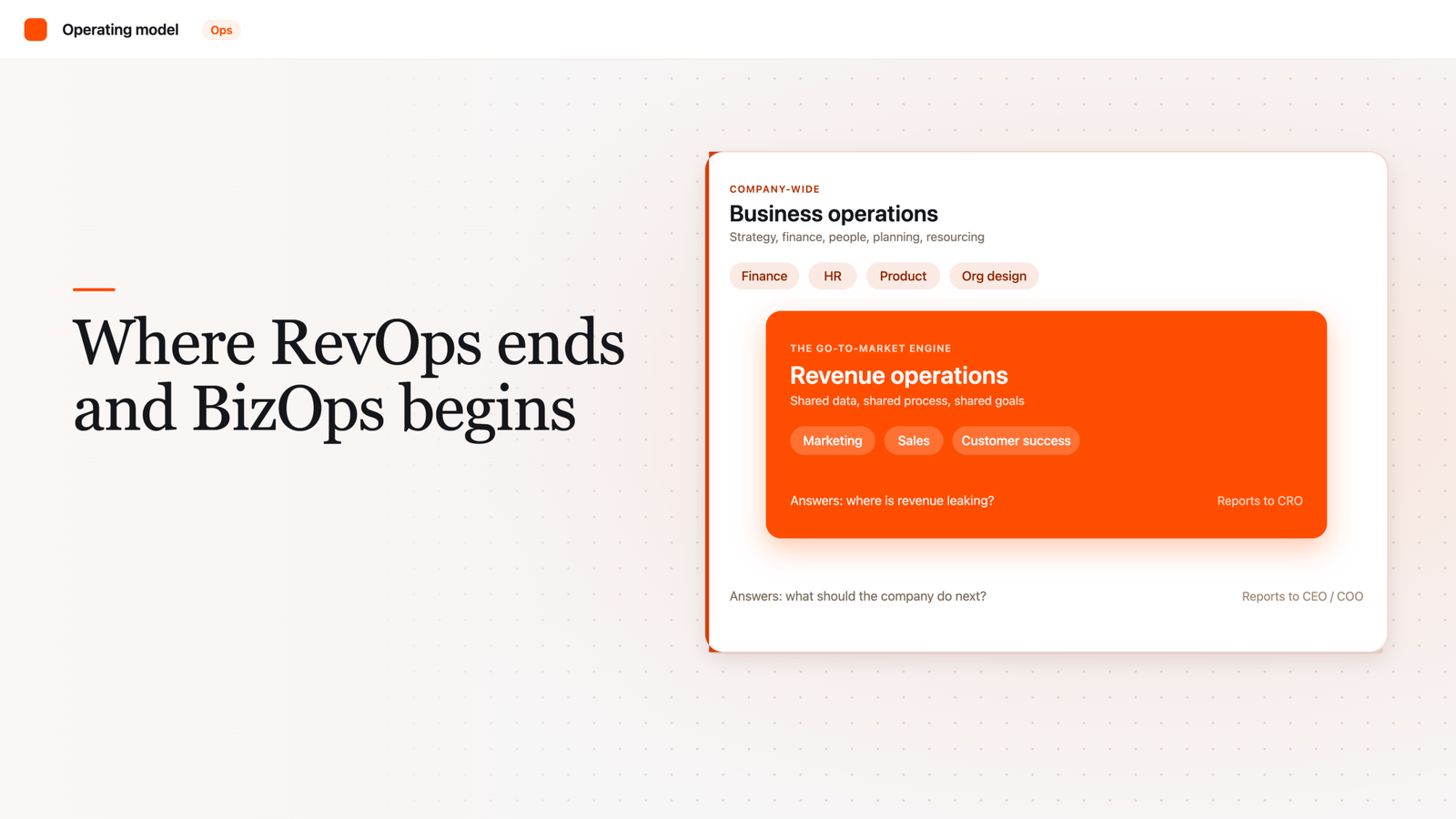
    RevOps (Revenue Operations) manages the systems, data, and processes behind your sales, marketing, and customer success teams so they work as one revenue engine. Business Operations (BizOps) is broader: it covers strategy, finance, HR, and execution across the entire company, not just the revenue-generating side.

    If you’ve ever sat in a leadership meeting and heard someone say “isn’t that basically the same as ops?” you’re not alone. These two functions get lumped together constantly, and honestly, the confusion is understandable. Both promise to fix inefficiency. Both show up when growth stalls. But they solve different problems, and mixing them up can lead you to hire the wrong person for the wrong job.

    What Is RevOps, Exactly?

    RevOps stands for Revenue Operations. It’s the function responsible for aligning your sales, marketing, and customer success teams around shared data, shared processes, and shared goals so revenue grows in a predictable way.

    Think of RevOps as the team that makes sure a lead moving from a marketing campaign to a sales rep to a customer success manager doesn’t fall through the cracks along the way. Revenue operations is a strategic framework that brings together all revenue-related activities in an organization, unifying marketing, sales, and customer success (and often finance) under one operational umbrella instead of letting each team run its own tools and metrics.

    RevOps typically doesn’t touch the day-to-day execution within each department. A RevOps team is usually a strategic function, not one focused on daily firefighting: it builds the systems and reports that let leadership see the whole revenue picture, then gets out of the way so sales, marketing, and CS can execute.

    Most companies don’t need a dedicated RevOps hire on day one. RevOps most commonly starts to take shape once a company hits somewhere around the $5 to $10 million ARR mark, when the handoffs between departments start creating real friction.

    What Is Business Operations (BizOps)?

    Business operations, often shortened to BizOps, is a much wider net. It covers the full set of activities a company uses to turn its people, money, and resources into value: everything from supply chain and HR to marketing execution and financial planning.

    Where RevOps lives inside the revenue engine, BizOps sits above it. A BizOps team acts as connective tissue between departments, translating company strategy into execution across finance, product, operations, and yes, sometimes revenue too. BizOps professionals are cross-functional by design, working alongside product, marketing, engineering, sales, and customer success teams to build the systems that keep the whole business running smoothly.

    The easiest way to picture it: BizOps owns the connective tissue of the entire company, while RevOps owns the GTM (go-to-market) engine specifically. One is company-wide. The other is revenue-specific.

    So What’s Actually Different?

    Here’s the plain version:

    • Scope. RevOps focuses only on sales, marketing, and customer success. Business consulting or BizOps looks at the entire organization, including finance, HR, and long-term structure.
    • Question they answer. BizOps tends to answer “what should the company do next?” (market entry, org design, resourcing). RevOps answers “how is revenue actually generated day to day, and where is it leaking?”
    • Where value shows up. RevOps work shows up in pipeline conversion, deal velocity, and churn. BizOps work shows up in strategic decisions, budget allocation, and cross-departmental planning.
    • Who they report to. RevOps typically reports to a CRO or VP of Sales. BizOps often reports to the CEO or COO directly.

    I’ll say the quiet part out loud: most of the confusion between these two roles isn’t really about job titles. It’s about founders hiring a generalist, calling them “ops,” and hoping they’ll absorb both jobs by osmosis. That works for a while at 10 people. It stops working fast once you’ve got separate sales, marketing, and CS teams that don’t talk to each other.

    Why This Distinction Actually Matters

    Getting this wrong costs you in a very specific way: you either hire a systems administrator and expect strategic thinking, or you hire a strategist and wonder why your CRM is still a mess.

    Organizations that align sales, marketing, and customer success under a coordinated RevOps model tend to see real operational payoff. One widely cited 2020 study found companies could see an increase of up to 20% in sales productivity, a 200% increase in digital marketing ROI, and a 30% reduction in go-to-market expenses after adopting RevOps. Analyst firm Gartner had also projected that by 2025, 75% of the highest-growth companies would run some form of RevOps model, a sign of how mainstream the function has become.

    BizOps has its own payoff, just at a different altitude. Because it sits closer to company-wide strategy, its wins tend to show up in things like faster board reporting, cleaner financial planning, and fewer instances of departments (like Finance and Sales) disagreeing on basic numbers like revenue recognition.

    A Quick Checklist: Which One Do You Actually Need?

    1. Are your growing pains specific to sales, marketing, and customer handoffs? That’s a RevOps problem.
    2. Are they showing up company-wide, like hiring outpacing onboarding or finance and sales disagreeing on numbers? That points to BizOps.
    3. Are you under roughly $5M ARR? Most founders should own operational thinking themselves before hiring either role.
    4. Are you between $5M and $10M ARR with a clear GTM structure but messy handoffs? This is usually the right window to hire dedicated RevOps.
    5. Are you past Series B with a functioning GTM engine but a fraying broader org? That’s typically when BizOps becomes worth building out separately.

    Pro tip: if you’re not sure which one you need, look at where the complaints are coming from. If it’s reps complaining about lead handoffs and dashboards that don’t match, that’s RevOps. If it’s your CFO and your head of sales arguing about whose numbers are right, that’s a BizOps conversation.

    Can One Person Do Both?

    At an early-stage company, yes, and it’s often the most practical path. A RevOps leader who has already mastered cross-functional alignment and systems thinking has a lot of the exact skill set BizOps needs, just applied to a wider canvas. The two disciplines share the same underlying instinct: replace gut-feel decisions with data. Don’t expect that to scale forever, though. Once you’re managing separate GTM and company-wide operating rhythms, splitting the roles usually pays for itself.

    FAQ

    Is RevOps a type of business operations?
    You could think of it that way. RevOps is a specialized, narrower slice of business operations that focuses only on the revenue-generating side of the company: sales, marketing, and customer success.

    Do small startups need both RevOps and BizOps?
    Probably not yet. Most early-stage founders are better off owning operational thinking themselves and adding a dedicated RevOps hire around the $5 to $10 million ARR range, then considering BizOps later as the whole org grows more complex.

    Does RevOps replace sales operations?
    Not exactly. Sales operations supports the sales team specifically with things like territory mapping and forecasting, while RevOps sits above sales ops, marketing ops, and customer success ops, unifying all three into one coordinated function.

    What titles report into RevOps vs BizOps?
    RevOps usually reports to a Chief Revenue Officer or VP of Sales. BizOps tends to report to the CEO or COO, since it operates across the whole company rather than just the revenue side.

    Which one should I hire first?
    If your pain is specifically in how leads move between marketing, sales, and customer success, start with RevOps. If your pain is broader (finance, hiring, cross-department planning), you’re probably looking for a BizOps hire instead.


  • What Is Product-Led Growth (PLG)? A Beginner’s Guide

    What Is Product-Led Growth (PLG)? A Beginner’s Guide

    Product-led growth (PLG) is a go-to-market strategy where your product itself, not a salesperson or an ad campaign, does the work of getting people to try, adopt, and pay for what you sell. Users experience value firsthand, often through a free trial or freemium version, before anyone in sales ever talks to them.

    If you’ve ever signed up for a tool, poked around for ten minutes, and started using it without a single call with a rep, you’ve already lived through PLG. It’s not a buzzword invented to sound fancy. It’s a real shift in how software companies grow, and it’s worth understanding even if you’re not planning to rebuild your GTM (go-to-market, meaning how a company brings a product to customers) motion around it tomorrow.

    What Is Product-Led Growth, Exactly?

    At its core, product-led growth is a business strategy that relies on product usage as the main way to acquire, engage, and retain customers, rather than leaning on a sales team to do the convincing. Instead of a rep walking a prospect through slides and a demo, the prospect just opens the product and figures out the value themselves.

    The term didn’t come out of nowhere. It was originally coined in 2016 by Blake Bartlett at OpenView, a venture capital firm, although the underlying tactics had already been floating around software companies before that. Companies were experimenting with freemium models (a free, limited version of the product) and self-guided product tours to grow while staying profitable, which used to be seen as a tradeoff you couldn’t avoid.

    Here’s the plain version: instead of hiring more salespeople to close more deals, you invest in making the product so good that it sells itself, or at least does most of the early legwork.

    How Is PLG Different From Sales-Led Growth?

    Sales-led growth (SLG) is the model most people picture when they think of enterprise software: a rep reaches out, books a demo, negotiates a contract, and eventually closes a deal. This approach tends to work well for complex products that need customization, hands-on onboarding, or in-depth explanation, which is part of why companies like Salesforce and Oracle still lean heavily on it.

    PLG flips that. Customers can purchase solutions and complete onboarding without ever coming into contact with a salesperson, because the product is built to explain and prove its own value. Companies like Slack, Shopify, and Zoom are frequently pointed to as strong examples of this in action.

    Neither model is objectively “better.” Honestly, most companies that claim to be pure PLG or pure sales-led are oversimplifying. A lot of successful B2B companies end up blending both: a self-serve product that lets small teams get started free, with a sales team that steps in once an account starts looking like a bigger opportunity.

    Why Does PLG Matter for B2B Founders?

    A few reasons founders and revenue leaders keep paying attention to this model:

    It can lower your cost of acquiring customers. PLG typically reduces sales friction and can lead to shorter sales cycles, lower customer acquisition costs, and higher revenue per employee, since the product is doing work that would otherwise require a headcount-heavy sales org.

    It scales without scaling headcount at the same rate. As a company grows, a 1:1 human-to-human support and sales model becomes harder to sustain, and PLG helps by automating onboarding, support, and parts of the sales motion so people can focus on more strategic work.

    The adoption numbers back this up too. According to one industry benchmarks report, almost 60% of surveyed SaaS companies had already implemented a product-led growth motion. And on the cost side, PLG companies report a median CAC (customer acquisition cost) payback period of about 15 months, compared to 29 months for sales-led companies, according to OpenView Partners research.

    That’s not a small gap. If you’re spending money to acquire customers, cutting your payback period nearly in half is the kind of thing that changes your whole financial picture.

    What Does PLG Actually Look Like Day to Day?

    It’s easier to picture with real examples. Companies such as Atlassian, Calendly, and Pinterest have used PLG to drive ongoing growth and customer loyalty, largely by getting users to a meaningful “aha moment” fast, without a sales conversation getting in the way.

    A simple example: someone signs up for a free trial of a project management tool on a Tuesday afternoon, invites two coworkers by Wednesday, and by the following week their whole team is using it daily. Nobody from sales called them. The product convinced them, and then their own usage convinced their teammates.

    How Do You Know If PLG Might Be Right for You?

    Before you decide PLG is (or isn’t) for your company, run through this quick checklist:

    1. Can a new user get real value from your product within minutes, without training? If it takes a two-hour onboarding call just to see the point, PLG will be an uphill climb.
    2. Is your product simple enough to try without heavy customization or implementation work?
    3. Can you offer a free trial or freemium tier without giving away your entire business model?
    4. Do your product, marketing, and support teams talk to each other regularly, or do they operate in silos? PLG needs cross-functional alignment to work.
    5. Are you set up to track in-product usage data, not just website visits and form fills?

    Pro tip: don’t try to flip a switch from fully sales-led to fully product-led overnight. Start by adding a free trial or limited free tier to one product line, watch how people actually use it, and build your sales process around what the data tells you, not the other way around.

    What Is a PQL, and Why Does It Come Up in PLG Conversations?

    Once you’re running a PLG motion, you’ll start hearing the term PQL, or product qualified lead. A product qualified lead is a user whose in-product behavior signals they’re ready to become a paying customer, as opposed to someone who just downloaded a whitepaper or filled out a form.

    FAQ

    Is product-led growth only for SaaS companies?
    Most of the well-known examples are SaaS, since software makes it easy to offer free trials and track usage data. But the underlying idea (let the product prove its value before you ask for money) can apply more broadly, it’s just harder to pull off outside software.

    Does PLG mean I don’t need a sales team?
    No. PLG is not a substitute for human support and sales, it’s a complement to it. Most companies running PLG still have a sales team, they just focus that team on the accounts and moments where a human conversation actually adds value.

    What’s the biggest mistake companies make when trying PLG?
    Treating it as a marketing tactic instead of a company-wide strategy. If your product, support, and sales teams aren’t aligned on what a good user experience looks like, a free trial alone won’t save you.

    How long does it take to see results from a PLG motion?
    There’s no universal timeline, and honestly anyone who gives you an exact number is guessing. It depends on how fast users reach real value in your product and how quickly your team can turn usage data into a working PQL definition.

    Can a company be both sales-led and product-led?
    Yes, and many successful B2B companies are. A self-serve free tier paired with a sales team for larger accounts is a common and practical setup.


  • RevOps vs. CRO: How the Roles Actually Relate

    RevOps vs. CRO: How the Roles Actually Relate

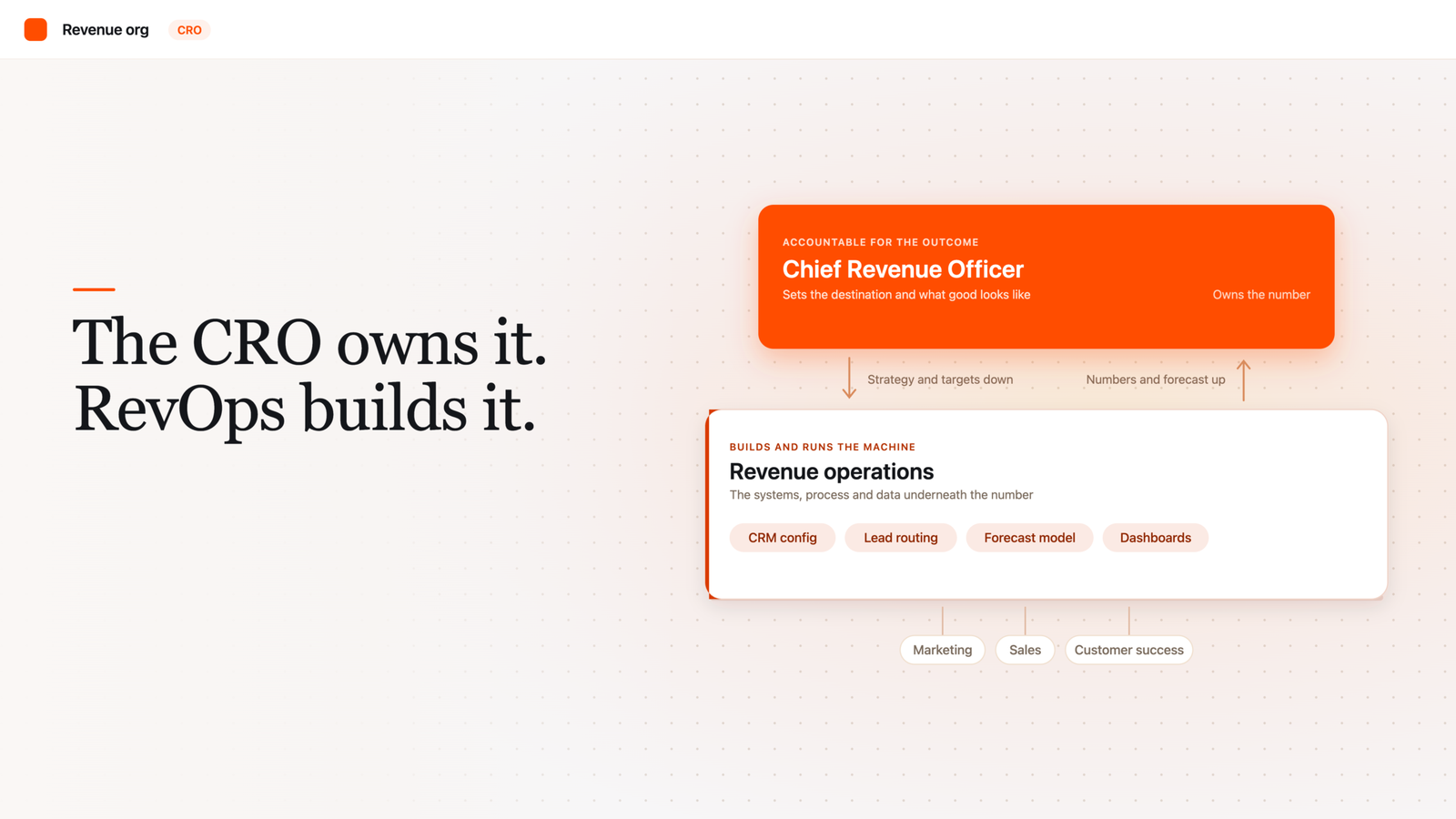
    RevOps is a function that aligns your sales, marketing, and customer success teams around shared processes, data, and tools. A CRO (Chief Revenue Officer) is the executive who owns revenue outcomes across those same teams. RevOps is the system; the CRO is the person accountable for what that system produces.

    If you’re a founder or early revenue leader, you’ve probably heard both terms thrown around in the same breath, sometimes even as if they’re interchangeable. They’re not. Mixing them up can lead you to hire the wrong person, build the wrong reporting line, or expect one role to do a job it was never designed for.

    What Is RevOps, Exactly?

    Revenue Operations (RevOps) is the function responsible for connecting the systems, processes, and data behind your sales, marketing, and customer success teams so they work off the same playbook instead of three different ones. If you want the fuller picture of what this function covers day to day, our beginner’s guide to RevOps walks through it from the ground up.

    RevOps people live in the weeds: CRM configuration, lead routing, forecasting models, reporting dashboards. They’re the ones who notice when marketing counts a “qualified lead” differently than sales does, and they fix it.

    What Is a Chief Revenue Officer (CRO)?

    A Chief Revenue Officer (CRO) is a C-suite executive responsible for all revenue-generating functions in a company, typically sales, marketing, and customer success. Salesforce describes the CRO as responsible for every process that generates revenue in an organization, connecting functions that range from marketing and sales to customer success, pricing, and revenue operations itself.

    The CRO title showed up mostly in tech and SaaS companies, originally as a way to unify departments that used to operate in silos. That’s a useful thing to know, because it tells you the role was invented to solve a coordination problem, not just to add another executive seat.

    A CRO isn’t the same as a VP of Sales, even though the two roles sound similar on paper. A VP of Sales is focused purely on sales performance, while a CRO’s mandate stretches across marketing, customer success, and pricing decisions too. Some companies also use a Chief Sales Officer (CSO) title, but that role focuses specifically on the sales function and closing revenue, while a CRO’s broader mandate includes marketing, customer success, and revenue operations on top of sales.

    So How Do RevOps and the CRO Actually Relate?

    Here’s the simplest way to think about it: RevOps builds and runs the machine. The CRO is accountable for what the machine produces.

    In a lot of organizations, RevOps reports directly into the CRO. Having RevOps report to the CRO is one of the most common structures in the industry, and the Head or VP of RevOps often ends up functioning as the CRO’s right hand, translating strategy into the systems and processes that make it real. That’s not a coincidence. A CRO needs oversight across every revenue function, and RevOps is the operational layer that makes that oversight possible instead of just aspirational.

    Think of it this way: the CRO sets the destination and decides what “good” looks like for growth. RevOps builds the roads, checks the fuel gauges, and flags when a wheel is about to fall off. Neither one works well without the other, but they’re clearly not the same job.

    That said, this reporting relationship isn’t universal, and it depends heavily on company size and stage. We cover the different ways RevOps can be structured, including when it should sit under a CRO versus a CEO or COO, in our post on RevOps org structure models.

    Why Do Companies Confuse the Two?

    Honestly, most of the confusion comes from job postings, not from the roles themselves. RevOps jobs sometimes get listed under titles like Chief Revenue Officer or VP of Revenue Operations, which blurs the line for anyone browsing job boards trying to understand the field.

    Add to that the fact that a Director of RevOps and a CRO both care about “revenue,” and it’s easy to see why people flatten the two into one idea. But their approaches differ: a CRO focuses on revenue strategy, go-to-market planning, and directly leading revenue-generating teams, while a Director of RevOps focuses on the operational infrastructure, the processes, systems, data, and analytics, that let those teams actually execute. In most companies, the Director of RevOps reports up to the CRO or an equivalent executive, not the other way around.

    Do You Need a CRO, a RevOps Hire, or Both?

    Most early-stage companies don’t need a CRO. They need someone fixing the operational mess first. Here’s a rough way to think through it:

    1. You’re pre-Series B and sales/marketing keep tripping over each other. Start with a RevOps hire, not an executive. You need someone untangling CRM data and lead handoffs before you need someone setting revenue strategy at the board level.
    2. You already have a functioning RevOps layer but no single owner of revenue outcomes. This is often the point where a CRO makes sense, since the operational foundation (data, systems, forecast rhythm) is already there for an executive to actually use.
    3. Your sales, marketing, and customer success leaders don’t trust each other’s numbers. That’s a RevOps problem first. A CRO without reliable data underneath them is just another executive guessing.
    4. You’re scaling past the point where the CEO can manage revenue alignment personally. This is a classic trigger for adding a CRO, especially once ARR and headcount both cross a threshold where cross-functional friction becomes the actual bottleneck, not lack of demand.

    Pro tip: if you’re not sure whether your company has hit the tipping point for a dedicated operational hire, our post on signs your company needs a dedicated RevOps hire has a more detailed checklist.

    One more thing worth saying plainly: a CRO hired into a company with no RevOps foundation is set up to fail before they even start. That’s part of why CRO tenure tends to run short. A recent analysis placed average CRO tenure somewhere between 17 and 25 months, and other industry commentary points to an even blunter figure, an average CRO lifespan of around 18 months, compared to roughly 7 years for CEOs and 5 for CFOs. A lot of that comes down to expectations versus support: CFOs inherit established financial systems, but CROs are often handed a bloated, inefficient revenue engine and told to make it work, without a proven playbook to lean on.

    That’s not a knock on the people taking these jobs. It’s a structural problem, and RevOps is usually the fix.

    FAQ

    Does RevOps replace the need for a CRO?
    No. RevOps handles the operational layer (systems, data, process), while a CRO owns the strategic accountability for revenue outcomes across teams. Most growing companies eventually need both, just not necessarily at the same time.

    Who does RevOps report to if there’s no CRO yet?
    It varies by company. RevOps commonly reports to a CEO, COO, or CRO depending on stage and structure, and our post on RevOps org structure breaks down when each model makes sense.

    Is a CRO the same as a VP of Sales with a bigger title?
    Not really. A VP of Sales is focused only on sales, while a CRO’s mandate spans marketing, customer success, and pricing decisions as well. Some companies use “CRO” loosely, but the intended scope is meaningfully broader.

    Can one person be both the RevOps lead and the CRO?
    In very early-stage companies, yes, it’s common for one person to wear both hats temporarily. As the company scales, though, the operational workload and the strategic workload usually get too big for one seat.

    Why do so many CROs leave within two years?
    A big part of it is inheriting broken systems with no existing playbook to fix them, which is a very different situation than a CFO or CEO typically walks into. Building out RevOps before or alongside a CRO hire is one of the more practical ways to avoid that trap.

  • HubSpot Free vs. Starter vs. Professional: Which Tier?

    HubSpot Free vs. Starter vs. Professional: Which Tier?

    HubSpot Free vs. Starter vs. Professional: Which Tier Do You Actually Need?

    If you’ve spent any time on HubSpot’s pricing page, you know the feeling. Three tiers, a handful of “Hubs,” per-seat math, and a nagging suspicion that you’re either about to overpay or about to get stuck two months in.

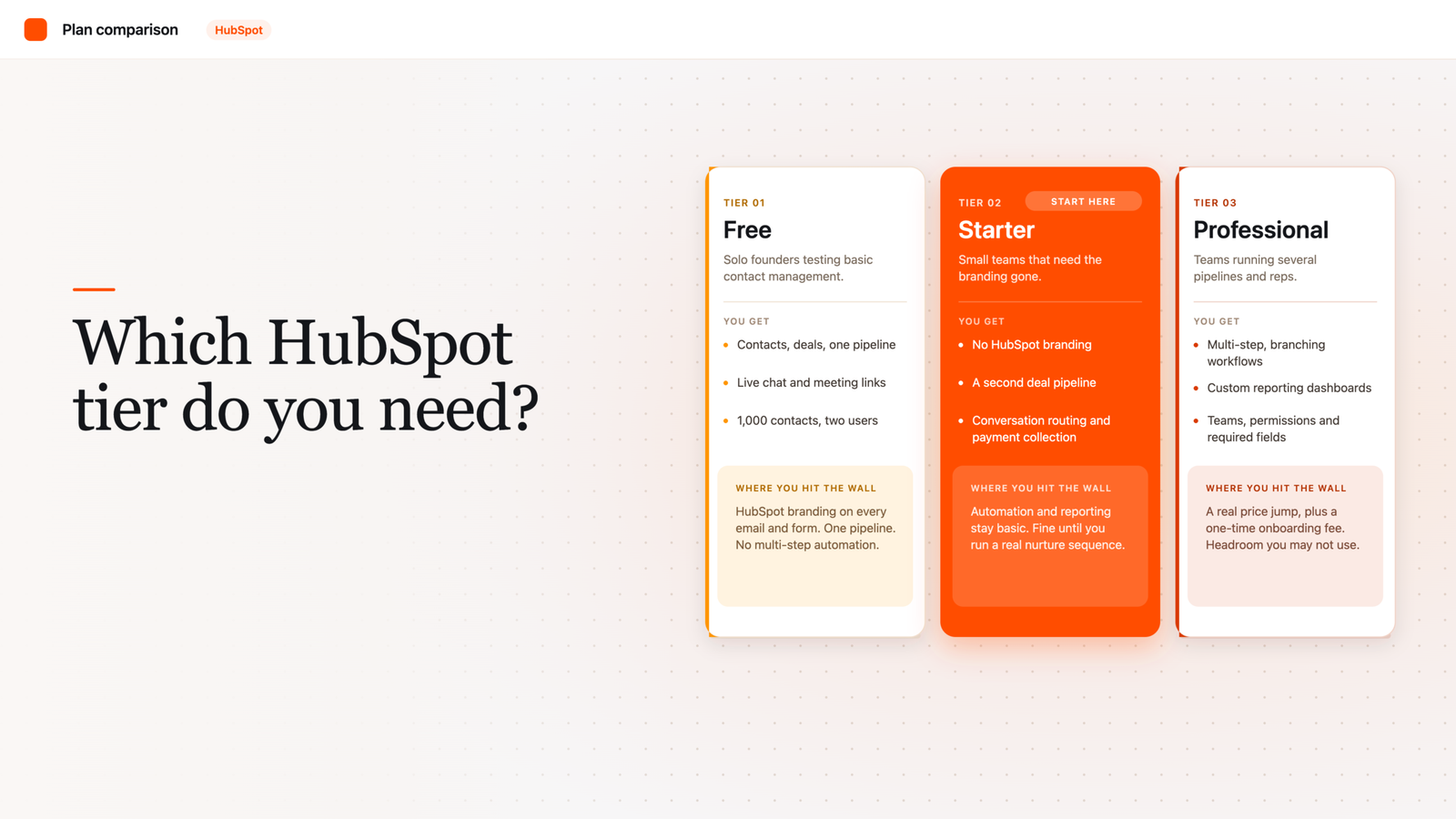
    HubSpot Free works for solo founders testing basic contact management. Starter (around $20/seat/month) fits small teams that need automation basics and no branding. Professional ($100+/seat or $890/month for Marketing Hub) suits teams that need multi-step automation, custom reporting, and multiple pipelines.

    That’s the short version. But the real answer depends on where your team actually gets stuck day to day, not on some abstract “company size” bracket. Let’s walk through what each tier really includes, so you’re not guessing.

    What’s actually different between the three tiers?

    A “tier” in HubSpot just means a package of features tied to a price point. You can mix tiers across different Hubs (Marketing, Sales, Service, Content, Operations), which is part of why the pricing page feels confusing.

    At a high level: Free gets you in the door with core CRM functionality. HubSpot’s free CRM includes up to two users and 1,000 contacts, with no limits on how long you can use it and no expiration date. Starter removes HubSpot’s branding from your emails and forms and adds early automation. Professional is where real workflow automation, custom reporting, and team management features live.

    What do you actually get with HubSpot Free?

    Free is a genuinely usable CRM (a system for tracking your contacts, companies, and deals in one place), not just a stripped-down demo. You get contact and deal records, basic pipeline tracking, live chat, and meeting scheduling at no cost.

    But it has real ceilings. You’re capped at two users and 1,000 contacts. You only get one deal pipeline (the stages a deal moves through, like “Prospect” to “Closed Won”), so if you run more than one sales process, say new business versus renewals, you’re already boxed in. There’s also no multi-step workflow automation on Free; you can trigger a single follow-up email off a form fill, but you can’t build a branching sequence.

    Every outward-facing piece of Free, your emails, forms, chat widget, and meeting links, carries HubSpot’s branding. For a two-person team testing the waters, that’s a non-issue. For a team fielding client questions about “what CRM are you using,” it starts to feel unprofessional.

    What does Starter add?

    Starter is priced around $20 per seat per month and is really the first “real” paid tier. It removes HubSpot’s branding and unlocks a second deal pipeline, so you can finally separate two different sales motions.

    On the sales side specifically, Starter adds conversation routing (automatically directing incoming chats or emails to the right rep), built-in payment collection, unlimited email notifications, and a set amount of calling minutes per account each month. It also introduces custom properties and task queues, small but meaningful upgrades if your team has outgrown default fields.

    Honestly, Starter is the tier most early-stage teams should be evaluating first, not Free and not Professional. It’s cheap enough to try without a real budget conversation, and it removes the two limitations (branding and single pipeline) that trip people up fastest.

    What does Professional unlock?

    This is where the price jump gets real. Sales Hub Professional runs about $100 per seat per month, while Marketing Hub Professional starts closer to $890 per month. Professional tiers also typically carry a one-time onboarding fee, roughly $1,500 for Professional plans, separate from your monthly subscription.

    What do you actually get for that? Multiple deal pipelines with more flexibility, required fields (so reps can’t skip critical data entry), Teams (for organizing larger sales orgs with permissions), advanced views, and significantly more calling minutes per rep each month. Professional also connects to Salesforce if you’re running a hybrid stack, and it’s the tier where custom reporting and true multi-step automation live.

    Here’s the honest take: most teams don’t actually need Professional because of one flashy feature. They need it because Starter’s automation and reporting genuinely can’t support a sales or marketing motion with more than a couple of pipelines and reps. If that’s not you yet, you’re paying for headroom you won’t use for a year.

    A quick self-check: which tier do you need?

    Run through these questions before you commit to a plan:

    1. How many people need CRM access today? More than two, and Free is already off the table.
    2. Do you run more than one sales or marketing process? If yes, you need at least Starter’s second pipeline.
    3. Does your team need multi-step automation (like a five-email nurture sequence triggered by behavior, not just one follow-up)? That’s a Professional-level need.
    4. Do you need custom reporting dashboards for leadership, not just default views? Professional territory.
    5. Is branding on your customer-facing emails and forms a dealbreaker? If yes, skip Free entirely.
    6. Can you absorb a one-time onboarding fee on top of monthly seats? If not, stay on Starter until you can.

    Pro tip: don’t buy Professional across every Hub at once just because you need it in one. Most teams only need Professional-level automation in Sales or Marketing, not both, at least in year one. Buying it everywhere just because the bundle looks tidy is how budgets balloon.

    FAQ

    Is HubSpot’s free CRM actually free forever, or is it a trial?
    It’s genuinely free forever, no expiration date and no credit card required for the core CRM. The catch is the two-user and 1,000-contact caps, not a hidden time limit.

    Can I mix tiers across different HubSpot Hubs?
    Yes. You could run Sales Hub Professional while staying on Marketing Hub Starter, and plenty of teams do exactly that to control cost.

    Does upgrading from Starter to Professional include onboarding help?
    Professional plans typically carry a one-time onboarding fee separate from your monthly subscription. That fee covers setup support, but it’s mandatory in most cases, not optional white-glove service.

    What’s the single biggest reason teams outgrow Starter?
    Automation. Starter gives you light, single-step automation, but the moment you need branching workflows based on contact behavior, you’re looking at Professional.

    Should a two-person startup ever start on Professional?
    Rarely. If you’re testing a motion, not scaling one, Free or Starter almost always makes more sense until your process is proven.


  • What Is a RevOps Tech Stack? Core Tools Explained

    What Is a RevOps Tech Stack? Core Tools Explained

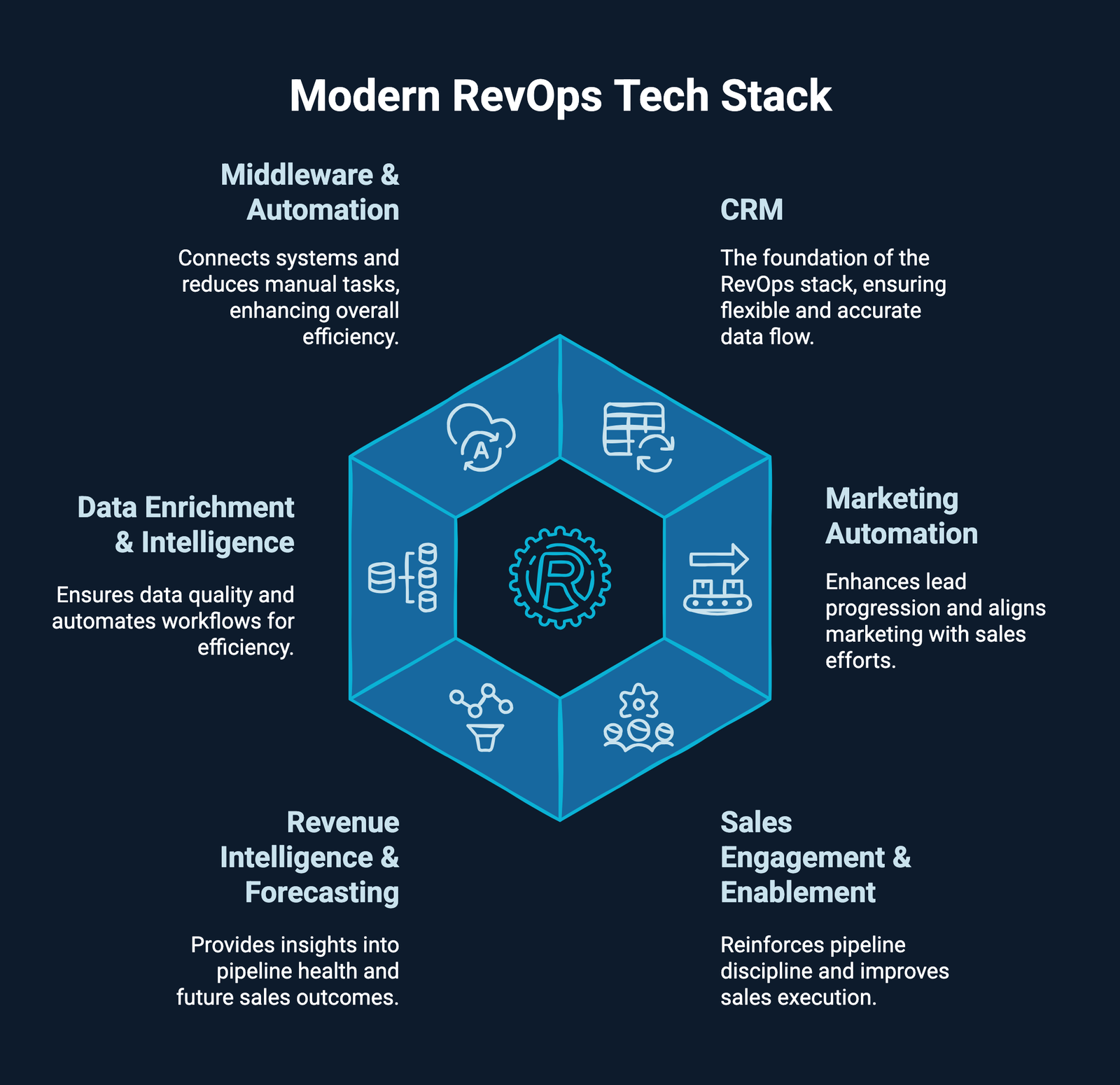
    A RevOps tech stack is the set of connected software tools that let your sales, marketing, and customer success teams share the same data and work off the same playbook. At minimum, it includes a CRM, marketing automation, sales enablement, and reporting tools, all wired together so information moves automatically instead of living in separate spreadsheets.

    If you’ve ever had a deal stall because sales didn’t know a prospect had already talked to support, you’ve felt what happens without one. Tools that don’t talk to each other create blind spots, and blind spots cost you revenue.

    Let’s get into what actually makes up a RevOps tech stack, why it matters, and how to start building or fixing yours.

    What Is RevOps, Quickly?

    Before we talk tools, a quick definition. Revenue operations (RevOps) is a business function that aligns sales, marketing, and customer success teams around shared data, processes, and goals so the whole revenue engine works as one system instead of three disconnected departments.

    RevOps isn’t a piece of software. It’s a way of running the business. The tech stack is just the infrastructure that makes that alignment possible day to day.

    What Is a RevOps Tech Stack?

    A RevOps tech stack is the collection of software tools and technologies that let revenue teams (sales, marketing, and customer success) work together instead of in silos. The goal isn’t to buy more software. It’s to make sure the software you already have shares data cleanly, so nobody’s working off stale or conflicting numbers.

    Most stacks lean on native integrations (built-in connections between two tools) and custom workflow automation to keep everything synced. Think of it less as a shopping list and more as plumbing: every pipe needs to connect, or the water backs up somewhere.

    Why Does a RevOps Tech Stack Matter?

    Here’s the problem most teams run into: tools that don’t sync create broken handoffs. When systems don’t talk, deals slip through the cracks between marketing, sales, and customer success. That leads directly to forecasting gaps, because disconnected data means unreliable pipeline projections and missed revenue targets.

    There’s also a hidden cost. Manual workarounds and duplicate records quietly cost you deals you should have won. Nobody notices this on a dashboard. It just shows up as a slower quarter.

    On the flip side, a well-connected stack turns raw activity data into decisions you can act on, instead of just numbers you report on. Gartner had projected that by 2025, 75% of the highest-growth companies globally would be running on some form of RevOps model, which tells you this isn’t a niche practice anymore. It’s becoming the default for companies that plan to scale.

    What Are the Core Tool Categories in a RevOps Stack?

    You don’t need every category from day one. But here’s what shows up in most functioning stacks, from foundation to nice-to-have.

    1. CRM (Customer Relationship Management)

    Your CRM is the central hub where customer and prospect data lives: contact info, deal stages, past conversations, purchase history. Salesforce and HubSpot are the two most common choices. Everything else in your stack should ultimately feed data into, or pull data from, this system.

    2. Marketing Automation

    These tools handle attracting, nurturing, and converting leads while keeping marketing and sales working from the same lead definitions. Without this connected to your CRM, marketing generates leads sales never sees clearly, or worse, leads get followed up twice by two different reps.

    3. Sales Enablement

    This covers everything that helps reps sell more effectively: sales content management, onboarding and training materials, automated outreach sequences, and battlecards for handling objections. It’s the layer between “we have leads” and “we closed the deal.”

    4. Revenue Intelligence and Forecasting

    These tools analyze deal activity, call data, and pipeline trends to flag risk and predict what will actually close. This is a newer category, but it’s quickly becoming a must-have alongside CRM and lead routing tools.

    5. CPQ (Configure, Price, Quote) and Billing

    CPQ software streamlines quoting and approvals, which matters most once your pricing or packaging gets complicated. Billing and revenue recognition tools then automate invoicing and subscription management so finance and go-to-market teams work from the same numbers. Don’t rush into CPQ before your pricing model is settled, it’ll just lock in confusion.

    6. Customer Success Platform

    This tracks health scores, usage data, and renewal risk after the deal closes. RevOps stacks increasingly stretch across the full customer lifecycle now, not just the sales funnel, covering everything from first anonymous website visit through renewal and expansion.

    7. Analytics and Reporting

    One of the core jobs of RevOps is giving leadership a single, trustworthy view of revenue performance. That requires a centralized reporting layer that pulls data across every tool in the stack instead of forcing someone to stitch together three exports in a spreadsheet every Friday.

    8. Integration and Data Quality Tools

    Middleware tools like Workato or Zapier handle the connections between systems that don’t integrate natively. This is the unglamorous layer, but it’s often the difference between a stack that works and one that just looks good in a slide deck. Data quality determines whether your stack delivers real insight or just amplifies bad data faster.

    How Do You Actually Build a RevOps Stack?

    You don’t build this in one sprint, and honestly, most teams shouldn’t try. Here’s a practical order of operations:

    1. Audit what you already have. Most B2B teams already own a CRM and probably more tools than they realize. Map what exists before buying anything new.
    2. Define your core metrics first. Pick a small number of KPIs, like customer acquisition cost, sales cycle length, or customer lifetime value, before you evaluate a single new tool.
    3. Fix the CRM before adding layers. If your CRM data is messy or your sales process isn’t reflected accurately in it, no new tool will fix that. Automation on top of a broken process just breaks things faster.
    4. Add tools by outcome, not by category checklist. Only add a layer (CPQ, revenue intelligence, CS platform) when it solves a specific, named problem you can point to.
    5. Build for integration, not isolation. Favor tools with strong native integrations so you’re not stuck building brittle custom connections for everything.
    6. Review and cut regularly. Audit your tech spend on a schedule and eliminate redundant or underused tools, especially ones with overlapping functionality.

    Pro tip: before you buy a single new tool, write down the exact workflow that’s broken today (“leads sit in marketing’s tool for 3 days before sales sees them”) and work backward from that. Buying tools to solve a vague feeling of disorganization almost never works.

    Honestly, most “RevOps tech stack” problems we see aren’t a tooling gap at all, they’re a process and ownership gap that a new tool gets blamed for. Adding software on top of an undefined sales process just automates the confusion faster.

    Quick Checklist: Is Your Stack RevOps-Ready?

    • CRM is the single source of truth, not one of three
    • Marketing and sales use the same lead definitions and stages
    • Deal, usage, and support data are visible to all three teams
    • You can build a full-funnel report without exporting to a spreadsheet
    • Every tool in the stack has a clear owner
    • You’ve audited tool spend in the last two quarters

    If you’re missing three or more of these, that’s a sign your stack is growing faster than your operations discipline.

    FAQ

    Do I need a dedicated RevOps tool, or can I use my existing CRM?
    Most B2B teams already have the core pieces (a CRM, some marketing tool, maybe a reporting dashboard). The real work usually isn’t buying new software, it’s configuring and connecting what you’ve already got.

    How many tools should be in a RevOps stack?
    There’s no fixed number. The right size depends on your revenue complexity: a small B2B team might run fine on a CRM plus one or two connected tools, while an enterprise org juggling multiple pricing tiers will need CPQ, contract management, and revenue intelligence layered in too.

    What’s the difference between a RevOps stack and a sales stack?
    A sales stack only covers tools sales reps use to close deals. A RevOps stack spans marketing, sales, and customer success, plus the integration and reporting layer that connects all three.

    Is HubSpot or Salesforce better for a RevOps tech stack?
    Both serve as a strong CRM foundation. HubSpot tends to appeal to teams that want built-in automation and reporting without heavy engineering, while Salesforce is often chosen for its depth of customization on complex, enterprise-level requirements.

    How much should a RevOps tech stack cost?
    There’s no universal benchmark, since it scales with headcount and deal complexity. What matters more than the total spend is whether you’re tracking ROI against clear KPIs like CAC, sales cycle length, or customer lifetime value after every new tool addition.

    Where to Go From Here

    A RevOps tech stack isn’t about owning the most tools. It’s about making sure the tools you have actually talk to each other and reflect how revenue really flows through your business. Get the foundation (a clean CRM and clear process) right before you stack anything else on top.


  • What Is CRM Data Enrichment? A Plain-English Guide

    What Is CRM Data Enrichment? A Plain-English Guide

    What Is CRM Data Enrichment and Why It Matters for Sales Teams

    Ever pulled up a lead in your CRM (customer relationship management system, the database where you track contacts, companies, and deals) and found… almost nothing? No job title, no company size, an email that bounces. Your rep ends up doing detective work on LinkedIn before they even write a cold email.

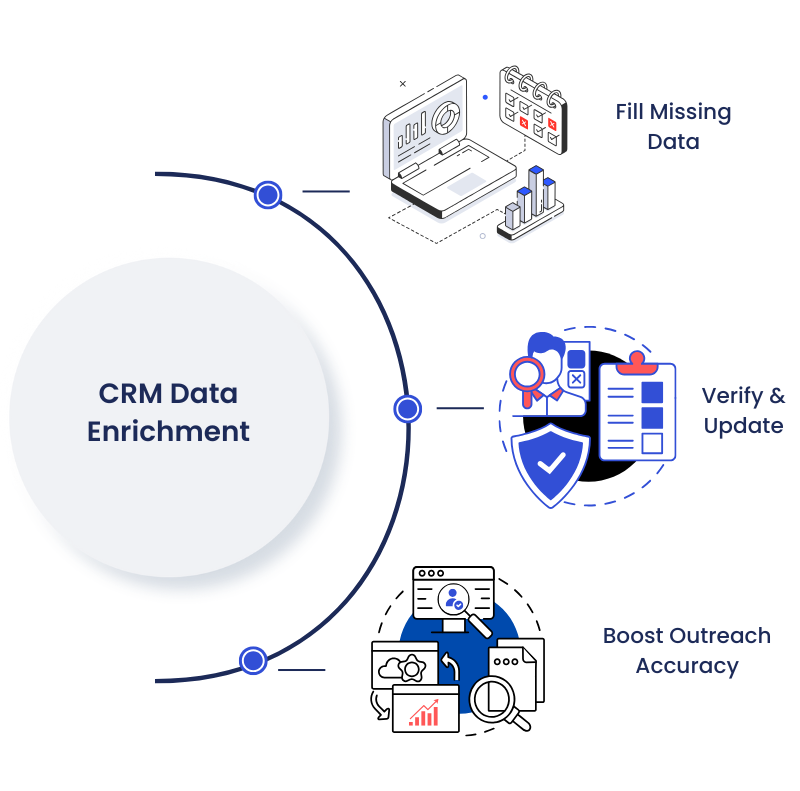
    CRM data enrichment is the process of automatically adding verified details, like job titles, company size, industry, and working contact info, to the records already sitting in your CRM. Instead of reps manually googling prospects, enrichment tools pull that missing information in from outside data sources and fill the gaps for you.

    That’s the short version. Here’s what it actually looks like in practice, why your CRM needs it more than you’d think, and how to get started without overcomplicating it.

    What Is CRM Data Enrichment, Exactly?

    At its core, CRM data enrichment connects your CRM to outside data sources through APIs (application programming interfaces, which is just a technical way for two systems to share information automatically) so new details can flow into your existing records without anyone typing them in by hand.

    Say a lead fills out a form on your website with just their name and work email. On its own, that record tells you almost nothing about whether they’re worth chasing. An enrichment tool can take that email, match it against outside data, and fill in the person’s job title, seniority, company size, industry, and sometimes even signals about what they’re actively researching.

    It’s worth separating enrichment from a couple of terms people use interchangeably. Data cleansing removes errors and duplicates from records you already have. Data enrichment adds brand-new fields you didn’t have before, like firmographic details (facts about a company, such as headcount or revenue) or technographic details (what software a company already uses). Both matter, but they solve different problems.

    Why Does Your CRM Data Fall Apart So Fast?

    Honestly, this is the part most teams underestimate. You don’t have a data entry problem so much as a decay problem, and decay never stops.

    People change jobs. Companies get acquired. Phone numbers get reassigned. None of that requires anyone on your team to make a mistake, your data just gets less accurate the longer it sits untouched.

    According to Salesforce’s State of Sales research, 91% of CRM data is incomplete, and that number reflects a structural reality: even well-maintained databases accumulate gaps faster than manual upkeep can fix them. On top of that, research cited by HubSpot puts B2B data decay at roughly 22.5% a year, meaning close to a quarter of your contact database can go stale in twelve months without anyone touching it.

    The financial side isn’t small either. Research cited by ZoomInfo found that sales reps waste around 27% of their time dealing with bad data, and separate research found that 44% of companies lose more than 10% of their annual revenue to data decay. That’s not a rounding error on a spreadsheet. That’s reps chasing dead leads instead of live ones.

    How Does CRM Data Enrichment Actually Work?

    There are two broad ways teams handle it, and most growing companies start with one and graduate to the other.

    Manual enrichment means someone on your team searches LinkedIn for a missing job title or checks a company website for headcount, then types it into the CRM by hand. It works fine at a tiny scale. It falls apart the moment you have more than a handful of leads coming in per week.

    Automated enrichment connects your CRM to third-party data providers through integrations or APIs, so missing fields get filled in the moment a record is created or updated, often within seconds. This is what most people mean when they talk about “CRM data enrichment” as a category of tool.

    Enrichment itself isn’t one-size-fits-all. A few common types show up again and again:

    • Contact enrichment: fills in job title, seniority, direct phone, and verified email so reps know who they’re actually talking to.
    • Firmographic enrichment: adds company size, industry, revenue range, and location so you can tell if a lead fits your ideal customer profile (ICP, meaning the type of company most likely to buy from you and succeed as a customer).
    • Intent data enrichment: surfaces signals that a company is actively researching a solution like yours right now, so reps know which accounts to call first instead of guessing.

    Why Does This Matter for Sales Teams Specifically?

    A rep with a full, accurate profile can qualify a lead in seconds instead of minutes. A rep working off three fields and a guess can’t personalize outreach, can’t prioritize, and honestly can’t forecast their pipeline with any confidence either, because forecasts are only as good as the data feeding them.

    This is where I’d push back on how most teams frame the problem. It’s rarely “our reps aren’t researching enough.” It’s that you’re asking humans to manually do a job that’s genuinely better suited to automation, and then blaming pipeline numbers when the research doesn’t happen consistently.

    Pro tip: before you buy any enrichment tool, sit down and list your must-have fields versus your nice-to-haves. Job title, company size, and industry are usually must-haves for sales qualification. Social profiles and interests are nice-to-haves. Knowing the difference keeps you from paying for enrichment you’ll never actually use.

    A Simple Checklist to Get Started

    1. Define your goal. Are you trying to qualify leads faster, personalize outreach, or improve forecast accuracy? Pick one primary goal first.
    2. List your must-have fields. Job title, company size, and industry are common starting points for most B2B sales teams.
    3. Audit what you already have. Pull a sample of records and see how many are missing your must-have fields or contain data that looks outdated.
    4. Choose manual or automated enrichment. Manual works for small volumes; automated tools make sense once lead volume grows past what a person can keep up with.
    5. Schedule recurring audits. Enrichment isn’t a one-time fix. Set a cadence, monthly or quarterly, to catch new gaps before they pile up.

    FAQ: CRM Data Enrichment

    Is CRM data enrichment the same as data cleansing?
    No. Cleansing removes errors, duplicates, and outdated entries from data you already have. Enrichment adds new information you didn’t have before, like a missing job title or company size.

    How often does CRM data actually need enriching?
    Given that B2B data decays at roughly 22.5% a year according to HubSpot-cited research, most teams are better off enriching continuously or at least monthly rather than waiting for an annual cleanup.

    Do small sales teams need an enrichment tool, or can they enrich manually?
    At low lead volume, manual research (checking LinkedIn or a company site) can work fine. Once your team is handling more than a few dozen new leads a week, manual enrichment usually can’t keep pace.

    What’s the difference between enrichment and enhancement?
    Enrichment adds entirely new fields from external sources. Enhancement improves what you already have, standardizing formats or adding context to existing fields, without necessarily pulling in new data points.

    Does enrichment help with sales forecasting?
    Yes, indirectly. Forecasts are built on pipeline data, and if that data is incomplete or outdated, the forecast built on top of it will be too.

  • What Is Market Segmentation? A Beginner’s GTM Guide

    What Is Market Segmentation? A Beginner’s GTM Guide

    What Is Market Segmentation? (And Why Your GTM Strategy Needs It)

    Market segmentation is the process of dividing your total market into smaller groups of prospects who share similar traits, needs, or behaviors, so you can target each group with tailored messaging, pricing, and outreach instead of one generic pitch for everyone. For B2B teams, this usually means grouping companies by industry, size, or buying behavior rather than blasting the same message to every lead in your CRM.

    If you’ve ever sent the same cold email to a 5-person startup and a 5,000-person enterprise, you already know why this matters. One of them probably ignored it. Market segmentation is how you stop guessing and start building a go-to-market (GTM) strategy, meaning your overall plan for reaching and winning customers, around who your buyers actually are.

    This post breaks down what market segmentation means, the main ways to slice up a market, and why it’s one of the first things you should nail down before you build out sales playbooks or marketing campaigns.

    What Is Market Segmentation, Exactly?

    At its core, market segmentation is the process of breaking up a large market into smaller groups of customers with similar needs, traits, or ways of behaving. Instead of treating your entire addressable market as one big, undifferentiated blob, you split it into segments that respond similarly to the same offer, message, or price point.

    Knowing your segments helps you target your product, sales, and marketing efforts more precisely instead of spreading budget thin across everyone. It’s a simple idea, but most early-stage companies skip it because it feels like a “marketing thing” rather than a revenue thing. Honestly, that’s backwards. Segmentation shapes who your sales team calls, what your website says, and even what features your product team builds next.

    The Main Types of Market Segmentation

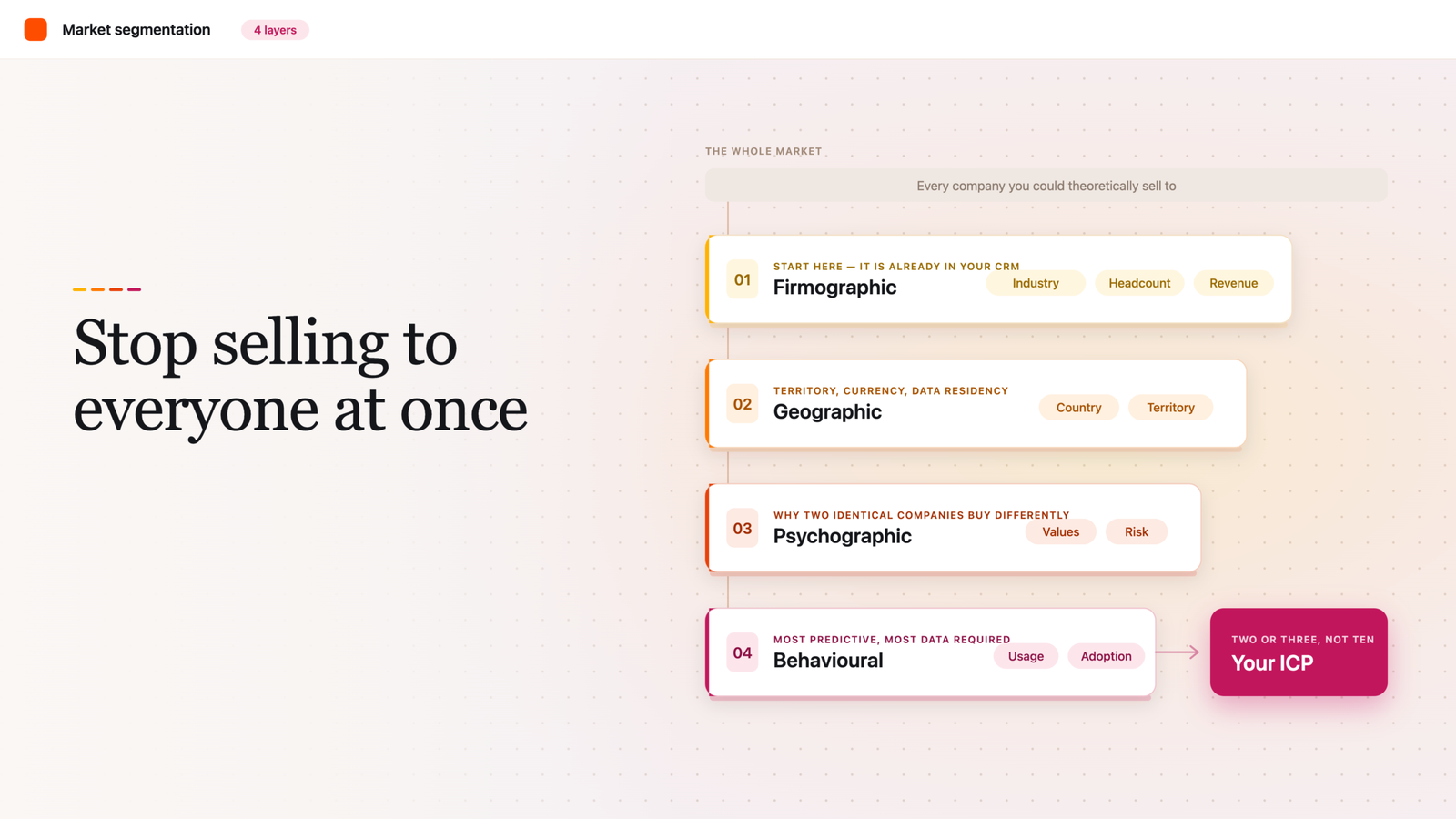
    Most frameworks point to four core ways to segment a market: demographic, geographic, psychographic, and behavioral. Each one looks at a different slice of who your buyer is or how they act.

    Demographic (or firmographic, for B2B). In consumer markets, this means age, income, or occupation. In B2B, you swap demographics for firmographics: grouping companies by traits such as industry, employee count, annual revenue, growth stage, or technology stack. This is usually the easiest segmentation to start with because the data (company size, industry code, revenue band) is often already sitting in your CRM.

    Geographic. This groups customers by where they’re located, since needs and interests often vary according to geographic location, climate, and region. For B2B, this might mean segmenting by country because of data residency laws, currency, or which sales rep owns the territory.

    Psychographic. This looks at attitudes, values, priorities, and how a buyer thinks about risk or innovation. It’s harder to measure than firmographics but often explains why two companies of the same size and industry buy completely differently.

    Behavioral. This groups people by what they actually do rather than who they are, looking at things like product usage, feature adoption, and the benefits customers seek. In B2B SaaS specifically, the most effective segmentation stacks these layers: firmographic first because it’s easy to identify, then technographic (what tools a prospect already uses), then behavioral, which is the most predictive but needs the most data to pull off well.

    Why Market Segmentation Matters for Your GTM Strategy

    Here’s the problem with skipping segmentation: your sales team ends up chasing everyone and closing almost no one efficiently. B2B firms have long treated segmentation as a cornerstone of good industrial marketing, and for good reason: success comes from identifying and serving the best-fit prospects for your offering, not everyone who fills out a form.

    The data backs this up at the GTM level too. Companies exceeding their revenue targets are 5.3 times more likely to have an advanced go-to-market strategy where the total addressable market is clearly defined and sales and marketing are aligned around it. Separately, companies with a clear GTM strategy have been shown to achieve roughly 30% higher revenue growth and 30% higher profitability than peers without one.

    Segmentation is also what makes account-based marketing (ABM), personalized outbound, and even basic lead scoring possible. Without defined segments, your “ideal customer profile” is really just a guess dressed up in a slide deck.

    How to Build a Basic Segmentation for Your GTM Plan

    You don’t need a data science team to get started. Here’s a simple sequence:

    1. Pull your firmographic data first. Export what you already have in your CRM: industry, employee count, revenue range, and location for existing customers and closed-lost deals.
    2. Layer in technographic and behavioral signals. Look at what tools your best customers already use and how they engage with your product or content before buying.
    3. Group companies into 2-3 high-impact segments. Resist the urge to create ten micro-segments. Focus on two or three segments instead of trying to cover every possible customer type, since more segments than your team can realistically act on just adds noise.
    4. Write one sentence per segment describing its core need. If you can’t summarize why this group buys in one sentence, the segment probably isn’t well-defined yet.
    5. Review it quarterly, rebuild it annually. Markets shift, your product evolves, and your customer base changes, so a segmentation model built 18 months ago may no longer reflect reality.

    Pro tip: don’t let sales and marketing build separate segmentation models. If your sales team’s territory logic and your marketing team’s audience segments don’t match, your messaging and your pipeline data will quietly drift apart, and nobody will notice until quota season.

    Market Segmentation vs. Ideal Customer Profile (ICP)

    People mix these up constantly. Segmentation is the broader map of all the meaningful groups in your market. Your ICP is the specific segment (or two) you’ve decided is most worth chasing right now, based on deal size, win rate, or retention. Think of segmentation as the full menu and your ICP as the dish you’re actually ordering.

    FAQ

    What’s the difference between market segmentation and market targeting?
    Segmentation is the analysis step: identifying the distinct groups in your market. Targeting is the decision step: choosing which of those groups you’ll actually pursue with dedicated sales and marketing effort.

    How many market segments should a B2B company track?
    Keep it tight. Most practical guidance points to focusing on two to three high-impact segments rather than spreading resources across every possible customer type.

    Is market segmentation still relevant with AI-driven personalization?
    Yes, if anything it matters more. AI and predictive models still need a segmentation structure to learn from; they just make it easier to score and prioritize accounts within your defined segments.

    How often should we update our segmentation?
    Plan on a quick review each quarter and a full rebuild once a year, since customer bases and markets shift faster than most teams expect.

    Does segmentation replace the need for an ICP?
    No. Segmentation gives you the full picture of your market; your ICP is the specific slice of that picture you’ve chosen to go after first.


  • HubSpot Lifecycle Stages Explained: A Beginner’s Guide

    HubSpot Lifecycle Stages Explained: A Beginner’s Guide

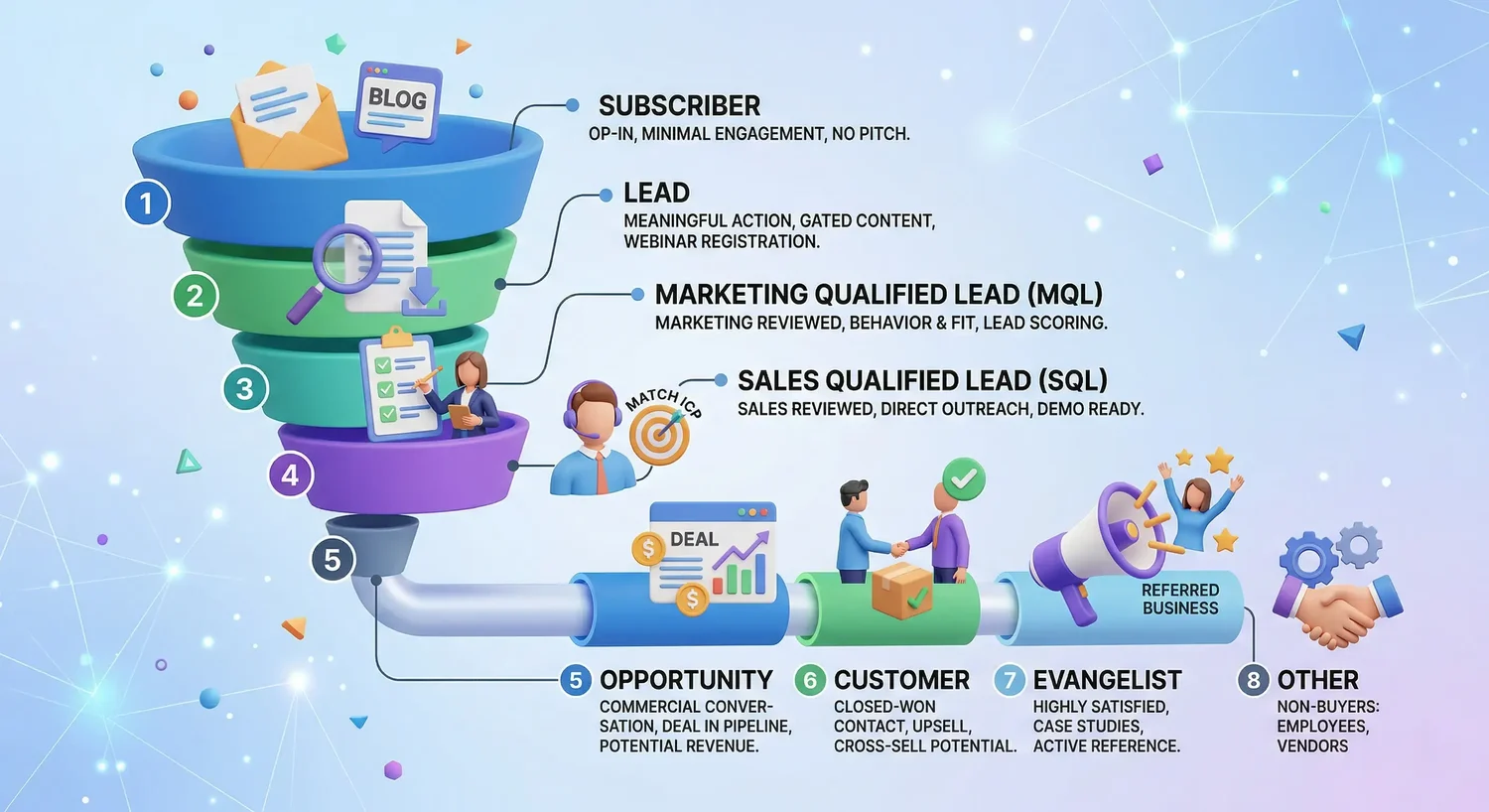
    HubSpot lifecycle stages are a CRM property that shows where each contact sits in your customer journey, from first contact to loyal customer. HubSpot ships with eight default stages: Subscriber, Lead, MQL, SQL, Opportunity, Customer, Evangelist, and Other, and you can customize them to match your sales process.

    If you’ve just logged into HubSpot for the first time, you’ve probably noticed a property called “Lifecycle Stage” sitting on every contact record. It’s easy to skim past it. Don’t.

    This one property quietly powers a lot of what makes HubSpot useful: your workflows, your funnel reports, and the handoff between marketing and sales. Get it wrong (or ignore it) and your reporting turns into guesswork. Get it right and everyone on your team can answer the same question the same way: where is this person in their journey with us, and what should happen next?

    What Is a HubSpot Lifecycle Stage, Exactly?

    The Lifecycle Stage property is a native field in HubSpot that tracks where a contact or company sits in your customer journey, starting from the first time you interact with them and continuing through purchase and beyond. Every single contact and company record in your HubSpot account carries this property, whether you’ve configured it or not.

    Think of it as a label that answers one question for your whole team: what milestone has this person actually crossed? It’s not meant to track daily busywork. It’s meant to mark the big, meaningful transitions in a relationship, like when someone stops being an anonymous website visitor and becomes a real sales opportunity.

    Properly configured lifecycle stages aren’t just cosmetic labels. They let your team segment contacts, personalize outreach, trigger automated workflows, and build pipeline reports that actually mean something. Skip the setup work and lifecycle stages become metadata that nobody trusts, not intelligence you can act on.

    The 8 Default HubSpot Lifecycle Stages Explained

    Out of the box, HubSpot gives you eight stages: Subscriber (opted into your communications, no buying intent yet), Lead (took a meaningful engagement action), MQL (marketing has qualified them as sales-ready), SQL (sales has verified them against your ideal customer profile), Opportunity (there’s a formal deal with a dollar value attached), Customer (closed-won), Evangelist (an active referral source or case study participant), and Other (for contacts who will never be customers, like vendors or job applicants).

    Here’s what each one actually means in practice.

    Subscriber. Someone who opted in to hear from you but hasn’t shown any real purchase intent yet. Newsletter signups, blog subscribers, and podcast registrants typically land here. Don’t try to sell to this group. Nurture them with useful content instead.

    Lead. A contact who has expressed some interest by filling out a form or downloading a resource. They’ve identified themselves, but they haven’t yet met your bar for marketing qualification.

    Marketing Qualified Lead (MQL). A contact who meets the behavioral and fit criteria your team defined as “ready for sales outreach.” Here’s the catch: there’s no universally agreed definition of MQL across companies, and HubSpot doesn’t apply this stage automatically. Most teams treat an MQL as someone marketing is comfortable handing to sales.

    Sales Qualified Lead (SQL). This is where a sales rep has personally made contact and confirmed the lead is worth pursuing. Some teams formalize this with BANT criteria (Budget, Authority, Need, and Timeline) before moving someone into SQL. Like MQL, HubSpot leaves the exact definition up to you.

    Opportunity. By default, HubSpot automatically applies this stage the moment an associated deal record gets created. You can also apply it manually if you want to flag someone as an opportunity before a deal exists.

    Customer. Once a deal tied to that contact gets marked Closed Won, HubSpot moves the contact to Customer automatically.

    Evangelist. Reserved for customers who’ve moved past satisfaction into advocacy: think referrals, testimonials, or case study participation. This and Customer both sit in what’s often called the retention or advocacy phase of the journey.

    Other. A catch-all for contacts who will never become customers, regardless of stage.

    Lifecycle Stage vs. Lead Status: What’s the Difference?

    This trips up nearly every new HubSpot admin. Lifecycle Stage answers “where is this person in the overall journey?” Lead Status answers a narrower question: “what’s happening with them right now, today, within that stage?”

    For example, a contact moving from Lead to MQL is a lifecycle stage change. Whether that same MQL has been “Attempted to Contact” or is “In Progress” with a rep is a lead status change. Mixing the two up is one of the most common reasons HubSpot reporting ends up unreliable. Lifecycle Stage should track milestones, not your rep’s daily to-do list.

    Can a Contact Move Backward in Lifecycle Stage?

    Not automatically, no. HubSpot’s built-in lifecycle stage automation is designed to move contacts forward, not backward, so a closed-lost deal won’t quietly demote someone from Opportunity back to Lead on its own. If you want that kind of downgrade to happen, a rep has to do it manually, or you need to build a workflow specifically for it.

    Honestly, most teams never bother building that backward workflow, and their reporting suffers for it. If your “Opportunity” count is padded with dead deals from six months ago, nobody trusts the funnel numbers anymore. Worth fixing early rather than discovering it during a board meeting.

    Should You Customize the Default Stages?

    Probably, eventually, but not on day one. Custom lifecycle stages make sense when your actual sales process has a distinct step the defaults just don’t capture, like a formal technical evaluation or a pre-renewal check-in. The tradeoff is real: too many custom stages make the CRM harder to manage and explain to new hires.

    A reasonable starting point most consultants agree on: keep Lead, Opportunity, and Customer as HubSpot defines them, since those map cleanly to almost any business. Don’t feel obligated to force Subscriber, MQL, SQL, or Evangelist into your process if they don’t fit your motion. You can always add them back later.

    Pro tip: before you touch any stage settings, write down a one-sentence definition for MQL and SQL that both marketing and sales sign off on. Verbal agreements that each team interprets differently are one of the most common causes of marketing-sales misalignment, and it’s a lot cheaper to fix on a whiteboard than inside a broken workflow.

    A Quick Checklist for Setting Up Lifecycle Stages

    1. Go to Settings, then Objects, then Contacts in your HubSpot navigation.
    2. Click the Lifecycle Stage tab to see your default stages listed in order.
    3. Write a one-sentence, specific definition for every stage, especially MQL and SQL.
    4. Get sign-off from both marketing and sales leadership on those definitions.
    5. Decide which default stages you’ll actually use and turn off or delete the rest.
    6. Add custom stages only for distinct steps your process genuinely needs.
    7. Build (or confirm) the workflow that moves Closed Won deals to the Customer stage.
    8. Set up a funnel report so you can watch conversion rates between stages monthly.

    One useful sanity check once you’re live: for a mid-market B2B company, a reasonably healthy funnel might look something like 100,000 Subscribers narrowing down to 20,000 Leads, 2,000 MQLs, 600 SQLs, 400 Opportunities, and 120 new Customers in a quarter. If the ratio between any two adjacent stages looks inverted, like more SQLs than MQLs, that’s usually a data problem, not a sign you’re crushing it.

    FAQ

    Do I have to use all eight default lifecycle stages?
    No. Plenty of companies skip Subscriber, Evangelist, or Other entirely because those stages don’t map to how they actually sell.

    What triggers HubSpot to move a contact to Customer automatically?
    HubSpot moves a contact to Customer once a deal associated with them is marked Closed Won.

    Is MQL the same across every company?
    Not even close. There’s no universal definition of MQL, and HubSpot doesn’t apply it automatically, which is exactly why your marketing and sales teams need to agree on your own criteria in writing.

    Can a lifecycle stage move backward if a deal falls through?
    Not on its own. HubSpot’s default automation only moves stages forward, so you’d need a manual update or a custom workflow to send a contact back down the funnel.

    What’s the difference between Lifecycle Stage and Lead Status?
    Lifecycle Stage tracks big-picture milestones in the customer journey. Lead Status tracks the day-to-day activity happening inside a single stage, like whether a rep has reached out yet.

  • How to Choose a SaaS CRM for Automation

    How to Choose a SaaS CRM for Automation

    As B2B teams get leaner and buyers get pickier, more of the revenue engine is running on software. Sales reps are expected to cover more accounts. Marketers are expected to prove pipeline, not just clicks. And the tool sitting in the middle of all of it, your CRM, is either multiplying your team’s effort or quietly draining it.

    That’s why the CRM decision has quietly become an automation decision. You’re not just buying a database of contacts anymore. You’re choosing the system that will route your leads, trigger your follow-ups, sync your marketing and sales data, and tell you what’s actually working.

    Get it right, and a five-person team can operate like fifteen. Get it wrong, and you’ll spend the next two years paying for workarounds, duct-tape integrations, and a sales team that lives in spreadsheets anyway.

    In this guide, we’ll walk through what a SaaS CRM actually needs to do for a modern revenue team, and the seven things to evaluate before you sign anything.

    What is a SaaS CRM, and why does automation change the buying criteria?

    What is a SaaS CRM? A SaaS CRM is customer relationship management software delivered in the cloud on a subscription basis. No servers to maintain, no versions to install; you log in, your data lives centrally, and updates ship continuously. For most B2B teams, it’s the system of record for every contact, company, deal, and conversation.

    Why does automation change how you should buy one? Because the value of modern CRM platforms no longer comes from storing information. It comes from acting on it. The best platforms watch for signals (a form fill, a stalled deal, a pricing-page visit) and do something useful without a human lifting a finger: assign the lead, send the follow-up, alert the rep, update the forecast.

    That means the old evaluation checklist (“Can it hold our contacts? Can we build a pipeline view?”) is table stakes. The real questions are about workflows. Which brings us to the list.

    1. Start with the workflows you want to automate, not the feature list.

    Every CRM vendor will hand you a feature grid with 200 rows of checkmarks. Ignore it, at least at first.

    Instead, sit down with your sales and marketing leads and write out the five to ten workflows that eat the most time or leak the most revenue today. For most B2B SaaS teams, the list looks something like this: routing inbound leads to the right rep, following up on demo requests within minutes, nurturing leads that aren’t ready to buy, reminding reps when deals go quiet, and handing off closed-won customers to onboarding.

    Now evaluate every CRM against that list. Can it run each workflow natively? How many clicks does it take to build? Does it require an admin, a consultant, or (worst case) a developer?

    This flips the power dynamic in the sales process. You’re no longer being sold features; you’re testing the product against your actual business. Vendors that are a good fit will love this exercise. Vendors that aren’t will get vague. That vagueness is data.

    2. Look for sales automation that removes admin work, not judgment.

    Here’s a useful rule of thumb: good sales automation takes the robot work away from humans. Bad sales automation tries to take the human work away from humans.

    The robot work is everything your reps do that a machine should be doing: logging emails and calls, creating tasks, updating deal stages, scheduling meetings, sending the third polite “just bumping this” follow-up. Research on sales productivity has found reps spend well under half their time actually selling, and admin is the biggest culprit. Every hour of it you automate goes straight back into conversations with buyers.

    So when you evaluate CRM platforms, look for automatic activity logging (email and calendar sync that just works), sequences or cadences for multi-step follow-up, meeting scheduling links, and workflow triggers like “if a deal hasn’t been touched in 10 days, create a task and notify the owner.”

    Then watch for the trap: automation that sends generic, robotic outreach at scale. Your buyers can smell it, and it burns your domain reputation and your brand at the same time. The platform should make personalization faster (templates with smart tokens, AI-assisted drafts a rep can edit), not make it optional.

    3. Make sure marketing automation and sales live on the same database.

    This is the single biggest structural decision in the whole evaluation, and it’s the one teams most often get wrong.

    Plenty of companies buy a CRM for sales and a separate marketing automation tool for email, forms, and nurturing, then wire the two together with a connector. On paper, it works. In practice, you’ve just created two versions of the truth. A lead updates their job title in one system and not the other. Marketing thinks a lead is nurturing; sales already closed them. Attribution reports disagree with pipeline reports, and now your Monday revenue meeting is a debate about whose numbers are right.

    Mistrust and miscommunication flare. Efficiency tanks.

    The alternative is a platform where marketing automation and the sales CRM share one contact record. When a prospect opens an email, visits your pricing page, or fills out a form, the rep sees it in the same timeline where they log calls. When sales disqualifies a lead, marketing’s nurture logic knows instantly.

    If you do end up with separate tools (sometimes there are good reasons), scrutinize the sync: Is it real-time and two-way, or a nightly batch job? What happens on conflicts? Who owns field mappings? Ask to see it working, not just a slide about it.

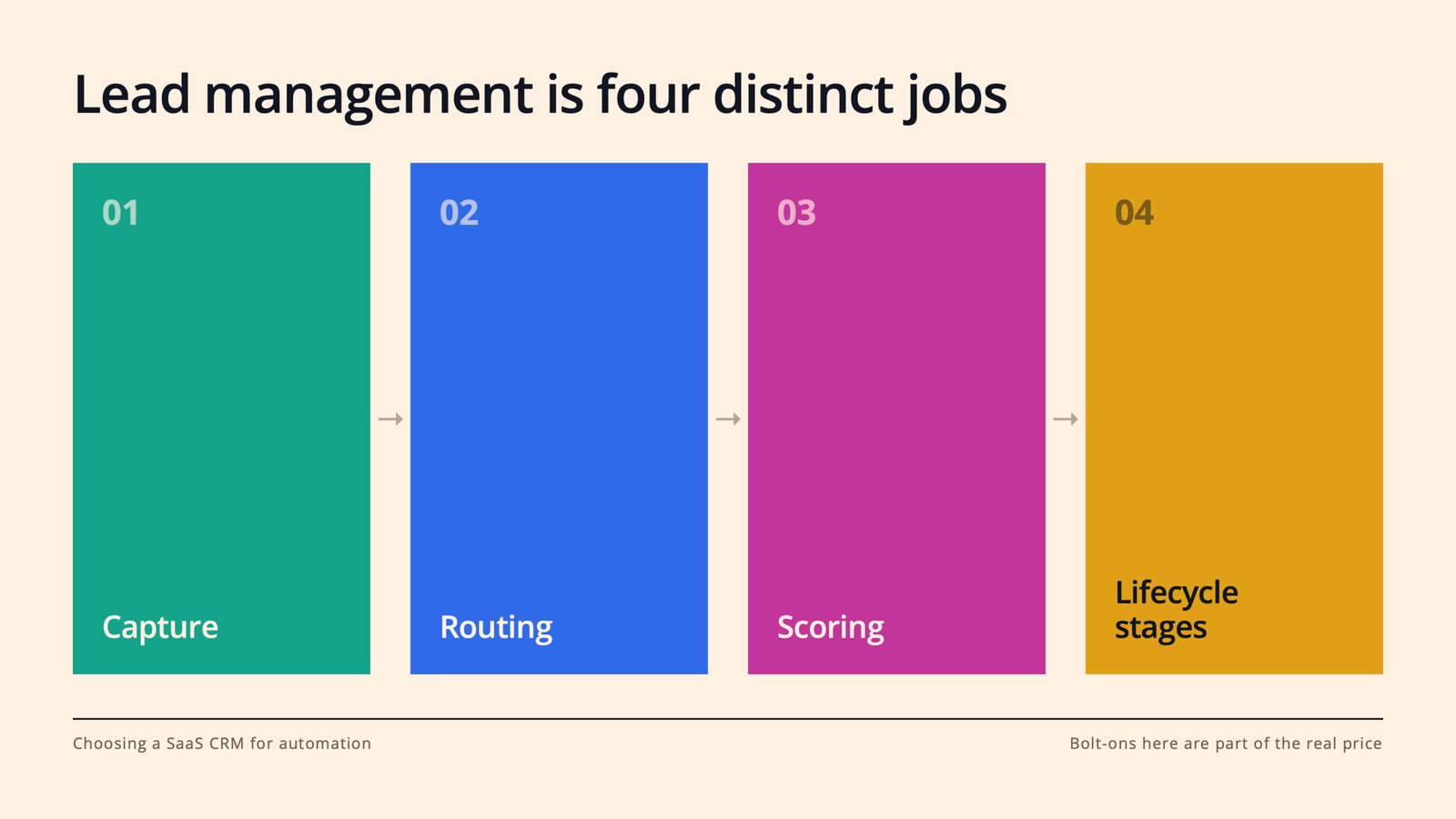
    4. Get specific about lead management: capture, routing, scoring, and lifecycle.

    “Lead management” is one of those phrases that appears on every vendor’s website and means something different at every company. Pin it down. A CRM worth buying should handle four distinct jobs:

    Capture. Forms, chat, meeting links, and ad integrations (think LinkedIn Lead Gen Forms) that feed leads into the CRM automatically, with source data attached.

    Routing. Rules that assign leads instantly by territory, segment, or round-robin. Speed matters enormously here; the odds of connecting with a lead drop off a cliff within the first hour, so “a rep will get to it tomorrow” is a revenue leak, not a process.

    Scoring and prioritization. The ability to rank leads on fit (does this match our ICP?) and behavior (what have they actually done?), so reps work the best leads first instead of the newest.

    Lifecycle stages. A shared definition of subscriber, lead, MQL, SQL, opportunity, and customer that both marketing and sales agree on, enforced by the system rather than by tribal knowledge.

    If a platform makes you bolt on third-party tools for two or three of these, factor that into the real price.

    5. Audit how it fits your existing stack.

    Your CRM will not live alone. It has to play nicely with your email and calendar, your data warehouse, your support desk, your billing system, and whatever else your team already depends on, whether that’s Slack, Snowflake, Stripe, or a homegrown product database.

    Three questions to ask every vendor:

    Does it integrate natively with our core tools? Native integrations are maintained by the vendor and tend to be sturdier than anything held together by middleware.

    How good is the API? Even if you never plan to touch it, a well-documented API is your escape hatch for the use case you haven’t thought of yet.

    What does the ecosystem look like? A healthy app marketplace means that when you adopt a new tool in two years, the connector probably already exists, for the low price of free ninety-nine (or at least without a services engagement).

    One more thing: ask about data portability on the way out. A vendor confident in their product will make exporting easy. A vendor relying on lock-in will not, and that tells you something.

    6. Demand reporting that connects marketing activity to revenue.

    Automation without measurement is just motion. The whole point of putting sales and marketing on one platform is that you can finally answer the questions that matter: Which campaigns create pipeline, not just leads? Where do deals stall? Which rep behaviors correlate with wins? What’s our real cost per opportunity by channel?

    In your evaluation, don’t settle for the demo dashboard (it’s always gorgeous). Bring three reports your leadership team actually asks for today, and ask the vendor to build them live with sample data. You’ll learn more in that 20 minutes than in the rest of the sales cycle combined.

    And check the AI story here, too. The current generation of CRM platforms is adding forecasting, deal-risk signals, and natural-language reporting. You don’t need all of it on day one, but you do want a vendor that’s clearly investing in it.

    7. Weigh adoption as heavily as capability.

    Here’s the uncomfortable truth about CRM projects: the most common failure mode isn’t missing features. It’s a sales team that won’t use the thing.

    A CRM only automates well if the data going in is clean and complete, and that only happens when reps want to live in it. So in your trial, put actual reps (not just ops) in the product for a week. Watch where they hesitate. Count the clicks to log a call or update a deal. Ask them, honestly, whether they’d use it without being nagged.

    Then look at the operational side of adoption: How long is implementation, really? Do you need a certified admin or an agency to make changes? What does onboarding and support cost? And how does pricing scale as you add seats, contacts, and automation volume? A platform that’s affordable at 10 seats and punishing at 50 is a decision you’ll have to unmake later, mid-growth, when you can least afford the disruption.

    Final thoughts

    Choosing a SaaS CRM for automation isn’t really a software decision. It’s a decision about how your revenue team will work for the next three to five years: how fast leads get touched, how aligned marketing and sales stay, and how much of your team’s week goes to selling instead of admin.

    So start where we started. Write down the workflows that matter, put two or three CRM platforms through a real trial against them, and let your reps and your reports cast the deciding votes.

    The teams that win with automation aren’t the ones with the longest feature list. They’re the ones whose system quietly handles the busywork so the humans can do the part humans are great at: building relationships and closing deals. Pick the platform that makes that your default, and you won’t just keep up with where B2B buying is going. You’ll be ready for it.