Choosing between B2B SaaS CRM and RevOps platforms is rarely a pure feature comparison, and that’s especially true for Australian SaaS companies running complex, multi-stakeholder sales cycles into the US, EMEA, and APAC simultaneously. A platform that works well for a domestic-only company, or even a US-based one, can quietly underperform once you factor in time zone gaps, currency exposure, and the reality that most Australian SaaS teams need international revenue to hit venture-scale outcomes.
This guide compares the CRM software worth evaluating and the revenue operations services available to run it, specifically through the lens of what changes for Australian SaaS companies rather than a generic global comparison.
Why Platform Selection Looks Different for Australian SaaS Companies
Small home market, early international expansion. Most Australian SaaS companies need US or UK revenue to reach venture-scale outcomes, which means the CRM has to support multi-currency, multi-region reporting from a much earlier stage than a comparable US company would need.
Time zone overlap that barely exists. Sydney and Melbourne business hours overlap awkwardly with both US and EMEA hours, which puts real weight on whether a platform supports time zone-aware lead routing and SLA automation rather than assuming a single business-hours window.
Complex, multi-stakeholder sales cycles. Longer, more considered B2B SaaS deals involving security review, procurement, and multiple decision-makers need a CRM built for opportunity-stage complexity, not just a simple pipeline kanban board.
Smaller local RevOps talent pool. Australia’s RevOps talent market is thinner than the US or UK, which is a major reason Australian SaaS companies lean on RevOps consulting partners rather than building out a large in-house function early.
None of these four factors show up in a standard vendor comparison chart, which is exactly why Australian teams that copy a US peer’s stack decision often discover the gap only after the contract is signed.
CRM Software Comparison for Australian SaaS Teams
Platform
Best Fit
Complex Sales Cycle Support
Considerations for Australian Teams
Salesforce
Larger, multi-product B2B SaaS companies with enterprise sales motions
Strong; built for multi-stakeholder opportunity management and custom approval flows
Higher implementation cost; usually needs a certified partner familiar with ANZ-to-global expansion
HubSpot
Mid-market teams wanting CRM, marketing, and RevOps tooling in one platform
Moderate to strong depending on tier; deal stages and playbooks configurable for longer cycles
Costs scale with contact volume; model total cost against AUD budgets, not list price
Zoho
Cost-conscious teams wanting broad functionality without enterprise pricing
Moderate; workable for complex cycles with more manual configuration
Good value, but less polished for very large, multi-region enterprise GTM
Pipedrive
Lean, early-stage, sales-led teams
Limited; built for simpler, faster-moving deals rather than long enterprise cycles
Native RevOps and forecasting depth thins out quickly as the team and deal complexity scale
Attio
Product-led and hybrid GTM teams wanting a flexible, modern CRM
Moderate; highly customizable data model suits evolving sales processes
Smaller partner and implementation ecosystem in Australia compared to Salesforce or HubSpot
The right platform among these B2B SaaS sales tools depends less on company size and more on how complex your actual sales cycle is. A company running a straightforward, single-stakeholder motion rarely needs Salesforce’s configuration depth, while a company managing security reviews, procurement, and multiple buying-committee members will hit real limits on Pipedrive fairly quickly.
RevOps Service Options: Who Actually Runs the Platform
Buying CRM software solves only half the problem. Someone still has to design the pipeline stages, build lead routing that accounts for the US-APAC time zone gap, and keep reporting clean as the company scales, and for most Australian SaaS companies that capacity doesn’t exist internally at the size the software is bought.
Option
Best For
Tradeoff
In-house RevOps hire
Companies with enough scale to justify a dedicated full-time role
Slower to build institutional expertise; a single hire can become a bottleneck
RevOps consulting services
Companies needing defined, project-based work, like a CRM re-architecture ahead of a US launch
Engagement ends once the project is complete; needs internal ownership afterward
Fractional RevOps leadership
Growth-stage companies whose international motion is live but still evolving
Higher ongoing cost than a single project, but avoids hiring a full-time role too early
Many Australian SaaS companies start with project-based RevOps consulting, typically a CRM re-architecture or lead-routing overhaul timed to a US or UK expansion push, before moving to fractional support once the international motion stabilizes. Given the smaller local talent pool, fractional revenue operations services are often more cost-effective than building a large in-house function too early.
What to Prioritize When Comparing Platforms and Partners
1. Multi-Currency and Multi-Region Reporting
If you’re billing in AUD, USD, and potentially GBP, confirm the CRM can roll this up cleanly for board reporting without manual spreadsheet reconciliation every cycle. Ask vendors to walk through what a single revenue dashboard looks like across three currencies, not just whether “multi-currency” appears on a feature list.
2. Time Zone-Aware Lead Routing
A lead generated during Sydney business hours shouldn’t sit unworked for ten-plus hours before a US-based rep sees it, and vice versa. Confirm the platform, or the RevOps partner building on top of it, can design SLA and routing rules that actually account for this gap rather than assuming a single global business-hours window.
3. Support for Genuinely Complex Sales Cycles
Confirm the CRM can represent multi-stakeholder deals accurately, with support for multiple contacts per opportunity, custom approval stages, and forecasting that doesn’t assume every deal moves through the pipeline at the same pace. This matters more as average deal size and buying-committee size grow.
4. Local Implementation and Partner Support
Platforms and RevOps consulting partners with genuine ANZ experience, not just a certification badge, generally mean faster onboarding and fewer surprises during implementation. Ask any prospective partner how many Australian SaaS clients they’ve helped expand internationally, and ask for specific examples rather than a general claim of “global experience.”
Common Mistakes Australian SaaS Teams Make
Choosing a CRM based on what a US-based peer uses, without checking pricing scalability against AUD budgets
Underestimating implementation time when a vendor’s support team operates entirely outside Australia-friendly hours
Buying enterprise-grade CRM software before the sales process and data hygiene underneath it are solid enough to justify the platform’s complexity
Hiring a full-time RevOps person before the company’s GTM motion is complex enough to keep that role fully utilized
Match the Platform and Partner to Your Actual Sales Complexity
There’s no single best answer among B2B SaaS CRM and RevOps platforms for Australian companies, only the combination that fits your current sales cycle complexity, international footprint, and internal RevOps capacity. A company with a straightforward motion and a lean team is usually better served by HubSpot or Zoho paired with project-based RevOps consulting. A company running genuinely complex, multi-region enterprise deals is more likely to need Salesforce alongside either an in-house hire or fractional RevOps leadership, depending on how quickly the international motion is still evolving.
Summary
Australian SaaS companies face platform decisions shaped by four factors most global comparisons ignore: a small home market forcing early international expansion, time zones that barely overlap with the US or EMEA, genuinely complex multi-stakeholder sales cycles, and a smaller local RevOps talent pool. Among CRM software, Salesforce fits larger, complex enterprise motions, HubSpot suits mid-market teams wanting an all-in-one platform, Zoho offers strong value for cost-conscious teams, Pipedrive fits lean early-stage motions, and Attio suits product-led or hybrid GTM approaches.
Buying the software is only half the decision. Revenue operations services, whether project-based consulting, fractional leadership, or an eventual in-house hire, determine whether the platform actually gets configured for AUD reporting, time zone-aware routing, and complex deal tracking. Weight multi-currency reporting, time zone-aware automation, complex sales cycle support, and genuine local implementation experience as heavily as the core feature set when comparing options.
FAQ
Which CRM is best for an Australian SaaS company with a complex sales cycle?
Salesforce generally offers the deepest support for multi-stakeholder, multi-region enterprise sales cycles, though it comes with higher implementation cost. HubSpot is a strong middle ground for mid-market teams wanting CRM, marketing, and RevOps tooling in one platform without Salesforce’s full configuration overhead.
Do we need a RevOps consultant, or can our sales team run the CRM themselves?
It depends on sales cycle complexity and international footprint. A simple, domestic-only sales motion may not need dedicated RevOps support early on, but once you’re managing multi-currency reporting and time zone-aware lead routing across US, EMEA, and APAC, RevOps consulting services or a fractional leader typically pay for themselves in avoided forecasting errors and missed leads.
Should we use a project-based RevOps engagement or fractional support?
Project-based engagements suit a defined, time-boxed problem, like rebuilding lead routing ahead of a US launch. Fractional RevOps leadership fits better once your international motion is live but still evolving and needs an ongoing owner rather than a one-time fix.
How does AUD pricing exposure affect choosing a USD-priced CRM?
Most major CRM platforms price in USD, which means currency fluctuation directly affects your real per-seat cost in a way it doesn’t for a US-based buyer. Model total cost at your projected headcount using a realistic AUD-to-USD range rather than the exchange rate on the day you sign the contract.
Why does time zone-aware lead routing matter so much for Australian SaaS teams?
Sydney and Melbourne business hours overlap only briefly with US hours and awkwardly with EMEA hours, so a lead generated outside that narrow window can sit unworked for most of a business day without deliberate routing rules. This creates real handoff and SLA problems between marketing, SDRs, and closing reps that a generic, single-timezone routing setup won’t catch.
What should we ask a RevOps consulting partner before hiring them?
Ask specifically how many Australian SaaS clients they’ve helped expand into the US or UK, and ask for a real example rather than a general claim of global experience. Also ask what they would explicitly not recommend given your current stage, since a partner focused on right-sizing the engagement is generally more trustworthy than one scoping the largest possible project.
Most “best CRM for SaaS” comparisons stop at the platform decision, HubSpot versus Salesforce versus Zoho, and leave out a question that matters just as much for Indian B2B SaaS teams: who’s actually going to configure, run, and improve that platform once it’s live? For a lot of teams, especially HubSpot users scaling past their first few reps, the real bottleneck isn’t the CRM itself, it’s whether they have the internal capacity or the right partner to get real value out of it.
This guide covers both halves of that decision: the CRM platforms worth considering for Indian B2B SaaS teams, and the RevOps consulting options available when internal capacity isn’t enough to run the platform well on its own.
Why This Is a Two-Part Decision, Not Just a CRM Choice
A CRM is infrastructure, not a finished process. Buying Salesforce doesn’t give you a working lead-routing system any more than buying a gym membership gives you a fitness routine. Someone still has to design the pipeline stages, configure the automation, and keep the data clean as the team grows, and for most Indian SaaS teams under a few hundred employees, that someone is either a single stretched-thin ops hire or nobody at all.
That’s the gap RevOps consulting partners exist to fill. Some buyers need this from day one, particularly HubSpot users who chose the platform for its ease of setup and then discovered that ease of setup doesn’t automatically mean the workflows are actually right for their specific sales motion.
CRM Platforms for Indian B2B SaaS Teams
The right platform depends on GTM complexity and budget more than company size alone.
Platform
Best Fit
Partner Ecosystem in India
HubSpot
Mid-market teams wanting CRM, marketing, and ops in one platform
Large certified Solutions Partner network, including India-based agencies
Salesforce
Larger, complex, multi-product or enterprise sales motions
Deep partner ecosystem, but implementation partners tend to be higher cost
Zoho
Cost-conscious teams wanting strong local support
India-headquartered, extensive domestic partner and support network
Freshsales / Freshworks
Teams wanting India-built pricing and regional support
Smaller partner network; less relevant once RevOps needs grow
HubSpot deserves particular attention here because of its scale in the Indian market and its large certified partner network, which makes it the platform most likely to have a genuine growth-support conversation attached to it, not just a licensing decision.
RevOps Consulting Partners: What They Actually Do Beyond the Platform
A good RevOps partner doesn’t just configure the CRM you already bought. They design lead routing and scoring rules, build the reporting your leadership team actually trusts, fix the sales-marketing handoff gaps that show up as forecasting confusion, and set up the forecasting infrastructure that holds up in a board meeting. Some also take on fractional RevOps leadership, effectively acting as an interim ops function while an internal hire matures into the role.
What separates a strong partner from a weak one usually isn’t platform certification, it’s whether they diagnose your actual stage and problem before recommending a scope of work, rather than defaulting to the biggest engagement they can sell.
HubSpot Users Specifically: When You Need a Growth Partner
HubSpot’s own partner program ranks Solutions Partners across tiers based on client volume and demonstrated outcomes, roughly from Community and Silver up through Gold, Platinum, Diamond, and Elite. A higher tier generally signals more implementation experience, but tier alone doesn’t tell you whether a partner understands your specific sales motion or your stage of growth, which matters more than the badge on their website.
The signal that a HubSpot user actually needs a growth partner, rather than just more HubSpot training, is usually one of these: reports that leadership stops trusting because sales and marketing numbers never match, lead routing that still runs on manual Slack messages months after go-live, or a forecasting process that lives in a spreadsheet parallel to the CRM because nobody trusts what HubSpot shows. None of these get fixed by watching another product tutorial, they get fixed by someone redesigning the underlying process.
It’s also worth distinguishing a HubSpot-certified implementation partner from an independent RevOps consultant who happens to work inside HubSpot. The former is usually strongest at platform configuration specifically. The latter tends to bring a broader lens, comp plans, forecasting methodology, org design, that isn’t tied to any one platform’s feature set.
What to Look for in a RevOps Partner
Stage fit. Case studies from companies at a comparable headcount and ARR, not just general SaaS experience.
Willingness to recommend less. A partner who tells you what you don’t need yet is more trustworthy than one who scopes the biggest possible engagement.
Execution capability, not just strategy. Confirm they can actually build the workflows and automation, not just advise on them in a slide deck.
An exit plan. A clear path for handing ownership back to an internal hire once your RevOps function matures.
Platform-Native Support vs. Independent RevOps Consultants
Both options have a real place depending on what’s actually broken.
Option
Best For
Limitation
HubSpot-certified Solutions Partner
Deep platform configuration, migrations, HubSpot-specific automation
Recommendations often stay within what HubSpot itself can do
Independent RevOps consultant
Cross-functional process design, forecasting, comp, org structure
May need to bring in a certified partner for deep platform build work
Fractional RevOps leader
Growth-stage teams needing an interim function, not just a project
Higher ongoing cost than a one-time implementation project
Common Mistakes When Choosing a CRM or RevOps Partner in India
Picking a platform based on what a US-based peer uses, without checking pricing scalability against INR budgets
Hiring a certified implementation partner to solve a problem that’s actually a process design gap, not a configuration gap
Assuming platform tier or partner badge is a substitute for asking about stage-specific case studies
Signing an open-ended consulting engagement with no defined exit plan for bringing the function in-house
Match the Partner to Your Stage and Platform
There’s no single “best” CRM or RevOps partner for Indian B2B SaaS teams, only the combination that fits your current stage, budget, and how much internal capacity you already have to run the platform yourself. A team with a stretched-thin ops hire and a messy HubSpot instance usually needs a certified implementation partner first. A team whose CRM is technically fine but whose forecasting and handoffs are broken usually needs an independent RevOps consultant instead.
Summary
Choosing CRM and RevOps support for an Indian B2B SaaS team is really two decisions layered together: which platform fits your GTM complexity and budget, and whether you need a partner to actually run it well. HubSpot, Zoho, and Freshworks tend to fit cost-conscious or mid-complexity teams with strong local support, while Salesforce fits larger, more complex enterprise motions at higher implementation cost.
On the partner side, a HubSpot-certified Solutions Partner is strongest for deep platform configuration, while an independent RevOps consultant or fractional leader brings a broader lens across forecasting, comp, and org design that isn’t tied to one platform. The signals that you need a partner at all, mismatched reports, manual lead routing months after go-live, a forecast nobody trusts, matter more than any certification badge, and any partner worth hiring should be able to show stage-specific case studies and a clear plan for eventually handing ownership back to your own team.
FAQ
Do we need a RevOps consultant if we already have a certified HubSpot implementation partner?
It depends on what’s broken. A certified implementation partner is usually strongest at platform configuration specifically. If the underlying issue is forecasting methodology, comp design, or cross-functional process rather than HubSpot setup itself, an independent RevOps consultant often brings a broader lens the implementation partner isn’t scoped to cover.
Does HubSpot’s partner tier matter when choosing an implementation partner?
A higher tier generally signals more implementation volume and demonstrated client outcomes, but it doesn’t guarantee the partner understands your specific sales motion or stage. Ask for case studies from companies at a comparable headcount and ARR rather than relying on the tier badge alone.
Is Zoho or Freshworks a better fit than HubSpot for a cost-conscious Indian SaaS team?
Both are India-built platforms with pricing and support already tuned to Indian budgets, which makes them attractive for cost-conscious teams. HubSpot tends to win out when a team specifically wants CRM, marketing, and ops in one platform with access to a large certified partner ecosystem for future growth support.
What’s the difference between a fractional RevOps leader and a project-based consultant?
A project-based consultant solves a defined problem within a set timeline, then the engagement ends. A fractional RevOps leader acts as an interim ops function over several months, staying involved as priorities shift, which tends to suit growth-stage teams whose needs are still changing faster than a single project can capture.
What questions reveal whether a RevOps partner actually understands our stage?
Ask what they would specifically not recommend given where your company is right now, and ask for an example engagement with a company at a similar headcount and ARR to yours. A partner who can only describe what they’d sell you, not what they’d hold back, is usually optimizing for a bigger engagement rather than the right one.
Should we sign an open-ended RevOps consulting engagement or a fixed-scope project?
Early-stage and platform-migration work tends to fit a fixed-scope project with a defined start and end date. Growth-stage teams with evolving needs often get more value from an ongoing fractional arrangement, but either way, the engagement should include a clear plan for eventually handing ownership back to an internal hire rather than running indefinitely with no exit point.
Most RevOps CRM evaluations focus on dashboards, workflow builders, and reporting templates, the parts of the product a vendor can show off in a thirty-minute demo. The part that actually determines whether that dashboard can be trusted, how customer lifecycle data actually gets unified across marketing, sales, and customer success in the first place, rarely gets the same scrutiny.
That’s a mistake, because integration depth is usually the difference between a platform that reflects reality and one that just looks like it does. This guide walks through the key considerations B2B SaaS revenue operations leaders should evaluate before committing to a platform, specifically around how it handles the data flowing in from your existing stack.
Why Integration Depth Matters More Than Feature Lists
A CRM’s reporting is only as accurate as the data underneath it, and that data usually originates in three or four other systems, marketing automation, product analytics, billing, support, before it ever reaches the CRM. If the connection between those systems and the CRM is shallow, delayed, or fragile, every report built on top of it inherits that weakness, no matter how polished the dashboard looks.
This is why two platforms with nearly identical feature lists can produce very different results in practice. The one with deeper, more resilient integrations will simply reflect what’s actually happening with customers more accurately, and that accuracy compounds over time as more decisions get made based on it.
Key Considerations for RevOps CRM Data Integrations
1. Native Integration Depth vs. Third-Party Connectors
A native integration, built and maintained by the CRM vendor itself, tends to be more reliable than a third-party connector pulled from an app marketplace, since the vendor has direct incentive to keep it working as both systems evolve. Ask specifically whether an integration is native or third-party, and if it’s third-party, who’s responsible for fixing it when it breaks. “Supports the integration” can mean either, and the difference only becomes obvious once something goes wrong.
2. Real-Time Sync vs. Batch Sync
Some integrations sync data continuously, while others batch updates on a delay, hourly, nightly, or even less frequently. For a signal like a usage spike that predicts expansion, a day-old data point can mean the difference between a proactive outreach and a missed window entirely. Ask vendors for a specific latency number, in minutes or hours, rather than accepting a vague claim of real-time sync.
3. Bi-Directional Sync and Field-Mapping Conflicts
Many integrations only push data one direction, into the CRM, without pulling updates back out to the source system. If a rep updates a field inside the CRM, does that change flow back to the originating tool, or do the two systems quietly drift out of sync? Ask specifically how the platform resolves a conflict when the same field gets updated in two systems before the next sync runs.
4. Cross-System Identity Resolution
A single customer often exists as slightly different records across marketing, sales, billing, and support, different email formats, different company name spellings, sometimes different contact identifiers entirely. A strong integration layer resolves these into one unified identity rather than leaving your team to manually reconcile duplicate records. Ask vendors to demonstrate this directly on a messy, real-world example, not a clean demo dataset built to avoid the problem.
5. System of Record Clarity
When the same field, say, a customer’s plan tier, exists in both the billing system and the CRM, which one wins if they disagree? Without a clear answer, teams end up with silent data drift that nobody notices until a report looks obviously wrong. Confirm the platform lets you designate a system of record per data type, rather than defaulting to whichever system happened to sync most recently.
6. Resilience to Upstream API and Schema Changes
Every connected system, your product analytics tool, your billing platform, occasionally changes its API or data schema. A fragile integration breaks silently when that happens, and nobody notices until a dashboard shows suspiciously flat numbers weeks later. Ask how the vendor detects and alerts on integration failures, and whether that alert reaches your team automatically or requires someone to notice the anomaly manually.
7. Data Governance and Access Control Across Integrated Systems
Once data from multiple systems lives inside one CRM, access control becomes more complicated, not less. A rep who shouldn’t see certain financial or support data in the source system shouldn’t automatically see it once it’s unified into a customer record. Confirm the platform supports field-level or object-level permissions that respect the original system’s access rules, rather than flattening everything into one broadly visible record.
How to Evaluate Vendors on These Criteria
Rather than asking generic questions about “integration support,” build a scorecard using these seven considerations and score each vendor based on a live demonstration using data structures similar to your own, not a curated demo environment. Where a vendor can’t answer a specific question concretely, for example, exact sync latency or how field conflicts get resolved, treat that gap as useful information about how reliable the integration will be once real usage begins.
Summary
A RevOps CRM’s reporting is only as trustworthy as the integrations feeding it, which is why integration depth deserves as much evaluation scrutiny as dashboards or workflow builders. The seven considerations that matter most are native integration depth versus third-party connectors, real-time versus batch sync speed, bi-directional sync with clear field-conflict resolution, cross-system identity resolution for unifying customer records, clear system-of-record rules when data disagrees, resilience to upstream API changes, and governance that respects source-system access controls once data is unified.
The most reliable way to evaluate any vendor against these criteria is a live demonstration using data that resembles your own, messy edge cases included, rather than a polished demo environment built to avoid revealing the gaps. A vendor that can’t answer these questions specifically is telling you the integration will need rework after the contract is signed, not before.
FAQ
What’s the difference between a native integration and a third-party connector?
A native integration is built and maintained directly by the CRM vendor, while a third-party connector is typically built by an independent developer or app marketplace partner. Native integrations tend to be more reliable over time since the vendor has direct incentive to keep them working as both connected systems evolve.
How important is real-time sync versus batch sync?
It depends on how time-sensitive the signal is. A usage spike that predicts expansion revenue loses much of its value if it takes a day to reach the CRM, while less urgent data, like historical support ticket counts, can often tolerate a batch delay without meaningfully affecting decisions.
What happens when the same field gets updated in two connected systems?
This depends entirely on how the platform handles bi-directional sync conflicts, which varies significantly between vendors. Some platforms let you designate a system of record per field so conflicts resolve predictably, while others simply apply whichever update synced most recently, which can silently overwrite the correct value.
Why does cross-system identity resolution matter for RevOps?
Without it, the same customer can appear as multiple disconnected records across marketing, sales, billing, and support, which fragments account health scoring and makes reporting unreliable. Strong identity resolution unifies these into one account view instead of leaving your team to manually reconcile duplicates.
How do we know if an integration will break silently?
Ask the vendor directly how integration failures are detected and whether alerts reach your team automatically, or whether someone has to notice an anomaly in the data manually. A platform without proactive failure alerting can leave broken data flowing unnoticed for weeks.
Should access permissions change once data is unified into one CRM record?
No, ideally the original system’s access rules should carry over. If a rep couldn’t see certain billing or support data in the source system, unifying that data into a CRM record shouldn’t suddenly make it visible to them. Confirm the platform supports field-level or object-level permissions rather than flattening everything into one broadly accessible record.
Choosing a CRM and RevOps platform is never purely a feature comparison, it’s a decision shaped by who you’re selling to, where your team sits, and what compliance and pricing realities you operate under. For Indian SaaS teams selling primarily into the US, EMEA, and APAC while managing teams based in India, those constraints look different than they do for a domestic-only company. This guide looks at platform selection specifically through that lens.
Most CRM comparison content is written from a US-centric vantage point, assuming USD pricing, US business hours, and US-based support are simply the default. For an India-headquartered SaaS company, none of those assumptions hold automatically, and treating them as if they do tends to produce a platform decision that looks fine on a feature checklist and causes friction for the next several years.
What’s Different About Platform Selection for Indian SaaS Teams
USD pricing on INR budgets. Most major CRM and RevOps platforms price in USD, which means currency fluctuation and per-seat cost scrutiny matter more for India-based finance teams than for US-based buyers.
Selling across time zones from a single hub. Unlike distributed teams, many Indian SaaS companies run GTM out of one or two India-based offices while selling into US and EMEA hours, which puts more weight on async workflow support and mobile access.
Blended local and global stack needs. Many Indian SaaS companies also need domestic invoicing, GST-compliant billing, and India-specific payment gateway integrations alongside a global CRM, which not every platform handles cleanly out of the box.
Talent and support access. Platform vendors with strong partner and implementation support in India, versus purely remote or US-based support, meaningfully affect onboarding speed and total cost.
None of these four factors show up clearly in a standard vendor comparison chart, which is exactly why they get missed. A platform can score well on every core CRM feature and still create real friction the moment your finance team tries to reconcile a USD-denominated invoice against an INR budget, or your support ticket sits unanswered overnight because the vendor’s team works exclusively in US hours.
Platform Categories to Evaluate
The table below reflects general fit patterns, not a ranking, since the right platform depends heavily on company stage, GTM complexity, and how many regions you’re actively selling into.
Platform
Fit for Indian SaaS Teams
Considerations
HubSpot
Strong for mid-market teams wanting CRM + marketing + ops in one platform, with a large partner ecosystem in India
Costs scale with contact volume; budget carefully against INR-denominated plans
Salesforce
Best for larger, complex India-based SaaS companies with multi-product or enterprise sales motions
Higher implementation cost; often needs a certified India-based partner
Zoho
India-headquartered, strong value for cost-conscious teams, good local support
Less polished for highly complex, multi-region enterprise GTM
Freshsales / Freshworks
India-built CRM with strong regional support and pricing tuned closer to Indian SaaS budgets
Smaller ecosystem of third-party integrations than Salesforce/HubSpot
Pipedrive
Lightweight option for lean, sales-led early-stage teams
Limited native RevOps/forecasting depth as team scales
Zoho and Freshworks carry a specific advantage worth calling out directly: both are India-built products, which tends to translate into pricing that’s already sensitive to INR budgets and support teams that operate in Indian time zones by default, rather than as an add-on. That doesn’t automatically make either the right choice, but it does remove two of the four friction points on this list without any extra evaluation work.
What to Prioritize When Comparing Platforms
1. Multi-Currency and Multi-Region Reporting
If revenue is closing in USD, GBP, and INR across different regions, confirm the platform can roll this up cleanly for board reporting without manual spreadsheet reconciliation. Ask vendors directly to walk through how a single revenue dashboard would look with deals closing in three currencies simultaneously, rather than accepting a general claim that “multi-currency is supported.”
2. Time Zone-Aware Automation
Lead routing and SLA automation should account for the reality that your India-based team may be handling leads generated during US or EMEA business hours, and vice versa. A lead generated at 9pm US Eastern time needs a routing rule that doesn’t just assume the India-based rep is already awake and available, or the response-time SLA becomes meaningless in practice even if it looks fine on paper.
3. Local Implementation and Support Access
Platforms with certified implementation partners or support teams based in India generally mean faster onboarding and lower ongoing dependency on offshore support tickets. This matters most in the first ninety days after signing, when small configuration questions come up frequently and a multi-hour response delay compounds into weeks of lost momentum.
4. Integration With India-Specific Tools
Check native or easy integration with tools commonly used by Indian SaaS finance and ops teams, GST-compliant billing systems, local payment gateways, and India-based communication tools. A platform that handles this well out of the box saves a meaningful amount of custom integration work that would otherwise fall to an already-stretched internal ops team.
Common Mistakes Indian SaaS Teams Make When Choosing a Platform
Choosing a platform based on what US-based peers use, without checking pricing scalability against INR budgets
Underestimating implementation time when the vendor’s support team operates entirely outside India-friendly hours
Ignoring multi-currency reporting until it becomes a painful, manual board-reporting exercise
The first mistake is the most common, and the most understandable. It’s natural to default to whatever a well-known US competitor or peer company uses, on the assumption that if it works for them, it’ll work equally well here. The problem is that a US-based company evaluating the same platform never has to think about INR-to-USD conversion on a per-seat basis, or whether support tickets get answered before the next business day starts in Bangalore, so their experience with the platform simply isn’t a reliable proxy for yours.
Choose the Platform That Matches Your Actual GTM Geography
For Indian SaaS teams, the “best” CRM and RevOps platform isn’t necessarily the one with the most brand recognition, it’s the one that handles your specific mix of currencies, time zones, and regional support needs without requiring constant manual workarounds. Weight local implementation support and multi-currency reporting as heavily as core CRM features when making the final call.
A useful exercise before finalizing a shortlist is to map out your actual revenue geography, what percentage of bookings close in USD versus INR versus GBP, and where your reps and support staff are physically located relative to your buyers. That map, more than any vendor’s feature list, should be doing most of the work in narrowing down which of these platforms genuinely fits.
Summary
Indian SaaS teams selling into the US, EMEA, and APAC face four constraints that don’t show up in a typical CRM comparison: USD pricing measured against INR budgets, time zone gaps between an India-based team and global buyers, the need for GST-compliant billing and local payment gateway integrations alongside a global CRM, and the value of vendor support actually operating in Indian time zones rather than purely remote support.
Zoho and Freshsales, both India-built, tend to remove two of those four friction points by default, while HubSpot and Salesforce offer stronger fit for larger or more complex GTM motions at the cost of higher implementation overhead. When comparing platforms, weight multi-currency reporting, time zone-aware automation, local implementation support, and India-specific tool integrations as heavily as core CRM features, and map your actual revenue geography before assuming a platform that works well for a US-based peer will work the same way for you.
FAQ
Is Zoho or Freshworks better for an Indian SaaS company than Salesforce or HubSpot?
It depends on GTM complexity. Zoho and Freshsales, both built in India, tend to offer pricing and support already tuned to Indian budgets and time zones, which suits cost-conscious or mid-complexity teams well. Salesforce and HubSpot generally fit better once a company has a more complex, multi-product, or enterprise-heavy sales motion that needs deeper customization than Zoho or Freshworks currently offer.
How does INR budgeting affect choosing a USD-priced CRM?
Most major CRM platforms price in USD, which means currency fluctuation directly affects per-seat cost predictability for an India-based finance team in a way it simply doesn’t for a US buyer. It’s worth modeling total cost at your expected headcount using a realistic USD-to-INR range, rather than the exchange rate on the day you signed the contract.
What’s the biggest platform selection mistake Indian SaaS teams make?
Choosing a platform mainly because a well-known US-based peer uses it, without checking whether the pricing scales sensibly against INR budgets or whether support is realistically available in India-friendly hours. A platform that works well for a US-based company isn’t automatically a reliable signal for an India-headquartered one facing different currency and time zone constraints.
Do we need local implementation partners, or can we manage with remote support?
It depends on how much configuration complexity you expect and how quickly you need to move. Local implementation partners or India-based support teams tend to mean faster onboarding and fewer multi-hour delays on small configuration questions, which matters most in the first few months after signing when those questions come up frequently.
How important is multi-currency reporting if we only sell in USD today?
It’s worth checking even if you’re USD-only today, since many Indian SaaS companies expand into additional currencies as they grow into EMEA or serve domestic Indian customers alongside global ones. Confirming this capability upfront avoids discovering, months later, that your board reporting requires a manual spreadsheet reconciliation every quarter.
Should platform choice differ based on whether we sell into the US, EMEA, or APAC?
Yes, to a degree. Selling primarily into US hours from an India-based team creates a different time zone gap than selling into EMEA or APAC, which affects how important time zone-aware lead routing and SLA automation are for your specific mix. Mapping out where your leads are actually generated relative to where your team sits should inform this more than a generic platform comparison would.
What Is RevOps Maturity? A Beginner’s Framework for Assessing Your Stage
If you’ve ever sat in a pipeline review where sales, marketing, and customer success each showed up with a different number for the same deal, you’ve already met the problem RevOps maturity tries to solve. Revenue operations (RevOps) is the function that aligns those teams around shared processes, data, and tools so revenue growth becomes predictable instead of accidental. But not every company practicing RevOps is doing it at the same level, and that’s where a maturity model comes in.
A RevOps maturity model is a framework that shows how far along a company is in unifying its sales, marketing, and customer success operations, usually ranked across stages from siloed and reactive to fully integrated and predictive. It helps you diagnose gaps in process, data, technology, and team alignment, then prioritize what to fix next.
Most teams overestimate where they actually stand. That gap between what you think your RevOps looks like and what’s actually happening day to day is worth taking seriously, because it’s usually where forecasts go wrong.
What Is RevOps Maturity, Exactly?
RevOps maturity is a way of measuring how consistently your revenue teams execute, not just whether you’ve hired a RevOps person or bought a CRM. If you’re new to the broader concept, our guide on what RevOps is covers the basics of the function itself. This post focuses specifically on how to tell which stage your organization is in.
Gartner, one of the most cited sources on this topic, frames RevOps maturity in three stages. The developing stage involves end-to-end revenue processes that are defined, but functional platforms and cross-functional alignment are still catching up. The intermediate stage brings well-defined processes with moderate data sharing, though it may offer either broad cross-functional support or sophisticated customer understanding, not usually both yet. The advanced stage is where revenue processes map to the full customer buying journey, backed by centralized data and broad cross-functional support.
Other vendors break this same arc into four or five stages with different names (Ad Hoc, Emerging, Defined, Optimized, Predictive is one common version), but they’re describing the same underlying progression: from disconnected teams guessing at numbers to a revenue engine that runs on shared, trustworthy data.
Why Does RevOps Maturity Actually Matter?
Honestly, most companies don’t fail at RevOps because they lack tools. They fail because they buy tools before fixing the process and data problems underneath them, and then wonder why the new platform didn’t move the needle.
The numbers back this up at scale. Accenture’s global research found that more than 80% of businesses sit in a developing or evolving phase of RevOps maturity, and only 6% of software and technology companies have reached a scaling or systemized level. That’s a big gap between where most companies think they are and where the leaders actually are.
The payoff for closing that gap is real. According to Gartner data cited by Outreach, companies with advanced RevOps maturity are twice as likely to exceed their revenue goals and 2.3 times more likely to exceed profit goals compared to less mature organizations. Most revenue organizations currently sit in the stage 2 to stage 3 range, so there’s real room to move.
What Are the Stages of RevOps Maturity?
Strip away the branding differences between vendors and you’ll find the same basic arc repeats:
Siloed / Ad Hoc. Teams operate independently, processes are manual, and customer engagement is mostly reactive. There’s no shared goal, and cross-functional communication happens by accident, not by design.
Defined. Core processes like lead qualification and handoffs get documented for the first time, even if execution is still inconsistent.
Managed / Intermediate. Data starts flowing between marketing, sales, and customer success systems. Shared dashboards and enforced handoff rules show up here.
Advanced. Predictive models start informing decisions like territory planning and pipeline forecasting, and the revenue engine runs on leading indicators, not just lagging ones.
Optimized / Predictive. Revenue processes map to the full customer journey, supported by sophisticated data centralization and broad cross-functional support.
A quick gut check: if your team can tell you what happened last quarter but can’t reliably tell you what to do differently next quarter, you’re probably somewhere in stage 2 or 3, not stage 4 or 5. That’s normal.
How Do You Assess Your Own RevOps Maturity Stage?
One widely used approach scores maturity across four dimensions on a 1-to-5 scale, then averages the results, measured against your typical week, not your best week: process standardization, data unification, technology integration, and cross-functional alignment.
Here’s a simple version you can run yourself:
Score process standardization. Are lead qualification criteria, pipeline stage definitions, and handoff rules documented and actually followed, regardless of which rep or manager is involved?
Score data unification. Does every revenue function read from a single source of truth, or does each team keep its own version of the numbers?
Score technology integration. Are your CRM, marketing automation, and customer success tools actually talking to each other, or are they disconnected point solutions?
Score cross-functional alignment. Do sales, marketing, and customer success share goals and dashboards, or does each team optimize for its own metrics?
Average the four scores and find your weakest link. That’s where your next investment should go, not wherever feels most urgent this week.
Pro tip: don’t let your weakest dimension drag down decisions you’re making in a stronger one. A company scoring high on technology but low on process will get disappointing results from any new tool, because the platform inherits the mess underneath it.
It’s also worth remembering that maturity isn’t purely about headcount or revenue size. RevOps maturity tracks more closely with the complexity of your go-to-market motion than with your annual revenue number. A smaller company with a complicated multi-product, multi-segment motion can genuinely need more RevOps maturity than a larger company with a simple, single-product sale.
And more maturity isn’t automatically better. Overinvesting in advanced capabilities you don’t need yet wastes resources just as much as underinvesting does. Right-size your RevOps investment to your current stage and actual situation, not to whatever the fanciest vendor pitch describes.
If you’re still sorting out how RevOps fits alongside your general business operations function, our post on RevOps vs. Business Operations breaks down where the two overlap and where they diverge, which matters a lot once you start assigning ownership for each maturity dimension.
Summary
RevOps maturity measures how consistently your revenue teams actually execute, not whether you’ve hired a RevOps person or bought a CRM. Most frameworks describe the same arc regardless of how many stages they use: siloed teams guessing at numbers, then documented processes, then shared data and dashboards, then predictive decision-making, then a fully integrated engine running on the complete customer journey. Most companies sit in the developing or evolving range, and that gap matters, since advanced maturity correlates with being significantly more likely to exceed both revenue and profit goals.
To find your own stage, score four dimensions, process standardization, data unification, technology integration, and cross-functional alignment, on a 1-to-5 scale, then invest in whichever one scores lowest rather than whatever feels most urgent this week. Maturity tracks with the complexity of your go-to-market motion more than with revenue size, and higher isn’t automatically better: the goal is right-sizing your RevOps investment to where you actually stand, not chasing a label from a vendor pitch.
FAQ
How many stages are in a RevOps maturity model?
It depends on the source. Gartner uses three stages (developing, intermediate, advanced), while several other vendors use four or five stages with names like Ad Hoc, Defined, Managed, Advanced, and Optimized. The number of stages matters less than understanding which dimension (process, data, technology, or alignment) is holding you back.
Is a higher maturity stage always the goal?
Not necessarily. Further along the model isn’t automatically better for your business. The goal is right-sizing your RevOps investment to your company’s actual stage and situation, not chasing a label.
Do small companies need to worry about RevOps maturity?
Yes, if your go-to-market motion is complex. Maturity is tied more to the complexity of your GTM motion than to your revenue size, so a smaller company selling multiple products across several segments can need more maturity than a bigger company with a simpler sale.
What’s the single biggest mistake companies make with RevOps maturity?
Buying advanced tools before the underlying process and data foundation is solid. A team without documented processes usually doesn’t get much value from a fancy forecasting platform, because the tool just makes bad data move faster.
Where do most companies currently sit on the maturity curve?
Most revenue organizations sit in the stage 2 to stage 3 range, meaning processes are somewhat documented but data and cross-functional alignment still lag behind. If that sounds like your team, you’re in good company, not behind schedule.
What Are RevOps KPIs? A Beginner’s List of Metrics That Matter
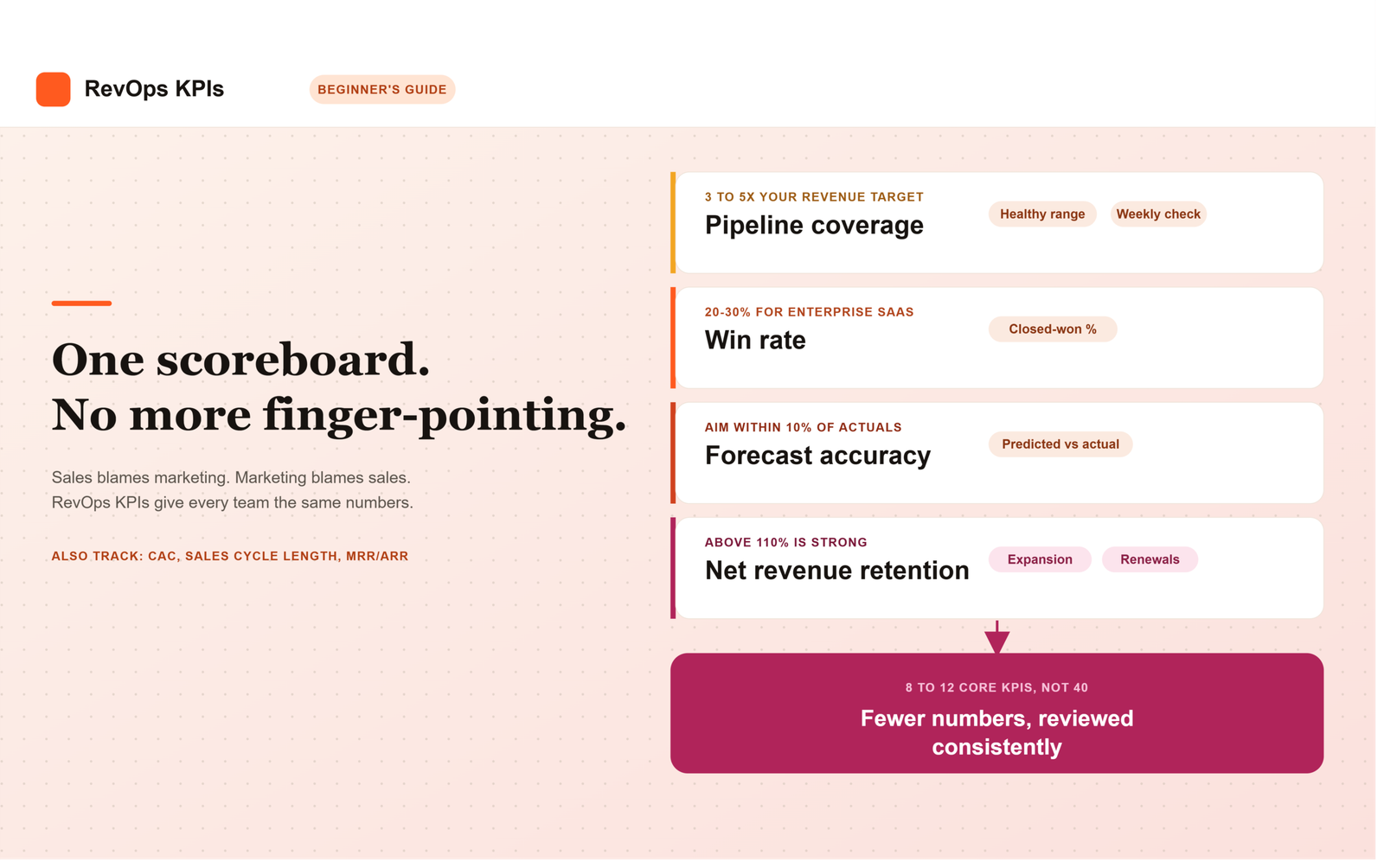
RevOps KPIs are the specific, shared numbers a revenue operations team uses to judge whether sales, marketing, and customer success are actually working toward one revenue goal. They typically include pipeline coverage, win rate, forecast accuracy, net revenue retention, and customer acquisition cost, tracked together instead of as isolated department scorecards.
If you’ve ever sat in a leadership meeting where sales blames a bad quarter on marketing, and marketing blames it on sales follow-up, you already know why this topic matters. RevOps (short for Revenue Operations) exists to end that finger-pointing by giving every team the same set of numbers to look at. But if you’re new to the function, the sheer list of acronyms (CAC, NRR, LTV, MQL) can feel like its own second language.
This post breaks down what RevOps KPIs actually are, why they’re different from the metrics your sales team already tracks, and which ones a beginner should focus on first.
What Is a RevOps KPI, Exactly?
A key performance indicator (KPI) is a measurable value that shows whether you’re hitting a specific goal. In a RevOps context, that goal is almost always tied to revenue, not just activity.
According to Highspot, revenue operations KPIs are key metrics that RevOps teams track regularly to make sure sales, marketing, and customer success activities align with pipeline health, forecast accuracy, retention, and goals. Notice the phrase “align with.” That’s the whole point. A RevOps KPI isn’t just a sales number or a marketing number, it’s a number that shows how well the departments are working as one system.
If you want the bigger picture of how that alignment actually works day to day, our guide to what RevOps is covers the function from the ground up.
Metrics vs. KPIs: What’s the Difference?
People use “metric” and “KPI” interchangeably, but they’re not quite the same thing. Metrics track what’s happening in your business day to day, things like conversion rates, pipeline value, and how many calls a rep made this week. KPIs, on the other hand, are the smaller set of metrics that are explicitly tied to outcomes and used to judge whether the company is hitting its revenue goals.
Put simply: every KPI is a metric, but not every metric deserves to be a KPI. Honestly, most of the RevOps dashboards we see fail not because the data is wrong, but because someone tried to make all 40 metrics equally important. They aren’t.
Why Do RevOps KPIs Matter?
Measuring performance isn’t a side task for RevOps, it’s close to the core of the job. Research from the Revenue Operations Alliance found that defining and measuring metrics and KPIs is one of the top three activities RevOps professionals undertake, with 89% saying it’s part of their role.
Here’s why that matters for you as a founder or revenue leader. Without a shared scoreboard, sales, marketing, and customer success each optimize for their own local goal. Marketing chases lead volume. Sales chases closed deals. Customer success chases renewals. None of those goals are wrong, but none of them alone tells you whether the business is actually healthy.
Leading vs. Lagging: The Framework Behind Every Good KPI List
Before you pick specific numbers to track, it helps to understand this one distinction. Lagging indicators tell you what already happened, things like revenue, churn, and closed deals. Leading indicators tell you what’s about to happen, like pipeline velocity, conversion trends, and satisfaction scores that are quietly declining.
A dashboard built only on lagging indicators is a rearview mirror. It tells you the crash already happened. A good RevOps KPI list mixes both, so you can see trouble coming and not just read the obituary afterward.
A Beginner’s List of RevOps KPIs
You don’t need forty metrics to start. Based on what actually shows up across most B2B revenue teams, here’s a practical starter list:
Pipeline coverage ratio, how much open pipeline you have compared to your revenue target. A commonly cited healthy range is around 3 to 5 times your goal.
Win rate, the percentage of opportunities that close as won. Enterprise SaaS deals often land somewhere around 20 to 30%.
Sales cycle length, how long it takes a deal to move from open to closed, which tends to run shorter for SMB deals and considerably longer for enterprise deals.
Forecast accuracy, how close your predicted revenue was to what actually closed. Many RevOps teams aim to stay within about 10% of actuals.
Net revenue retention (NRR), how much revenue you keep and grow from existing customers, with anything above 110% generally considered strong.
Customer acquisition cost (CAC), the total cost of acquiring a new customer, usually made more useful when compared against customer lifetime value (LTV) as a ratio.
MRR/ARR (Monthly/Annual Recurring Revenue), your baseline for measuring current performance and growth over time.
Pro tip: don’t try to report all seven of these plus a dozen more in one weekly meeting. The best RevOps dashboards focus on roughly 8 to 12 core KPIs, not forty.
How Do You Actually Build a RevOps KPI Dashboard?
Pick your two or three headline numbers first. Pipeline coverage, win rate, and forecast accuracy are often the numbers that get checked most consistently at the leadership level.
Add supporting metrics underneath. These feed into the headline numbers rather than competing with them.
Set a review cadence. Revenue operations metrics should generally be reviewed at least monthly, with the most critical ones checked weekly or in real time.
Clean your data before you trust the dashboard. A KPI is only as good as the CRM data behind it.
Revisit the list quarterly. What mattered at 10 employees won’t matter the same way at 100.
Summary
A RevOps KPI is different from an ordinary metric because it’s explicitly tied to whether the whole revenue engine, not just one department, is hitting its goal. The distinction between leading indicators, which warn you something is coming, and lagging indicators, which only confirm what already happened, is what separates a useful dashboard from a rearview mirror.
For a beginner team, the starter list comes down to seven numbers: pipeline coverage, win rate, sales cycle length, forecast accuracy, net revenue retention, CAC, and MRR/ARR. Building a dashboard around them means picking two or three headline numbers first, layering supporting metrics underneath, reviewing on a set cadence, and keeping the underlying CRM data clean enough to trust. The goal isn’t tracking more, it’s keeping everyone looking at the same 8 to 12 numbers instead of forty competing ones.
Frequently Asked Questions
What’s the difference between a RevOps metric and a RevOps KPI?
Metrics are the raw numbers you track day to day, like conversion rate or pipeline value. KPIs are the smaller, selected subset of those metrics that are directly tied to whether you’re hitting your revenue goals.
How many KPIs should a RevOps team track?
Most practitioners land somewhere between 8 and 12 core KPIs. More than that tends to create noise instead of clarity.
Do RevOps KPIs replace sales or marketing metrics?
No, they sit above them. Sales metrics still track individual rep performance, RevOps KPIs look at the big-picture, cross-team numbers that show whether the whole revenue engine is working.
How often should we review RevOps KPIs?
Generally at least monthly, with your most important numbers, like pipeline coverage or forecast accuracy, checked weekly or even in real time.
What’s a reasonable forecast accuracy target for a beginner RevOps team?
Staying within about 10% of your actual results is a commonly cited benchmark worth aiming for as you mature your process.
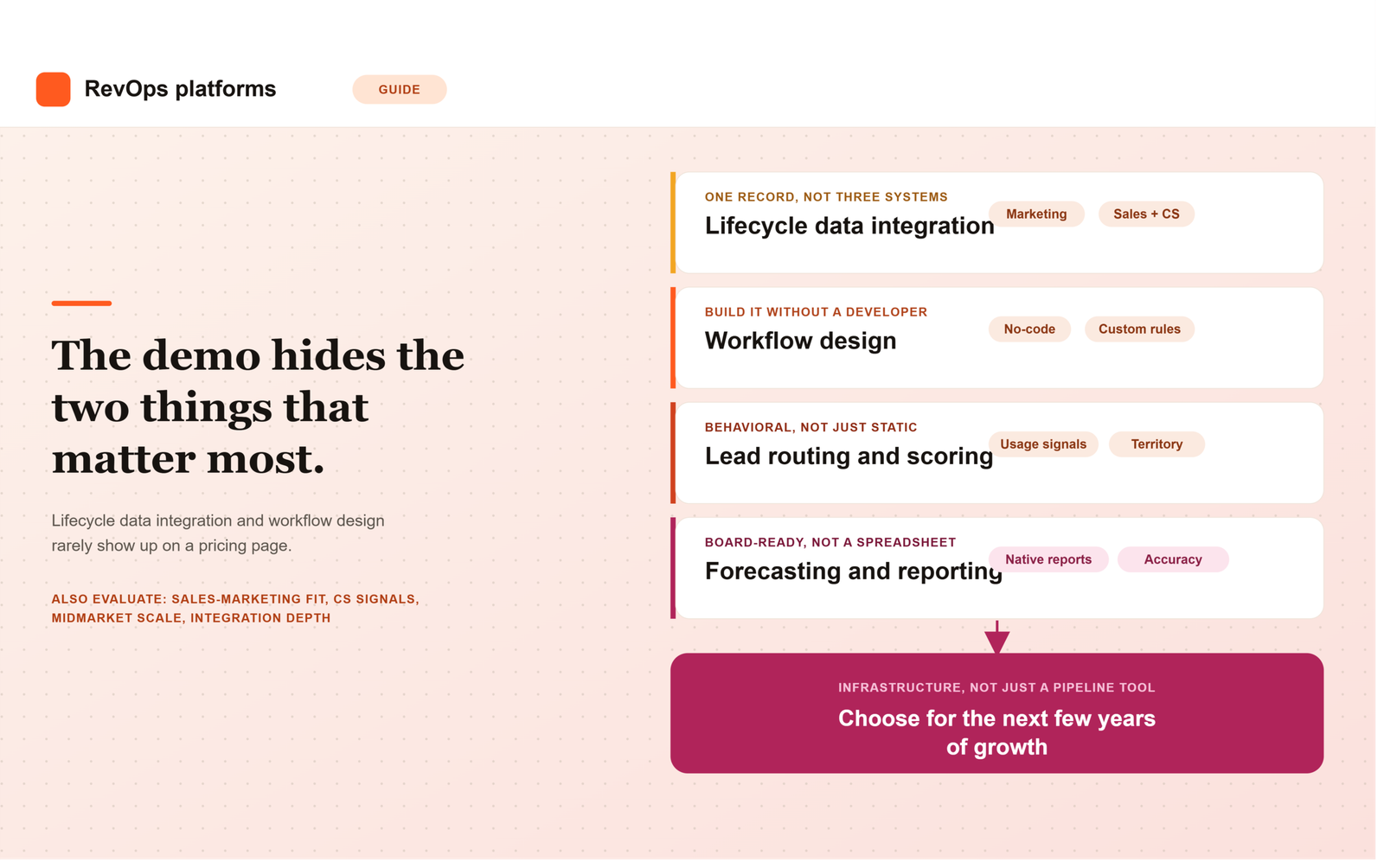
Most comparisons of B2B SaaS CRM and revenue operations platforms focus on the wrong layer. They compare pricing tiers, seat counts, and feature checklists, while the thing that actually determines whether a platform works long term rarely shows up on a pricing page: how well it unifies customer lifecycle data, and how flexibly it lets your team design the workflows that run on top of that data.
A platform can look impressive in a demo and still fail in production if marketing, sales, and customer success data live in three loosely connected systems, or if every process change requires a support ticket to the vendor. This guide breaks down the core capabilities B2B SaaS revenue operations leaders should actually evaluate, with particular attention to lifecycle data integration and workflow design, the two areas where most revenue operations software quietly falls short.
1. Unified Customer Lifecycle Data Integration
Customer lifecycle data integration is the foundation everything else depends on. A B2B SaaS customer generates data across marketing engagement, sales activity, product usage, and support interactions, and a platform that treats these as separate silos forces your team to reconcile them manually every time leadership asks a cross-functional question.
When evaluating a SaaS CRM on this dimension, ask whether marketing engagement data, sales activity, and product usage signals live natively in the same record, or whether they require a separate integration layer to connect. Ask specifically how the platform handles a lead that becomes a customer, then later shows churn risk based on product usage. If tracing that single customer’s full history requires exporting data from three systems, the integration is shallower than the vendor’s pitch suggests.
2. Flexible Workflow Design, Not Just Pre-Built Templates
Workflow design is where a genuine revenue operations platform separates itself from a CRM with automation bolted on. Most platforms ship with template workflows for common processes like lead routing or renewal reminders, which work fine until your business has a rule those templates never anticipated.
Strong RevOps workflow management means your team can build, test, and modify multi-step workflows without needing a developer or a vendor consulting engagement for every change. Ask to see the workflow builder directly during evaluation, not just a slide describing it. Have someone from your own team attempt to build a workflow that mirrors a real process you run today, and see how many steps it actually takes.
3. Native Lead Routing and Scoring
Lead routing and scoring sound like basic features, and most platforms claim to support both. The real question is whether the logic lives natively inside the platform or depends on a third-party add-on that has to be separately licensed and maintained.
Native scoring should weigh behavioral signals such as product usage and engagement, not just static firmographic fields like company size or job title. Ask vendors to walk through exactly how a lead moves from marketing to a specific sales rep, and what happens when routing rules need to change because your territory model changed. If that change requires reconfiguring a separate app rather than adjusting a setting inside the core platform, the routing capability is thinner than it initially appears.
4. Sales and Marketing Automation That Actually Shares Data
Sales and marketing automation frequently exist as two separate products stitched together through an integration, which means definitions drift apart over time. Marketing’s idea of a qualified lead and sales’ idea of a qualified opportunity can end up describing two different things, even though both teams are looking at what they assume is the same data.
A platform built for B2B SaaS revenue operations should let both teams work from shared definitions and shared reporting, not parallel dashboards that require manual reconciliation. Ask the vendor to show a single report tracing a lead from its first marketing touch through to closed revenue, built entirely inside their platform. If that report requires exporting data to a spreadsheet, the alignment gap you’re trying to solve will likely persist regardless of which platform you choose.
5. Customer Success and Retention Signals Built Into the Same System
Retention and expansion depend on customer success signals that many CRM platforms treat as an afterthought, even though recurring revenue businesses depend on them as much as new pipeline. Product usage, support ticket volume, and renewal timing all need to feed into the same system that sales and marketing already use.
When evaluating a platform, ask specifically how it surfaces an account that’s showing early churn risk, and whether that signal reaches the account owner automatically or requires a customer success manager to notice it manually inside a separate tool. A platform that treats retention data as a bolt-on report rather than a native part of the customer record will always lag behind the accounts it should be flagging.
6. Forecasting and Revenue Reporting That Holds Up in a Board Meeting
Forecasting accuracy depends directly on how clean the underlying lifecycle data is, which is why this capability sits so close to data integration on this list. A platform with weak native reporting pushes the real forecasting work onto a RevOps team that then has to rebuild the analysis manually in a spreadsheet every cycle.
Test this directly during evaluation by asking the vendor to reproduce a report your team currently builds by hand, using only their platform’s native reporting tools. If it takes several workarounds or an export to get there, that gap resurfaces every single reporting cycle after the contract is signed.
7. Scalability for Midmarket B2B SaaS Teams Specifically
Midmarket B2B SaaS teams sit in a specific gap: too complex for a bare-bones starter CRM, but without the budget or headcount for a heavy enterprise implementation. A platform aimed at this segment needs to scale with headcount and data volume without forcing a disruptive migration within a couple of years.
Ask vendors directly what breaks first as usage scales, record limits, workflow complexity caps, or reporting performance, and at what size their typical customers outgrow the tier you’re evaluating. Vendors are rarely eager to volunteer this information unprompted, since it points toward a more expensive tier sooner than their sales team would prefer.
8. Integration Depth With Your Existing Stack
Most B2B SaaS teams already run a marketing automation tool, a billing system, and a product analytics platform before they ever evaluate a new CRM. How cleanly a platform connects to that existing stack matters more than how many integrations appear on its marketplace page.
A native, well-maintained integration and a fragile third-party connector can look identical on a features list. The difference only becomes visible once something breaks during a sync, so ask specifically how the integration handles conflicting field updates and what happens when a connected system changes its API.
How to Score These Capabilities When Evaluating Vendors
Rather than treating this list as a generic checklist, build a simple scorecard with these eight capabilities as rows and your shortlisted platforms as columns. Score each cell based on a direct answer or a live demonstration, not marketing copy. Where a vendor cannot answer a specific question concretely, for example, exactly how lifecycle data connects across marketing, sales, and customer success, treat that gap itself as useful information about how the relationship will go after the contract is signed.
The Platform Is Infrastructure, Not Just a Pipeline Tool
The teams that choose well treat a B2B SaaS CRM and revenue operations platform as infrastructure for the next several years of growth, not just a tool for tracking today’s pipeline. Customer lifecycle data integration and flexible workflow design are the two capabilities most likely to be underestimated during a demo, and the two most likely to cause real pain eighteen months after signing if they were.
Frequently Asked Questions
What is customer lifecycle data integration in a RevOps platform?
It means marketing engagement, sales activity, product usage, and customer success signals all live in the same customer record rather than in separate, loosely connected systems. Strong integration lets your team trace one customer’s full history, from first touch through renewal, without exporting data from multiple tools.
Do midmarket B2B SaaS teams need a different platform than enterprise teams?
Often, yes. Midmarket teams need a system that scales for the next few years without a disruptive re-platform, but typically lack the dedicated admin headcount enterprise teams have. The right platform for this stage balances scalability with a workflow builder your existing team can maintain without a certified specialist.
What’s the difference between a SaaS CRM and a full revenue operations platform?
A SaaS CRM typically centers on tracking deals and contacts. A revenue operations platform goes further, natively connecting marketing, sales, and customer success data and supporting the workflow automation that runs across all three, rather than treating pipeline tracking as the only core function.
How important is workflow design compared to out-of-the-box features?
It matters more over time than it does during a demo. Pre-built templates cover common processes, but every company eventually has a rule those templates don’t anticipate. A platform with flexible workflow design lets your team adapt without a developer or a vendor consulting engagement for every change.
Should sales and marketing automation live in the same platform?
Ideally, yes, or at minimum share the same underlying data and definitions. When sales and marketing automation exist as separate products stitched together, lead definitions tend to drift apart, and reporting stops matching between teams even though both are supposedly looking at the same pipeline.
What should we ask vendors specifically about lifecycle data integration?
Ask them to trace one customer’s full history, from first marketing touch through a product usage signal that indicates churn risk, entirely inside their platform. If that requires exporting data to a spreadsheet or switching between separate tools, the integration is shallower than it may have appeared during the initial pitch.
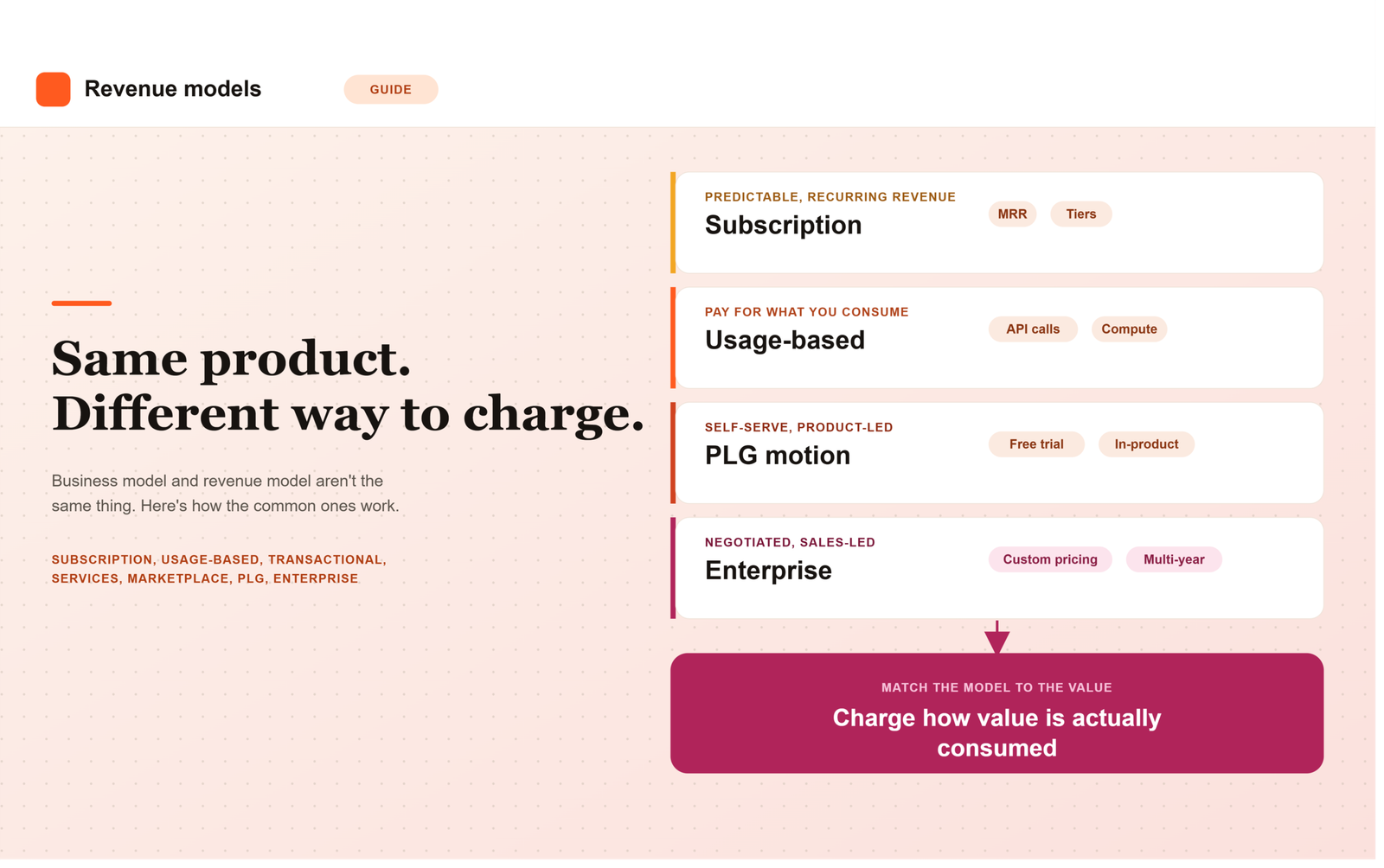
“Business model” and “revenue model” get used as if they mean the same thing. A business model describes how a company creates and delivers value to customers. A revenue model describes the specific mechanism a company uses to convert that value into money. Two companies can share the exact same business model and use completely different revenue models to monetize it.
Take two project management tools built for small teams. Same business model, same target customer, same core value. One charges a flat monthly fee per team. The other charges per active user, per month, based on how many people actually log in. Same product, different meter.
Getting this distinction wrong tends to show up later as a pricing problem that is not really about pricing at all. It is a mismatch between how value gets delivered and how the company chose to charge for it. This guide covers the most common revenue models in use today: subscription, usage-based, transactional, services, marketplace, PLG, and enterprise, along with how to tell which one fits your business.
Business Model vs Revenue Model: What’s the Difference
A business model is the bigger picture: who you serve, what problem you solve, and how you deliver that solution. SaaS, marketplace, agency, and hardware are all business models. A revenue model sits underneath that and answers a narrower question: how does money actually change hands?
A single business model can support several different revenue models at once. A SaaS company might charge some customers a flat subscription, charge others based on usage, and negotiate custom enterprise contracts for its largest accounts, all while running the exact same product and the exact same business model underneath. The revenue model is the layer that changes based on the customer, the market, and how value actually gets consumed.
Subscription: Predictable, Recurring Revenue
Subscription pricing charges a fixed, recurring fee, usually monthly or annually, in exchange for ongoing access to a product or service. It is the dominant revenue model in SaaS for a simple reason: it produces predictable, recurring revenue that is easy to forecast and easy to report to a board.
Subscription works best when value is delivered continuously rather than in a single moment. A customer does not buy project management software once and finish using it. They rely on it every day, which makes a recurring fee feel proportionate to the ongoing value they get.
Most subscription businesses layer tiers on top of the base model, separating features, seats, or support levels into Basic, Pro, and Enterprise packages. The metric that matters most here is monthly recurring revenue, or MRR, along with net revenue retention, since subscription businesses live and die by how well they keep and expand existing customers, not just how many new ones they sign.
The weak point of subscription pricing shows up when usage varies wildly between customers. A flat fee undercharges your heaviest users and overcharges your lightest ones, which is exactly the gap usage-based pricing was built to close.
Usage-Based: Pay for What You Consume
Usage-based pricing charges customers according to how much they actually consume: API calls, compute time, messages sent, storage used, or transactions processed. Instead of a flat monthly number, the bill moves with actual activity.
This model has become the default for infrastructure and API-driven products. Companies like Twilio, AWS, and Snowflake all charge this way, largely because it aligns cost directly with the value a customer is getting in that specific month. A customer sending a thousand messages pays less than one sending a million, without anyone having to negotiate a custom tier.
Usage-based pricing also makes it easier to land small and expand naturally. A new customer can start with a tiny footprint and a tiny bill, then grow into a much larger contract as their usage grows, all without a renegotiation. The tradeoff is forecasting difficulty. Revenue depends on customer behavior that is harder to predict than a fixed subscription count, which makes usage-based businesses lean harder on cohort analysis and consumption trends to build a credible forecast.
Transactional: A Fee Per Transaction
Transactional revenue models charge a fee for each discrete transaction or event that flows through the system, rather than a recurring subscription or a usage meter. Payment processors are the clearest example: Stripe and similar companies charge a small percentage plus a fixed fee on every transaction processed, and revenue scales directly with transaction volume.
This model fits businesses where the core value genuinely happens transaction by transaction, moving money, processing an order, completing a booking, rather than through continuous product access. The upside is that revenue grows automatically as customers do more business, without anyone needing to upsell a bigger plan. The downside is that revenue can swing with external factors like seasonality or a customer’s own business volume, which is largely outside your control.
Services: Billing for Human Labor
Services revenue comes from billable hours, fixed-price projects, or ongoing retainers, where the primary value delivered is human expertise rather than software. Consultancies, agencies, and implementation partners run on this model, and it remains common even inside software companies, particularly for onboarding, custom integrations, and enterprise implementation work.
The defining constraint of a services model is that revenue is tied to headcount capacity, not software leverage. A consultancy cannot serve twice as many clients without roughly twice as many consultants, which caps how efficiently the model scales compared to a pure software business.
Many software companies run a blended model on purpose, software revenue for the recurring product and services revenue for the one-time implementation work that gets a customer live. The services piece often exists specifically to reduce the risk of the software piece failing to deliver value fast enough on its own.
Marketplace: A Take Rate on Both Sides
Marketplace revenue models take a commission, often called a take rate, on transactions that happen between two separate parties on a shared platform: buyers and sellers, drivers and riders, freelancers and clients. The platform itself rarely owns the underlying inventory or service; it earns money by facilitating the match and taking a cut of the value that changes hands.
What makes marketplace revenue distinct is that it depends on liquidity on both sides at once. A marketplace with plenty of buyers and no sellers earns nothing, and vice versa, which means growth strategy has to account for both sides simultaneously rather than just acquiring customers the way a typical subscription business would.
Take rates vary enormously by category, from low single digits in categories with thin margins to twenty percent or more in categories where the platform provides significant additional value, like payment handling, trust and safety, or logistics.
PLG: A Motion That Shapes the Revenue Model
Product-led growth, or PLG, is technically a go-to-market motion rather than a revenue model on its own, but it shapes which revenue model actually works. In a PLG motion, the product itself drives acquisition and conversion through a free trial or freemium tier, with little or no sales involvement until later in the customer’s lifecycle.
Because there is no salesperson negotiating a custom deal, PLG companies almost always pair the motion with self-serve pricing, either a simple subscription tier a user can select with a credit card, or usage-based pricing that scales automatically as the account grows. The monetization has to be instrumented directly into the product, since there is nobody manually walking a prospect through a pricing conversation.
The tell that a company is running a genuine PLG motion is not the pricing page, it is whether a user can go from signup to real value without ever speaking to a human being.
Enterprise: Negotiated, Sales-Led Revenue
Enterprise revenue models rely on custom, negotiated contracts closed through a sales-led process rather than a self-serve checkout. Pricing is rarely published, terms are negotiated deal by deal, and contracts often run multi-year with committed spend, custom SLAs, and dedicated support built in.
This model produces a very different shape of business than subscription or PLG: fewer total customers, but a much higher average contract value per account. It also introduces a much longer sales cycle, often stretching across procurement and legal review that a self-serve customer never has to think about.
Many companies that start on subscription or PLG eventually add an enterprise tier once their largest customers start asking for things a standard plan cannot accommodate: custom security requirements, dedicated infrastructure, or contract terms their legal team requires before they can sign anything at all.
How to Choose, or Blend, the Right Model
Most real businesses do not run a single, pure revenue model. They blend two or three: a base subscription plus usage-based overage charges, a subscription plus a one-time services fee for onboarding, or a self-serve PLG tier that graduates into negotiated enterprise contracts once an account grows large enough.
The right starting point is not which model is easiest to bill for. It is how your customer naturally experiences and consumes value. If value is delivered continuously and evenly, subscription usually fits. If value scales directly with volume of activity, usage-based or transactional pricing usually fits better. If the value is mostly human expertise, a services model probably belongs somewhere in the mix, even if the core product is software.
Choosing the wrong model rarely looks like a pricing failure at first. It looks like customers churning for reasons that do not show up in a typical exit survey, or expansion revenue that never quite materializes even though usage is clearly growing. Before assuming your price is wrong, it is worth asking whether your model is.
Frequently Asked Questions
What is the difference between a business model and a revenue model?
A business model describes how a company creates and delivers value, who it serves and what problem it solves. A revenue model describes the specific mechanism used to charge for that value, such as a subscription fee, a usage meter, or a transaction fee. The same business model can support several different revenue models at once.
Can a company use more than one revenue model at the same time?
Yes, and most established companies do. A common blend is a base subscription plus usage-based overage charges once a customer exceeds an included amount, or a self-serve subscription for smaller accounts alongside negotiated enterprise contracts for the largest ones. Blending models lets a company match different customer segments to the pricing approach that fits how each one actually consumes value.
Is PLG a revenue model or a go-to-market strategy?
PLG, or product-led growth, is a go-to-market motion, not a revenue model on its own. It describes how customers discover and adopt a product, largely through a free trial or freemium tier without sales involvement. It usually pairs with a self-serve subscription or usage-based pricing model, since both can be instrumented directly into the product without a salesperson negotiating terms.
Why do SaaS companies eventually add an enterprise pricing tier?
Large customers often need things a standard self-serve plan cannot accommodate: custom security or compliance requirements, dedicated infrastructure, multi-year commitments, or contract terms their legal and procurement teams require before signing. Adding a negotiated enterprise tier lets a company capture that revenue without forcing every customer through the same sales-led process.
How do I know if I picked the wrong revenue model?
The signals rarely look like an obvious pricing complaint. Watch for churn that does not show up as a clear complaint in exit surveys, or expansion revenue that stays flat even though product usage is clearly growing. Both often mean the way you charge does not match how customers actually experience value, which is a model problem, not just a price problem.
What is a take rate in a marketplace revenue model?
A take rate is the commission percentage a marketplace keeps from each transaction that happens between buyers and sellers on its platform. Take rates vary widely by category, from low single digits in thin-margin categories to twenty percent or more where the platform adds significant extra value, such as payment processing, trust and safety, or logistics handling.
Understanding what each function owns and where they overlap
The language around commercial operations has become harder to follow than the underlying work.
A growing company may have Sales Operations, Marketing Operations, Customer Success Operations, Revenue Operations, Deal Desk, Sales Strategy, Business Operations, and several systems or analytics teams working around them. Their job descriptions often use much of the same vocabulary: process, data, systems, planning, forecasting, productivity, automation, reporting.
From the outside, the distinctions can look artificial.
There is a reason for the overlap. These functions did not emerge from a single organizational model. They developed at different times to solve different operating problems, usually inside departments that had become large enough to need specialist support.
Sales Operations came first. Marketing later built its own operations capability as marketing became more dependent on data and technology. Customer Success Operations developed as post-sale work became more structured, particularly in recurring-revenue businesses. Revenue Operations appeared later, partly because companies were finding that the specialist teams could work well inside their own areas while the full customer journey remained fragmented.
It helps to look at that history before trying to draw neat ownership boundaries.
Sales Operations grew around the needs of the sales force
Sales Operations has the longest history of the four. Salesforce traces the formal function to Xerox in the 1970s, when J. Patrick Kelly created a team to handle planning, forecasting, territory design, compensation, and other work required to run an increasingly complex sales organization.
The basic problem has changed less than the technology around it.
Once a company employs more than a small number of salespeople, someone has to decide how accounts should be divided, how many sellers are required, how targets should be allocated, how opportunities are tracked, and how management should interpret the pipeline.
Territories alone can become complicated. A company might divide accounts by geography, industry, size, product, existing relationship, or some combination of these. The design affects hiring, compensation, customer ownership, and the likelihood that good opportunities receive attention.
Forecasting creates another body of work. Sales managers need a common way to describe the status of opportunities. Senior management needs an estimate of likely future sales. Those estimates depend on the quality of the underlying sales process and the discipline with which people maintain it.
GitLab’s public Sales Operations documentation gives a useful picture of the function in practice. Its team works on sales processes, policies, systems, reporting, territories, field support, and go-to-market planning.
This is familiar Sales Ops territory. The team is close to sellers and sales management because most of its work begins with the question of how the sales organization should operate.
That proximity matters. A territory model may look balanced analytically and still fail because experienced sellers know that two apparently similar regions behave very differently. A required opportunity field may improve reporting while making little sense in the actual sales conversation. Good Sales Ops usually requires frequent contact with the people whose work it is organizing.
Some responsibilities move in and out of the function depending on the company. Sales compensation might sit with Finance. Deal Desk may be part of Sales Ops in one organization and RevOps in another. Sales enablement may be closely connected or entirely separate.
There is no standard boundary that every company follows.
Marketing developed a different operating problem
The modern marketing organization produces large amounts of activity and data before a salesperson becomes involved.
A potential customer might attend an event, visit the website several times, subscribe to a newsletter, download a research report, respond to an advertisement, or join a webinar. Each interaction may enter a different system.
Someone has to make those systems usable.
Marketing Operations usually works on the infrastructure behind marketing execution: automation, campaign setup, databases, tracking, lead processes, reporting, and the technology connecting these activities.
HubSpot describes the function broadly around the people, processes, and technology that support marketing strategy, including planning, workflow development, campaign analysis, data management, and performance measurement. GitLab’s Marketing Operations charter places similar emphasis on marketing technology, standardized processes, data quality, and systems management.
The difference from Sales Ops becomes easier to see in day-to-day work.
A Marketing Ops manager might spend time fixing campaign attribution, improving the process for handling webinar registrations, cleaning duplicate contact records, redesigning lead scoring, or deciding how data should move between the marketing automation platform and the CRM.
A Sales Ops manager may use some of the same systems and data while worrying about a different set of questions: account ownership, pipeline quality, seller capacity, or whether a manager’s forecast is realistic.
The distinction is clear enough while the work remains inside each department. It becomes less clear when Marketing decides that a person is ready for Sales.
At that point, the two operating systems meet.
Marketing may have a rule saying that a lead becomes qualified after a certain combination of actions. Sales may discover that the rule generates too many weak opportunities. Marketing Ops can adjust the scoring model, but Sales has information that matters to the change. Sales Ops understands territories and account ownership, which in turn affects where qualified leads should go.
The work is shared because the process itself crosses the departmental boundary.
Customer Success Operations appeared later
Customer Success became a major organizational function much later than Sales or Marketing, particularly with the growth of software subscriptions and other recurring-revenue business models.
In these businesses, the first sale may represent only part of the value of the customer relationship.
A customer needs to begin using the product, adopt it successfully, receive enough value to remain, and eventually decide whether to renew. Some customers expand. Others reduce spending or leave.
Customer Success teams eventually encounter many of the same operating challenges that Sales and Marketing faced earlier.
Accounts need to be assigned. Managers need to understand how many customers each Customer Success Manager can reasonably handle. Onboarding processes need some consistency. Customer information sits in several systems. Renewal dates need to be visible before they become urgent. Leaders want to identify accounts that may be at risk.
CS Ops grew around these needs.
Gainsight describes Customer Success Operations as supporting CS organizations through systems, analytics, process development, and program management. GitLab’s CS Ops team works on customer-success systems, reporting, customer journeys, product-usage analytics, renewals, and operational planning.
Much of the work concerns scale.
A good Customer Success Manager may notice that a particular customer has stopped using an important part of the product and decide to intervene. CS Ops looks across the customer base and asks whether similar signals can be identified systematically.
The team may also help determine which customers should receive high-touch service, which can be supported through more standardized programs, and how renewal activity should be organized.
As with the other functions, these decisions often extend beyond the department itself. Renewal revenue matters to Finance and company forecasting. Expansion may return the customer to Sales. Product-usage information may change how Marketing defines a strong prospective customer.
The customer may be “post-sale,” but the commercial relationship is still active.
Why the boundaries get messy
A diagram of the customer lifecycle makes ownership look straightforward.
Marketing continues to influence existing customers. Customer Success may identify an expansion opportunity that requires a salesperson. Sales may remain involved in a large account long after the original contract is signed. Finance can influence pricing and renewal terms. Product usage can become relevant to both Sales and Marketing.
Even relatively simple processes can require several operations teams.
Suppose Marketing generates an inbound request from a company that is already a customer.
Marketing Ops controls the system that captured the request. Sales Ops may own the rules determining which salesperson handles the account. CS Ops may know that the customer is currently in a sensitive renewal conversation. Sending the request directly to a new-business seller without considering the existing relationship could create an awkward customer experience.
The system needs some way to recognize the situation.
A similar issue appears when territories change. Sales Ops may redesign account ownership at the beginning of the year. Marketing’s routing logic must then reflect the new structure. If it does not, leads continue travelling according to last year’s rules.
Neither function can complete the change entirely on its own.
This kind of overlap occurs repeatedly: lead qualification, lead routing, account ownership, sales handoffs, renewals, expansion, forecasting, and customer data. The difficulty usually comes from different teams having legitimate interests in the same process.
Where Revenue Operations enters
Revenue Operations developed in part because companies needed a broader operating view across these specialist functions.
Forrester’s work on RevOps describes Marketing Operations, Sales Operations, and Customer Success Operations as parts of a wider revenue system and focuses on the coordination of data, technology, processes, and planning across them.
Annual planning shows why that broader view can be useful.
Marketing may expect to generate a certain amount of demand. Sales may plan headcount and territories based on an expected number of opportunities. Customer Success may be preparing for a much larger customer base. Finance has revenue and cost assumptions of its own.
Each team can create a credible plan based on its local information. The problems appear when the assumptions do not line up.
Sales may expect more opportunities than Marketing believes it can produce. Customer Success may need to support a level of growth without the required capacity. Finance may assume a renewal rate that recent customer behavior does not support.
These are the situations in which a RevOps team can be useful. It can bring together assumptions that otherwise live in separate planning processes and help management understand the operating implications of the revenue target.
The same role appears in reporting.
Marketing may report leads and opportunities created. Sales reports pipeline and bookings. Customer Success reports renewals and expansion. Finance has the official financial view.
A management team trying to understand the complete commercial picture needs those measures to connect. RevOps often works on that connection, sometimes through shared definitions, sometimes through common systems, and sometimes simply by bringing the operating teams into the same planning process.
Not every company centralizes this work. Forrester has argued that Revenue Operations can exist as a coordinated capability even when Marketing Ops, Sales Ops, and CS Ops remain separate organizations.
That model is common because the specialist teams still have substantial work that belongs inside their functions.
GitLab shows how the overlap looks in practice
GitLab is useful because its public handbook exposes much of the operating structure that other companies keep internal.
Its Marketing Operations team manages marketing technology, processes, data quality, and systems. Sales Operations focuses on the sales organization, including policies, tools, territories, and sales execution. Customer Success Operations works on customer-success processes, systems, reporting, and renewals.
On paper, these responsibilities can be separated easily.
The handbook itself shows constant interaction between them.
GitLab’s Sales Operations roles include collaboration with Marketing on lead-management processes. Marketing Operations manages systems whose outputs are used elsewhere in the commercial organization. Customer Success Operations works on renewal processes that eventually affect revenue forecasting and account planning.
The teams remain distinct because they need specialist knowledge. The connections remain because customers and customer data move through more than one function.
GitLab also places Sales Operations and Customer Success Operations within a broader Field Operations organization alongside Sales Strategy, Deal Desk, Sales Systems, and Data Intelligence.
That structure is specific to GitLab. Another company might group the same work differently.
The example is useful because it shows that operational design tends to develop around practical needs rather than around perfectly clean definitions.
Ownership is often shared at the edges
Some activities have a natural home.
Sales territory design will usually sit close to Sales Ops. Marketing automation belongs naturally with Marketing Ops. CSM capacity planning is normally a CS Ops concern.
Other activities are harder to place because the consequences spread across functions.
Forecasting is one example.
Sales managers usually produce views of the opportunities they expect to close. Sales Ops supports the process and systems behind those estimates. CS Ops may contribute renewal expectations. RevOps may assemble the broader commercial forecast. Finance may adjust or interpret it for the financial plan.
Several groups can therefore “own forecasting” without doing the same work.
Customer data has the same characteristic.
Marketing needs campaign and engagement information. Sales needs accounts, contacts, opportunities, and pipeline history. Customer Success cares about product usage, customer health, support issues, renewal dates, and outcomes.
A company still needs agreement on basic identifiers and definitions if those records are expected to describe the same customer.
This is where many arguments about organizational ownership become unproductive. The useful level of detail is usually the specific decision being made.
Who decides the sales territory? Who maintains the routing logic? Who defines a qualified marketing lead? Who decides when a customer becomes at risk? Who determines the renewal forecast category? Who can change a customer identifier used across several systems?
The answers may be different even when all of these activities sit inside the same technology platform.
Technical ownership and business ownership are often separate.
A practical view of the boundaries
The following map reflects common patterns rather than fixed rules.
Area of work
Typical operational home
Common overlap
Marketing automation and campaign operations
Marketing Ops
RevOps on shared data and lifecycle rules
Marketing data quality and attribution
Marketing Ops
Sales Ops when measuring conversion into pipeline
Lead qualification
Marketing Ops
Sales Ops and RevOps
Lead and account routing
Sales Ops / Marketing Ops
RevOps when company-wide rules are needed
Territory design
Sales Ops
Finance and RevOps during annual planning
Quotas and seller capacity
Sales Ops
Finance and RevOps
Sales pipeline process
Sales Ops
RevOps for company-wide definitions and reporting
Sales forecasting mechanics
Sales Ops
RevOps and Finance
Sales-to-CS handoff
Sales Ops / CS Ops
RevOps when standardization spans the lifecycle
CSM capacity and customer segmentation
CS Ops
RevOps during company planning
Customer health and CS systems
CS Ops
Product, Sales, and RevOps depending on use
Renewal operations
Often CS Ops
Sales Ops, RevOps, and Finance
Expansion process
CS Ops or Sales Ops
RevOps when ownership crosses teams
Shared customer definitions
RevOps / shared governance
All specialist Ops teams
End-to-end revenue reporting
RevOps
Marketing Ops, Sales Ops, CS Ops, Finance
Revenue capacity planning
RevOps with Finance
All specialist Ops teams
The table becomes inaccurate as soon as it is treated as a template.
A company in which Sales owns renewals will organize renewal operations differently from one in which Customer Success owns them. A channel business may have a large Partner Operations function that changes several of these responsibilities. A small company may place nearly everything in the hands of one Sales Ops or RevOps employee.
The business model usually explains more than the title.
Company size changes the answer
Early-stage companies tend to have blurred operations roles because specialization would create more overhead than value.
The first operations hire may manage Salesforce, prepare board reports, calculate commissions, clean marketing data, fix account assignments, and maintain renewal information. Whether the person’s title is Sales Operations or Revenue Operations often tells us less than the list of work on their desk.
Specialization appears as the volume grows.
Marketing eventually needs dedicated expertise in its technology and data. Sales requires more sophisticated territory, compensation, forecasting, and capacity work. Customer Success needs its own processes and systems as the customer base expands.
The company gains deeper expertise, though coordination becomes harder.
This is one reason RevOps often becomes more visible in later stages of growth. The business now has enough specialized operating teams that somebody has to maintain a view across them.
Sometimes that leads to centralization under one RevOps leader. Sometimes the teams remain separate and share planning, data governance, and systems standards. Some companies use a hybrid arrangement.
The right structure also changes over time. A centralized model can be useful while a company standardizes fragmented processes, then becomes unnecessarily heavy later. A decentralized model can preserve expertise and speed while creating duplicated technology and inconsistent definitions.
Organizational design in this area is rarely permanent.
How to tell whether the boundaries are working
The quality of the structure becomes visible in routine situations.
When Marketing changes the definition of a qualified lead, Sales should understand the consequence before the change goes live.
When Sales redesigns territories, inbound routing should change at the same time.
When a salesperson closes a customer, the post-sale team should receive the information it needs without reconstructing the entire sales history.
When a renewal becomes uncertain, the change should eventually reach the revenue outlook.
Managers should also know where to take a problem. If every cross-functional issue requires escalation to the Chief Revenue Officer, the operating model is probably incomplete. If teams routinely change shared processes without speaking to one another, the model has a different weakness.
Some overlap is healthy. It forces functions to consider consequences outside their immediate department.
The burden comes when the same decision has several owners, or none.
What each function is really there to do
Sales Ops, Marketing Ops, and CS Ops remain useful categories because the departments they support have genuinely different operating needs.
Sales Ops spends most of its time making the sales organization easier to manage and more productive. Marketing Ops builds the systems and processes that allow Marketing to operate at scale. CS Ops provides similar operating support for the post-sale customer organization.
Revenue Operations becomes relevant when the company needs a wider operating view across those functions.
That wider view can involve shared planning, definitions, technology, customer data, lifecycle processes, forecasting, and reporting. The exact scope changes from company to company because the commercial model changes.
There is little benefit in forcing every activity into one universal chart.
A more realistic organization accepts that some work is local, some is shared, and some needs a common owner because several teams depend on the same decision.
That is where the distinctions among RevOps, Sales Ops, Marketing Ops, and CS Ops become useful in practice.
Frequently Asked Questions
What’s the actual difference between RevOps, Sales Ops, Marketing Ops, and CS Ops?
Sales Ops, Marketing Ops, and CS Ops each support one department: sales, marketing, and post-sale customer teams respectively, and grew up solving that department’s specific operating problems. RevOps sits above them, focused on the shared processes, definitions, and reporting that cross department lines, like lead handoffs, forecasting, and renewal visibility.
Which came first: Sales Ops, Marketing Ops, or CS Ops?
Sales Operations has the longest history, tracing back to Xerox in the 1970s. Marketing Operations developed later as marketing became more dependent on data and technology. Customer Success Operations is the newest of the three, emerging alongside the growth of subscription and recurring-revenue business models. Revenue Operations appeared after all three, once companies needed a broader view across specialist teams that were each working well on their own.
Who owns lead routing, Sales Ops or Marketing Ops?
Often both, which is exactly the kind of overlap that causes confusion. Marketing Ops typically controls the system that captures and scores the lead, while Sales Ops owns the rules for which salesperson or team receives it, based on territory and account ownership. When company-wide consistency is needed across both sides of that handoff, RevOps usually gets involved.
Does a company need RevOps if it already has Sales Ops, Marketing Ops, and CS Ops?
Not necessarily as a separate team. Some companies centralize this coordination under a dedicated RevOps function, while others keep Marketing Ops, Sales Ops, and CS Ops separate and share planning, data governance, and systems standards between them. Both models work; what matters is that somebody has responsibility for the decisions that cross departmental lines, like shared customer definitions and end-to-end revenue reporting.
Why do these org structures vary so much between companies?
Because the business model usually explains more than the title does. A company where Sales owns renewals will structure renewal operations differently than one where Customer Success owns them. A channel-based business may have a Partner Operations function that reshapes several other responsibilities. There’s no universal chart that fits every company, only common patterns.
How does company size change how these functions are organized?
Early-stage companies tend to blur these roles into one person handling everything from CRM administration to board reporting, since specialization would create more overhead than value at that size. As volume grows, Marketing, Sales, and Customer Success each need dedicated operating expertise, and RevOps typically becomes more visible at that later stage, once there are enough specialized teams that someone needs to maintain a view across all of them.
Scope, purpose, responsibilities, and why RevOps exists
In 2025, Pearson made an organizational change that received far less attention than its investments in artificial intelligence or new products. The company brought several teams together under a dedicated Revenue Operations unit. Pearson said the change was intended to standardize sales processes, strengthen pipeline management, unify data sources, and make decision-making clearer and faster.
The decision is interesting because Pearson already had the functions one would normally associate with producing revenue. It had sales teams, marketing teams, customer-facing groups, finance professionals, technology, and management. Creating Revenue Operations therefore raises a basic organizational question: what was missing?
The answer is found in the way companies divide work.
A business usually organizes people according to expertise. Marketing attracts and develops potential customers. Sales manages commercial conversations and closes business. Finance deals with the financial consequences. Customer Success, service, implementation, or account-management teams take responsibility after the sale. Specialization makes each of these groups better at its own work.
Customers do not move through a company in the same way that boxes appear on its organization chart. Their experience passes through several of those groups, often without knowing where one department ends and another begins. A person may respond to an advertisement, speak to a salesperson, negotiate a contract, receive an invoice, begin using a service, ask for support, and eventually renew. To the customer, it is one relationship.
Inside the company, it can be six different processes.
Revenue Operations grew out of that gap.
The awkward spaces between departments
Consider something as ordinary as a new sales inquiry. Marketing has to decide when a person’s interest is strong enough to justify a salesperson’s time. Sales then needs to know who should receive the opportunity. That may depend on geography, company size, product, existing relationships, or the salesperson’s capacity.
None of this is especially difficult when a business has ten employees. People can talk to each other. Exceptions are remembered. A founder may know the history of every important account.
The same arrangements become fragile when a company has several sales teams, thousands of customers, multiple products and several information systems. One region develops a different definition of a qualified opportunity. Another keeps a spreadsheet because the central system does not quite fit its needs. Marketing believes it has produced a strong pipeline; Sales believes much of it is unusable. Both can support their position with data.
The problem continues further down the customer journey. A salesperson may agree to a special contract term without realizing how difficult it will be to administer. Information discussed during the sale may never reach the implementation team. Nobody starts work on a renewal because Sales believes Customer Success owns it and Customer Success believes the account manager owns it.
Most of these failures are unremarkable when seen individually. One lead waits too long. One field is missing. One account is assigned to the wrong person. One contract takes four additional days to approve. Over time, the accumulated cost can be substantial, and much of it sits between conventional departmental responsibilities.
Research firms have come to describe RevOps in similar terms. Gartner frames it as an end-to-end operating model spanning go-to-market functions, with shared processes and information across the revenue cycle. Forrester emphasizes the coordination of data, processes, technology, and people across the customer lifecycle.
Those definitions are useful, although they can make the subject sound more abstract than it needs to be. RevOps deals with the practical consequences of having several departments participate in the same commercial relationship.
What people in RevOps spend their time doing
The work is often surprisingly ordinary.
A RevOps team may decide how accounts are assigned to salespeople. It may define the stages in a sales process and determine what information is required before an opportunity can move from one stage to the next. It may establish rules for discounts or approvals. It can maintain the systems through which sales and customer information flows, build the process used for forecasting, or investigate why Marketing and Sales report different numbers for what appears to be the same activity.
Some teams also work on renewals, sales compensation, territories, capacity planning, pricing processes, and customer handoffs. The precise list changes considerably from one company to another.
A recent Zoom Revenue Operations role gives a sense of that range. Its responsibilities cover the path from demand generation and pipeline management through forecasting, quoting, billing, renewals, and expansion. The role also works with Sales, Marketing, Finance, IT, Legal, and customer-facing operations.
A job description should not be mistaken for a universal definition of RevOps. It does reveal why the function can be difficult to explain. Many of its activities already existed somewhere in the company before anyone used the name Revenue Operations.
Sales Operations, for instance, has long handled territories, forecasts, sales systems, quotas and sales-process design. Marketing Operations manages important parts of the marketing process and its supporting technology. Customer Success Operations performs similar work after a customer has purchased. Finance has always cared about pricing, contracts, forecasts and revenue.
RevOps changes the field of view. An issue can begin in Marketing and show up later as a Sales problem. A sales decision can create a billing problem months afterward. A weak handoff at the time of purchase may later appear in customer-retention figures. Looking at each function separately makes these connections harder to see.
This broader view is also where the boundaries of RevOps become less tidy. There is no universal organization chart that every company should copy. Some firms place Marketing Operations, Sales Operations and Customer Success Operations under one leader. Others keep those teams separate and use RevOps as a smaller coordinating group. In some businesses the function reports to the Chief Revenue Officer; elsewhere it may sit closer to Finance or the Chief Operating Officer.
The practical arrangement depends on the company’s business model and history. A recurring-revenue software business faces different operating questions from an industrial manufacturer working through distributors. The former may devote considerable attention to renewals and account expansion. The latter may care more about channel ownership, pricing, inventory commitments, or dealer relationships.
This variation is sometimes treated as evidence that RevOps lacks a clear definition. It may simply reflect the fact that operating problems differ.
Why the function tends to appear during growth
The need for RevOps often becomes noticeable after a company has already succeeded.
Early growth can be held together by people. A strong sales manager remembers exceptions. A founder resolves disputes. Finance knows which unusual contracts need attention. Employees develop informal habits that compensate for gaps in the formal process.
Headcount then increases. A second region opens. A new product line requires different expertise. One customer system is joined by another. People who designed the original process leave and their replacements inherit pieces of it without the original context.
At some point, coordination that depended on familiarity has to become explicit.
Pearson’s description of its own change is revealing here. The company placed Revenue Operations under a broader effort to create “execution synergies” and described the consolidation alongside work on operational systems and customer-centric execution. Elsewhere in the same report, Pearson says the new Revenue Operations team is intended to improve coordination between marketing, sales, and customer success operations.
There is a familiar pattern behind this. Growing organizations acquire complexity in small increments. A new approval is introduced because a previous deal went wrong. A new field is added because management wants another report. A region creates its own process because the global one does not fit a local need. Another software product is purchased to solve a problem in the existing software.
No single decision creates the complexity. A few years later, employees may need five systems and several manual workarounds to complete a task that once required an email.
Revenue Operations can provide a place to examine that accumulation. Sometimes the answer is a new process. Sometimes an old process needs to be removed. The second outcome receives less attention, although it is often more valuable.
Revenue targets eventually become operating questions
Senior management may set a goal such as increasing revenue by 15 percent. The goal itself says little about how the additional revenue will appear.
Perhaps the company needs many more new customers. Perhaps existing customers could purchase more. Perhaps customer losses are high enough that improving retention would have a larger effect than increasing new sales. The business may already have sufficient demand and lack enough sales capacity to handle it.
Once the goal reaches the operating level, it produces a series of questions. How many credible sales opportunities are required? How long does a typical deal take? Does the company have enough people to work those opportunities? Which customer segments convert well? Are current renewal rates sufficient? Where are deals slowing down? What happens to margins as discounting increases?
These questions cut across the information held by several departments. Marketing knows something about demand. Sales knows something about the active pipeline. Customer teams know something about retention and expansion. Finance has the financial view. RevOps often becomes the place where those pieces are assembled into a usable operating picture.
Forecasting provides a good example. A forecast is easy to think of as a Sales responsibility because salespeople know the deals currently under discussion. Yet future revenue in many companies also depends on renewals, new demand entering the system, available selling capacity, pricing decisions, and the reliability of the stages used to classify opportunities.
The mechanics of forecasting are therefore closely related to the mechanics of the commercial process itself. A beautifully designed forecasting model will still produce weak information when opportunities are poorly defined or updated inconsistently.
The same is true of dashboards. Management teams sometimes respond to disagreement about numbers by asking for another report. RevOps is more useful when it traces the disagreement backward. Two dashboards may differ because teams use different definitions, because systems are not synchronized, or because one part of the organization has created a parallel process. Fixing the report leaves the cause untouched.
Where RevOps can go wrong
The function has its own failure modes.
One is administrative expansion. A RevOps team adds fields, rules, approvals and required steps because each one appears reasonable in isolation. Salespeople gradually spend more time maintaining the process. Managers compensate by allowing workarounds. Data quality then worsens because employees no longer regard the official process as useful.
Another is excessive attention to technology. Revenue teams now have access to a large market of customer-management, forecasting, sales-engagement, analytics, automation and artificial-intelligence products. These tools can remove significant amounts of manual work. They can also give organizations a sophisticated way to run a badly designed process.
There is also a subtler risk. A RevOps team can become distant from the work it is organizing. A routing rule that looks efficient in a spreadsheet may create strange incentives for salespeople. A required field may appear essential to an analyst and feel meaningless to the employee expected to enter it fifty times a week. A centralized process may remove exactly the flexibility that made a particular local team effective.
Good operations requires contact with operating reality. That means sitting with the people who use the process, watching where they work around it, and being willing to discover that the formal rule is causing the problem.
This is one reason the quality of RevOps cannot be judged from the sophistication of its dashboards or the number of systems it manages.
A useful test is much more mundane. When a good customer expresses interest, does that interest reach the right person? Can the salesperson find the information needed to act? Can a sensible deal move through approvals without unnecessary delay? Does the next team know what happened before the sale? Can managers understand likely revenue without spending half the meeting reconciling spreadsheets?
These are ordinary questions. They are also close to the economic purpose of the function.
The economic case is mostly about wasted motion
Revenue growth receives attention because it is visible. Operational leakage is harder to see.
A company spends money generating interest and then responds slowly. Salespeople pursue accounts that were never a good fit. Managers spend hours preparing reports that disagree. A customer enters implementation with expectations the delivery team did not know about. An avoidable pricing exception creates months of billing work.
Every example consumes resources that have already been paid for.
The cost is distributed across departments, which makes it difficult to recognize. Marketing sees campaign spending. Sales sees seller capacity. Finance sees discounts and billing. Customer Success sees churn. The connection between them may appear only after someone follows the customer or the revenue process from beginning to end.
This explains some of the interest in RevOps among companies looking for more predictable growth. Gartner, for example, links the model with efficiency, reduced revenue leakage, and greater predictability across the customer lifecycle.
Still, expectations should remain modest. Revenue Operations cannot compensate for a weak product, an unattractive market, poor sales leadership, or customers who simply do not want to buy. Its influence is on the quality with which the commercial organization turns opportunity into revenue and manages the customer relationship afterward.
That quality matters more as the organization becomes difficult to coordinate by personal effort alone.
A working definition
The term Revenue Operations now covers enough activities that a definition can become either vague or excessively elaborate. For practical purposes, I would describe it this way:
Revenue Operations is the function that designs and improves the shared operating processes through which a company finds customers, sells to them, and manages the commercial relationship over time.
“Shared” carries much of the meaning. RevOps becomes relevant when several groups depend on the same information, when work passes from one team to another, or when a decision made in one function changes the economics or workload of another.
This also explains why Sales Operations can remain perfectly useful inside a company that has RevOps. Sales still has operating problems that belong specifically to Sales. Marketing has its own. So does Customer Success. Centralizing every operating decision would simply create a new bottleneck.
The distinctive contribution of RevOps lies in the areas where local optimization stops being enough.
There are several ways to organize that work, and companies will continue to use the title inconsistently. That is not unusual for a relatively young management function. The more useful question is whether somebody has responsibility for understanding how the pieces of the commercial process interact.
Pearson’s reorganization offers one answer. Another company may arrive at a different structure. What both are responding to is an old problem in management: specialization creates expertise, and expertise creates boundaries that then have to be coordinated.
Revenue Operations is one contemporary way of doing that coordination for revenue.
Frequently Asked Questions
What is Revenue Operations (RevOps) in simple terms?
Revenue Operations is the function that designs and improves the shared processes through which a company finds customers, sells to them, and manages the relationship afterward. It exists because a customer’s experience crosses Marketing, Sales, Customer Success, and Finance as one relationship, even though each department runs its own separate process internally.
Why would a company create a RevOps team if it already has sales, marketing, and finance?
Because those teams are organized around expertise, not around the customer’s actual journey. A lead can wait too long between Marketing and Sales, a special contract term can create billing problems Finance never anticipated, or a renewal can fall through because Sales and Customer Success each assume the other owns it. RevOps exists to manage those handoffs, not to duplicate the work each department already does well.
Is RevOps the same thing as Sales Operations?
No. Sales Operations handles problems that belong specifically to Sales, such as territories, quotas, and sales-process design. RevOps takes a broader view across Marketing, Sales, Customer Success, and often Finance, focusing on the shared processes and handoffs between those functions. Sales Operations continues to be useful even inside a company that also has RevOps.
When does a company typically need to introduce RevOps?
The need usually becomes noticeable during growth, not at launch. Early on, a small team can coordinate informally, a founder remembers exceptions and a manager resolves disputes directly. As headcount grows, new regions open, more systems get added, and that informal coordination stops working. At that point, the coordination that depended on people knowing each other has to become an explicit, designed process.
Who does RevOps typically report to?
There is no single standard. In some companies RevOps reports to the Chief Revenue Officer, in others it sits closer to Finance or the Chief Operating Officer. The right structure depends on the company’s business model, for example a recurring-revenue software business tends to focus RevOps heavily on renewals and expansion, while a company selling through distributors may focus it more on channel and pricing questions.
What are the most common ways RevOps goes wrong?
Three failure modes show up repeatedly: administrative expansion, where fields, rules, and approvals pile up until reps spend more time maintaining the process than selling; over-reliance on technology, where a sophisticated tool stack is used to run a badly designed process instead of fixing it; and distance from operating reality, where rules that look efficient on a spreadsheet create bad incentives for the people actually doing the work.