If you’ve ever watched a sales leader announce a huge pipeline number, then watched the quarter close way under target, you’ve seen the problem weighted pipeline is built to fix. Raw pipeline totals lie to you. They treat a deal that just had a first call the same as one that’s ready to sign, and that’s a recipe for false confidence.
A weighted pipeline is a forecasting method that multiplies each open deal’s value by its probability of closing, then adds up those adjusted numbers. Instead of counting every deal at full value, it shows you what you’ll likely actually collect, based on how far along each opportunity really is.
What Is a Weighted Pipeline, Exactly?
Let’s back up and define a few terms first, since none of this makes sense without them. A sales pipeline is the list of open deals, called opportunities, that your reps are working, usually organized by stage, like “discovery,” “proposal sent,” or “contract negotiation.” A weighted pipeline takes that same list and adjusts it for reality.
Instead of assuming every deal will close, it assigns each one a probability based on where it sits in your sales process, then multiplies that probability by the deal’s dollar value. Add up all those adjusted values and you get your weighted pipeline total.
The core idea is that deals further along in the pipeline are more likely to close than deals that just started, so they should count for more in your forecast. A weighted sales pipeline recognizes that not every opportunity results in a sale, and assigns a value to each one based on its position in the sales process.
How Is Weighted Pipeline Different from Unweighted Pipeline?
An unweighted pipeline, sometimes just called “total pipeline,” adds up every open deal at its full value, no matter what stage it’s in. A brand-new $200K lead counts exactly the same as a $200K deal that’s about to sign.
That’s obviously not how real sales works. An unweighted pipeline treats every deal as equally likely to close, whether you just made contact or they’re ready to sign, and that can lead to inflated revenue forecasts if the big deals don’t come through.
Unweighted pipeline still has its uses. It’s fine for capacity planning or lead-gen targets, where you just want to know volume. But when it comes to forecasting actual revenue, weighted pipeline is the more honest number, because it adjusts for close probability instead of assuming everything lands.
If you’re still fuzzy on how pipeline and funnel relate to each other, our post on sales pipeline vs. sales funnel breaks down that distinction in plain terms.
How Do You Calculate Weighted Pipeline Value?
The formula itself is simple, even if getting the inputs right takes some work. The standard formula is Weighted Pipeline = Deal Amount multiplied by Stage Probability, summed across every open deal.
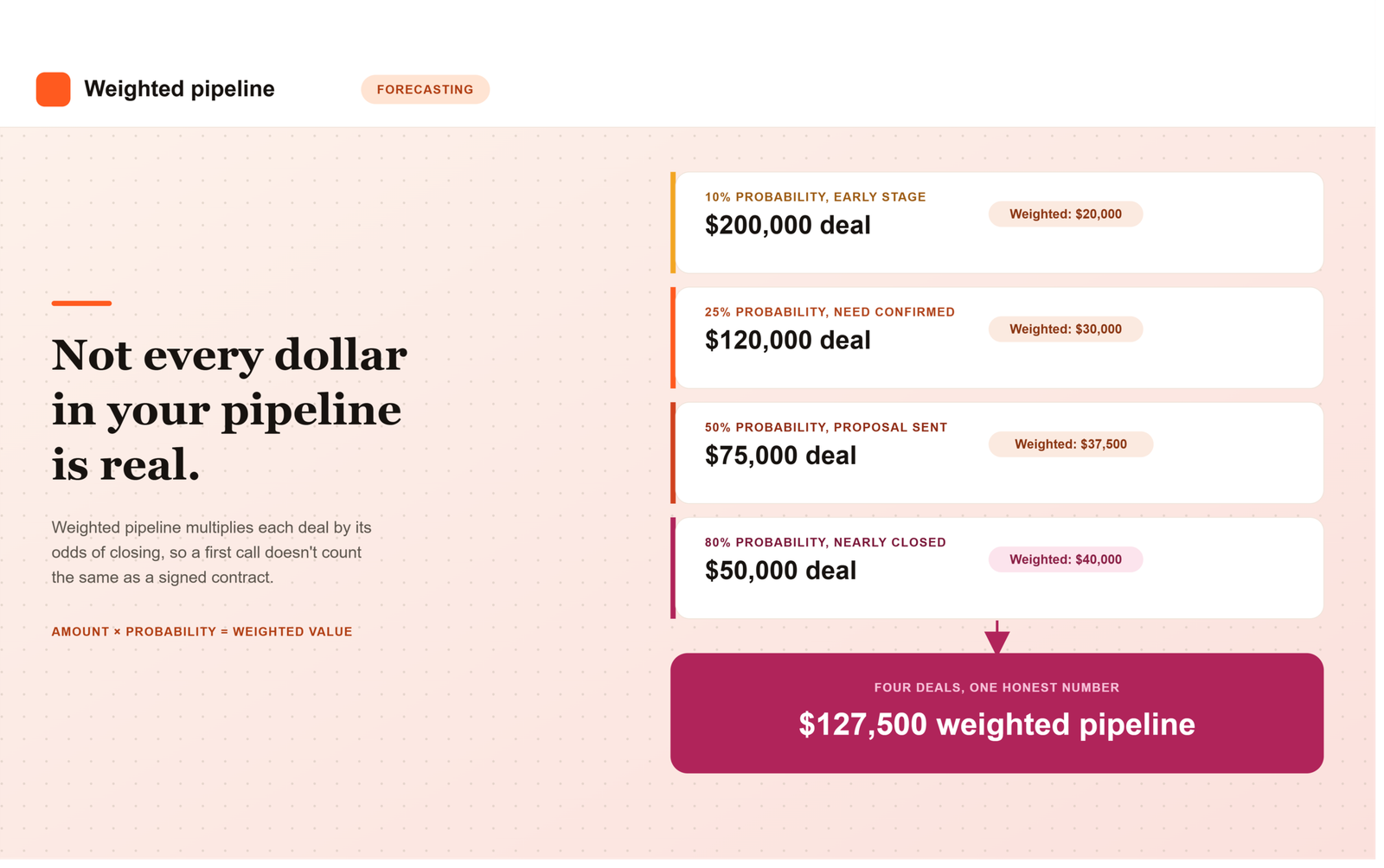
Here’s a worked example using four hypothetical deals at different stages: a $200K deal at 10% probability, a $120K deal at 25%, a $75K deal at 50%, and a $50K deal at 80%. Multiplying each deal by its stage probability and adding the results gives you a weighted pipeline of $127,500, which becomes a reasonable estimate of near-term new bookings.
Here’s how to actually build this for your own team:
- Map your sales stages. Write out every stage a deal moves through, from first contact to closed-won.
- Assign a close probability to each stage, ideally based on your own historical conversion data rather than a guess.
- Multiply each open deal’s value by its stage’s probability to get that deal’s weighted value.
- Add up every weighted value across all open opportunities. That total is your weighted pipeline.
- Recalibrate regularly. A common recommendation is to compare your weighted forecast against what actually closed each quarter, then adjust your stage probabilities based on the gap.
Pro tip: don’t hand-wave your stage probabilities. If you’re just guessing “discovery is 20 percent, proposal is 50 percent,” you’re not building a forecast, you’re building a nicer-looking version of a guess. Pull actual historical win rates by stage from your CRM. Even a simple lookback at the last four to six quarters of closed deals gives you a far more honest starting point than a probability borrowed from a template or a competitor’s blog post.
Common Mistakes That Wreck a Weighted Forecast
Weighted pipeline only works if the inputs behind it are trustworthy, and a few recurring mistakes quietly break that trust. The most common is letting stage probabilities go stale. A company sets them once during CRM setup and never revisits them, even as the sales motion, product, and market shift underneath those original assumptions.
Another common issue is reps manually overriding probabilities on individual deals based on gut feel rather than actual stage movement. When that happens enough times across a team, the weighted total stops reflecting the sales process and starts reflecting whatever mood the pipeline review was in that week. A third mistake is applying the same probability curve across very different deal types, treating a small self-serve upgrade the same as a large multi-stakeholder enterprise deal, when the two rarely behave the same way as they move through a pipeline.
Weighted Pipeline vs. Other Forecasting Approaches
Weighted pipeline is one forecasting method among several, and most sales organizations end up using it alongside, not instead of, other approaches. A rep’s manual forecast category, commit, best case, pipeline, reflects human judgment about a specific deal. Historical trending looks at how deals of a similar size and type have converted in the past regardless of current stage. Weighted pipeline sits between the two: more systematic than a gut-feel forecast, more current than a purely historical trend line.
More mature revenue operations software increasingly blends all three, layering rep judgment and historical win-rate data on top of stage-based weighting to produce a forecast that’s harder to game and easier to defend in a board meeting. If you’re evaluating a platform partly for its forecasting capability, our guide on what to look for in a B2B SaaS RevOps platform covers what native forecasting and reporting should actually look like before you sign a contract.
Why Weighted Pipeline Matters Beyond the Sales Team
Weighted pipeline isn’t just a sales reporting exercise. Finance uses it to model cash flow and hiring plans. Customer success and implementation teams use it to anticipate onboarding volume a quarter or two out. Marketing uses it to judge whether current pipeline generation is actually on pace to hit the number, rather than just counting raw leads.
This is also where RevOps earns its keep. Someone has to own the stage probabilities, make sure they’re based on real historical data rather than assumption, and recalibrate them as the business changes. Get that ownership wrong, and every team downstream ends up planning against a number that looks precise but was never actually accurate to begin with.
The Bottom Line
Weighted pipeline exists because raw pipeline totals oversell certainty that doesn’t exist yet. By multiplying each deal’s value against a realistic probability of closing, it gives leadership a number that’s less exciting than the full pipeline total, but considerably more likely to actually show up in the bank account. The formula is simple. Getting the probabilities right, and keeping them honest over time, is the real work.
Frequently Asked Questions
What’s a good starting point for stage probabilities if we don’t have historical data yet?
If you’re too new to have reliable historical win rates, start with a conservative curve, something like 10 percent for early discovery, 25 to 30 percent once a deal has a confirmed need, 50 percent at proposal, and 75 to 80 percent once verbal commitment is given. Treat these as placeholders and replace them with real data as soon as you have a few closed quarters to look back on.
How often should we update our stage probabilities?
Most teams review stage probabilities quarterly, comparing what the weighted forecast predicted against what actually closed. If a stage consistently over- or under-predicts close rates by a meaningful margin, adjust the probability rather than waiting for an annual planning cycle to fix it.
Should every deal type use the same probability curve?
Not necessarily. A small self-serve upgrade and a large multi-stakeholder enterprise deal often behave very differently as they move through a pipeline, so applying one universal curve to both can distort the forecast. Many teams build separate probability curves by deal size or segment once they have enough volume to support it.
Can reps manually override a deal’s weighted probability?
Some CRMs allow it, but it’s worth limiting how often this happens. If reps regularly override probabilities based on gut feel rather than actual stage progression, the weighted total stops reflecting your sales process and starts reflecting individual optimism or caution instead, which defeats the purpose of weighting in the first place.
Is weighted pipeline the same thing as a sales forecast?
They’re related but not identical. Weighted pipeline is one input into a forecast, a systematic, stage-based estimate. A full sales forecast often also incorporates rep judgment categories like commit and best case, along with historical trending, to produce a final number leadership actually commits to externally.
Why does weighted pipeline matter to teams outside of sales?
Finance uses it for cash flow and hiring plans, customer success uses it to anticipate onboarding volume, and marketing uses it to judge whether pipeline generation is actually on pace. Because so many teams plan against this number, getting the underlying probabilities right is a shared responsibility, not just a sales metric.
Leave a Reply