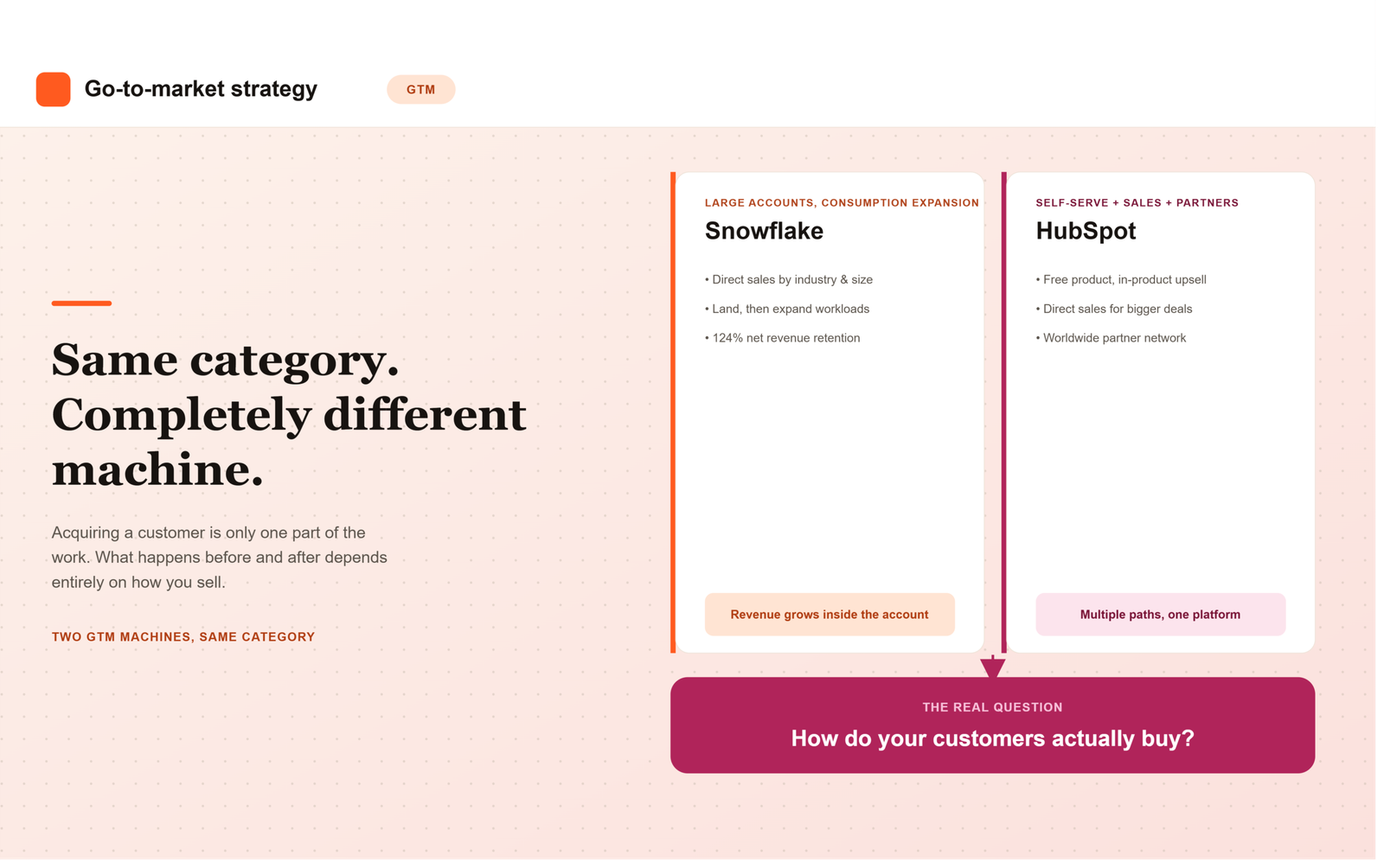
Snowflake and HubSpot both sell business software. A description at that level makes their commercial models sound similar. Their own filings tell a different story.
Snowflake concentrates its selling effort on large organizations, using a direct sales force divided by industry, size, and geography. After a customer starts using the platform, Snowflake works to move additional workloads onto it, which increases consumption and revenue. HubSpot serves companies with between 2 and 2,000 employees through a mix of direct sales, free products customers adopt themselves, in-product offers, and a worldwide partner network. Some customers buy with little or no interaction with a salesperson.
Both companies need customers to discover a product, decide to use it, pay for it, and eventually spend more. The machinery through which that happens is quite different, and that machinery is the subject of go-to-market strategy. GTM determines which customers a company intends to serve, how those customers encounter and buy the product, and how the relationship develops afterward. Acquiring a customer is only one part of the work.
Before a company acquires anyone, it has already made several GTM choices
A sales team cannot pursue “the market.” It has to pursue particular customers. Companies that grow opportunistically, one seller finds a hospital, marketing discovers a segment responds well, end up with a customer base that reflects what the organization happened to win rather than a deliberate choice about where it has an advantage. Scott Edinger framed this in Harvard Business Review as asking whether a company is selling what it intends to sell, to the customers it intends to serve, or simply accepting whatever its sales organization can win.
Different customers create very different commercial requirements. A small company buying a $50 monthly tool can research it online and self-serve. A global bank evaluating a multimillion-dollar system needs months of meetings, security review, procurement, legal, and executive approval, all for a related product category. This is why segmentation, by size, industry, geography, or buying behavior, sits near the beginning of GTM design. Snowflake segments by industry, size, and region toward large organizations; Freshworks serves a broader range through user-led adoption, sales coverage, and partners. These choices ripple into channels, pricing, sales-cycle length, and how much a company can afford to spend winning each account.
Acquisition is really a question of how customers enter the company’s world
Companies often summarize acquisition with a single number, leads or new accounts, but the paths producing those customers may have little in common: advertising, search, outbound email, a conference, a partner, a free product, or a referral. Each path places work in a different part of the organization. HubSpot runs several acquisition systems at once: direct sales, free products, a partner network, and years of inbound content. Freshworks blends user-driven adoption, free trials, sales activity, and partners, designed to reduce friction for new users while keeping sales coverage for larger opportunities.
None of these channels is inherently superior; the economics have to fit the customer and the purchase. Sending a field seller after a $100 annual product makes no sense, and neither does expecting a major bank to buy complex infrastructure through a checkout screen. A 2026 Harvard Business Review article notes that companies increasingly run multiple GTM models at once, citing Microsoft serving small customers digitally while using account teams for large enterprises. The real challenge is deciding which customer enters which path.
Interest has to become a purchase
Acquisition creates attention, not revenue. A person can try a product and disappear; an enterprise buyer can evaluate for months and choose a competitor. Conversion is where interest has to survive the buying process. For simple products, this happens inside the product itself: a user hits a limit, picks a plan, and pays. The questions become familiar to product-led businesses, how fast does a new user reach value, where do people abandon onboarding, which free users eventually pay.
As purchases grow more complicated, salespeople help buyers build an internal case, involve stakeholders, and negotiate terms, though not always in a clean sequence. Amplitude describes combining direct field and inside sales, product-led growth, marketing, and solution consultants, with salespeople working both new accounts and expansion in existing ones. PLG and sales-led motion increasingly operate inside the same customer journey: product creates evidence of demand, and sales becomes useful once the purchase exceeds what self-service can handle. Poor conversion often traces back to the offer itself, confusing pricing, risky commitment terms, painful implementation, not just weak selling.
What happens immediately after the sale affects the GTM model
A signed contract feels like completion, but the customer has only begun trying to receive what it purchased. Recurring-revenue businesses depend on customers continuing to see enough value to remain, which makes the handoff after purchase part of GTM design: who welcomes the customer, what has to be implemented, what commitments made during sales need to reach delivery or Customer Success.
A company can become efficient at winning customers it subsequently loses. Add 1,000 customers in a year and lose 800 existing ones, and the business barely moves while looking busy. Freshworks defines net dollar retention as the revenue change within an existing customer group after upsells, cross-sells, renewals, contraction, and attrition, a measure that forces growth to be viewed through the installed base, not just new logos. Retention problems usually start earlier: a poor-fit sale, an implementation that took too long, features nobody adopted, which is why retention responsibility spreads across Product, Sales, Customer Success, and Support.
Expansion changes the economics of customer acquisition
The first transaction is often only the opening value of a relationship. Snowflake makes this visible through its consumption model: as customers find new use cases and consume more compute and storage, account revenue grows, reporting 124 percent net revenue retention as of April 2025. The mechanism differs elsewhere, a seat-based company expands as headcount grows, a multi-product company cross-sells, a marketplace earns more as participants transact more. Shopify describes revenue from merchants who stay historically growing enough to offset revenue lost from those who leave.
Expansion changes what a company can rationally spend to acquire a customer. Two businesses each spending $1,000 to win an account produce very different economics if one customer pays $1,200 and leaves while the other grows to $5,000 annually over several years. Same acquisition cost, completely different relationship quality, which is why sophisticated GTM organizations spend so much time on customer fit rather than just close rate.
One company can operate several GTM motions
Large companies rarely enforce a single motion everywhere. A small customer and a global enterprise need different channels, sales processes, and economics even on the same platform. Freshworks combines product-led adoption with sales assistance and partners; Atlassian pairs easy product adoption with enterprise cloud as a strategic priority, reporting more than 300,000 cloud customers and 120 percent cloud net revenue retention in fiscal 2025.
A customer can also change motions mid-relationship: a ten-person team’s self-service purchase spreads to 200 employees, IT gets involved, procurement wants a contract, and a product-led account becomes an enterprise opportunity. Missing that transition either leaves expansion revenue on the table or sends expensive sellers after every small signup, destroying the economics that made self-service work in the first place. GTM design has to define the thresholds for when a salesperson, a Customer Success Manager, or a partner gets involved.
GTM strategy is visible in the way resources are allocated
Strategy becomes real once money and people get assigned. “Enterprise healthcare is a priority” means something only once the company hires sellers who understand healthcare, builds the compliance capability buyers expect, and adjusts territories. Otherwise it stays a sentence in a slide deck. The same applies to PLG: a free trial alone doesn’t create product-led growth without accessible onboarding, thoughtful pricing, and product analytics that show when free usage signals willingness to pay. McKinsey frames GTM design in similarly economic terms, deciding whom to sell to, which channels to use, and what coverage each transaction deserves. Resource allocation is what turns GTM from an idea into an operating model.
The funnel is useful, but incomplete
The sales funnel shows that many prospects enter and fewer eventually buy, but it distorts thinking in three ways: customers rarely travel in a straight line, the funnel usually ends at purchase even though much of the value happens afterward, and it makes every prospect look like it’s moving through the same machine, which is increasingly untrue. A lifecycle view captures more of what’s actually happening:
| Stage | Commercial Question |
|---|---|
| Market choice | Which customers are attractive enough to pursue? |
| Acquisition | How do those customers discover or enter the company? |
| Conversion | What enables them to move from interest or usage to a purchase? |
| Onboarding and adoption | How do new customers begin receiving the value they expected? |
| Retention | What makes the commercial relationship continue? |
| Expansion | What causes an existing customer to spend more? |
| Advocacy | Do successful customers help create future demand through references, reviews, referrals, or ecosystem effects? |
These rows are connected: poor market selection creates retention problems later, weak onboarding damages expansion, and strong outcomes lower future acquisition costs through referrals. A GTM system behaves differently once these interactions become visible.
GTM is partly a set of economic trade-offs
There is no free acquisition channel. Organic demand looks inexpensive, but brand, content, and time created it. Direct sales adds headcount cost for control and insight. Partners extend reach but take economics and some control. Free products lower the barrier to adoption while creating large populations who may never pay. Each choice carries a cost structure, which is why customer lifetime economics matter alongside growth rate: what it costs to acquire and serve a customer against what that relationship is expected to create. The math is rarely precise enough to dictate strategy alone, but it rules out impossible combinations, an expensive field-sales model can’t indefinitely chase customers whose lifetime value barely covers the seller’s cost.
Go-to-market strategy does not remain fixed
A company’s GTM system changes as the company, product, and market develop. Early on, founders sell directly, hearing objections and adjusting the pitch themselves. A repeatable process appears only once that uncertainty decreases, after which companies add specialist sellers, territories, demand generation, and partners. A self-service company can move into enterprise; an enterprise company can build a digital channel for smaller customers. A June 2026 Harvard Business Review piece argues companies increasingly run multiple GTM models and need distinct digital strategies for each, but the underlying reason predates AI: customers simply differ in how they want to buy, and a good GTM system keeps learning from that rather than assuming the process built three years ago should stay permanent.
What RevOps sees when it looks at GTM
For Revenue Operations, GTM strategy becomes a set of operating assumptions: how many account executives are needed, how many accounts each can cover, how much pipeline is required and where it originates, what conversion rate makes the plan plausible, and how many implementation or Customer Success resources new customers will need. Those assumptions connect the revenue target to the organization expected to deliver it.
HubSpot’s mixed model requires RevOps to see direct sales, freemium conversion, partner-sourced business, and expansion together. Snowflake’s model requires monitoring consumption expansion inside the installed base. A services company needs to connect sales demand with available delivery capacity. This is why copying another company’s GTM dashboard rarely works, the measures that matter come from the specific economics of that model.
A Working Definition
Go-to-market strategy describes how a company turns a chosen market into customers and then develops those relationships economically over time: whom to serve, what channels create demand, how customers evaluate and buy, how they begin using what they purchased, and the mechanisms that support renewal and expansion. Marketing, Sales, Customer Success, Product, Partners, and RevOps all participate, with their relative importance shifting by model. For a self-service product, Product and Marketing carry most of the burden; for an enterprise purchase, Sales dominates; for a consumption business, usage drives expansion.
The most revealing GTM question is therefore rarely “are we sales-led or product-led?” A company can be both. The useful discussion is about the customers a company wants, how those customers actually buy and receive value, and whether the commercial system built around them can produce attractive economics repeatedly. That is the work behind go-to-market strategy.
Frequently Asked Questions
What’s the difference between go-to-market strategy and a sales funnel?
A funnel visualizes how prospects narrow toward a purchase. GTM strategy is broader, covering which customers to serve, how they buy, and how the relationship grows afterward through retention and expansion, well past where a funnel typically ends.
Can a company use more than one GTM motion at once?
Yes, and most established companies do. HubSpot combines direct sales, a free product, and partners; Freshworks blends self-serve adoption with sales coverage for larger deals. A single customer can even move between motions as the account grows.
Why does net revenue retention matter to GTM strategy?
It shows whether existing customer revenue is growing or shrinking after upsells, renewals, and churn. That number changes what a company can rationally spend to acquire new customers, a business where accounts expand significantly, like Snowflake’s, can justify higher acquisition cost than one where customers rarely grow.
How does GTM strategy relate to RevOps?
RevOps translates GTM strategy into operating assumptions: seller headcount, pipeline requirements, conversion rates, and Customer Success resourcing. Different GTM models produce different operating requirements, which is why borrowing another company’s dashboard rarely fits without adapting it first.
When should a self-serve or PLG account get handed to a salesperson?
Common signals include a product spreading to far more users, IT or security asking questions, or procurement requesting a formal contract. Missing that transition either leaves expansion revenue on the table or destroys the low-cost economics that made self-service work.
Why doesn’t copying another company’s GTM dashboard work?
Because the metrics that matter depend on a company’s specific economics. A consumption business tracks workload expansion, a mixed-motion company needs visibility across sales, freemium, and partner channels, and a services company tracks demand against delivery capacity. Borrowing a dashboard built for a different model usually means tracking the wrong things.
Leave a Reply