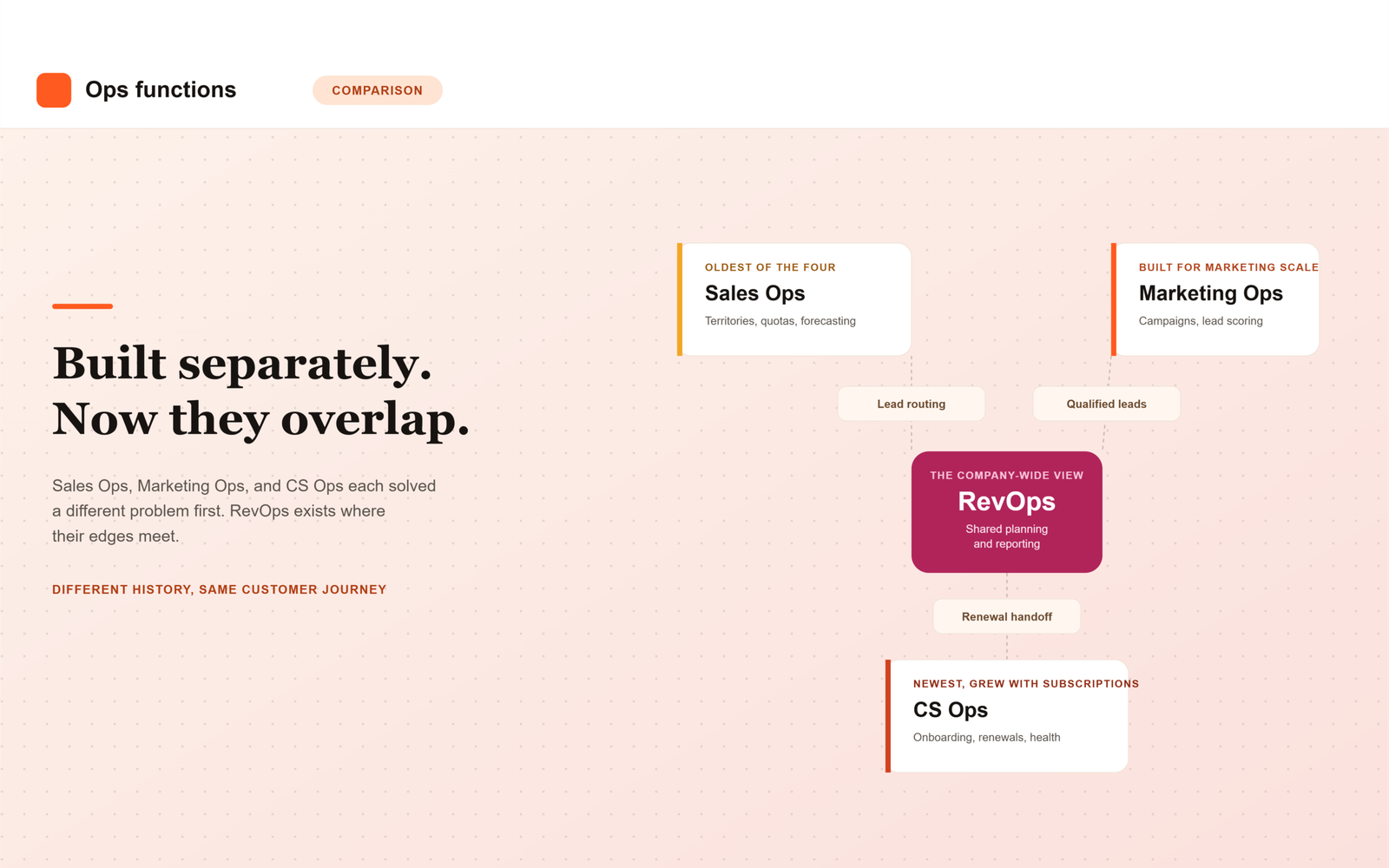
Understanding what each function owns and where they overlap
The language around commercial operations has become harder to follow than the underlying work.
A growing company may have Sales Operations, Marketing Operations, Customer Success Operations, Revenue Operations, Deal Desk, Sales Strategy, Business Operations, and several systems or analytics teams working around them. Their job descriptions often use much of the same vocabulary: process, data, systems, planning, forecasting, productivity, automation, reporting.
From the outside, the distinctions can look artificial.
There is a reason for the overlap. These functions did not emerge from a single organizational model. They developed at different times to solve different operating problems, usually inside departments that had become large enough to need specialist support.
Sales Operations came first. Marketing later built its own operations capability as marketing became more dependent on data and technology. Customer Success Operations developed as post-sale work became more structured, particularly in recurring-revenue businesses. Revenue Operations appeared later, partly because companies were finding that the specialist teams could work well inside their own areas while the full customer journey remained fragmented.
It helps to look at that history before trying to draw neat ownership boundaries.
Sales Operations grew around the needs of the sales force
Sales Operations has the longest history of the four. Salesforce traces the formal function to Xerox in the 1970s, when J. Patrick Kelly created a team to handle planning, forecasting, territory design, compensation, and other work required to run an increasingly complex sales organization.
The basic problem has changed less than the technology around it.
Once a company employs more than a small number of salespeople, someone has to decide how accounts should be divided, how many sellers are required, how targets should be allocated, how opportunities are tracked, and how management should interpret the pipeline.
Territories alone can become complicated. A company might divide accounts by geography, industry, size, product, existing relationship, or some combination of these. The design affects hiring, compensation, customer ownership, and the likelihood that good opportunities receive attention.
Forecasting creates another body of work. Sales managers need a common way to describe the status of opportunities. Senior management needs an estimate of likely future sales. Those estimates depend on the quality of the underlying sales process and the discipline with which people maintain it.
GitLab’s public Sales Operations documentation gives a useful picture of the function in practice. Its team works on sales processes, policies, systems, reporting, territories, field support, and go-to-market planning.
This is familiar Sales Ops territory. The team is close to sellers and sales management because most of its work begins with the question of how the sales organization should operate.
That proximity matters. A territory model may look balanced analytically and still fail because experienced sellers know that two apparently similar regions behave very differently. A required opportunity field may improve reporting while making little sense in the actual sales conversation. Good Sales Ops usually requires frequent contact with the people whose work it is organizing.
Some responsibilities move in and out of the function depending on the company. Sales compensation might sit with Finance. Deal Desk may be part of Sales Ops in one organization and RevOps in another. Sales enablement may be closely connected or entirely separate.
There is no standard boundary that every company follows.
Marketing developed a different operating problem
The modern marketing organization produces large amounts of activity and data before a salesperson becomes involved.
A potential customer might attend an event, visit the website several times, subscribe to a newsletter, download a research report, respond to an advertisement, or join a webinar. Each interaction may enter a different system.
Someone has to make those systems usable.
Marketing Operations usually works on the infrastructure behind marketing execution: automation, campaign setup, databases, tracking, lead processes, reporting, and the technology connecting these activities.
HubSpot describes the function broadly around the people, processes, and technology that support marketing strategy, including planning, workflow development, campaign analysis, data management, and performance measurement. GitLab’s Marketing Operations charter places similar emphasis on marketing technology, standardized processes, data quality, and systems management.
The difference from Sales Ops becomes easier to see in day-to-day work.
A Marketing Ops manager might spend time fixing campaign attribution, improving the process for handling webinar registrations, cleaning duplicate contact records, redesigning lead scoring, or deciding how data should move between the marketing automation platform and the CRM.
A Sales Ops manager may use some of the same systems and data while worrying about a different set of questions: account ownership, pipeline quality, seller capacity, or whether a manager’s forecast is realistic.
The distinction is clear enough while the work remains inside each department. It becomes less clear when Marketing decides that a person is ready for Sales.
At that point, the two operating systems meet.
Marketing may have a rule saying that a lead becomes qualified after a certain combination of actions. Sales may discover that the rule generates too many weak opportunities. Marketing Ops can adjust the scoring model, but Sales has information that matters to the change. Sales Ops understands territories and account ownership, which in turn affects where qualified leads should go.
The work is shared because the process itself crosses the departmental boundary.
Customer Success Operations appeared later
Customer Success became a major organizational function much later than Sales or Marketing, particularly with the growth of software subscriptions and other recurring-revenue business models.
In these businesses, the first sale may represent only part of the value of the customer relationship.
A customer needs to begin using the product, adopt it successfully, receive enough value to remain, and eventually decide whether to renew. Some customers expand. Others reduce spending or leave.
Customer Success teams eventually encounter many of the same operating challenges that Sales and Marketing faced earlier.
Accounts need to be assigned. Managers need to understand how many customers each Customer Success Manager can reasonably handle. Onboarding processes need some consistency. Customer information sits in several systems. Renewal dates need to be visible before they become urgent. Leaders want to identify accounts that may be at risk.
CS Ops grew around these needs.
Gainsight describes Customer Success Operations as supporting CS organizations through systems, analytics, process development, and program management. GitLab’s CS Ops team works on customer-success systems, reporting, customer journeys, product-usage analytics, renewals, and operational planning.
Much of the work concerns scale.
A good Customer Success Manager may notice that a particular customer has stopped using an important part of the product and decide to intervene. CS Ops looks across the customer base and asks whether similar signals can be identified systematically.
The team may also help determine which customers should receive high-touch service, which can be supported through more standardized programs, and how renewal activity should be organized.
As with the other functions, these decisions often extend beyond the department itself. Renewal revenue matters to Finance and company forecasting. Expansion may return the customer to Sales. Product-usage information may change how Marketing defines a strong prospective customer.
The customer may be “post-sale,” but the commercial relationship is still active.
Why the boundaries get messy
A diagram of the customer lifecycle makes ownership look straightforward.
Marketing generates demand. Sales closes business. Customer Success manages the relationship afterward.
Real companies rarely work that cleanly.
Marketing continues to influence existing customers. Customer Success may identify an expansion opportunity that requires a salesperson. Sales may remain involved in a large account long after the original contract is signed. Finance can influence pricing and renewal terms. Product usage can become relevant to both Sales and Marketing.
Even relatively simple processes can require several operations teams.
Suppose Marketing generates an inbound request from a company that is already a customer.
Marketing Ops controls the system that captured the request. Sales Ops may own the rules determining which salesperson handles the account. CS Ops may know that the customer is currently in a sensitive renewal conversation. Sending the request directly to a new-business seller without considering the existing relationship could create an awkward customer experience.
The system needs some way to recognize the situation.
A similar issue appears when territories change. Sales Ops may redesign account ownership at the beginning of the year. Marketing’s routing logic must then reflect the new structure. If it does not, leads continue travelling according to last year’s rules.
Neither function can complete the change entirely on its own.
This kind of overlap occurs repeatedly: lead qualification, lead routing, account ownership, sales handoffs, renewals, expansion, forecasting, and customer data. The difficulty usually comes from different teams having legitimate interests in the same process.
Where Revenue Operations enters
Revenue Operations developed in part because companies needed a broader operating view across these specialist functions.
Forrester’s work on RevOps describes Marketing Operations, Sales Operations, and Customer Success Operations as parts of a wider revenue system and focuses on the coordination of data, technology, processes, and planning across them.
Annual planning shows why that broader view can be useful.
Marketing may expect to generate a certain amount of demand. Sales may plan headcount and territories based on an expected number of opportunities. Customer Success may be preparing for a much larger customer base. Finance has revenue and cost assumptions of its own.
Each team can create a credible plan based on its local information. The problems appear when the assumptions do not line up.
Sales may expect more opportunities than Marketing believes it can produce. Customer Success may need to support a level of growth without the required capacity. Finance may assume a renewal rate that recent customer behavior does not support.
These are the situations in which a RevOps team can be useful. It can bring together assumptions that otherwise live in separate planning processes and help management understand the operating implications of the revenue target.
The same role appears in reporting.
Marketing may report leads and opportunities created. Sales reports pipeline and bookings. Customer Success reports renewals and expansion. Finance has the official financial view.
A management team trying to understand the complete commercial picture needs those measures to connect. RevOps often works on that connection, sometimes through shared definitions, sometimes through common systems, and sometimes simply by bringing the operating teams into the same planning process.
Not every company centralizes this work. Forrester has argued that Revenue Operations can exist as a coordinated capability even when Marketing Ops, Sales Ops, and CS Ops remain separate organizations.
That model is common because the specialist teams still have substantial work that belongs inside their functions.
GitLab shows how the overlap looks in practice
GitLab is useful because its public handbook exposes much of the operating structure that other companies keep internal.
Its Marketing Operations team manages marketing technology, processes, data quality, and systems. Sales Operations focuses on the sales organization, including policies, tools, territories, and sales execution. Customer Success Operations works on customer-success processes, systems, reporting, and renewals.
On paper, these responsibilities can be separated easily.
The handbook itself shows constant interaction between them.
GitLab’s Sales Operations roles include collaboration with Marketing on lead-management processes. Marketing Operations manages systems whose outputs are used elsewhere in the commercial organization. Customer Success Operations works on renewal processes that eventually affect revenue forecasting and account planning.
The teams remain distinct because they need specialist knowledge. The connections remain because customers and customer data move through more than one function.
GitLab also places Sales Operations and Customer Success Operations within a broader Field Operations organization alongside Sales Strategy, Deal Desk, Sales Systems, and Data Intelligence.
That structure is specific to GitLab. Another company might group the same work differently.
The example is useful because it shows that operational design tends to develop around practical needs rather than around perfectly clean definitions.
Ownership is often shared at the edges
Some activities have a natural home.
Sales territory design will usually sit close to Sales Ops. Marketing automation belongs naturally with Marketing Ops. CSM capacity planning is normally a CS Ops concern.
Other activities are harder to place because the consequences spread across functions.
Forecasting is one example.
Sales managers usually produce views of the opportunities they expect to close. Sales Ops supports the process and systems behind those estimates. CS Ops may contribute renewal expectations. RevOps may assemble the broader commercial forecast. Finance may adjust or interpret it for the financial plan.
Several groups can therefore “own forecasting” without doing the same work.
Customer data has the same characteristic.
Marketing needs campaign and engagement information. Sales needs accounts, contacts, opportunities, and pipeline history. Customer Success cares about product usage, customer health, support issues, renewal dates, and outcomes.
A company still needs agreement on basic identifiers and definitions if those records are expected to describe the same customer.
This is where many arguments about organizational ownership become unproductive. The useful level of detail is usually the specific decision being made.
Who decides the sales territory? Who maintains the routing logic? Who defines a qualified marketing lead? Who decides when a customer becomes at risk? Who determines the renewal forecast category? Who can change a customer identifier used across several systems?
The answers may be different even when all of these activities sit inside the same technology platform.
Technical ownership and business ownership are often separate.
A practical view of the boundaries
The following map reflects common patterns rather than fixed rules.
| Area of work | Typical operational home | Common overlap |
|---|---|---|
| Marketing automation and campaign operations | Marketing Ops | RevOps on shared data and lifecycle rules |
| Marketing data quality and attribution | Marketing Ops | Sales Ops when measuring conversion into pipeline |
| Lead qualification | Marketing Ops | Sales Ops and RevOps |
| Lead and account routing | Sales Ops / Marketing Ops | RevOps when company-wide rules are needed |
| Territory design | Sales Ops | Finance and RevOps during annual planning |
| Quotas and seller capacity | Sales Ops | Finance and RevOps |
| Sales pipeline process | Sales Ops | RevOps for company-wide definitions and reporting |
| Sales forecasting mechanics | Sales Ops | RevOps and Finance |
| Sales-to-CS handoff | Sales Ops / CS Ops | RevOps when standardization spans the lifecycle |
| CSM capacity and customer segmentation | CS Ops | RevOps during company planning |
| Customer health and CS systems | CS Ops | Product, Sales, and RevOps depending on use |
| Renewal operations | Often CS Ops | Sales Ops, RevOps, and Finance |
| Expansion process | CS Ops or Sales Ops | RevOps when ownership crosses teams |
| Shared customer definitions | RevOps / shared governance | All specialist Ops teams |
| End-to-end revenue reporting | RevOps | Marketing Ops, Sales Ops, CS Ops, Finance |
| Revenue capacity planning | RevOps with Finance | All specialist Ops teams |
The table becomes inaccurate as soon as it is treated as a template.
A company in which Sales owns renewals will organize renewal operations differently from one in which Customer Success owns them. A channel business may have a large Partner Operations function that changes several of these responsibilities. A small company may place nearly everything in the hands of one Sales Ops or RevOps employee.
The business model usually explains more than the title.
Company size changes the answer
Early-stage companies tend to have blurred operations roles because specialization would create more overhead than value.
The first operations hire may manage Salesforce, prepare board reports, calculate commissions, clean marketing data, fix account assignments, and maintain renewal information. Whether the person’s title is Sales Operations or Revenue Operations often tells us less than the list of work on their desk.
Specialization appears as the volume grows.
Marketing eventually needs dedicated expertise in its technology and data. Sales requires more sophisticated territory, compensation, forecasting, and capacity work. Customer Success needs its own processes and systems as the customer base expands.
The company gains deeper expertise, though coordination becomes harder.
This is one reason RevOps often becomes more visible in later stages of growth. The business now has enough specialized operating teams that somebody has to maintain a view across them.
Sometimes that leads to centralization under one RevOps leader. Sometimes the teams remain separate and share planning, data governance, and systems standards. Some companies use a hybrid arrangement.
The right structure also changes over time. A centralized model can be useful while a company standardizes fragmented processes, then becomes unnecessarily heavy later. A decentralized model can preserve expertise and speed while creating duplicated technology and inconsistent definitions.
Organizational design in this area is rarely permanent.
How to tell whether the boundaries are working
The quality of the structure becomes visible in routine situations.
When Marketing changes the definition of a qualified lead, Sales should understand the consequence before the change goes live.
When Sales redesigns territories, inbound routing should change at the same time.
When a salesperson closes a customer, the post-sale team should receive the information it needs without reconstructing the entire sales history.
When a renewal becomes uncertain, the change should eventually reach the revenue outlook.
Managers should also know where to take a problem. If every cross-functional issue requires escalation to the Chief Revenue Officer, the operating model is probably incomplete. If teams routinely change shared processes without speaking to one another, the model has a different weakness.
Some overlap is healthy. It forces functions to consider consequences outside their immediate department.
The burden comes when the same decision has several owners, or none.
What each function is really there to do
Sales Ops, Marketing Ops, and CS Ops remain useful categories because the departments they support have genuinely different operating needs.
Sales Ops spends most of its time making the sales organization easier to manage and more productive. Marketing Ops builds the systems and processes that allow Marketing to operate at scale. CS Ops provides similar operating support for the post-sale customer organization.
Revenue Operations becomes relevant when the company needs a wider operating view across those functions.
That wider view can involve shared planning, definitions, technology, customer data, lifecycle processes, forecasting, and reporting. The exact scope changes from company to company because the commercial model changes.
There is little benefit in forcing every activity into one universal chart.
A more realistic organization accepts that some work is local, some is shared, and some needs a common owner because several teams depend on the same decision.
That is where the distinctions among RevOps, Sales Ops, Marketing Ops, and CS Ops become useful in practice.
Frequently Asked Questions
What’s the actual difference between RevOps, Sales Ops, Marketing Ops, and CS Ops?
Sales Ops, Marketing Ops, and CS Ops each support one department: sales, marketing, and post-sale customer teams respectively, and grew up solving that department’s specific operating problems. RevOps sits above them, focused on the shared processes, definitions, and reporting that cross department lines, like lead handoffs, forecasting, and renewal visibility.
Which came first: Sales Ops, Marketing Ops, or CS Ops?
Sales Operations has the longest history, tracing back to Xerox in the 1970s. Marketing Operations developed later as marketing became more dependent on data and technology. Customer Success Operations is the newest of the three, emerging alongside the growth of subscription and recurring-revenue business models. Revenue Operations appeared after all three, once companies needed a broader view across specialist teams that were each working well on their own.
Who owns lead routing, Sales Ops or Marketing Ops?
Often both, which is exactly the kind of overlap that causes confusion. Marketing Ops typically controls the system that captures and scores the lead, while Sales Ops owns the rules for which salesperson or team receives it, based on territory and account ownership. When company-wide consistency is needed across both sides of that handoff, RevOps usually gets involved.
Does a company need RevOps if it already has Sales Ops, Marketing Ops, and CS Ops?
Not necessarily as a separate team. Some companies centralize this coordination under a dedicated RevOps function, while others keep Marketing Ops, Sales Ops, and CS Ops separate and share planning, data governance, and systems standards between them. Both models work; what matters is that somebody has responsibility for the decisions that cross departmental lines, like shared customer definitions and end-to-end revenue reporting.
Why do these org structures vary so much between companies?
Because the business model usually explains more than the title does. A company where Sales owns renewals will structure renewal operations differently than one where Customer Success owns them. A channel-based business may have a Partner Operations function that reshapes several other responsibilities. There’s no universal chart that fits every company, only common patterns.
How does company size change how these functions are organized?
Early-stage companies tend to blur these roles into one person handling everything from CRM administration to board reporting, since specialization would create more overhead than value at that size. As volume grows, Marketing, Sales, and Customer Success each need dedicated operating expertise, and RevOps typically becomes more visible at that later stage, once there are enough specialized teams that someone needs to maintain a view across all of them.
Leave a Reply