Category: Comparison

  • Best AI Platforms for SaaS Lifecycle Automation

    Which AI platforms for B2B SaaS revenue operations actually cover the full customer lifecycle, not just the front half of the funnel? Most comparisons stop at forecasting and lead scoring, the workflows every revenue leader already knows to evaluate, and skip past onboarding and renewals, where a large share of net revenue retention quietly gets decided. For Australian B2B SaaS teams specifically, that lifecycle-wide view matters even more, since a small domestic market forces earlier international expansion, and the same customer might be onboarded from Sydney, supported through a renewal from a partner in the UK, and forecasted against by a revenue team working three time zones at once.

    This guide compares the AI platforms worth evaluating across acquisition, conversion, onboarding, and renewal, and the specific buying criteria that change once you’re running these tools out of Australia rather than the US.

    Why Lifecycle-Wide AI Coverage Matters, Not Just Front-of-Funnel

    A customer’s relationship with a B2B SaaS company doesn’t stop at the signed contract, and neither should the AI tooling around it. Revenue workflow optimization that only touches forecasting and lead scoring leaves a gap right where a lot of quiet revenue leakage actually happens: a customer who never activates properly, a renewal that nobody flagged as at-risk until the cancellation email arrives.

    Salesloft’s 2026 Revenue Benchmark found every surveyed revenue organization already uses AI somewhere in the process, but only 20.6% describe their deployment as production-ready with measurable outcomes, with the gap traced to CRM data hygiene and deal visibility rather than a lack of access to tools. That gap tends to widen further once you look past the sales stage, since onboarding and renewal data often lives in a separate system that never feeds back into core RevOps reporting at all.

    AI Platform Comparison Across the SaaS Lifecycle

    Tool Lifecycle Stage Primary Workflow Best-Fit Team Size Australia-Specific Consideration
    Clari Forecasting Pipeline prediction from CRM activity and engagement signals Mid-market to enterprise Confirm multi-currency rollup handles AUD, USD, and GBP cleanly for board reporting
    Gong Conversion Conversation intelligence and deal risk flagging Mid-market to enterprise Check call-recording compliance under Australian rules and where recordings are stored
    6sense Acquisition Account and intent-based lead scoring Mid-market to enterprise Intent data coverage can be thinner for APAC accounts than US ones; verify before buying
    HubSpot (Breeze) Acquisition through renewal Native CRM AI across scoring, forecasting, and admin automation SMB to mid-market Large ANZ partner network; costs still scale in USD against AUD budgets
    Salesforce (Agentforce) Acquisition through renewal Native CRM AI, configurable across the full lifecycle Mid-market to enterprise Data residency options exist but need to be explicitly configured, not assumed default
    Rocketlane Onboarding Standardized, human-led implementation project management Mid-market Founded by an India-based team; understands INR/AUD-scale budgets and non-US support hours
    Vitally Renewal Configurable customer health scoring and churn-risk detection Mid-market Health-score configurability lets you build signals specific to APAC usage patterns
    ChurnZero Renewal Automated renewal playbooks and in-app engagement Mid-market to enterprise Primarily US-based support; confirm SLA response times against AEST/AEDT before signing

    Acquisition and Forecasting: Where AI Has Matured the Most

    Forecasting is the clearest AI win in the lifecycle, and tools like Clari pull signal from CRM activity, email and calendar engagement, and historical win-rate patterns to produce forecasts that frequently beat manager roll-ups based purely on rep judgment. For Australian teams, the specific thing to verify is multi-currency and multi-region rollup, since revenue closing in AUD, USD, and GBP across different accounts needs to reconcile into one board-ready number without manual spreadsheet work every quarter.

    On the acquisition side, tools like 6sense use behavioral and intent signals rather than static firmographic rules to prioritize accounts. This is genuinely useful revenue workflow optimization, but Australian teams should specifically check intent data coverage for APAC accounts, since these data sets are frequently built and calibrated primarily around US web traffic.

    Conversion: Conversation Intelligence and Deal Risk

    Tools like Gong and Chorus have moved from premium add-on to close to standard infrastructure for any team running more than a handful of reps. The real value isn’t call recording itself, it’s automated risk flagging, competitor mentions, pricing objections, stalled momentum, surfaced directly into deal records without a manager listening to every call.

    For Australian teams recording calls with customers across multiple jurisdictions, it’s worth confirming both where call recordings are stored and how the tool handles consent requirements that can vary between the states a customer might be calling from and the regions your own team operates out of.

    Onboarding: Getting Customers to Value Without Losing the Handoff

    Onboarding tools split into two genuinely different categories, and picking the wrong one matters more than comparing price. Human-led implementation platforms like Rocketlane manage a multi-stakeholder onboarding project with milestones, automated nudges, and status visibility. Self-serve, in-product onboarding tools guide a PLG user to activation without a human ever getting involved. Confirm which category actually matches your onboarding motion before shortlisting vendors, since the two aren’t interchangeable regardless of how similar the marketing pages look.

    Whichever category fits, the onboarding tool’s data needs to flow back into whatever CRM your RevOps team reports from. An onboarding status that only the Customer Success team can see isn’t visible as a risk signal to the rest of the revenue org, which defeats much of the point of automating it in the first place.

    Renewal and Retention: Catching Risk Before the Cancellation Email

    Vitally and ChurnZero both offer AI-driven health scoring, but the value depends entirely on whether the scoring model can be configured to the specific usage signals that predict renewal or churn for your product, rather than a generic model built for a different kind of SaaS business. Ask vendors to demonstrate configuration on a real account, not a curated demo, and push for a specific number on signal-to-action speed, how fast a usage drop actually becomes a visible alert to a CSM.

    The best renewal tools roll up into a forecast RevOps can actually use, not a separate CS-only dashboard that competes with the CRM’s own forecast. Confirm renewal probability data feeds into your core reporting rather than requiring someone to manually reconcile two disconnected numbers.

    Evaluation Criteria for Australian Operators

    1. Data Residency and Privacy Compliance

    Ask vendors directly where customer data is processed and stored, not just whether they claim to be compliant. If your own contracts include data residency clauses, or if any customers operate in regulated sectors, get this answer in writing before signing, particularly for tools touching call recordings or product usage data.

    2. Genuine AEST/AEDT-Aware Support and Automation

    Confirm actual support hours rather than a generic “24/7” claim that turns out to mean a next-business-day US response. The same applies to any AI-driven alerting inside the tool itself, a churn-risk signal that surfaces at 3am US time and sits unactioned until the next Australian business day defeats the purpose of the automation entirely.

    3. AUD Pricing Exposure

    Most of these platforms price in USD, so per-seat and usage-based costs move with the exchange rate in a way that matters more to an Australian finance team than a US buyer evaluating the same platform. Model total cost at your projected usage rather than the exchange rate on the day of signing.

    4. Reference Customers With a Comparable Footprint

    Ask specifically for reference customers with a similar GTM footprint, ideally other companies also managing the currency and time zone complexity of selling out of Australia into larger markets. A case study from a large US enterprise says very little about how a tool performs for a lean Australian team operating across the same time zone gaps you are.

    Common Mistakes When Adopting AI Across the Lifecycle

    • Buying a forecasting tool before CRM data hygiene is good enough for it to learn from
    • Treating AI scoring or health-scoring output as a replacement for, rather than an input to, human judgment
    • Letting onboarding and renewal data live in a separate system that never feeds back into core revenue reporting
    • Assuming a US or European case study translates directly to an Australian team’s time zone and market context
    • Adding tools faster than the team can actually adopt them into daily customer lifecycle management

    Start With the Broken Lifecycle Stage, Not the Platform Category

    The same principle applies across the full lifecycle as it does at any single stage: start by identifying which specific workflow is clearly broken, forecast accuracy, call coaching, slow activation, reactive churn discovery, and evaluate AI platforms specifically against fixing that problem. Platform-first shopping, buying “an AI tool for B2B SaaS customer workflows” without a defined problem, tends to produce an expensive tool that looks impressive in a demo and never gets fully adopted.

    Summary

    AI platforms for B2B SaaS revenue operations cluster around four lifecycle stages worth evaluating separately: acquisition and forecasting (Clari, 6sense), conversion (Gong, Chorus), onboarding (Rocketlane and similar tools, split between human-led and self-serve categories), and renewal (Vitally, ChurnZero). Native CRM AI in HubSpot’s Breeze and Salesforce’s Agentforce spans multiple stages at once and is often the more sensible starting point before adding standalone tools.

    For Australian operators, the evaluation criteria that don’t show up in a generic comparison matter just as much as the feature list: data residency and privacy compliance, genuinely AEST/AEDT-aware support and automation, AUD pricing exposure on tools priced in USD, and reference customers with a comparable footprint rather than a large US enterprise case study. The most common failure mode is buying the platform before fixing the process underneath it, whether that’s messy CRM data feeding a forecast or onboarding data that never reaches the rest of the revenue team.

    FAQ

    What are the best AI platforms for B2B SaaS revenue operations covering the full lifecycle?

    No single platform covers every stage equally well. Clari and 6sense lead in forecasting and account scoring, Gong and Chorus lead in conversation intelligence, Rocketlane leads in human-led onboarding, and Vitally or ChurnZero lead in renewal health scoring. HubSpot’s Breeze and Salesforce’s Agentforce offer native coverage across most stages at once, which is often a sensible starting point before adding specialized standalone tools.

    Do these AI platforms handle Australian data residency requirements?

    It varies significantly by vendor. Some, like Salesforce, offer configurable data residency options that need to be explicitly set up rather than assumed as default. Others process and store data in US-based infrastructure by default. Get the vendor’s actual data location policy in writing before signing, particularly for tools handling call recordings or customer usage data.

    Should we buy one lifecycle-wide platform or specialized tools for each stage?

    Most established teams end up combining native CRM AI, like HubSpot’s Breeze or Salesforce’s Agentforce, for broad coverage with specialized standalone tools, like Gong for conversation intelligence or Vitally for health scoring, where the native version doesn’t go deep enough. Starting with native AI and adding standalone tools only where a genuine gap appears tends to avoid overbuying.

    How does time zone gap affect renewal risk detection specifically?

    A churn-risk signal that surfaces overnight relative to your team’s working hours can sit unactioned for most of a business day, which narrows the window for a CSM to intervene before a renewal conversation is already underway. Confirm both the tool’s signal-to-action speed and whether alerts route to someone actually online when the signal fires.

    What should we fix before adopting any AI tool across the customer lifecycle?

    CRM data hygiene comes first, consistent stage definitions, accurate close dates, and clean historical win-loss records for forecasting tools, plus onboarding and renewal data that actually flows back into the core CRM rather than sitting in a separate system. An AI tool layered on top of messy or siloed data produces confident-looking output that’s still wrong.

    Is intent-based lead scoring reliable for Australian and APAC accounts?

    It depends on the vendor’s underlying data coverage. Intent data providers are frequently built and calibrated primarily around US web traffic, so coverage and accuracy for APAC accounts can be thinner. Ask vendors directly about their data coverage for your specific target region before relying on the scoring for account prioritization.
  • RevOps vs Sales Ops vs Marketing Ops vs CS Ops

    RevOps vs Sales Ops vs Marketing Ops vs CS Ops

    Understanding what each function owns and where they overlap

    The language around commercial operations has become harder to follow than the underlying work.

    A growing company may have Sales Operations, Marketing Operations, Customer Success Operations, Revenue Operations, Deal Desk, Sales Strategy, Business Operations, and several systems or analytics teams working around them. Their job descriptions often use much of the same vocabulary: process, data, systems, planning, forecasting, productivity, automation, reporting.

    From the outside, the distinctions can look artificial.

    There is a reason for the overlap. These functions did not emerge from a single organizational model. They developed at different times to solve different operating problems, usually inside departments that had become large enough to need specialist support.

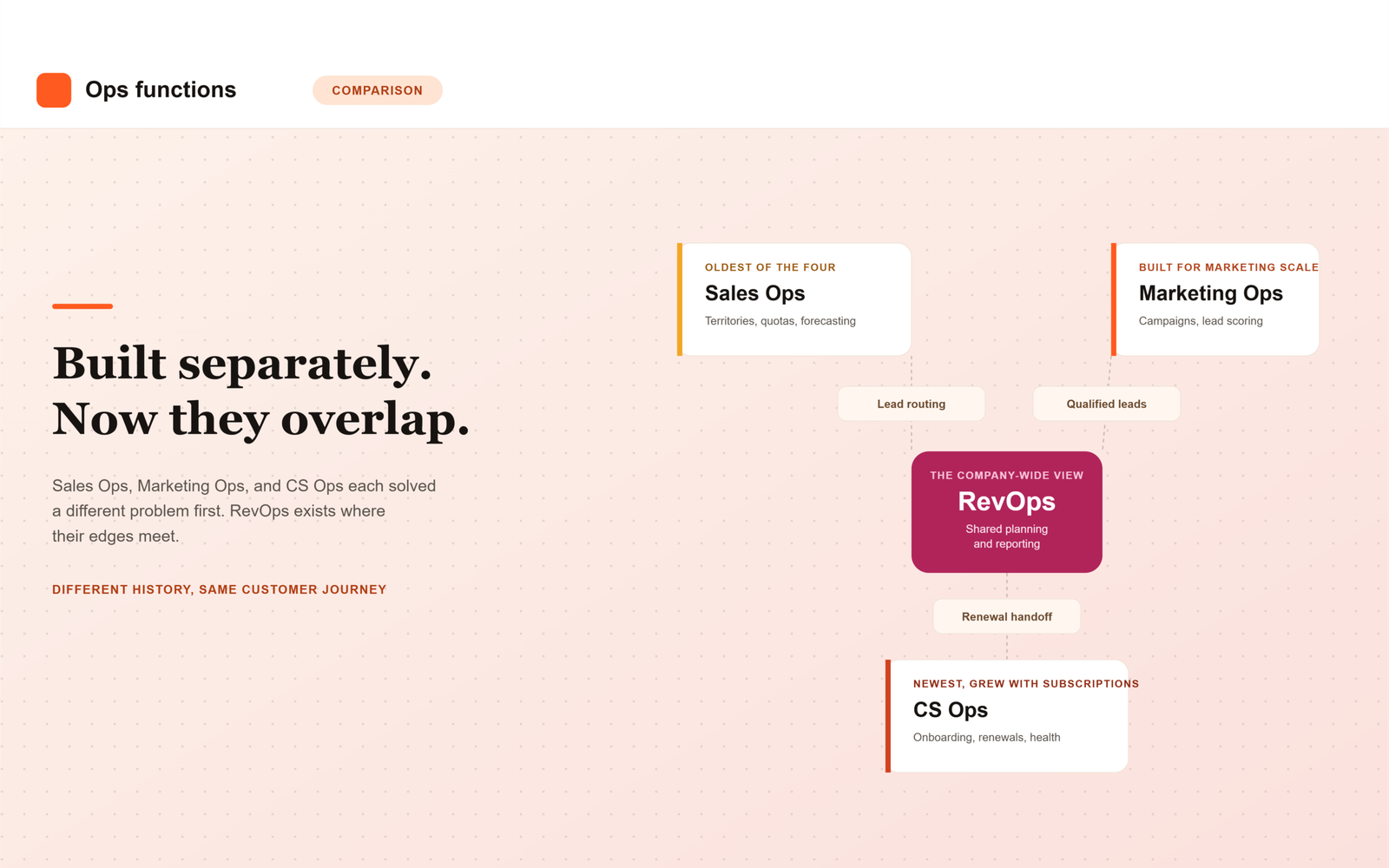
    Sales Operations came first. Marketing later built its own operations capability as marketing became more dependent on data and technology. Customer Success Operations developed as post-sale work became more structured, particularly in recurring-revenue businesses. Revenue Operations appeared later, partly because companies were finding that the specialist teams could work well inside their own areas while the full customer journey remained fragmented.

    It helps to look at that history before trying to draw neat ownership boundaries.

    Sales Operations grew around the needs of the sales force

    Sales Operations has the longest history of the four. Salesforce traces the formal function to Xerox in the 1970s, when J. Patrick Kelly created a team to handle planning, forecasting, territory design, compensation, and other work required to run an increasingly complex sales organization.

    The basic problem has changed less than the technology around it.

    Once a company employs more than a small number of salespeople, someone has to decide how accounts should be divided, how many sellers are required, how targets should be allocated, how opportunities are tracked, and how management should interpret the pipeline.

    Territories alone can become complicated. A company might divide accounts by geography, industry, size, product, existing relationship, or some combination of these. The design affects hiring, compensation, customer ownership, and the likelihood that good opportunities receive attention.

    Forecasting creates another body of work. Sales managers need a common way to describe the status of opportunities. Senior management needs an estimate of likely future sales. Those estimates depend on the quality of the underlying sales process and the discipline with which people maintain it.

    GitLab’s public Sales Operations documentation gives a useful picture of the function in practice. Its team works on sales processes, policies, systems, reporting, territories, field support, and go-to-market planning.

    This is familiar Sales Ops territory. The team is close to sellers and sales management because most of its work begins with the question of how the sales organization should operate.

    That proximity matters. A territory model may look balanced analytically and still fail because experienced sellers know that two apparently similar regions behave very differently. A required opportunity field may improve reporting while making little sense in the actual sales conversation. Good Sales Ops usually requires frequent contact with the people whose work it is organizing.

    Some responsibilities move in and out of the function depending on the company. Sales compensation might sit with Finance. Deal Desk may be part of Sales Ops in one organization and RevOps in another. Sales enablement may be closely connected or entirely separate.

    There is no standard boundary that every company follows.

    Marketing developed a different operating problem

    The modern marketing organization produces large amounts of activity and data before a salesperson becomes involved.

    A potential customer might attend an event, visit the website several times, subscribe to a newsletter, download a research report, respond to an advertisement, or join a webinar. Each interaction may enter a different system.

    Someone has to make those systems usable.

    Marketing Operations usually works on the infrastructure behind marketing execution: automation, campaign setup, databases, tracking, lead processes, reporting, and the technology connecting these activities.

    HubSpot describes the function broadly around the people, processes, and technology that support marketing strategy, including planning, workflow development, campaign analysis, data management, and performance measurement. GitLab’s Marketing Operations charter places similar emphasis on marketing technology, standardized processes, data quality, and systems management.

    The difference from Sales Ops becomes easier to see in day-to-day work.

    A Marketing Ops manager might spend time fixing campaign attribution, improving the process for handling webinar registrations, cleaning duplicate contact records, redesigning lead scoring, or deciding how data should move between the marketing automation platform and the CRM.

    A Sales Ops manager may use some of the same systems and data while worrying about a different set of questions: account ownership, pipeline quality, seller capacity, or whether a manager’s forecast is realistic.

    The distinction is clear enough while the work remains inside each department. It becomes less clear when Marketing decides that a person is ready for Sales.

    At that point, the two operating systems meet.

    Marketing may have a rule saying that a lead becomes qualified after a certain combination of actions. Sales may discover that the rule generates too many weak opportunities. Marketing Ops can adjust the scoring model, but Sales has information that matters to the change. Sales Ops understands territories and account ownership, which in turn affects where qualified leads should go.

    The work is shared because the process itself crosses the departmental boundary.

    Customer Success Operations appeared later

    Customer Success became a major organizational function much later than Sales or Marketing, particularly with the growth of software subscriptions and other recurring-revenue business models.

    In these businesses, the first sale may represent only part of the value of the customer relationship.

    A customer needs to begin using the product, adopt it successfully, receive enough value to remain, and eventually decide whether to renew. Some customers expand. Others reduce spending or leave.

    Customer Success teams eventually encounter many of the same operating challenges that Sales and Marketing faced earlier.

    Accounts need to be assigned. Managers need to understand how many customers each Customer Success Manager can reasonably handle. Onboarding processes need some consistency. Customer information sits in several systems. Renewal dates need to be visible before they become urgent. Leaders want to identify accounts that may be at risk.

    CS Ops grew around these needs.

    Gainsight describes Customer Success Operations as supporting CS organizations through systems, analytics, process development, and program management. GitLab’s CS Ops team works on customer-success systems, reporting, customer journeys, product-usage analytics, renewals, and operational planning.

    Much of the work concerns scale.

    A good Customer Success Manager may notice that a particular customer has stopped using an important part of the product and decide to intervene. CS Ops looks across the customer base and asks whether similar signals can be identified systematically.

    The team may also help determine which customers should receive high-touch service, which can be supported through more standardized programs, and how renewal activity should be organized.

    As with the other functions, these decisions often extend beyond the department itself. Renewal revenue matters to Finance and company forecasting. Expansion may return the customer to Sales. Product-usage information may change how Marketing defines a strong prospective customer.

    The customer may be “post-sale,” but the commercial relationship is still active.

    Why the boundaries get messy

    A diagram of the customer lifecycle makes ownership look straightforward.

    Marketing generates demand. Sales closes business. Customer Success manages the relationship afterward.

    Real companies rarely work that cleanly.

    Marketing continues to influence existing customers. Customer Success may identify an expansion opportunity that requires a salesperson. Sales may remain involved in a large account long after the original contract is signed. Finance can influence pricing and renewal terms. Product usage can become relevant to both Sales and Marketing.

    Even relatively simple processes can require several operations teams.

    Suppose Marketing generates an inbound request from a company that is already a customer.

    Marketing Ops controls the system that captured the request. Sales Ops may own the rules determining which salesperson handles the account. CS Ops may know that the customer is currently in a sensitive renewal conversation. Sending the request directly to a new-business seller without considering the existing relationship could create an awkward customer experience.

    The system needs some way to recognize the situation.

    A similar issue appears when territories change. Sales Ops may redesign account ownership at the beginning of the year. Marketing’s routing logic must then reflect the new structure. If it does not, leads continue travelling according to last year’s rules.

    Neither function can complete the change entirely on its own.

    This kind of overlap occurs repeatedly: lead qualification, lead routing, account ownership, sales handoffs, renewals, expansion, forecasting, and customer data. The difficulty usually comes from different teams having legitimate interests in the same process.

    Where Revenue Operations enters

    Revenue Operations developed in part because companies needed a broader operating view across these specialist functions.

    Forrester’s work on RevOps describes Marketing Operations, Sales Operations, and Customer Success Operations as parts of a wider revenue system and focuses on the coordination of data, technology, processes, and planning across them.

    Annual planning shows why that broader view can be useful.

    Marketing may expect to generate a certain amount of demand. Sales may plan headcount and territories based on an expected number of opportunities. Customer Success may be preparing for a much larger customer base. Finance has revenue and cost assumptions of its own.

    Each team can create a credible plan based on its local information. The problems appear when the assumptions do not line up.

    Sales may expect more opportunities than Marketing believes it can produce. Customer Success may need to support a level of growth without the required capacity. Finance may assume a renewal rate that recent customer behavior does not support.

    These are the situations in which a RevOps team can be useful. It can bring together assumptions that otherwise live in separate planning processes and help management understand the operating implications of the revenue target.

    The same role appears in reporting.

    Marketing may report leads and opportunities created. Sales reports pipeline and bookings. Customer Success reports renewals and expansion. Finance has the official financial view.

    A management team trying to understand the complete commercial picture needs those measures to connect. RevOps often works on that connection, sometimes through shared definitions, sometimes through common systems, and sometimes simply by bringing the operating teams into the same planning process.

    Not every company centralizes this work. Forrester has argued that Revenue Operations can exist as a coordinated capability even when Marketing Ops, Sales Ops, and CS Ops remain separate organizations.

    That model is common because the specialist teams still have substantial work that belongs inside their functions.

    GitLab shows how the overlap looks in practice

    GitLab is useful because its public handbook exposes much of the operating structure that other companies keep internal.

    Its Marketing Operations team manages marketing technology, processes, data quality, and systems. Sales Operations focuses on the sales organization, including policies, tools, territories, and sales execution. Customer Success Operations works on customer-success processes, systems, reporting, and renewals.

    On paper, these responsibilities can be separated easily.

    The handbook itself shows constant interaction between them.

    GitLab’s Sales Operations roles include collaboration with Marketing on lead-management processes. Marketing Operations manages systems whose outputs are used elsewhere in the commercial organization. Customer Success Operations works on renewal processes that eventually affect revenue forecasting and account planning.

    The teams remain distinct because they need specialist knowledge. The connections remain because customers and customer data move through more than one function.

    GitLab also places Sales Operations and Customer Success Operations within a broader Field Operations organization alongside Sales Strategy, Deal Desk, Sales Systems, and Data Intelligence.

    That structure is specific to GitLab. Another company might group the same work differently.

    The example is useful because it shows that operational design tends to develop around practical needs rather than around perfectly clean definitions.

    Ownership is often shared at the edges

    Some activities have a natural home.

    Sales territory design will usually sit close to Sales Ops. Marketing automation belongs naturally with Marketing Ops. CSM capacity planning is normally a CS Ops concern.

    Other activities are harder to place because the consequences spread across functions.

    Forecasting is one example.

    Sales managers usually produce views of the opportunities they expect to close. Sales Ops supports the process and systems behind those estimates. CS Ops may contribute renewal expectations. RevOps may assemble the broader commercial forecast. Finance may adjust or interpret it for the financial plan.

    Several groups can therefore “own forecasting” without doing the same work.

    Customer data has the same characteristic.

    Marketing needs campaign and engagement information. Sales needs accounts, contacts, opportunities, and pipeline history. Customer Success cares about product usage, customer health, support issues, renewal dates, and outcomes.

    A company still needs agreement on basic identifiers and definitions if those records are expected to describe the same customer.

    This is where many arguments about organizational ownership become unproductive. The useful level of detail is usually the specific decision being made.

    Who decides the sales territory? Who maintains the routing logic? Who defines a qualified marketing lead? Who decides when a customer becomes at risk? Who determines the renewal forecast category? Who can change a customer identifier used across several systems?

    The answers may be different even when all of these activities sit inside the same technology platform.

    Technical ownership and business ownership are often separate.

    A practical view of the boundaries

    The following map reflects common patterns rather than fixed rules.

    Area of workTypical operational homeCommon overlap
    Marketing automation and campaign operationsMarketing OpsRevOps on shared data and lifecycle rules
    Marketing data quality and attributionMarketing OpsSales Ops when measuring conversion into pipeline
    Lead qualificationMarketing OpsSales Ops and RevOps
    Lead and account routingSales Ops / Marketing OpsRevOps when company-wide rules are needed
    Territory designSales OpsFinance and RevOps during annual planning
    Quotas and seller capacitySales OpsFinance and RevOps
    Sales pipeline processSales OpsRevOps for company-wide definitions and reporting
    Sales forecasting mechanicsSales OpsRevOps and Finance
    Sales-to-CS handoffSales Ops / CS OpsRevOps when standardization spans the lifecycle
    CSM capacity and customer segmentationCS OpsRevOps during company planning
    Customer health and CS systemsCS OpsProduct, Sales, and RevOps depending on use
    Renewal operationsOften CS OpsSales Ops, RevOps, and Finance
    Expansion processCS Ops or Sales OpsRevOps when ownership crosses teams
    Shared customer definitionsRevOps / shared governanceAll specialist Ops teams
    End-to-end revenue reportingRevOpsMarketing Ops, Sales Ops, CS Ops, Finance
    Revenue capacity planningRevOps with FinanceAll specialist Ops teams

    The table becomes inaccurate as soon as it is treated as a template.

    A company in which Sales owns renewals will organize renewal operations differently from one in which Customer Success owns them. A channel business may have a large Partner Operations function that changes several of these responsibilities. A small company may place nearly everything in the hands of one Sales Ops or RevOps employee.

    The business model usually explains more than the title.

    Company size changes the answer

    Early-stage companies tend to have blurred operations roles because specialization would create more overhead than value.

    The first operations hire may manage Salesforce, prepare board reports, calculate commissions, clean marketing data, fix account assignments, and maintain renewal information. Whether the person’s title is Sales Operations or Revenue Operations often tells us less than the list of work on their desk.

    Specialization appears as the volume grows.

    Marketing eventually needs dedicated expertise in its technology and data. Sales requires more sophisticated territory, compensation, forecasting, and capacity work. Customer Success needs its own processes and systems as the customer base expands.

    The company gains deeper expertise, though coordination becomes harder.

    This is one reason RevOps often becomes more visible in later stages of growth. The business now has enough specialized operating teams that somebody has to maintain a view across them.

    Sometimes that leads to centralization under one RevOps leader. Sometimes the teams remain separate and share planning, data governance, and systems standards. Some companies use a hybrid arrangement.

    The right structure also changes over time. A centralized model can be useful while a company standardizes fragmented processes, then becomes unnecessarily heavy later. A decentralized model can preserve expertise and speed while creating duplicated technology and inconsistent definitions.

    Organizational design in this area is rarely permanent.

    How to tell whether the boundaries are working

    The quality of the structure becomes visible in routine situations.

    When Marketing changes the definition of a qualified lead, Sales should understand the consequence before the change goes live.

    When Sales redesigns territories, inbound routing should change at the same time.

    When a salesperson closes a customer, the post-sale team should receive the information it needs without reconstructing the entire sales history.

    When a renewal becomes uncertain, the change should eventually reach the revenue outlook.

    Managers should also know where to take a problem. If every cross-functional issue requires escalation to the Chief Revenue Officer, the operating model is probably incomplete. If teams routinely change shared processes without speaking to one another, the model has a different weakness.

    Some overlap is healthy. It forces functions to consider consequences outside their immediate department.

    The burden comes when the same decision has several owners, or none.

    What each function is really there to do

    Sales Ops, Marketing Ops, and CS Ops remain useful categories because the departments they support have genuinely different operating needs.

    Sales Ops spends most of its time making the sales organization easier to manage and more productive. Marketing Ops builds the systems and processes that allow Marketing to operate at scale. CS Ops provides similar operating support for the post-sale customer organization.

    Revenue Operations becomes relevant when the company needs a wider operating view across those functions.

    That wider view can involve shared planning, definitions, technology, customer data, lifecycle processes, forecasting, and reporting. The exact scope changes from company to company because the commercial model changes.

    There is little benefit in forcing every activity into one universal chart.

    A more realistic organization accepts that some work is local, some is shared, and some needs a common owner because several teams depend on the same decision.

    That is where the distinctions among RevOps, Sales Ops, Marketing Ops, and CS Ops become useful in practice.

    Frequently Asked Questions

    What’s the actual difference between RevOps, Sales Ops, Marketing Ops, and CS Ops?

    Sales Ops, Marketing Ops, and CS Ops each support one department: sales, marketing, and post-sale customer teams respectively, and grew up solving that department’s specific operating problems. RevOps sits above them, focused on the shared processes, definitions, and reporting that cross department lines, like lead handoffs, forecasting, and renewal visibility.

    Which came first: Sales Ops, Marketing Ops, or CS Ops?

    Sales Operations has the longest history, tracing back to Xerox in the 1970s. Marketing Operations developed later as marketing became more dependent on data and technology. Customer Success Operations is the newest of the three, emerging alongside the growth of subscription and recurring-revenue business models. Revenue Operations appeared after all three, once companies needed a broader view across specialist teams that were each working well on their own.

    Who owns lead routing, Sales Ops or Marketing Ops?

    Often both, which is exactly the kind of overlap that causes confusion. Marketing Ops typically controls the system that captures and scores the lead, while Sales Ops owns the rules for which salesperson or team receives it, based on territory and account ownership. When company-wide consistency is needed across both sides of that handoff, RevOps usually gets involved.

    Does a company need RevOps if it already has Sales Ops, Marketing Ops, and CS Ops?

    Not necessarily as a separate team. Some companies centralize this coordination under a dedicated RevOps function, while others keep Marketing Ops, Sales Ops, and CS Ops separate and share planning, data governance, and systems standards between them. Both models work; what matters is that somebody has responsibility for the decisions that cross departmental lines, like shared customer definitions and end-to-end revenue reporting.

    Why do these org structures vary so much between companies?

    Because the business model usually explains more than the title does. A company where Sales owns renewals will structure renewal operations differently than one where Customer Success owns them. A channel-based business may have a Partner Operations function that reshapes several other responsibilities. There’s no universal chart that fits every company, only common patterns.

    How does company size change how these functions are organized?

    Early-stage companies tend to blur these roles into one person handling everything from CRM administration to board reporting, since specialization would create more overhead than value at that size. As volume grows, Marketing, Sales, and Customer Success each need dedicated operating expertise, and RevOps typically becomes more visible at that later stage, once there are enough specialized teams that someone needs to maintain a view across all of them.