PLG CRM Software
Product-led growth changed how SaaS companies acquire customers, but for years, the CRM software supporting those companies didn’t change with it. PLG CRM software is the category that’s emerged to close that gap: systems built around usage-driven signals and self-serve customer journeys, rather than the traditional linear sales pipeline. This guide covers what PLG CRM software actually is, why it matters, and how the category has developed heading into 2026.
What Is PLG CRM Software?
PLG CRM software is a category of tools, sometimes a purpose-built platform, sometimes a configuration of a traditional CRM plus supporting tools, designed to track and act on customer behavior across the entire self-serve lifecycle: signup, activation, expansion, and renewal, largely driven by in-product usage rather than sales activity.
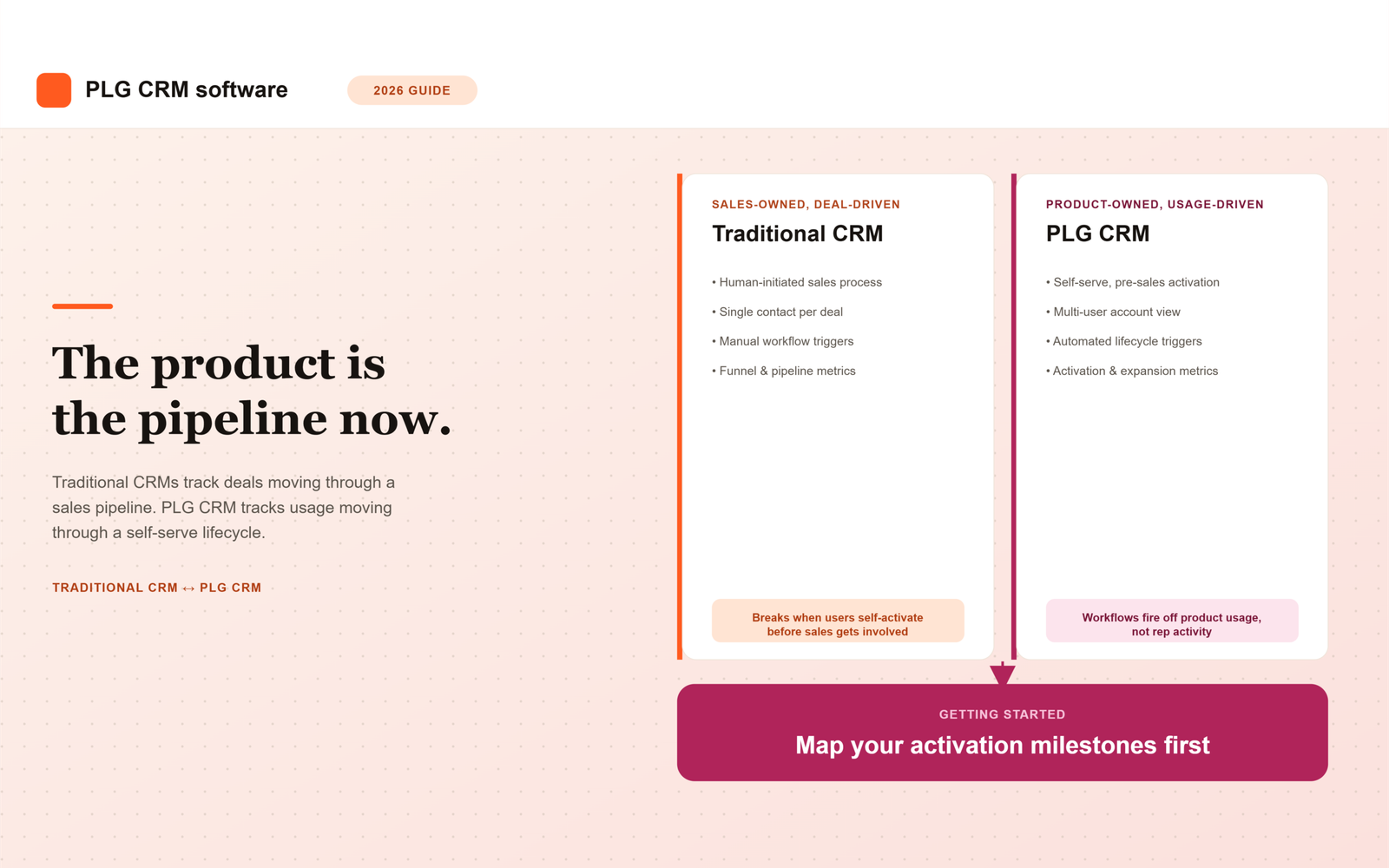
Unlike a traditional CRM, which is built around deals moving through a sales-owned pipeline, PLG CRM software treats the product itself as the primary source of lifecycle data, with sales and customer success acting on signals the product generates rather than driving the process from the start. A user signing up, exploring a feature, inviting a colleague, or hitting a usage limit all become data points the system can act on automatically, long before a rep ever gets involved.
This distinction matters because the underlying assumption behind most CRMs, that a human initiates and drives the sale, simply doesn’t hold for a self-serve product. The account already exists, is already being used, and may already be showing signs of expanding or churning before anyone at the company has spoken to a single user.
Why Traditional CRMs Fall Short for PLG Companies
Most traditional CRMs were designed decades before product-led growth became a standard motion, and the gaps that creates tend to show up in the same four places.
- They assume a human-initiated sales process, when in PLG the user often self-activates before any sales contact happens
- They’re built around single primary contacts per deal, not the multi-user, multi-role accounts typical of PLG products
- They lack native support for triggering workflows off product usage events rather than manually logged sales activity
- Reporting defaults to funnel and pipeline metrics rather than activation and expansion metrics that actually matter for PLG growth
None of these gaps are fatal on their own, but they compound. A team can work around any single one with a manual process or a spreadsheet. Once a company has enough self-serve accounts to matter, though, those manual workarounds turn into the full-time job of someone stitching data together that the CRM should have surfaced natively.
Core Capabilities of PLG CRM Software
1. Usage-Based Account Health Scoring
Rather than scoring leads on firmographic data alone, PLG CRM systems weigh product usage patterns, feature adoption, login frequency, seat expansion, to determine account health and expansion readiness. A company with 500 employees that logs in once a month is a worse expansion candidate than a 50-person company where three teams use the product daily, and a good PLG CRM should reflect that in the score rather than defaulting to company size.
2. Multi-User Account Views
Because PLG accounts often have many individual users at different points in the activation journey, the software needs to represent the account as a whole, not just individual contact records. One user might be a power user driving expansion, while three others haven’t logged in since their invite. A single contact record can’t capture that spread, but an account-level view built for multi-user products can.
3. Automated Lifecycle Triggers
Workflows fire based on product behavior, a user hitting an activation milestone, usage dropping below a churn-risk threshold, a team adding new seats, rather than requiring manual updates from a rep. This is where PLG CRM software earns its keep operationally: a sales or customer success rep doesn’t need to remember to check in on an account, the system surfaces the account the moment its behavior changes.
4. Self-Serve to Sales-Assist Handoff
As PLG motions mature, most add a sales-assist layer for larger accounts or enterprise upsell. Good PLG CRM software supports a clean handoff at the right moment, without losing the lifecycle context built up during the self-serve journey. A rep picking up an account should see its full usage history and activation milestones, not just a name and an email address with no context for why the account is suddenly worth a phone call.
How the Category Has Evolved Heading Into 2026
Early PLG companies stitched together product analytics tools, Amplitude or Mixpanel, a CDP like Segment, and a traditional CRM to approximate this functionality. That stitched approach worked, but it required significant engineering investment to keep the pipes between systems running and in sync.
By 2026, purpose-built PLG CRM and growth platforms, such as Endgame, Correlated, and Pocus, have matured enough that many companies are replacing parts of that stitched-together stack with more integrated, purpose-built tooling. At the same time, traditional CRM vendors have added usage-data ingestion and lifecycle automation of their own to compete, narrowing the gap between the two categories in some cases while widening it in others, depending on how deeply each vendor actually built the capability versus bolted it on.
Build vs. Buy: How to Decide
The right approach depends less on company size and more on how much engineering capacity is available to maintain the system once it’s built.
| Approach | Best For | Trade-off |
|---|---|---|
| Stitched stack (CRM + analytics + CDP) | Teams with strong data/engineering resources wanting full customization | Higher maintenance burden, more integration risk |
| Purpose-built PLG CRM platform | Teams wanting faster time-to-value without heavy engineering investment | Less customization than a fully bespoke stack |
| Traditional CRM with PLG add-ons | Teams already standardized on a major CRM wanting incremental PLG capability | May not fully solve multi-user, usage-native lifecycle needs |
Teams that already have a data engineering function tend to lean toward the stitched stack, since they can build exactly what they need and already have the capacity to maintain it. Teams without that capacity are usually better served by a purpose-built platform, even with less customization, simply because the alternative is a fragile stack nobody has time to keep working.
Getting Started: A Practical First Step
Rather than starting with a platform search, start by mapping your actual activation milestones, the specific in-product events that reliably predict a user or account will convert, expand, or churn. This step matters more than it sounds like it should, because most teams skip it and go straight to evaluating vendors on feature lists.
Any PLG CRM software you evaluate should be judged first on how easily it can track and act on those specific milestones, not on its feature list in the abstract. A platform with an impressive list of integrations is useless if it can’t surface the one signal, say, a team inviting five new users in a week, that your data already shows predicts expansion.
Summary
PLG CRM software exists because traditional CRMs were built around a human-initiated sales process that doesn’t match how self-serve products actually get adopted, used, and expanded. The core capabilities that matter are usage-based account health scoring, multi-user account views, automated lifecycle triggers, and a clean handoff to sales-assist once an account is ready for it.
Heading into 2026, companies are choosing between a stitched analytics-plus-CRM stack, a purpose-built PLG platform, or a traditional CRM with PLG add-ons, with the right choice depending mostly on available engineering capacity rather than company size alone. Whichever direction a team takes, the starting point should be the same: map your specific activation milestones first, then evaluate any platform against how well it tracks and acts on those exact signals, not against a generic feature list.
Frequently Asked Questions
What’s the main difference between PLG CRM software and a traditional CRM?
A traditional CRM is built around deals moving through a sales-owned pipeline, driven by rep activity. PLG CRM software treats the product itself as the primary source of lifecycle data, tracking usage-driven signals like activation, feature adoption, and seat expansion, with sales and customer success acting on those signals rather than initiating the process.
Do we need to replace our existing CRM to support PLG?
Not necessarily. Some companies add PLG capability to their existing CRM through add-ons or integrations, particularly if they’re already standardized on a major platform. This tends to work best for incremental needs, but it may not fully solve the multi-user, usage-native lifecycle gaps that a purpose-built PLG CRM or a custom stitched stack can address more directly.
What are activation milestones and why should we map them first?
Activation milestones are the specific in-product events that reliably predict whether a user or account will convert, expand, or churn, such as inviting a teammate or completing a key setup step. Mapping these first matters because any CRM platform is only as useful as its ability to track and act on the exact signals that predict outcomes for your product, not a generic list of features.
Should we build a stitched PLG stack or buy a purpose-built platform?
It depends mainly on available engineering capacity. Teams with strong data and engineering resources can build a fully customized stitched stack using analytics tools, a CDP, and a CRM, but that comes with a higher maintenance burden. Teams without that capacity typically get faster time-to-value from a purpose-built PLG CRM platform, even with somewhat less customization.
How does account health scoring work in PLG CRM software?
Instead of scoring based on firmographic data like company size alone, PLG CRM systems weigh actual product usage patterns, including feature adoption, login frequency, and seat expansion, to determine how healthy an account is and how ready it may be for expansion. A smaller account with high daily engagement can score higher than a larger account that logs in rarely.
When should a self-serve account get a sales-assist layer?
There’s no single universal trigger, but common signals include an account approaching usage limits, multiple teams within the same company adopting the product, or a company requesting features like centralized billing or custom contracts that self-serve typically can’t support. Good PLG CRM software should surface these signals automatically, along with the account’s full usage history, so the handoff doesn’t lose the context built up during the self-serve journey.
Leave a Reply