Category: RevOps

  • Best RevOps Services for Australian B2B SaaS

    Best RevOps Services for Australian B2B SaaS

    Australian B2B SaaS companies sell into one of the more demanding go-to-market environments in the world: a small domestic market that forces early international expansion, usually into the US and APAC simultaneously, across time zones that overlap awkwardly with both. That combination makes strong RevOps services less of a nice-to-have and more of a survival requirement once a company passes its first few million in ARR.

    This guide covers what to look for in a RevOps services partner if you’re an Australian B2B SaaS revenue leader, and how the local market context should shape your evaluation.

    Why Australian B2B SaaS Teams Have a Unique RevOps Problem

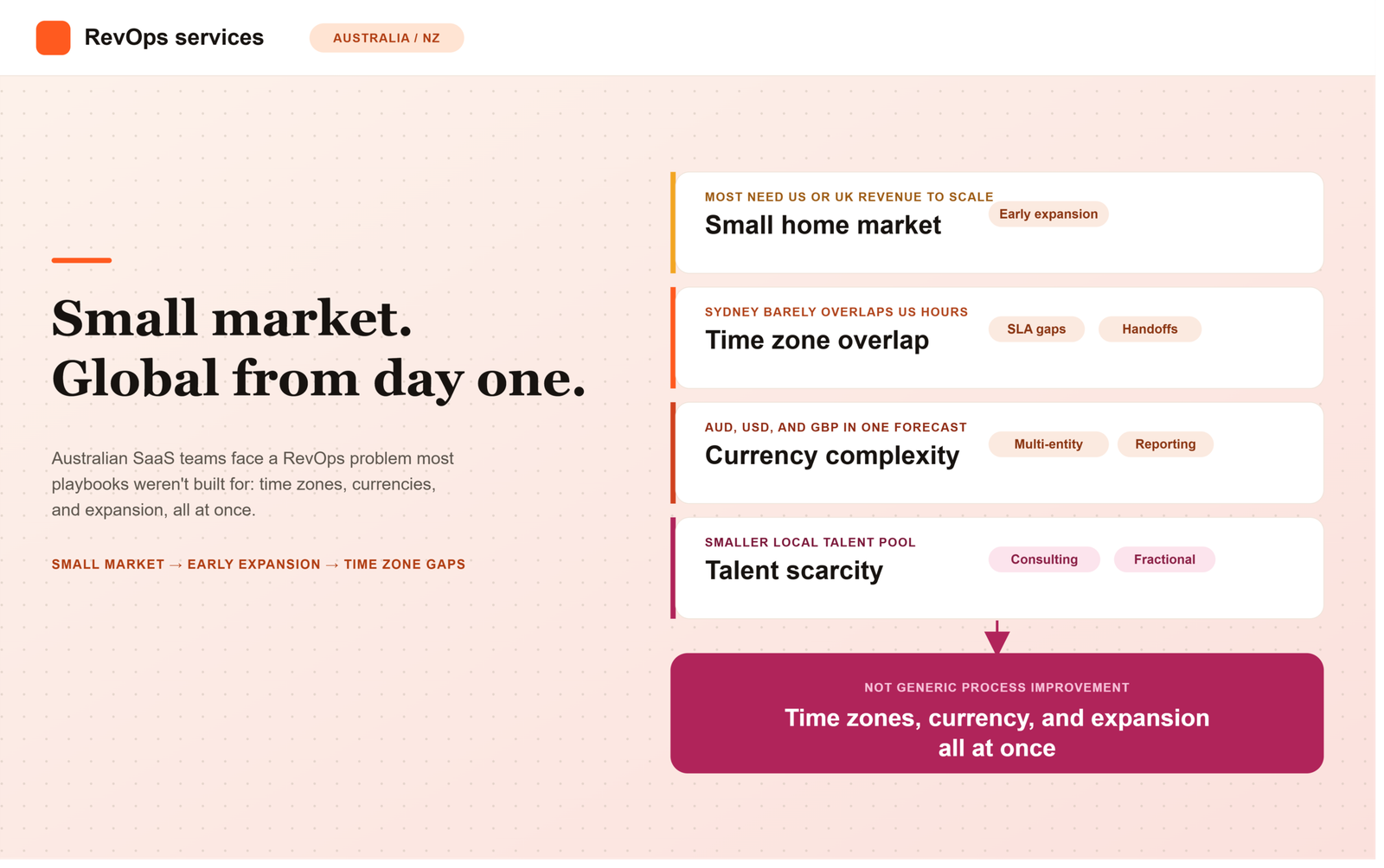
    • Small home market, early internationalization. Most Australian SaaS companies need US or UK revenue to hit venture-scale outcomes, often starting international expansion earlier than comparable companies in larger domestic markets.
    • Awkward time zone overlap. Sydney/Melbourne business hours barely overlap with US business hours, which creates real handoff and SLA problems between marketing, SDRs, and closing reps across regions.
    • Currency and reporting complexity. Multi-currency deals and ANZ-specific compliance and invoicing norms add friction that generic RevOps playbooks don’t account for.
    • Talent scarcity. The local RevOps talent pool is smaller than in the US or UK, which is a major reason Australian SaaS companies lean on consulting partners rather than building large in-house teams early.

    What Good RevOps Services Look Like for This Market

    1. Explicit Time Zone and Handoff Design

    A partner worth hiring should be able to describe, concretely, how they design SLAs and lead routing so a lead generated during Sydney business hours doesn’t sit for 10+ hours before a US-based rep sees it and vice versa.

    2. Multi-Currency and Multi-Entity Reporting

    If you’re billing in AUD, USD, and potentially GBP, your RevOps partner needs experience building forecasting and pipeline reporting that rolls up cleanly across currencies without manual reconciliation every board cycle.

    3. Sales and Marketing Alignment That Survives Time Zone Handoffs

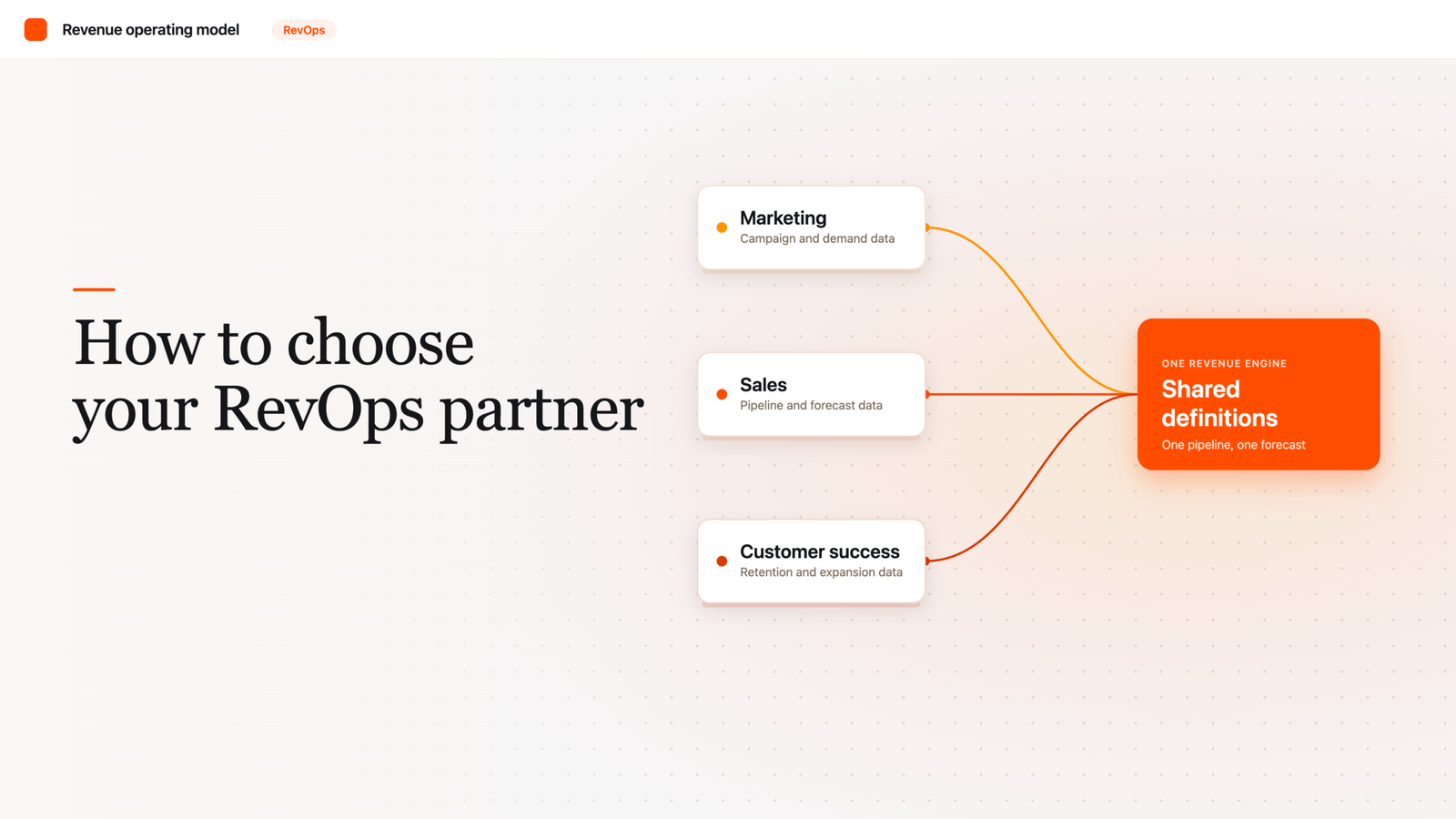
    Alignment is harder to maintain when your marketing team, SDR team, and closing reps are spread across three time zones. Look for partners who build closed-loop attribution and shared lead definitions that hold up even when teams rarely overlap in real time.

    4. Familiarity With the ANZ-to-Global Expansion Playbook

    Ask any prospective partner how many Australian SaaS clients they’ve helped expand into the US specifically, this is a well-worn but specific playbook, and experience with it should be easy for them to demonstrate with real examples.

    Evaluation Checklist

    Criteria What to Look For
    Time zone design Concrete SLA and routing rules across ANZ/US/APAC hours
    Currency handling Multi-currency forecasting and reporting experience
    Expansion track record Prior work with Australian SaaS companies expanding into the US or UK
    Alignment tooling Ability to keep sales/marketing aligned across distributed teams
    Engagement flexibility Comfortable working async and outside standard AU business hours

    Fractional vs. Project Engagements

    Many Australian SaaS companies start with a project-based engagement, typically a CRM re-architecture or lead routing overhaul timed to a US expansion push, before moving to fractional, ongoing RevOps support once the international motion stabilizes. Given the smaller local talent pool, fractional support is often more cost-effective than trying to hire a full in-house RevOps function too early.

    Frequently Asked Questions

    What makes RevOps different for Australian SaaS companies?

    The core process work, forecasting, lead routing, CRM hygiene, is the same everywhere. What’s different is the operating environment: a small home market that forces early international expansion, time zones that barely overlap with the US, and multi-currency reporting that most generic RevOps playbooks aren’t built to handle.

    How much does RevOps consulting cost in Australia?

    Project-based engagements, such as a CRM re-architecture ahead of a US launch, are usually quoted as a fixed fee for a defined scope. Fractional support is typically billed monthly. Because the local talent pool is smaller, fractional consulting is often more cost-effective than hiring a full-time in-house RevOps lead too early.

    Should we hire a local Australian RevOps partner or one based in the US?

    What matters more than location is whether the partner has direct experience with the ANZ-to-US or ANZ-to-UK expansion playbook, including time zone handoff design and multi-currency reporting. A partner who understands Sydney-to-US SLA gaps firsthand is more valuable than one who only knows a single region well, regardless of where they’re headquartered.

    When should an Australian SaaS company invest in RevOps services?

    Most teams feel the need once they pass their first few million in ARR and start hiring SDRs or reps outside Australia. The clearest trigger is usually the moment leads generated in Sydney hours start sitting unworked for most of a US business day, that handoff gap is exactly what a RevOps partner should be brought in to fix.

    What’s the most common RevOps mistake Australian SaaS teams make when expanding overseas?

    Treating the expansion as a hiring problem rather than a systems problem. Adding US-based reps without first fixing lead routing, SLA rules across time zones, and multi-currency reporting just moves the same handoff gaps into a bigger, more expensive team.

    Is fractional or project-based RevOps better for a scaling ANZ SaaS company?

    Project-based work fits a defined, time-boxed problem, like rebuilding lead routing ahead of a US launch. Fractional support fits the stretch after that, when the international motion is live but still evolving and needs an ongoing owner. Many Australian companies use a project engagement to prepare for expansion, then shift to fractional support once they’re actually operating across regions.

    The Bottom Line

    For Australian B2B SaaS teams, the value of a RevOps services partner isn’t generic process improvement, it’s specifically solving the time zone, currency, and international expansion problems that come with building a global GTM motion from a small home base. Evaluate partners on that specific experience, not just general RevOps credentials.
     

  • Best RevOps Consulting Services for B2B SaaS

    Best RevOps Consulting Services for B2B SaaS

    Most comparisons of RevOps consulting services treat every B2B SaaS company as if it needs the same thing. It doesn’t. What a seed-stage company with five reps needs from a RevOps partner looks almost nothing like what a 300-person, multi-product SaaS company needs. The right way to evaluate consulting services isn’t by brand name or feature checklist, it’s by matching the partner’s model to your company’s actual stage of growth.

    Why Stage Matters More Than Almost Anything Else

    A RevOps consulting engagement that’s perfect for a company doing $2M ARR can be actively wrong for a company doing $20M ARR, and vice versa. Company stage determines:

    • How much process needs to exist before tooling makes sense
    • Whether you need strategic diagnosis or hands-on execution capacity
    • Whether a fractional or project-based model fits better
    • How much of the engagement should focus on people/process versus systems

    What to Look For by Stage

    Early Stage (Pre-Seed to Series A)

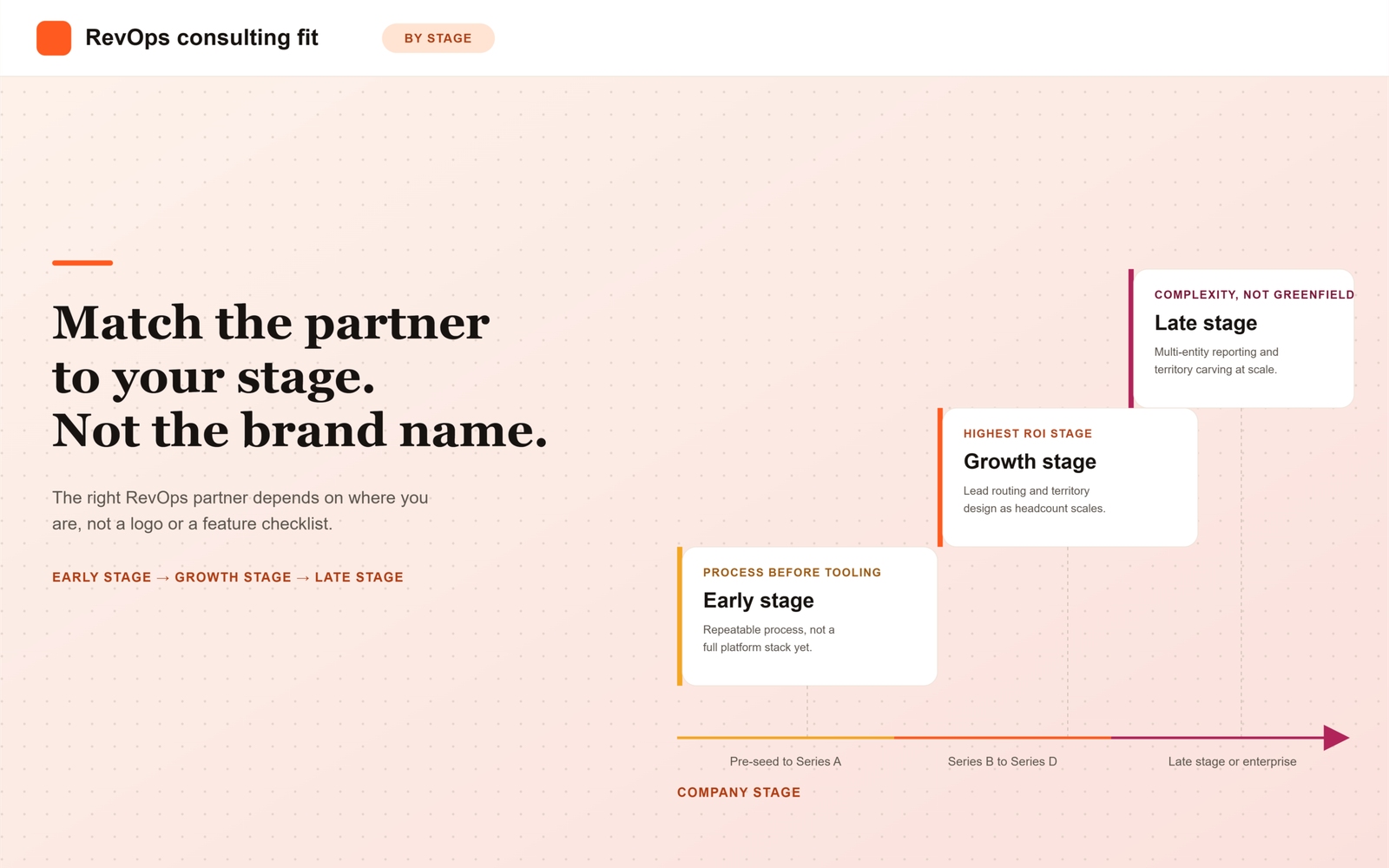
    At this stage, most companies don’t need a full RevOps build-out, they need someone to help define a repeatable sales process and basic CRM hygiene before scaling spend on tooling. Look for consultants who explicitly say “you might not need everything yet” rather than upselling a full platform stack. The best early-stage engagements are short, focused, and leave you with lightweight, repeatable processes rather than a heavy system.

    Growth Stage (Series B to Series D)

    This is where dedicated RevOps consulting delivers the most obvious ROI. Pipeline is growing faster than process, sales and marketing are starting to trip over each other, and forecasting needs to hold up for board meetings. Good partners at this stage focus on:

    • Lead routing, scoring, and SLA design between marketing and sales
    • Territory and comp plan structure as headcount scales
    • Forecasting infrastructure that’s accurate enough to bet the business on

    Late Stage / Enterprise SaaS

    At scale, the problem shifts from “build the process” to “manage complexity across multiple products, regions, and go-to-market motions.” Consultants here need experience with multi-entity reporting, complex territory carving, and change management across large, established teams, not just greenfield process design.

    Core Evaluation Criteria That Apply at Every Stage

    Criteria What to Look For
    Stage fit Case studies from companies at a comparable ARR and headcount, not just “SaaS experience”
    Sales-marketing alignment Concrete deliverables around shared lead definitions and closed-loop reporting
    Right-sized scope Willingness to recommend less, not just sell more services
    Execution capability Hands-on CRM/systems expertise, not strategy-only advice
    Exit plan Clear plan for handing off ownership to an internal team eventually

    Fractional vs. Project-Based: Which Fits Your Stage?

    Early-stage and enterprise companies tend to prefer project-based engagements, a defined problem with a start and end date. Growth-stage companies scaling quickly often get more value from fractional RevOps support, where a consultant effectively acts as an interim RevOps leader across several months while the internal function matures.

    Questions That Reveal Whether a Partner Understands Your Stage

    1. What would you NOT recommend we do right now, given where we are?
    2. Can you show me an engagement with a company at a similar ARR and headcount to ours?
    3. How does your approach change for a 20-person sales team versus a 5-person one?
    4. What does success look like in 90 days versus 12 months?

    Frequently Asked Questions

    How much does RevOps consulting cost?

    Pricing typically depends on the engagement model. Project-based engagements are often quoted as a fixed fee for a defined scope, while fractional RevOps support is usually billed monthly, similar to a part-time hire. Expect the price to scale with company stage and the number of systems involved, not just the number of hours.

    What is the difference between fractional and project-based RevOps consulting?

    A project-based engagement solves one defined problem within a set timeline, then ends. Fractional RevOps means the consultant acts as an interim RevOps leader over several months, staying involved as priorities shift. Growth-stage companies often prefer fractional support because their needs keep changing faster than a single project can capture.

    When should a SaaS company hire a RevOps consultant?

    The clearest signal is when process gaps start showing up in the numbers: forecasts that don’t hold up, leads that stall between marketing and sales, or reporting that takes days to reconcile. Waiting until Series B or later is common, but even earlier-stage teams benefit from a short engagement that sets up clean CRM habits before scaling.

    How is RevOps consulting different from hiring an in-house RevOps person?

    An in-house hire owns the function long term and lives inside the company’s day-to-day priorities. A consultant brings pattern recognition from many companies at a similar stage and is often used to build the initial system, then hand it off. Many companies use a consultant first and hire in-house once the role’s scope is clear.

    How long does a typical RevOps consulting engagement last?

    Early-stage and enterprise engagements are often project-based and run four to twelve weeks. Growth-stage fractional engagements commonly run three to nine months, long enough to build lasting infrastructure, but scoped to end once an internal hire can take over.

    What should be included in a RevOps consulting proposal?

    Look for a clear problem statement specific to your stage, defined deliverables rather than vague strategy sessions, a stated timeline, and an explicit exit plan for handing ownership back to your team. A proposal that can’t describe what “done” looks like is a warning sign.

    Match the Partner to the Problem You Actually Have

    The best RevOps consulting relationships aren’t built on the most impressive platform certifications or the biggest brand name, they’re built on a partner who correctly diagnoses what stage you’re at and resists the urge to sell you a bigger engagement than you need. Ask every prospective partner to tell you what they wouldn’t recommend, not just what they would.


  • Best CRM and RevOps Platforms for SaaS in 2026

    Best CRM and RevOps Platforms for SaaS in 2026

    Choosing a CRM used to be a single decision. In 2026, it’s rarely just one platform anymore: most SaaS revenue teams are stitching together a core CRM, a RevOps/operations layer, and one or more AI-driven analytics or forecasting tools. Getting this stack right matters more than ever, because the cost of getting it wrong now compounds across every downstream system it touches.

    This guide breaks down the CRM and RevOps platforms SaaS teams are actually standardizing on in 2026, how the category has shifted, and how to match a platform combination to your company’s growth stage.

    What Changed in the CRM and RevOps Platform Market for 2026

    Three shifts define the current landscape:

    • AI moved from add-on to default. Lead scoring, forecast modeling, and deal-risk flagging are now built into core CRM tiers rather than sold as separate modules.
    • The “RevOps layer” became its own category. Tools like Clari, Gong, and HubSpot’s Operations Hub now sit on top of or alongside the CRM, handling forecasting, conversation intelligence, and data hygiene as dedicated functions.
    • Buyers consolidated vendors. After years of tool sprawl, SaaS RevOps leaders are actively cutting point solutions in favor of platforms that cover more of the revenue workflow natively.

    The Three Layers You’re Actually Choosing Between

    When people say “CRM platform,” they’re usually describing a stack with three distinct layers:

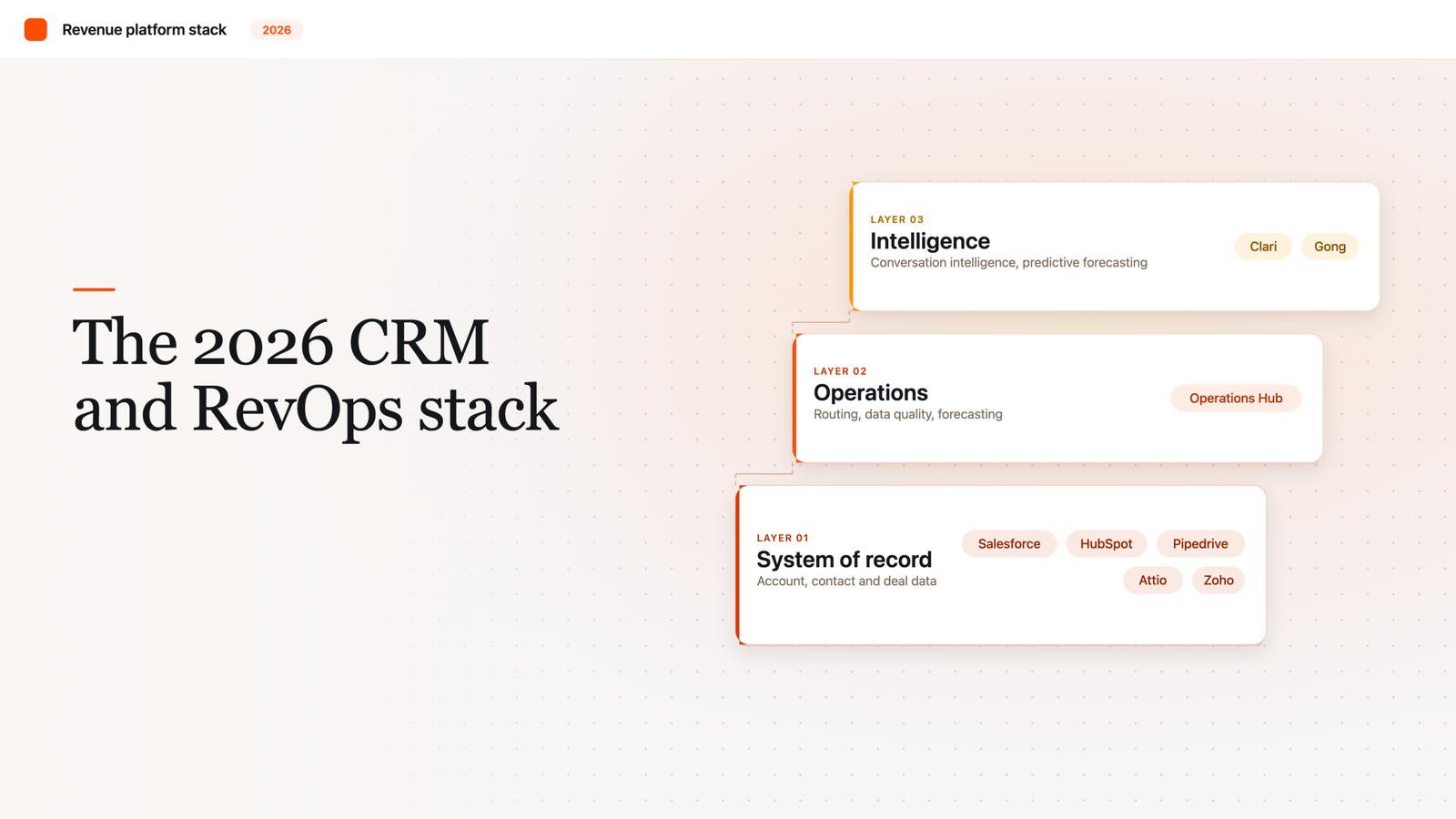
    1. System of record: the core CRM (Salesforce, HubSpot, Pipedrive, Attio, Zoho) that stores account, contact, and deal data.
    2. Operations layer: tools that sit on top to manage routing, data quality, forecasting, and workflow automation.
    3. Intelligence layer: AI-driven tools for conversation intelligence, signal-based selling, and predictive forecasting.

    Most vendors now compete to own more than one layer, which is why platform comparisons have gotten more complex than a simple feature checklist.

    Platform Comparison at a Glance

    Platform Best For Watch Out For
    Salesforce Complex, multi-product enterprises needing deep customization Implementation cost and admin overhead
    HubSpot Mid-market SaaS wanting CRM + marketing + ops in one suite Costs scale quickly as contact volume grows
    Pipedrive / Attio Lean sales-led teams wanting speed over depth Fewer native RevOps and forecasting features
    Zoho Cost-conscious teams needing broad functionality Less polished UX, smaller partner ecosystem
    Clari / Gong (layered on CRM) Teams that need forecasting and conversation intelligence, not a CRM replacement Additional cost and integration overhead

    How to Match a Platform to Your Growth Stage

    The right stack depends less on brand reputation and more on where your revenue team actually is:

    • Pre-Series A: A lightweight CRM (Pipedrive, Attio, or HubSpot’s free/starter tier) is usually enough. Don’t buy a RevOps layer before you have repeatable process to operationalize.
    • Series A to B, scaling GTM: This is where most teams add an operations layer. Lead routing, forecasting, and reporting typically outgrow spreadsheets and native CRM reporting around this stage.
    • Series C and beyond: Multi-product, multi-region GTM usually justifies Salesforce’s customization depth, paired with dedicated intelligence-layer tools.

    Questions to Ask Before You Commit

    1. Which layer (system of record, operations, or intelligence) is this actually solving for, and do we already own a tool that covers it?
    2. What does data migration and integration actually cost, in time and dollars, not just license price?
    3. Will this platform still fit at 3x our current headcount, or are we buying for today’s team size only?
    4. Who owns admin and configuration internally, and do they have the bandwidth to maintain it?

    The Platform Is Only as Good as the Operating Model Around It

    No CRM or RevOps platform fixes misalignment between sales and marketing on its own. It just gives you the infrastructure to enforce alignment once you’ve defined it. The teams getting the most value from their 2026 stack are the ones who nailed process and definitions first, then chose tooling to support it, rather than the reverse.

    Frequently Asked Questions

    What’s the difference between a CRM and a RevOps platform?

    A CRM is the system of record: it stores account, contact, and deal data. A RevOps platform (or RevOps layer) sits on top of or alongside the CRM to handle lead routing, forecasting, reporting, and data hygiene across sales, marketing, and customer success. Many teams need both, not one instead of the other.

    Do I need a separate RevOps layer if I already have a CRM?

    Not always. Early-stage teams with simple, low-volume pipelines can often rely on native CRM reporting and manual process. A dedicated RevOps layer typically becomes worth the investment once lead volume, headcount, or reporting complexity outgrows what the CRM handles natively, usually around Series A to B.

    Which CRM is best for early-stage SaaS companies?

    Lightweight, fast-to-implement tools like Pipedrive, Attio, or HubSpot’s starter tier are usually the right fit pre-Series A. The priority at this stage is speed and low overhead, not deep customization or a full RevOps layer.

    How much does implementing a RevOps stack typically cost?

    Costs vary widely based on team size, data volume, and how many systems need to integrate, but license price is rarely the biggest cost. Implementation time, data migration, and ongoing admin work usually add up to more than the subscription fee itself, which is why total cost of ownership matters more than sticker price when comparing platforms.

    When should a SaaS company move from HubSpot to Salesforce?

    This shift usually makes sense when a company moves into multi-product or multi-region go-to-market motions that require deeper customization than HubSpot supports, or when contact volume growth makes HubSpot’s pricing model less cost-effective than Salesforce’s structure. It’s rarely worth making the switch before that complexity actually exists.

    What’s the biggest mistake SaaS teams make when choosing a CRM or RevOps stack?

    Buying tooling before defining process. A platform can’t fix misaligned sales and marketing definitions or an undefined lead lifecycle on its own. Teams that get the most value from their stack define their process and shared definitions first, then choose tools to support it, rather than expecting the software to create alignment for them.

  • Best RevOps Consulting Services for India SaaS Teams.

    Best RevOps Consulting Services for India SaaS Teams.

    Indian B2B SaaS companies are scaling faster than ever, but many hit the same wall on the way to $10M+ ARR: sales, marketing, and customer success stop moving in the same direction. Pipeline data lives in one system, campaign data in another, and forecasts become guesswork. This is where revenue operations consulting earns its keep it’s the discipline that aligns people, process, and platforms around a single revenue engine.

    If you’re a RevOps leader evaluating outside help, this guide breaks down what good revenue operations services actually look like, the criteria that separate a strong partner from a mediocre one, and how to shortlist consultants who understand the realities of Indian B2B growth teams selling into global markets.

    Why RevOps Matters More for Indian SaaS Teams Right Now

    Indian SaaS companies operate under a specific set of pressures that make revenue operations consulting especially valuable:

    • Multi-timezone go-to-market motions. Many Indian SaaS teams sell into the US, EMEA, and APAC simultaneously, which means sales and marketing handoffs need to work across time zones without losing momentum.
    • Capital efficiency expectations. Post-2022, Indian SaaS investors have pushed harder on efficient growth metrics CAC payback, net revenue retention, and pipeline conversion all of which depend on clean, aligned revenue data.
    • Rapid tool sprawl. Fast-growing teams often accumulate a patchwork of CRM, marketing automation, and customer success tools before anyone designs how they should talk to each other.
    • Thin RevOps benches. Many Indian SaaS companies are hiring their first dedicated RevOps person around Series A or B, which means there’s rarely internal precedent for how to structure the function.

    A consulting partner that understands these dynamics can shortcut months of trial and error but only if they’re evaluated against the right criteria.

    What Good RevOps Consulting Actually Looks Like

    Not all revenue operations services are built the same. Some consultancies specialize narrowly in CRM administration; others focus on high-level GTM strategy without ever touching your tech stack. For most India-based B2B growth teams, the most valuable partners sit in the middle combining strategic thinking with hands-on systems work.

    1. Sales and Marketing Alignment as a Core Deliverable

    The single biggest sign of a strong RevOps partner is whether sales and marketing alignment is treated as a first-class deliverable, not an afterthought. Look for consultants who:

    • Build a shared definition of a Marketing Qualified Lead (MQL) and Sales Qualified Lead (SQL) that both teams actually agree on.
    • Design lead routing and SLA rules so leads don’t sit untouched between systems.
    • Set up closed-loop reporting so marketing can see which campaigns actually influenced closed-won revenue, not just form fills.
    • Facilitate regular pipeline review cadences that bring sales and marketing leadership into the same room.

    If a consultant can’t describe how they’ll get your CRM and marketing automation platform talking to each other in the first conversation, that’s a red flag.

    2. A Clear, Phased Go-To-Market Strategy Framework

    Strong partners don’t jump straight into system configuration. They start by mapping your go-to-market strategy your ideal customer profile, buying committee, sales motion (PLG, sales-led, or hybrid), and expansion strategy before recommending any process or tooling change. Ask prospective consultants to walk you through:

    • How they diagnose gaps in your current GTM motion.
    • Whether they differentiate their recommendations for new logo acquisition versus expansion and renewal revenue.
    • How they sequence quick wins (things you can fix in 30 days) against longer structural changes (territory design, comp plan redesign, multi-quarter roadmaps).

    3. Deep, Practical CRM and Tech Stack Expertise

    Strategy without execution capability isn’t RevOps it’s just consulting. The best firms bring certified, hands-on expertise in the platforms Indian SaaS teams actually run: Salesforce, HubSpot, Pipedrive, Zoho, and the marketing automation and CS platforms that sit alongside them. Evaluate this by asking for:

    • Specific examples of CRM migrations or re-architectures they’ve led.
    • Their approach to data hygiene and deduplication a chronic problem for fast-growing teams.
    • How they handle integrations between CRM, marketing automation, billing, and customer success tools.

    4. Metrics and Reporting Built for Investor and Board Conversations

    For Indian SaaS companies raising subsequent rounds, RevOps consulting should produce reporting infrastructure that holds up in board meetings pipeline coverage ratios, CAC payback, magic number, NRR, and forecast accuracy. A good partner builds dashboards your CFO and CEO will actually trust, not vanity metrics that look good but don’t inform decisions.

    5. Experience With Cross-Border, Multi-Timezone Teams

    Because so much Indian SaaS revenue comes from outside India, ask any prospective partner how they’ve handled:

    • Territory and comp design across US, EMEA, and India-based sales reps.
    • Marketing attribution when demand generation spans multiple regions and currencies.
    • Handoffs between an India-based SDR team and a US-based closing team, or vice versa.

    Evaluation Criteria: A Practical Scorecard

    When comparing revenue operations consulting firms, score each on the following dimensions before making a decision:

    Criteria What to Look For
    Alignment focus Explicit sales-marketing alignment deliverables, not just CRM cleanup
    Strategic depth Ability to diagnose GTM strategy gaps, not just execute tickets
    Technical fluency Hands-on certifications and migration case studies in your CRM/MAP stack
    Reporting rigor Board-ready dashboards tied to revenue outcomes, not activity metrics
    Cross-border experience Track record with multi-timezone, multi-currency GTM motions
    Engagement model Fixed-scope project vs. ongoing fractional RevOps support — match to your stage
    References Willingness to connect you with similarly-sized Indian SaaS clients

    Fractional vs. Project-Based RevOps Consulting

    Two common engagement models show up across business growth consulting firms serving SaaS:

    • Project-based engagements are best when you have a defined problem a CRM migration, a lead scoring rebuild, or a comp plan redesign with a clear start and end date.
    • Fractional RevOps support works well for earlier-stage companies that need ongoing strategic and operational leadership but aren’t ready to hire a full-time VP of RevOps yet.

    Many B2B growth teams in India start with a project engagement to solve an urgent problem, then transition into fractional support as the relationship proves out and the function matures internally.

    Questions to Ask Before You Sign

    Before committing to a RevOps consulting partner, get clear answers to:

    1. What does the first 30/60/90 days of the engagement actually look like?
    2. Who on their team will be doing the hands-on work is it the person in the sales pitch, or a more junior team member?
    3. Can they show a before/after example of sales and marketing alignment improving pipeline conversion for a comparable client?
    4. How do they measure success, and will they commit to specific outcomes or KPIs?
    5. What happens to documentation, process ownership, and system access when the engagement ends?

    Getting Alignment Right Is the Whole Point

    Revenue operations consulting isn’t about buying another tool or adding another process layer it’s about making sure your sales, marketing, and customer success teams are pulling in the same direction, with data everyone trusts. For Indian SaaS teams competing for global budgets against well-resourced competitors, that alignment is often the difference between a forecast you can bet the business on and one that falls apart every quarter.

    Whether you’re evaluating your first RevOps partner or replacing one that never quite delivered, the criteria above alignment focus, strategic depth, technical fluency, reporting rigor, cross-border experience, and the right engagement model give you a concrete way to compare options instead of choosing on brand name alone.


  • RevOps vs Business Operations: What’s the Difference?

    RevOps vs Business Operations: What’s the Difference?

    RevOps (Revenue Operations) manages the systems, data, and processes behind your sales, marketing, and customer success teams so they work as one revenue engine. Business Operations (BizOps) is broader: it covers strategy, finance, HR, and execution across the entire company, not just the revenue-generating side.

    If you’ve ever sat in a leadership meeting and heard someone say “isn’t that basically the same as ops?” you’re not alone. These two functions get lumped together constantly, and honestly, the confusion is understandable. Both promise to fix inefficiency. Both show up when growth stalls. But they solve different problems, and mixing them up can lead you to hire the wrong person for the wrong job.

    What Is RevOps, Exactly?

    RevOps stands for Revenue Operations. It’s the function responsible for aligning your sales, marketing, and customer success teams around shared data, shared processes, and shared goals so revenue grows in a predictable way.

    Think of RevOps as the team that makes sure a lead moving from a marketing campaign to a sales rep to a customer success manager doesn’t fall through the cracks along the way. Revenue operations is a strategic framework that brings together all revenue-related activities in an organization, unifying marketing, sales, and customer success (and often finance) under one operational umbrella instead of letting each team run its own tools and metrics.

    RevOps typically doesn’t touch the day-to-day execution within each department. A RevOps team is usually a strategic function, not one focused on daily firefighting: it builds the systems and reports that let leadership see the whole revenue picture, then gets out of the way so sales, marketing, and CS can execute.

    Most companies don’t need a dedicated RevOps hire on day one. RevOps most commonly starts to take shape once a company hits somewhere around the $5 to $10 million ARR mark, when the handoffs between departments start creating real friction.

    What Is Business Operations (BizOps)?

    Business operations, often shortened to BizOps, is a much wider net. It covers the full set of activities a company uses to turn its people, money, and resources into value: everything from supply chain and HR to marketing execution and financial planning.

    Where RevOps lives inside the revenue engine, BizOps sits above it. A BizOps team acts as connective tissue between departments, translating company strategy into execution across finance, product, operations, and yes, sometimes revenue too. BizOps professionals are cross-functional by design, working alongside product, marketing, engineering, sales, and customer success teams to build the systems that keep the whole business running smoothly.

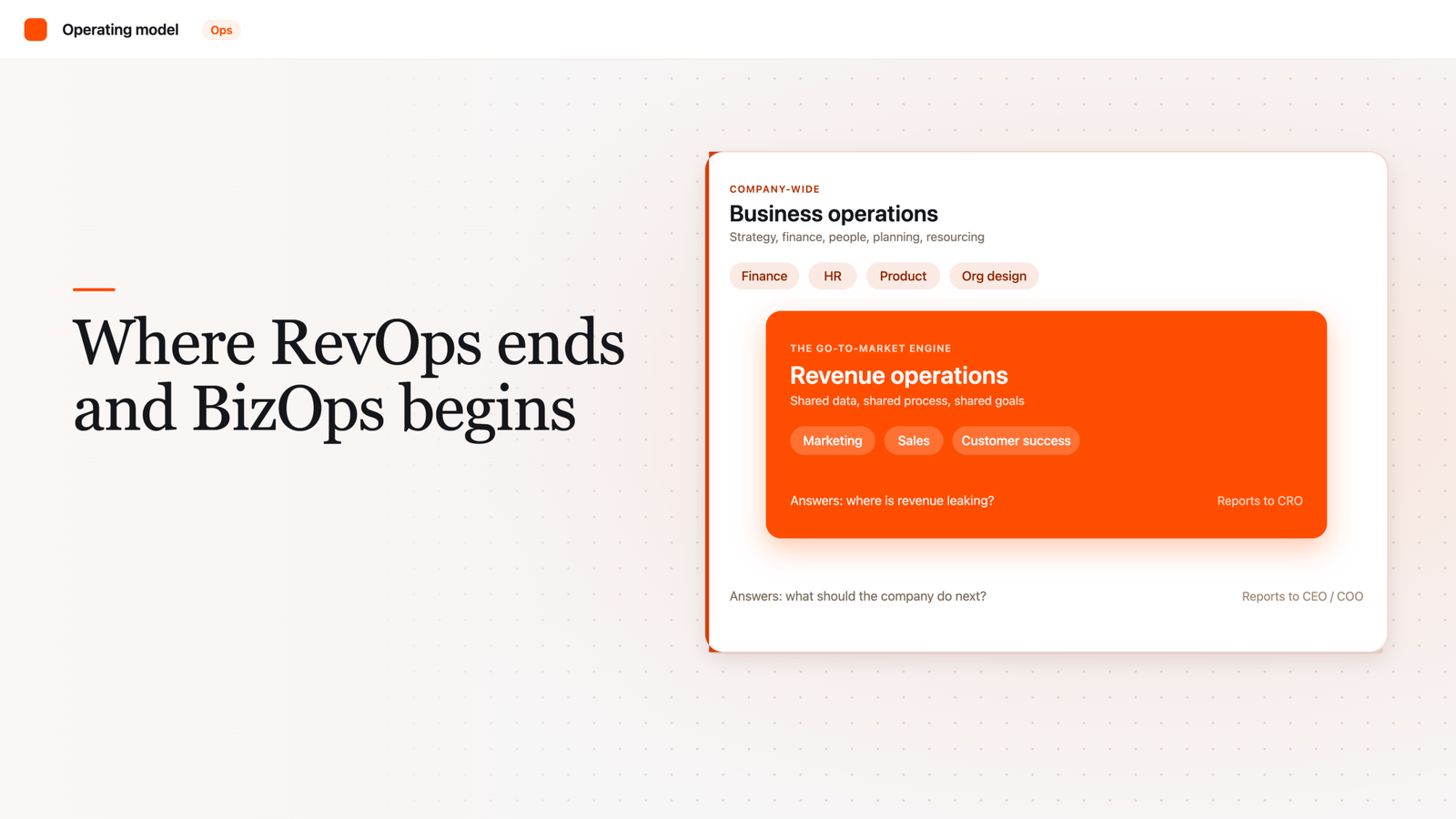
    The easiest way to picture it: BizOps owns the connective tissue of the entire company, while RevOps owns the GTM (go-to-market) engine specifically. One is company-wide. The other is revenue-specific.

    So What’s Actually Different?

    Here’s the plain version:

    • Scope. RevOps focuses only on sales, marketing, and customer success. Business consulting or BizOps looks at the entire organization, including finance, HR, and long-term structure.
    • Question they answer. BizOps tends to answer “what should the company do next?” (market entry, org design, resourcing). RevOps answers “how is revenue actually generated day to day, and where is it leaking?”
    • Where value shows up. RevOps work shows up in pipeline conversion, deal velocity, and churn. BizOps work shows up in strategic decisions, budget allocation, and cross-departmental planning.
    • Who they report to. RevOps typically reports to a CRO or VP of Sales. BizOps often reports to the CEO or COO directly.

    I’ll say the quiet part out loud: most of the confusion between these two roles isn’t really about job titles. It’s about founders hiring a generalist, calling them “ops,” and hoping they’ll absorb both jobs by osmosis. That works for a while at 10 people. It stops working fast once you’ve got separate sales, marketing, and CS teams that don’t talk to each other.

    Why This Distinction Actually Matters

    Getting this wrong costs you in a very specific way: you either hire a systems administrator and expect strategic thinking, or you hire a strategist and wonder why your CRM is still a mess.

    Organizations that align sales, marketing, and customer success under a coordinated RevOps model tend to see real operational payoff. One widely cited 2020 study found companies could see an increase of up to 20% in sales productivity, a 200% increase in digital marketing ROI, and a 30% reduction in go-to-market expenses after adopting RevOps. Analyst firm Gartner had also projected that by 2025, 75% of the highest-growth companies would run some form of RevOps model, a sign of how mainstream the function has become.

    BizOps has its own payoff, just at a different altitude. Because it sits closer to company-wide strategy, its wins tend to show up in things like faster board reporting, cleaner financial planning, and fewer instances of departments (like Finance and Sales) disagreeing on basic numbers like revenue recognition.

    A Quick Checklist: Which One Do You Actually Need?

    1. Are your growing pains specific to sales, marketing, and customer handoffs? That’s a RevOps problem.
    2. Are they showing up company-wide, like hiring outpacing onboarding or finance and sales disagreeing on numbers? That points to BizOps.
    3. Are you under roughly $5M ARR? Most founders should own operational thinking themselves before hiring either role.
    4. Are you between $5M and $10M ARR with a clear GTM structure but messy handoffs? This is usually the right window to hire dedicated RevOps.
    5. Are you past Series B with a functioning GTM engine but a fraying broader org? That’s typically when BizOps becomes worth building out separately.

    Pro tip: if you’re not sure which one you need, look at where the complaints are coming from. If it’s reps complaining about lead handoffs and dashboards that don’t match, that’s RevOps. If it’s your CFO and your head of sales arguing about whose numbers are right, that’s a BizOps conversation.

    Can One Person Do Both?

    At an early-stage company, yes, and it’s often the most practical path. A RevOps leader who has already mastered cross-functional alignment and systems thinking has a lot of the exact skill set BizOps needs, just applied to a wider canvas. The two disciplines share the same underlying instinct: replace gut-feel decisions with data. Don’t expect that to scale forever, though. Once you’re managing separate GTM and company-wide operating rhythms, splitting the roles usually pays for itself.

    FAQ

    Is RevOps a type of business operations?
    You could think of it that way. RevOps is a specialized, narrower slice of business operations that focuses only on the revenue-generating side of the company: sales, marketing, and customer success.

    Do small startups need both RevOps and BizOps?
    Probably not yet. Most early-stage founders are better off owning operational thinking themselves and adding a dedicated RevOps hire around the $5 to $10 million ARR range, then considering BizOps later as the whole org grows more complex.

    Does RevOps replace sales operations?
    Not exactly. Sales operations supports the sales team specifically with things like territory mapping and forecasting, while RevOps sits above sales ops, marketing ops, and customer success ops, unifying all three into one coordinated function.

    What titles report into RevOps vs BizOps?
    RevOps usually reports to a Chief Revenue Officer or VP of Sales. BizOps tends to report to the CEO or COO, since it operates across the whole company rather than just the revenue side.

    Which one should I hire first?
    If your pain is specifically in how leads move between marketing, sales, and customer success, start with RevOps. If your pain is broader (finance, hiring, cross-department planning), you’re probably looking for a BizOps hire instead.


  • RevOps vs. CRO: How the Roles Actually Relate

    RevOps vs. CRO: How the Roles Actually Relate

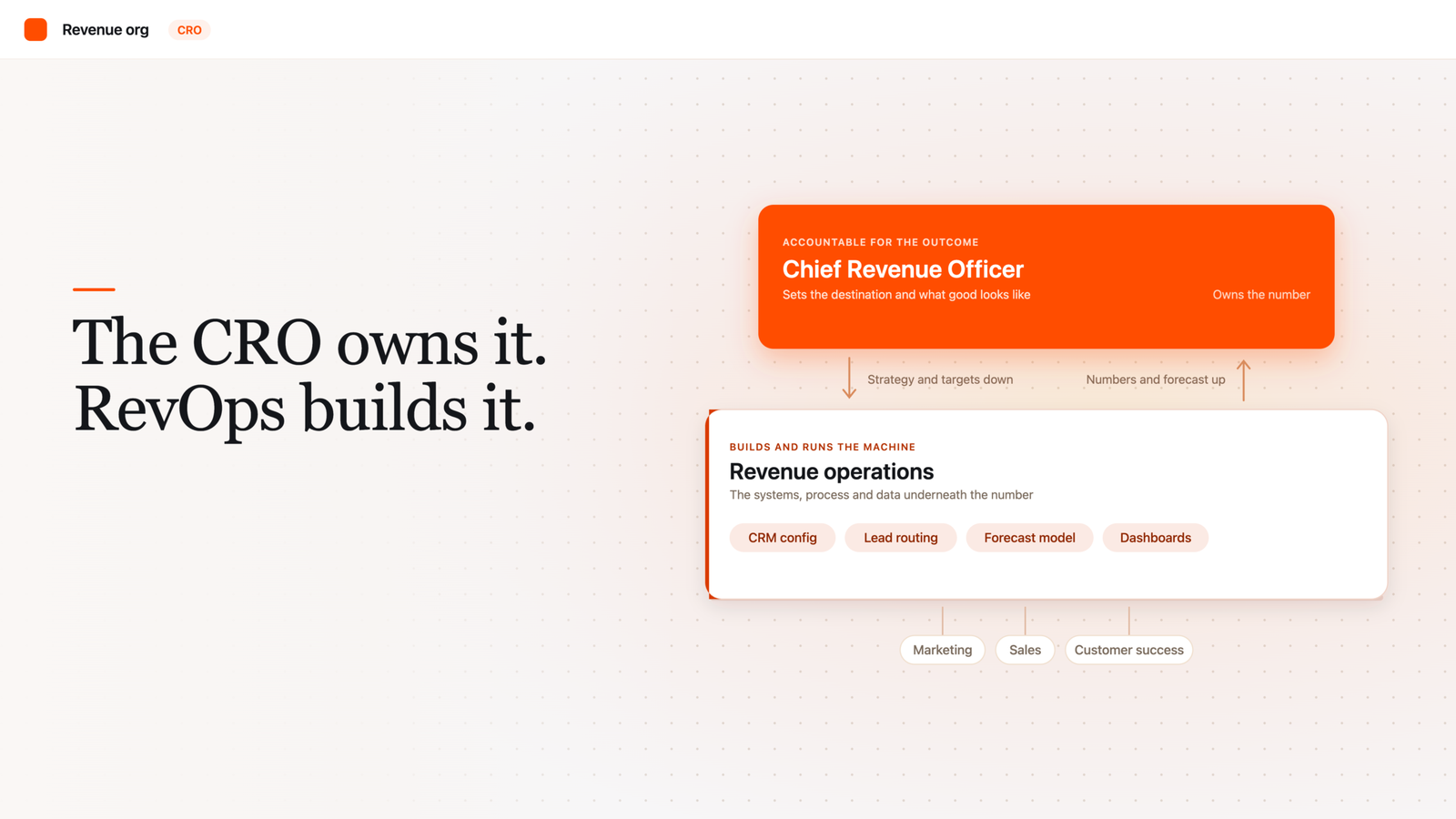
    RevOps is a function that aligns your sales, marketing, and customer success teams around shared processes, data, and tools. A CRO (Chief Revenue Officer) is the executive who owns revenue outcomes across those same teams. RevOps is the system; the CRO is the person accountable for what that system produces.

    If you’re a founder or early revenue leader, you’ve probably heard both terms thrown around in the same breath, sometimes even as if they’re interchangeable. They’re not. Mixing them up can lead you to hire the wrong person, build the wrong reporting line, or expect one role to do a job it was never designed for.

    What Is RevOps, Exactly?

    Revenue Operations (RevOps) is the function responsible for connecting the systems, processes, and data behind your sales, marketing, and customer success teams so they work off the same playbook instead of three different ones. If you want the fuller picture of what this function covers day to day, our beginner’s guide to RevOps walks through it from the ground up.

    RevOps people live in the weeds: CRM configuration, lead routing, forecasting models, reporting dashboards. They’re the ones who notice when marketing counts a “qualified lead” differently than sales does, and they fix it.

    What Is a Chief Revenue Officer (CRO)?

    A Chief Revenue Officer (CRO) is a C-suite executive responsible for all revenue-generating functions in a company, typically sales, marketing, and customer success. Salesforce describes the CRO as responsible for every process that generates revenue in an organization, connecting functions that range from marketing and sales to customer success, pricing, and revenue operations itself.

    The CRO title showed up mostly in tech and SaaS companies, originally as a way to unify departments that used to operate in silos. That’s a useful thing to know, because it tells you the role was invented to solve a coordination problem, not just to add another executive seat.

    A CRO isn’t the same as a VP of Sales, even though the two roles sound similar on paper. A VP of Sales is focused purely on sales performance, while a CRO’s mandate stretches across marketing, customer success, and pricing decisions too. Some companies also use a Chief Sales Officer (CSO) title, but that role focuses specifically on the sales function and closing revenue, while a CRO’s broader mandate includes marketing, customer success, and revenue operations on top of sales.

    So How Do RevOps and the CRO Actually Relate?

    Here’s the simplest way to think about it: RevOps builds and runs the machine. The CRO is accountable for what the machine produces.

    In a lot of organizations, RevOps reports directly into the CRO. Having RevOps report to the CRO is one of the most common structures in the industry, and the Head or VP of RevOps often ends up functioning as the CRO’s right hand, translating strategy into the systems and processes that make it real. That’s not a coincidence. A CRO needs oversight across every revenue function, and RevOps is the operational layer that makes that oversight possible instead of just aspirational.

    Think of it this way: the CRO sets the destination and decides what “good” looks like for growth. RevOps builds the roads, checks the fuel gauges, and flags when a wheel is about to fall off. Neither one works well without the other, but they’re clearly not the same job.

    That said, this reporting relationship isn’t universal, and it depends heavily on company size and stage. We cover the different ways RevOps can be structured, including when it should sit under a CRO versus a CEO or COO, in our post on RevOps org structure models.

    Why Do Companies Confuse the Two?

    Honestly, most of the confusion comes from job postings, not from the roles themselves. RevOps jobs sometimes get listed under titles like Chief Revenue Officer or VP of Revenue Operations, which blurs the line for anyone browsing job boards trying to understand the field.

    Add to that the fact that a Director of RevOps and a CRO both care about “revenue,” and it’s easy to see why people flatten the two into one idea. But their approaches differ: a CRO focuses on revenue strategy, go-to-market planning, and directly leading revenue-generating teams, while a Director of RevOps focuses on the operational infrastructure, the processes, systems, data, and analytics, that let those teams actually execute. In most companies, the Director of RevOps reports up to the CRO or an equivalent executive, not the other way around.

    Do You Need a CRO, a RevOps Hire, or Both?

    Most early-stage companies don’t need a CRO. They need someone fixing the operational mess first. Here’s a rough way to think through it:

    1. You’re pre-Series B and sales/marketing keep tripping over each other. Start with a RevOps hire, not an executive. You need someone untangling CRM data and lead handoffs before you need someone setting revenue strategy at the board level.
    2. You already have a functioning RevOps layer but no single owner of revenue outcomes. This is often the point where a CRO makes sense, since the operational foundation (data, systems, forecast rhythm) is already there for an executive to actually use.
    3. Your sales, marketing, and customer success leaders don’t trust each other’s numbers. That’s a RevOps problem first. A CRO without reliable data underneath them is just another executive guessing.
    4. You’re scaling past the point where the CEO can manage revenue alignment personally. This is a classic trigger for adding a CRO, especially once ARR and headcount both cross a threshold where cross-functional friction becomes the actual bottleneck, not lack of demand.

    Pro tip: if you’re not sure whether your company has hit the tipping point for a dedicated operational hire, our post on signs your company needs a dedicated RevOps hire has a more detailed checklist.

    One more thing worth saying plainly: a CRO hired into a company with no RevOps foundation is set up to fail before they even start. That’s part of why CRO tenure tends to run short. A recent analysis placed average CRO tenure somewhere between 17 and 25 months, and other industry commentary points to an even blunter figure, an average CRO lifespan of around 18 months, compared to roughly 7 years for CEOs and 5 for CFOs. A lot of that comes down to expectations versus support: CFOs inherit established financial systems, but CROs are often handed a bloated, inefficient revenue engine and told to make it work, without a proven playbook to lean on.

    That’s not a knock on the people taking these jobs. It’s a structural problem, and RevOps is usually the fix.

    FAQ

    Does RevOps replace the need for a CRO?
    No. RevOps handles the operational layer (systems, data, process), while a CRO owns the strategic accountability for revenue outcomes across teams. Most growing companies eventually need both, just not necessarily at the same time.

    Who does RevOps report to if there’s no CRO yet?
    It varies by company. RevOps commonly reports to a CEO, COO, or CRO depending on stage and structure, and our post on RevOps org structure breaks down when each model makes sense.

    Is a CRO the same as a VP of Sales with a bigger title?
    Not really. A VP of Sales is focused only on sales, while a CRO’s mandate spans marketing, customer success, and pricing decisions as well. Some companies use “CRO” loosely, but the intended scope is meaningfully broader.

    Can one person be both the RevOps lead and the CRO?
    In very early-stage companies, yes, it’s common for one person to wear both hats temporarily. As the company scales, though, the operational workload and the strategic workload usually get too big for one seat.

    Why do so many CROs leave within two years?
    A big part of it is inheriting broken systems with no existing playbook to fix them, which is a very different situation than a CFO or CEO typically walks into. Building out RevOps before or alongside a CRO hire is one of the more practical ways to avoid that trap.

  • What Is a RevOps Tech Stack? Core Tools Explained

    What Is a RevOps Tech Stack? Core Tools Explained

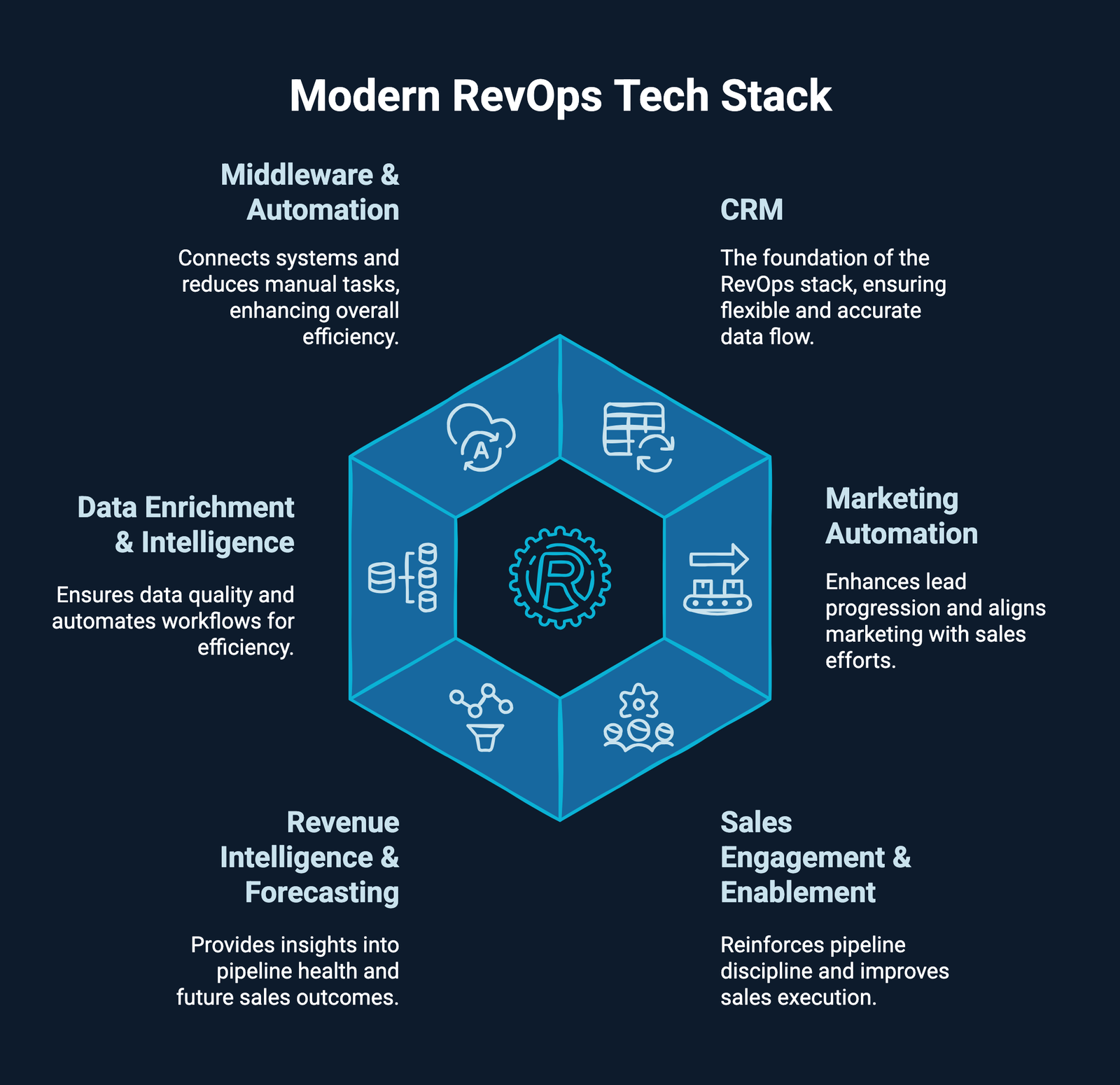
    A RevOps tech stack is the set of connected software tools that let your sales, marketing, and customer success teams share the same data and work off the same playbook. At minimum, it includes a CRM, marketing automation, sales enablement, and reporting tools, all wired together so information moves automatically instead of living in separate spreadsheets.

    If you’ve ever had a deal stall because sales didn’t know a prospect had already talked to support, you’ve felt what happens without one. Tools that don’t talk to each other create blind spots, and blind spots cost you revenue.

    Let’s get into what actually makes up a RevOps tech stack, why it matters, and how to start building or fixing yours.

    What Is RevOps, Quickly?

    Before we talk tools, a quick definition. Revenue operations (RevOps) is a business function that aligns sales, marketing, and customer success teams around shared data, processes, and goals so the whole revenue engine works as one system instead of three disconnected departments.

    RevOps isn’t a piece of software. It’s a way of running the business. The tech stack is just the infrastructure that makes that alignment possible day to day.

    What Is a RevOps Tech Stack?

    A RevOps tech stack is the collection of software tools and technologies that let revenue teams (sales, marketing, and customer success) work together instead of in silos. The goal isn’t to buy more software. It’s to make sure the software you already have shares data cleanly, so nobody’s working off stale or conflicting numbers.

    Most stacks lean on native integrations (built-in connections between two tools) and custom workflow automation to keep everything synced. Think of it less as a shopping list and more as plumbing: every pipe needs to connect, or the water backs up somewhere.

    Why Does a RevOps Tech Stack Matter?

    Here’s the problem most teams run into: tools that don’t sync create broken handoffs. When systems don’t talk, deals slip through the cracks between marketing, sales, and customer success. That leads directly to forecasting gaps, because disconnected data means unreliable pipeline projections and missed revenue targets.

    There’s also a hidden cost. Manual workarounds and duplicate records quietly cost you deals you should have won. Nobody notices this on a dashboard. It just shows up as a slower quarter.

    On the flip side, a well-connected stack turns raw activity data into decisions you can act on, instead of just numbers you report on. Gartner had projected that by 2025, 75% of the highest-growth companies globally would be running on some form of RevOps model, which tells you this isn’t a niche practice anymore. It’s becoming the default for companies that plan to scale.

    What Are the Core Tool Categories in a RevOps Stack?

    You don’t need every category from day one. But here’s what shows up in most functioning stacks, from foundation to nice-to-have.

    1. CRM (Customer Relationship Management)

    Your CRM is the central hub where customer and prospect data lives: contact info, deal stages, past conversations, purchase history. Salesforce and HubSpot are the two most common choices. Everything else in your stack should ultimately feed data into, or pull data from, this system.

    2. Marketing Automation

    These tools handle attracting, nurturing, and converting leads while keeping marketing and sales working from the same lead definitions. Without this connected to your CRM, marketing generates leads sales never sees clearly, or worse, leads get followed up twice by two different reps.

    3. Sales Enablement

    This covers everything that helps reps sell more effectively: sales content management, onboarding and training materials, automated outreach sequences, and battlecards for handling objections. It’s the layer between “we have leads” and “we closed the deal.”

    4. Revenue Intelligence and Forecasting

    These tools analyze deal activity, call data, and pipeline trends to flag risk and predict what will actually close. This is a newer category, but it’s quickly becoming a must-have alongside CRM and lead routing tools.

    5. CPQ (Configure, Price, Quote) and Billing

    CPQ software streamlines quoting and approvals, which matters most once your pricing or packaging gets complicated. Billing and revenue recognition tools then automate invoicing and subscription management so finance and go-to-market teams work from the same numbers. Don’t rush into CPQ before your pricing model is settled, it’ll just lock in confusion.

    6. Customer Success Platform

    This tracks health scores, usage data, and renewal risk after the deal closes. RevOps stacks increasingly stretch across the full customer lifecycle now, not just the sales funnel, covering everything from first anonymous website visit through renewal and expansion.

    7. Analytics and Reporting

    One of the core jobs of RevOps is giving leadership a single, trustworthy view of revenue performance. That requires a centralized reporting layer that pulls data across every tool in the stack instead of forcing someone to stitch together three exports in a spreadsheet every Friday.

    8. Integration and Data Quality Tools

    Middleware tools like Workato or Zapier handle the connections between systems that don’t integrate natively. This is the unglamorous layer, but it’s often the difference between a stack that works and one that just looks good in a slide deck. Data quality determines whether your stack delivers real insight or just amplifies bad data faster.

    How Do You Actually Build a RevOps Stack?

    You don’t build this in one sprint, and honestly, most teams shouldn’t try. Here’s a practical order of operations:

    1. Audit what you already have. Most B2B teams already own a CRM and probably more tools than they realize. Map what exists before buying anything new.
    2. Define your core metrics first. Pick a small number of KPIs, like customer acquisition cost, sales cycle length, or customer lifetime value, before you evaluate a single new tool.
    3. Fix the CRM before adding layers. If your CRM data is messy or your sales process isn’t reflected accurately in it, no new tool will fix that. Automation on top of a broken process just breaks things faster.
    4. Add tools by outcome, not by category checklist. Only add a layer (CPQ, revenue intelligence, CS platform) when it solves a specific, named problem you can point to.
    5. Build for integration, not isolation. Favor tools with strong native integrations so you’re not stuck building brittle custom connections for everything.
    6. Review and cut regularly. Audit your tech spend on a schedule and eliminate redundant or underused tools, especially ones with overlapping functionality.

    Pro tip: before you buy a single new tool, write down the exact workflow that’s broken today (“leads sit in marketing’s tool for 3 days before sales sees them”) and work backward from that. Buying tools to solve a vague feeling of disorganization almost never works.

    Honestly, most “RevOps tech stack” problems we see aren’t a tooling gap at all, they’re a process and ownership gap that a new tool gets blamed for. Adding software on top of an undefined sales process just automates the confusion faster.

    Quick Checklist: Is Your Stack RevOps-Ready?

    • CRM is the single source of truth, not one of three
    • Marketing and sales use the same lead definitions and stages
    • Deal, usage, and support data are visible to all three teams
    • You can build a full-funnel report without exporting to a spreadsheet
    • Every tool in the stack has a clear owner
    • You’ve audited tool spend in the last two quarters

    If you’re missing three or more of these, that’s a sign your stack is growing faster than your operations discipline.

    FAQ

    Do I need a dedicated RevOps tool, or can I use my existing CRM?
    Most B2B teams already have the core pieces (a CRM, some marketing tool, maybe a reporting dashboard). The real work usually isn’t buying new software, it’s configuring and connecting what you’ve already got.

    How many tools should be in a RevOps stack?
    There’s no fixed number. The right size depends on your revenue complexity: a small B2B team might run fine on a CRM plus one or two connected tools, while an enterprise org juggling multiple pricing tiers will need CPQ, contract management, and revenue intelligence layered in too.

    What’s the difference between a RevOps stack and a sales stack?
    A sales stack only covers tools sales reps use to close deals. A RevOps stack spans marketing, sales, and customer success, plus the integration and reporting layer that connects all three.

    Is HubSpot or Salesforce better for a RevOps tech stack?
    Both serve as a strong CRM foundation. HubSpot tends to appeal to teams that want built-in automation and reporting without heavy engineering, while Salesforce is often chosen for its depth of customization on complex, enterprise-level requirements.

    How much should a RevOps tech stack cost?
    There’s no universal benchmark, since it scales with headcount and deal complexity. What matters more than the total spend is whether you’re tracking ROI against clear KPIs like CAC, sales cycle length, or customer lifetime value after every new tool addition.

    Where to Go From Here

    A RevOps tech stack isn’t about owning the most tools. It’s about making sure the tools you have actually talk to each other and reflect how revenue really flows through your business. Get the foundation (a clean CRM and clear process) right before you stack anything else on top.


  • 5 Signs Your Company Needs a Dedicated RevOps Hire

    5 Signs Your Company Needs a Dedicated RevOps Hire

    You probably need a dedicated RevOps hire if your sales, marketing, and customer success teams run on different data, your leaders spend more time reconciling spreadsheets than closing revenue, or you’ve outgrown founder-led sales without anyone systemizing the handoffs between teams. If two or more of these sound familiar, it’s time to act, not wait.

    Here’s a scene that plays out at a lot of growing companies: your VP of Sales pulls a pipeline number from the CRM (customer relationship management software, the system that tracks every deal and customer interaction). Your CFO pulls a different number from a spreadsheet. Nobody agrees on what “qualified lead” even means anymore. Sound familiar?

    That’s not a people problem. It’s a systems problem, and it usually means you’ve outgrown informal coordination between departments.

    What Does a RevOps Hire Actually Do?

    RevOps stands for Revenue Operations. It’s the function that aligns your sales, marketing, and customer success teams around one set of data, one set of processes, and one shared definition of how revenue actually gets made. The goal of RevOps is to break down departmental silos and create a single, unified approach to generating and growing revenue.

    Instead of each department running its own tools, its own reports, and its own version of the truth, a RevOps hire (or team) owns the connective tissue between them. Think of it as the person who makes sure the baton doesn’t get dropped every time a deal moves from marketing to sales to customer success.

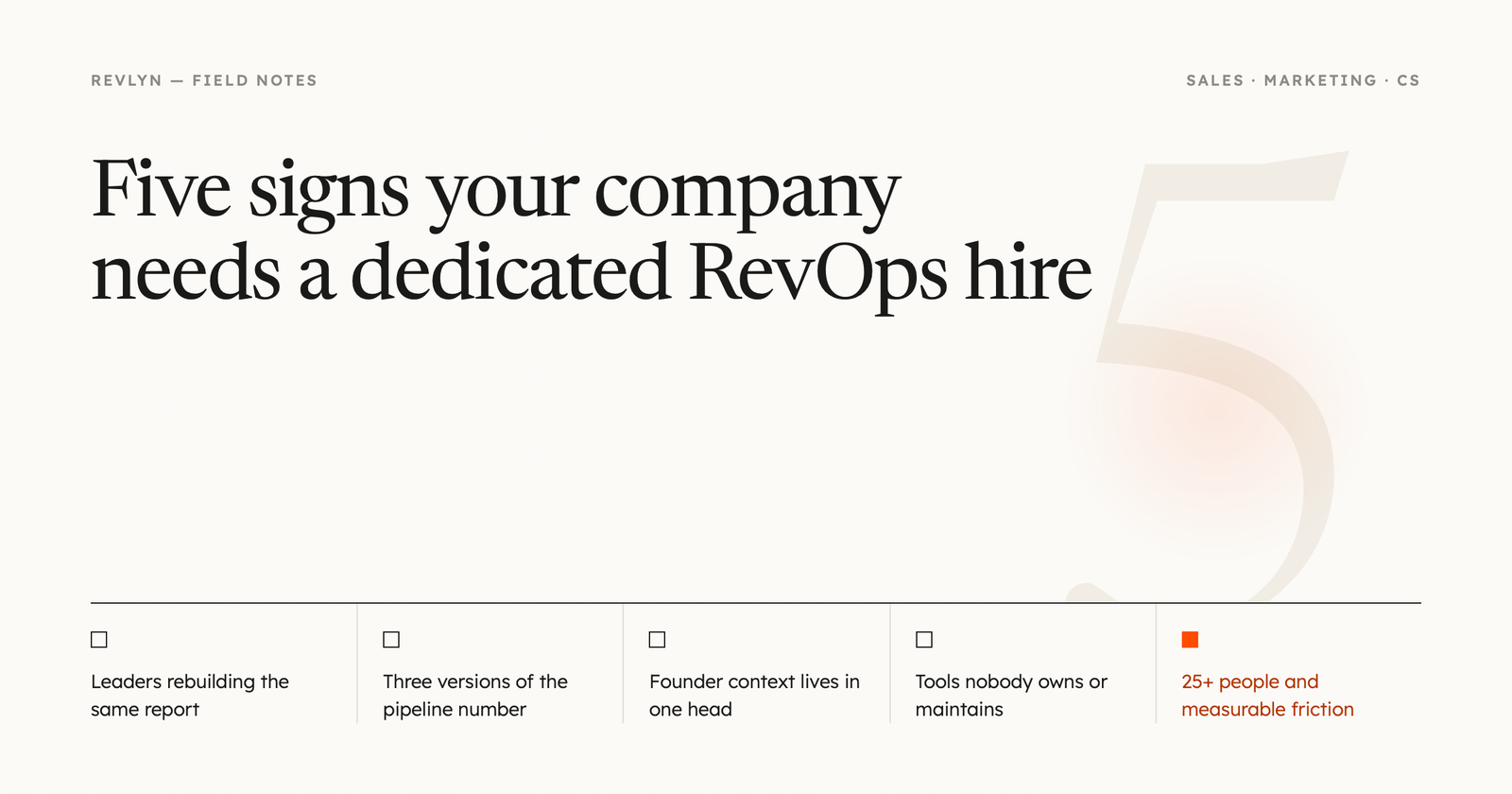
    5 Signs You Need to Hire a Dedicated RevOps Person

    1. Your leaders are doing data janitor work instead of leading

    If your VP of Sales spends Monday mornings rebuilding the same Excel report because nobody trusts the CRM data, that’s a RevOps signal, plain and simple. Executive time is too expensive to spend on data cleanup that a system or a process should be handling automatically.

    Your sales leader should be coaching reps and building playbooks, not burning 10 hours a week configuring workflows and chasing down numbers.

    2. Sales, marketing, and CS can’t agree on the numbers

    When your company can’t effectively upsell, cross-sell, manage renewals, or reduce churn, it’s usually because sales, marketing, and customer success aren’t on the same page. Departmental silos get in the way, and that friction shows up as compromised customer experience and lost revenue, not just internal annoyance.

    If your teams are handing customers off like a bucket brigade instead of managing one continuous journey, that’s worth fixing before it costs you a renewal.

    3. You’ve outgrown founder-led sales

    When a founder is doing the selling, they hold all the context in their head: every customer, every deal, every quirky exception. That works fine at a tiny scale.

    But once you’ve hired a sales leader and started building out a real team, that tribal knowledge needs to live in a system, not in one person’s memory. Without someone systemizing it, new hires reinvent the wheel and mistakes repeat.

    4. Your tech stack has grown faster than your process

    As companies scale, leaders often end up with a sprawling, disconnected tech stack. New hires bring in their own favorite tools, nobody owns integration, and pretty soon you’ve got five systems that don’t talk to each other.

    Without a dedicated RevOps resource orchestrating a smooth handoff between tools and teams, your business will struggle to scale past this point. That’s not an opinion, it’s basically the definition of what happens when tooling outpaces process.

    5. You’re past 25+ employees with distinct sales and marketing functions

    Once you’ve got roughly 25 or more employees split across dedicated sales and marketing teams, and friction between those teams is causing measurable revenue loss (not just office tension), it’s usually time to bring on dedicated RevOps help. Waiting until it’s a full-blown crisis just makes the eventual fix more expensive.

    Most companies bring in RevOps somewhere between Series A and Series C funding, depending on how complex their go-to-market motion has gotten. There’s no magic revenue number that triggers the hire. It’s really about whether operational complexity has outrun what your current team can coordinate informally.

    Pro tip: before you post the job, run a quick funnel audit. Map out where deals actually get stuck or where data breaks down between systems. That audit tells you whether you need a generalist RevOps hire, a specialist (like someone focused purely on the tech stack), or a fractional consultant to start.

    When Should You Hire Full-Time vs. Bring in Outside Help?

    Not every company needs a full-time RevOps hire right away. Fractional RevOps leaders, who typically work 15-20 hours a week with a company, can be a smart middle step if you need strategic guidance but aren’t ready to commit to a full-time senior salary.

    A hybrid approach works well for a lot of teams: bring in outside help to build the foundation (clean data, defined processes, a real reporting structure), then hire internally once the role is clearly scoped. Honestly, most botched first RevOps hires happen because the company tried to hire before anyone had actually defined what the job was supposed to fix.

    Where Should RevOps Report?

    This matters more than most founders think. A RevOps leader typically reports directly to the CRO (Chief Revenue Officer). In some cases, they report to the CFO or COO instead.

    What you want to avoid is burying RevOps inside sales or marketing, where it inevitably ends up biased toward whichever department it sits under. RevOps only works if it can call out problems in every department, including the one it reports through.

    A Quick Self-Check Before You Post the Job

    1. Can your leadership team agree on last quarter’s pipeline number without three separate spreadsheets?
    2. Does your CRM data get trusted enough that reps actually use it to prioritize their day?
    3. Is anyone currently “unofficially” doing RevOps work on top of their real job?
    4. Have you added tools in the last year that nobody fully owns or maintains?
    5. Are handoffs between marketing, sales, and customer success documented anywhere?

    If you answered “no” to two or more of these, that’s your signal.

    FAQ

    Do we need a RevOps hire even if we’re a small startup?
    Probably not yet. At the earliest stages, revenue teams are usually small enough that founders or early GTM leaders can manage operations without a dedicated hire.

    What’s the difference between RevOps and sales operations?
    Sales ops focuses narrowly on the sales team’s tools and process. RevOps sits above that, unifying sales, marketing, and customer success into one shared system and one shared set of metrics.

    How fast can a RevOps hire show impact?
    It varies a lot by company, but the fastest wins usually come from fixing data trust issues and clarifying handoffs between teams, not from big strategic overhauls in month one.

    Should our first RevOps hire be a generalist or a specialist?
    Start with a generalist. Once you’ve got 25+ employees across distinct GTM teams, that’s usually when it makes sense to start splitting the role into specialists for enablement, systems, and analytics.

    What happens if we wait too long to hire?
    Waiting too long tends to mean sales leaders doing manual reporting instead of coaching, more data conflicts between departments, and a tech stack nobody fully owns. None of that fixes itself.

    If you’re staring at two or three of these signs right now and not sure whether to hire, build a fractional bridge, or fix your process first, that’s exactly the kind of question worth a real conversation. Book a RevOps diagnostic call with Revlyn and we’ll help you figure out what your revenue engine actually needs before you write the job description.