Category: CRM

  • Best CRM Tools for PLG Customer Lifecycle Teams

    Product-led growth companies have a customer lifecycle problem that traditional CRMs weren’t built for: users sign up and activate long before a salesperson ever talks to them, and by the time a human touches the account, most of the meaningful lifecycle data already lives in the product, not the CRM. Choosing the right CRM tools for a PLG customer lifecycle team means picking systems built around usage data and activation signals, not just contact records and deal stages.

    Why Standard CRMs Struggle With PLG Lifecycle Data

    Traditional CRMs are built around a linear sales funnel: lead, opportunity, close. PLG lifecycle teams need something closer to a living map of account health across free trial, activation, expansion, and renewal, most of it driven by product usage events rather than sales activity. That mismatch shows up in the same three gaps across nearly every standard CRM.

    • No native way to ingest product usage or event data as a first-class object
    • Poor support for tracking multiple users within one account at different activation stages
    • Weak signal-based alerting for expansion or churn risk based on in-product behavior

    None of these gaps look dramatic in isolation, which is exactly why they persist so long. A team can patch around one with a spreadsheet or a Slack channel. Once there are enough self-serve accounts to matter, though, that patchwork becomes someone’s full-time job, and the CRM stops being the system of record it was supposed to be.

    What to Look for in CRM Tools for PLG Lifecycle Management

    1. Native or Easy Product Usage Integration

    The CRM needs to ingest usage data from your product analytics tool, such as Amplitude, Mixpanel, or PostHog, or a CDP like Segment, without heavy custom engineering, so account health reflects actual behavior, not just CRM activity. If every integration requires a developer sprint, the data will always lag behind what’s actually happening in the product.

    2. Account-Level Views Across Multiple Users

    PLG accounts often have dozens of individual users at different activation stages. Look for tools that roll this up into a single account health view rather than forcing reps to piece it together contact by contact. A rep should be able to see at a glance which users are active, which are stalled, and whether the account as a whole is trending toward expansion or churn.

    3. Lifecycle-Stage Automation, Not Just Deal-Stage Automation

    Good PLG CRM tooling triggers workflows off product events, a user hitting an activation milestone, a team inviting new seats, usage dropping below a threshold, not just off manually updated deal stages. This is the difference between a system that reacts to what a rep remembers to log and one that reacts to what the customer is actually doing.

    4. Sales-Assist Handoff Support

    Most mature PLG motions add a sales-assist layer for expansion or enterprise upsell. The CRM needs to support a clean handoff from self-serve to human-assisted selling without losing lifecycle context. A rep picking up an account should inherit its full usage history, not start from a blank contact record and a vague note about why the account suddenly matters.

    Tool Categories to Evaluate

    Most PLG lifecycle stacks combine several of these categories rather than relying on a single tool to do everything.

    Category Role in PLG Lifecycle Examples
    Core CRM System of record for accounts, users, and deals HubSpot, Salesforce, Attio
    Product analytics Tracks usage events and activation milestones Amplitude, Mixpanel, PostHog
    Customer data platform Unifies product and CRM data into one account view Segment, RudderStack
    PLG-native growth tools Purpose-built for usage-based signals and expansion triggers Endgame, Correlated, Pocus

    A common pattern is a core CRM for the system of record, a product analytics tool for event tracking, and either a CDP or a PLG-native growth tool sitting between them to translate usage signals into account health and routing decisions.

    Signs Your Current CRM Isn’t Built for PLG Lifecycle Work

    These patterns tend to show up gradually, which is part of why they’re easy to miss until they’re already costing real deals.

    • Sales and customer success teams manually re-explain account context to each other because the CRM doesn’t hold it
    • Expansion opportunities get identified reactively, a customer emails asking for more seats, rather than proactively, usage data flags the account first
    • Reps rely on spreadsheets or Slack threads to track activation status because the CRM can’t represent it well

    If more than one of these sounds familiar, the issue usually isn’t a training gap or a data hygiene problem. It’s the CRM itself not being built to represent how a self-serve product actually generates lifecycle signals.

    How to Evaluate a Tool Before Committing

    1. Ask for a live demo using your actual product usage event structure, not a generic sales demo.
    2. Check whether account health scoring is configurable to your specific activation milestones, or a fixed generic model.
    3. Confirm how the tool handles multi-user, multi-role accounts, a common PLG blind spot in older CRM platforms.
    4. Ask current customers running a similar-sized PLG motion how long implementation actually took.

    The first step matters more than it looks. A vendor demo built around a generic SaaS trial rarely surfaces the gaps that show up once your actual event data, with all its inconsistencies and edge cases, gets loaded into the system.

    The Right Tool Reflects How Your Customers Actually Grow

    For PLG companies, the CRM shouldn’t just be a sales tool retrofitted with product data bolted on, it needs to reflect how your customers actually move through activation, expansion, and renewal in the product itself. Prioritize usage-data integration and account-level lifecycle views over traditional deal-pipeline features when comparing options.

    Summary

    Traditional CRMs are built for a linear sales funnel, while PLG lifecycle teams need a living view of account health across trial, activation, expansion, and renewal, driven mostly by product usage rather than sales activity. The tools worth evaluating should integrate usage data natively, roll multi-user accounts into one health view, trigger workflows off product events instead of deal stages, and support a clean handoff to sales-assist without losing lifecycle context.

    Most real stacks combine a core CRM, a product analytics tool, and either a CDP or a PLG-native growth platform to connect the two. Before committing to any option, test it against your own usage event structure rather than a generic demo, and talk to customers running a similarly sized PLG motion about how long implementation actually took.

    Frequently Asked Questions

    What’s the difference between a CRM built for PLG and a traditional sales CRM?

    A traditional sales CRM is built around leads, opportunities, and deal stages driven by rep activity. A PLG-oriented CRM is built around account health across the full lifecycle, trial, activation, expansion, and renewal, driven primarily by product usage signals rather than manually logged sales activity.

    Do we need a separate product analytics tool if our CRM claims to support PLG?

    Usually, yes. Most CRMs that claim PLG support still rely on a dedicated product analytics tool like Amplitude, Mixpanel, or PostHog to actually capture granular usage events. The CRM’s job is typically to ingest and act on that data, not to replace the analytics layer entirely.

    How do we know our current CRM isn’t working for our PLG motion?

    Common signs include teams manually re-explaining account context to each other, expansion opportunities getting caught reactively instead of being flagged by usage data first, and reps tracking activation status in spreadsheets because the CRM can’t represent it. If more than one of these is happening regularly, the CRM itself is likely the bottleneck.

    What should a PLG CRM demo actually show us?

    Ask the vendor to run the demo using your actual product usage event structure rather than a generic sales scenario, and confirm whether account health scoring can be configured to your specific activation milestones rather than relying on a fixed, generic model that may not match how your product actually works.

    Is HubSpot or Salesforce good enough for a PLG lifecycle team, or do we need a specialized tool?

    It depends on how deeply usage data needs to be reflected in account health and automation. Core CRMs like HubSpot and Salesforce can work well as the system of record, but many PLG teams pair them with a CDP or a PLG-native growth tool like Endgame, Correlated, or Pocus to handle the usage-based scoring and lifecycle triggers the core CRM wasn’t built to do natively.

    How long does it typically take to implement a PLG-native CRM?

    Implementation time varies significantly based on how clean your existing usage event data is and how many systems need to connect. Rather than relying on a vendor’s stated timeline, ask current customers running a similarly sized PLG motion how long their implementation actually took, since that tends to be a more reliable estimate than the sales pitch.
  • The Complete Guide to PLG CRM Software in 2026

    The Complete Guide to PLG CRM Software in 2026

    PLG CRM Software

    Product-led growth changed how SaaS companies acquire customers, but for years, the CRM software supporting those companies didn’t change with it. PLG CRM software is the category that’s emerged to close that gap: systems built around usage-driven signals and self-serve customer journeys, rather than the traditional linear sales pipeline. This guide covers what PLG CRM software actually is, why it matters, and how the category has developed heading into 2026.

    What Is PLG CRM Software?

    PLG CRM software is a category of tools, sometimes a purpose-built platform, sometimes a configuration of a traditional CRM plus supporting tools, designed to track and act on customer behavior across the entire self-serve lifecycle: signup, activation, expansion, and renewal, largely driven by in-product usage rather than sales activity.

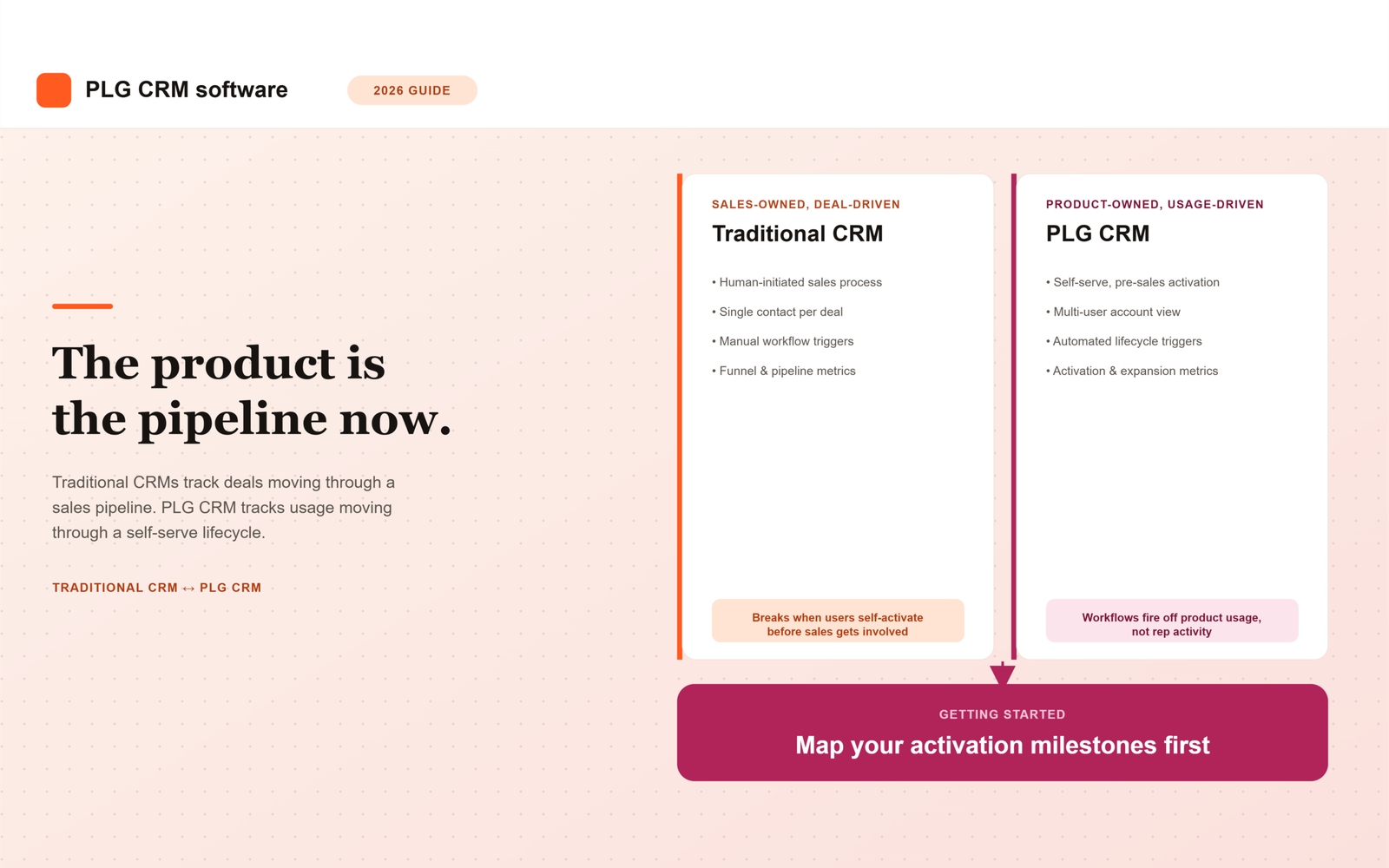
    Unlike a traditional CRM, which is built around deals moving through a sales-owned pipeline, PLG CRM software treats the product itself as the primary source of lifecycle data, with sales and customer success acting on signals the product generates rather than driving the process from the start. A user signing up, exploring a feature, inviting a colleague, or hitting a usage limit all become data points the system can act on automatically, long before a rep ever gets involved.

    This distinction matters because the underlying assumption behind most CRMs, that a human initiates and drives the sale, simply doesn’t hold for a self-serve product. The account already exists, is already being used, and may already be showing signs of expanding or churning before anyone at the company has spoken to a single user.

    Why Traditional CRMs Fall Short for PLG Companies

    Most traditional CRMs were designed decades before product-led growth became a standard motion, and the gaps that creates tend to show up in the same four places.

    • They assume a human-initiated sales process, when in PLG the user often self-activates before any sales contact happens
    • They’re built around single primary contacts per deal, not the multi-user, multi-role accounts typical of PLG products
    • They lack native support for triggering workflows off product usage events rather than manually logged sales activity
    • Reporting defaults to funnel and pipeline metrics rather than activation and expansion metrics that actually matter for PLG growth

    None of these gaps are fatal on their own, but they compound. A team can work around any single one with a manual process or a spreadsheet. Once a company has enough self-serve accounts to matter, though, those manual workarounds turn into the full-time job of someone stitching data together that the CRM should have surfaced natively.

    Core Capabilities of PLG CRM Software

    1. Usage-Based Account Health Scoring

    Rather than scoring leads on firmographic data alone, PLG CRM systems weigh product usage patterns, feature adoption, login frequency, seat expansion, to determine account health and expansion readiness. A company with 500 employees that logs in once a month is a worse expansion candidate than a 50-person company where three teams use the product daily, and a good PLG CRM should reflect that in the score rather than defaulting to company size.

    2. Multi-User Account Views

    Because PLG accounts often have many individual users at different points in the activation journey, the software needs to represent the account as a whole, not just individual contact records. One user might be a power user driving expansion, while three others haven’t logged in since their invite. A single contact record can’t capture that spread, but an account-level view built for multi-user products can.

    3. Automated Lifecycle Triggers

    Workflows fire based on product behavior, a user hitting an activation milestone, usage dropping below a churn-risk threshold, a team adding new seats, rather than requiring manual updates from a rep. This is where PLG CRM software earns its keep operationally: a sales or customer success rep doesn’t need to remember to check in on an account, the system surfaces the account the moment its behavior changes.

    4. Self-Serve to Sales-Assist Handoff

    As PLG motions mature, most add a sales-assist layer for larger accounts or enterprise upsell. Good PLG CRM software supports a clean handoff at the right moment, without losing the lifecycle context built up during the self-serve journey. A rep picking up an account should see its full usage history and activation milestones, not just a name and an email address with no context for why the account is suddenly worth a phone call.

    How the Category Has Evolved Heading Into 2026

    Early PLG companies stitched together product analytics tools, Amplitude or Mixpanel, a CDP like Segment, and a traditional CRM to approximate this functionality. That stitched approach worked, but it required significant engineering investment to keep the pipes between systems running and in sync.

    By 2026, purpose-built PLG CRM and growth platforms, such as Endgame, Correlated, and Pocus, have matured enough that many companies are replacing parts of that stitched-together stack with more integrated, purpose-built tooling. At the same time, traditional CRM vendors have added usage-data ingestion and lifecycle automation of their own to compete, narrowing the gap between the two categories in some cases while widening it in others, depending on how deeply each vendor actually built the capability versus bolted it on.

    Build vs. Buy: How to Decide

    The right approach depends less on company size and more on how much engineering capacity is available to maintain the system once it’s built.

    Approach Best For Trade-off
    Stitched stack (CRM + analytics + CDP) Teams with strong data/engineering resources wanting full customization Higher maintenance burden, more integration risk
    Purpose-built PLG CRM platform Teams wanting faster time-to-value without heavy engineering investment Less customization than a fully bespoke stack
    Traditional CRM with PLG add-ons Teams already standardized on a major CRM wanting incremental PLG capability May not fully solve multi-user, usage-native lifecycle needs

    Teams that already have a data engineering function tend to lean toward the stitched stack, since they can build exactly what they need and already have the capacity to maintain it. Teams without that capacity are usually better served by a purpose-built platform, even with less customization, simply because the alternative is a fragile stack nobody has time to keep working.

    Getting Started: A Practical First Step

    Rather than starting with a platform search, start by mapping your actual activation milestones, the specific in-product events that reliably predict a user or account will convert, expand, or churn. This step matters more than it sounds like it should, because most teams skip it and go straight to evaluating vendors on feature lists.

    Any PLG CRM software you evaluate should be judged first on how easily it can track and act on those specific milestones, not on its feature list in the abstract. A platform with an impressive list of integrations is useless if it can’t surface the one signal, say, a team inviting five new users in a week, that your data already shows predicts expansion.

    Summary

    PLG CRM software exists because traditional CRMs were built around a human-initiated sales process that doesn’t match how self-serve products actually get adopted, used, and expanded. The core capabilities that matter are usage-based account health scoring, multi-user account views, automated lifecycle triggers, and a clean handoff to sales-assist once an account is ready for it.

    Heading into 2026, companies are choosing between a stitched analytics-plus-CRM stack, a purpose-built PLG platform, or a traditional CRM with PLG add-ons, with the right choice depending mostly on available engineering capacity rather than company size alone. Whichever direction a team takes, the starting point should be the same: map your specific activation milestones first, then evaluate any platform against how well it tracks and acts on those exact signals, not against a generic feature list.

    Frequently Asked Questions

    What’s the main difference between PLG CRM software and a traditional CRM?

    A traditional CRM is built around deals moving through a sales-owned pipeline, driven by rep activity. PLG CRM software treats the product itself as the primary source of lifecycle data, tracking usage-driven signals like activation, feature adoption, and seat expansion, with sales and customer success acting on those signals rather than initiating the process.

    Do we need to replace our existing CRM to support PLG?

    Not necessarily. Some companies add PLG capability to their existing CRM through add-ons or integrations, particularly if they’re already standardized on a major platform. This tends to work best for incremental needs, but it may not fully solve the multi-user, usage-native lifecycle gaps that a purpose-built PLG CRM or a custom stitched stack can address more directly.

    What are activation milestones and why should we map them first?

    Activation milestones are the specific in-product events that reliably predict whether a user or account will convert, expand, or churn, such as inviting a teammate or completing a key setup step. Mapping these first matters because any CRM platform is only as useful as its ability to track and act on the exact signals that predict outcomes for your product, not a generic list of features.

    Should we build a stitched PLG stack or buy a purpose-built platform?

    It depends mainly on available engineering capacity. Teams with strong data and engineering resources can build a fully customized stitched stack using analytics tools, a CDP, and a CRM, but that comes with a higher maintenance burden. Teams without that capacity typically get faster time-to-value from a purpose-built PLG CRM platform, even with somewhat less customization.

    How does account health scoring work in PLG CRM software?

    Instead of scoring based on firmographic data like company size alone, PLG CRM systems weigh actual product usage patterns, including feature adoption, login frequency, and seat expansion, to determine how healthy an account is and how ready it may be for expansion. A smaller account with high daily engagement can score higher than a larger account that logs in rarely.

    When should a self-serve account get a sales-assist layer?

    There’s no single universal trigger, but common signals include an account approaching usage limits, multiple teams within the same company adopting the product, or a company requesting features like centralized billing or custom contracts that self-serve typically can’t support. Good PLG CRM software should surface these signals automatically, along with the account’s full usage history, so the handoff doesn’t lose the context built up during the self-serve journey.

  • What to Look for in a B2B SaaS RevOps Platform

    What to Look for in a B2B SaaS RevOps Platform

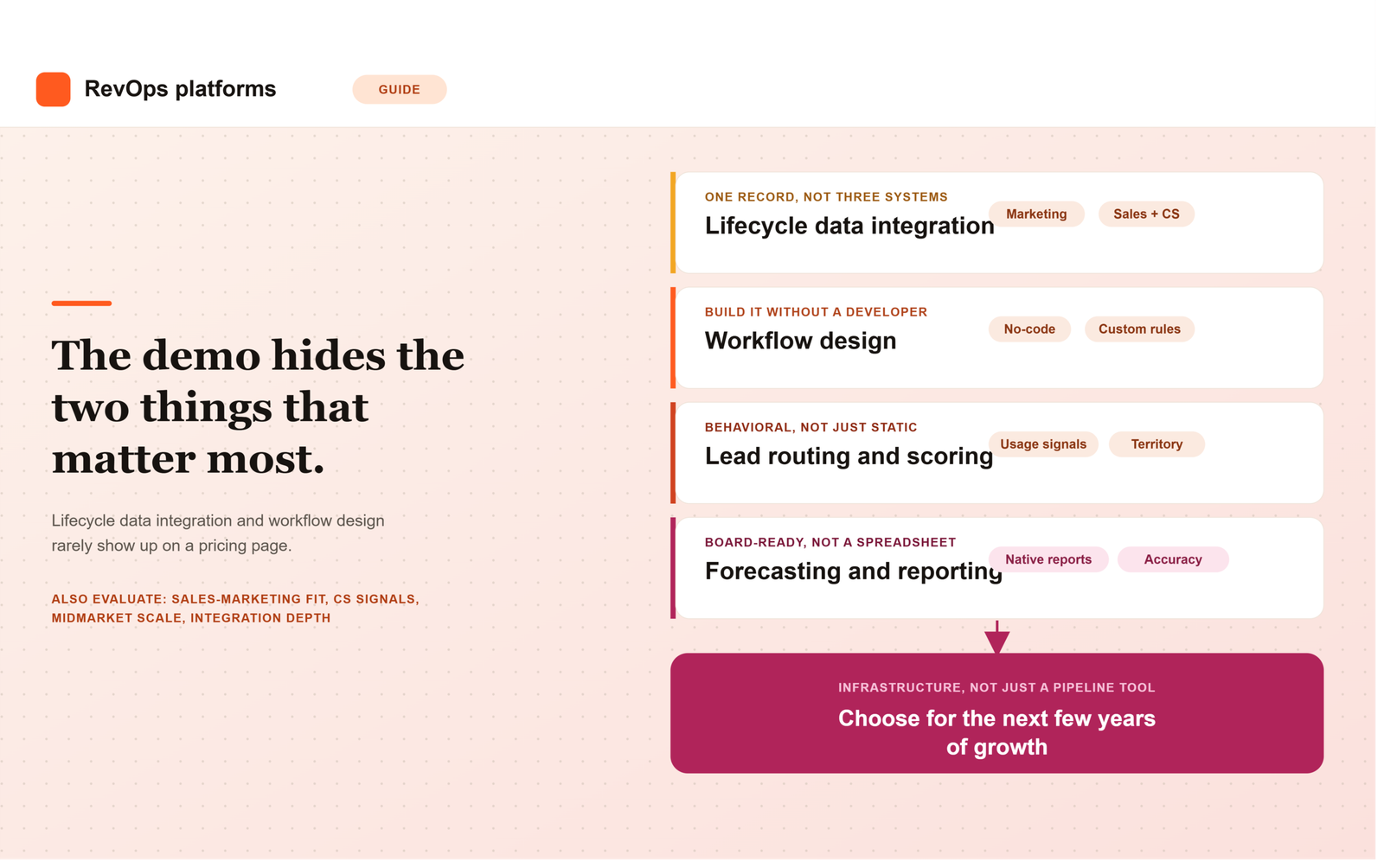
    Most comparisons of B2B SaaS CRM and revenue operations platforms focus on the wrong layer. They compare pricing tiers, seat counts, and feature checklists, while the thing that actually determines whether a platform works long term rarely shows up on a pricing page: how well it unifies customer lifecycle data, and how flexibly it lets your team design the workflows that run on top of that data.

    A platform can look impressive in a demo and still fail in production if marketing, sales, and customer success data live in three loosely connected systems, or if every process change requires a support ticket to the vendor. This guide breaks down the core capabilities B2B SaaS revenue operations leaders should actually evaluate, with particular attention to lifecycle data integration and workflow design, the two areas where most revenue operations software quietly falls short.

    1. Unified Customer Lifecycle Data Integration

    Customer lifecycle data integration is the foundation everything else depends on. A B2B SaaS customer generates data across marketing engagement, sales activity, product usage, and support interactions, and a platform that treats these as separate silos forces your team to reconcile them manually every time leadership asks a cross-functional question.

    When evaluating a SaaS CRM on this dimension, ask whether marketing engagement data, sales activity, and product usage signals live natively in the same record, or whether they require a separate integration layer to connect. Ask specifically how the platform handles a lead that becomes a customer, then later shows churn risk based on product usage. If tracing that single customer’s full history requires exporting data from three systems, the integration is shallower than the vendor’s pitch suggests.

    2. Flexible Workflow Design, Not Just Pre-Built Templates

    Workflow design is where a genuine revenue operations platform separates itself from a CRM with automation bolted on. Most platforms ship with template workflows for common processes like lead routing or renewal reminders, which work fine until your business has a rule those templates never anticipated.

    Strong RevOps workflow management means your team can build, test, and modify multi-step workflows without needing a developer or a vendor consulting engagement for every change. Ask to see the workflow builder directly during evaluation, not just a slide describing it. Have someone from your own team attempt to build a workflow that mirrors a real process you run today, and see how many steps it actually takes.

    3. Native Lead Routing and Scoring

    Lead routing and scoring sound like basic features, and most platforms claim to support both. The real question is whether the logic lives natively inside the platform or depends on a third-party add-on that has to be separately licensed and maintained.

    Native scoring should weigh behavioral signals such as product usage and engagement, not just static firmographic fields like company size or job title. Ask vendors to walk through exactly how a lead moves from marketing to a specific sales rep, and what happens when routing rules need to change because your territory model changed. If that change requires reconfiguring a separate app rather than adjusting a setting inside the core platform, the routing capability is thinner than it initially appears.

    4. Sales and Marketing Automation That Actually Shares Data

    Sales and marketing automation frequently exist as two separate products stitched together through an integration, which means definitions drift apart over time. Marketing’s idea of a qualified lead and sales’ idea of a qualified opportunity can end up describing two different things, even though both teams are looking at what they assume is the same data.

    A platform built for B2B SaaS revenue operations should let both teams work from shared definitions and shared reporting, not parallel dashboards that require manual reconciliation. Ask the vendor to show a single report tracing a lead from its first marketing touch through to closed revenue, built entirely inside their platform. If that report requires exporting data to a spreadsheet, the alignment gap you’re trying to solve will likely persist regardless of which platform you choose.

    5. Customer Success and Retention Signals Built Into the Same System

    Retention and expansion depend on customer success signals that many CRM platforms treat as an afterthought, even though recurring revenue businesses depend on them as much as new pipeline. Product usage, support ticket volume, and renewal timing all need to feed into the same system that sales and marketing already use.

    When evaluating a platform, ask specifically how it surfaces an account that’s showing early churn risk, and whether that signal reaches the account owner automatically or requires a customer success manager to notice it manually inside a separate tool. A platform that treats retention data as a bolt-on report rather than a native part of the customer record will always lag behind the accounts it should be flagging.

    6. Forecasting and Revenue Reporting That Holds Up in a Board Meeting

    Forecasting accuracy depends directly on how clean the underlying lifecycle data is, which is why this capability sits so close to data integration on this list. A platform with weak native reporting pushes the real forecasting work onto a RevOps team that then has to rebuild the analysis manually in a spreadsheet every cycle.

    Test this directly during evaluation by asking the vendor to reproduce a report your team currently builds by hand, using only their platform’s native reporting tools. If it takes several workarounds or an export to get there, that gap resurfaces every single reporting cycle after the contract is signed.

    7. Scalability for Midmarket B2B SaaS Teams Specifically

    Midmarket B2B SaaS teams sit in a specific gap: too complex for a bare-bones starter CRM, but without the budget or headcount for a heavy enterprise implementation. A platform aimed at this segment needs to scale with headcount and data volume without forcing a disruptive migration within a couple of years.

    Ask vendors directly what breaks first as usage scales, record limits, workflow complexity caps, or reporting performance, and at what size their typical customers outgrow the tier you’re evaluating. Vendors are rarely eager to volunteer this information unprompted, since it points toward a more expensive tier sooner than their sales team would prefer.

    8. Integration Depth With Your Existing Stack

    Most B2B SaaS teams already run a marketing automation tool, a billing system, and a product analytics platform before they ever evaluate a new CRM. How cleanly a platform connects to that existing stack matters more than how many integrations appear on its marketplace page.

    A native, well-maintained integration and a fragile third-party connector can look identical on a features list. The difference only becomes visible once something breaks during a sync, so ask specifically how the integration handles conflicting field updates and what happens when a connected system changes its API.

    How to Score These Capabilities When Evaluating Vendors

    Rather than treating this list as a generic checklist, build a simple scorecard with these eight capabilities as rows and your shortlisted platforms as columns. Score each cell based on a direct answer or a live demonstration, not marketing copy. Where a vendor cannot answer a specific question concretely, for example, exactly how lifecycle data connects across marketing, sales, and customer success, treat that gap itself as useful information about how the relationship will go after the contract is signed.

    The Platform Is Infrastructure, Not Just a Pipeline Tool

    The teams that choose well treat a B2B SaaS CRM and revenue operations platform as infrastructure for the next several years of growth, not just a tool for tracking today’s pipeline. Customer lifecycle data integration and flexible workflow design are the two capabilities most likely to be underestimated during a demo, and the two most likely to cause real pain eighteen months after signing if they were.

    Frequently Asked Questions

    What is customer lifecycle data integration in a RevOps platform?

    It means marketing engagement, sales activity, product usage, and customer success signals all live in the same customer record rather than in separate, loosely connected systems. Strong integration lets your team trace one customer’s full history, from first touch through renewal, without exporting data from multiple tools.

    Do midmarket B2B SaaS teams need a different platform than enterprise teams?

    Often, yes. Midmarket teams need a system that scales for the next few years without a disruptive re-platform, but typically lack the dedicated admin headcount enterprise teams have. The right platform for this stage balances scalability with a workflow builder your existing team can maintain without a certified specialist.

    What’s the difference between a SaaS CRM and a full revenue operations platform?

    A SaaS CRM typically centers on tracking deals and contacts. A revenue operations platform goes further, natively connecting marketing, sales, and customer success data and supporting the workflow automation that runs across all three, rather than treating pipeline tracking as the only core function.

    How important is workflow design compared to out-of-the-box features?

    It matters more over time than it does during a demo. Pre-built templates cover common processes, but every company eventually has a rule those templates don’t anticipate. A platform with flexible workflow design lets your team adapt without a developer or a vendor consulting engagement for every change.

    Should sales and marketing automation live in the same platform?

    Ideally, yes, or at minimum share the same underlying data and definitions. When sales and marketing automation exist as separate products stitched together, lead definitions tend to drift apart, and reporting stops matching between teams even though both are supposedly looking at the same pipeline.

    What should we ask vendors specifically about lifecycle data integration?

    Ask them to trace one customer’s full history, from first marketing touch through a product usage signal that indicates churn risk, entirely inside their platform. If that requires exporting data to a spreadsheet or switching between separate tools, the integration is shallower than it may have appeared during the initial pitch.

  • Best CRM and RevOps Platforms for SaaS in 2026

    Best CRM and RevOps Platforms for SaaS in 2026

    Choosing a CRM used to be a single decision. In 2026, it’s rarely just one platform anymore: most SaaS revenue teams are stitching together a core CRM, a RevOps/operations layer, and one or more AI-driven analytics or forecasting tools. Getting this stack right matters more than ever, because the cost of getting it wrong now compounds across every downstream system it touches.

    This guide breaks down the CRM and RevOps platforms SaaS teams are actually standardizing on in 2026, how the category has shifted, and how to match a platform combination to your company’s growth stage.

    What Changed in the CRM and RevOps Platform Market for 2026

    Three shifts define the current landscape:

    • AI moved from add-on to default. Lead scoring, forecast modeling, and deal-risk flagging are now built into core CRM tiers rather than sold as separate modules.
    • The “RevOps layer” became its own category. Tools like Clari, Gong, and HubSpot’s Operations Hub now sit on top of or alongside the CRM, handling forecasting, conversation intelligence, and data hygiene as dedicated functions.
    • Buyers consolidated vendors. After years of tool sprawl, SaaS RevOps leaders are actively cutting point solutions in favor of platforms that cover more of the revenue workflow natively.

    The Three Layers You’re Actually Choosing Between

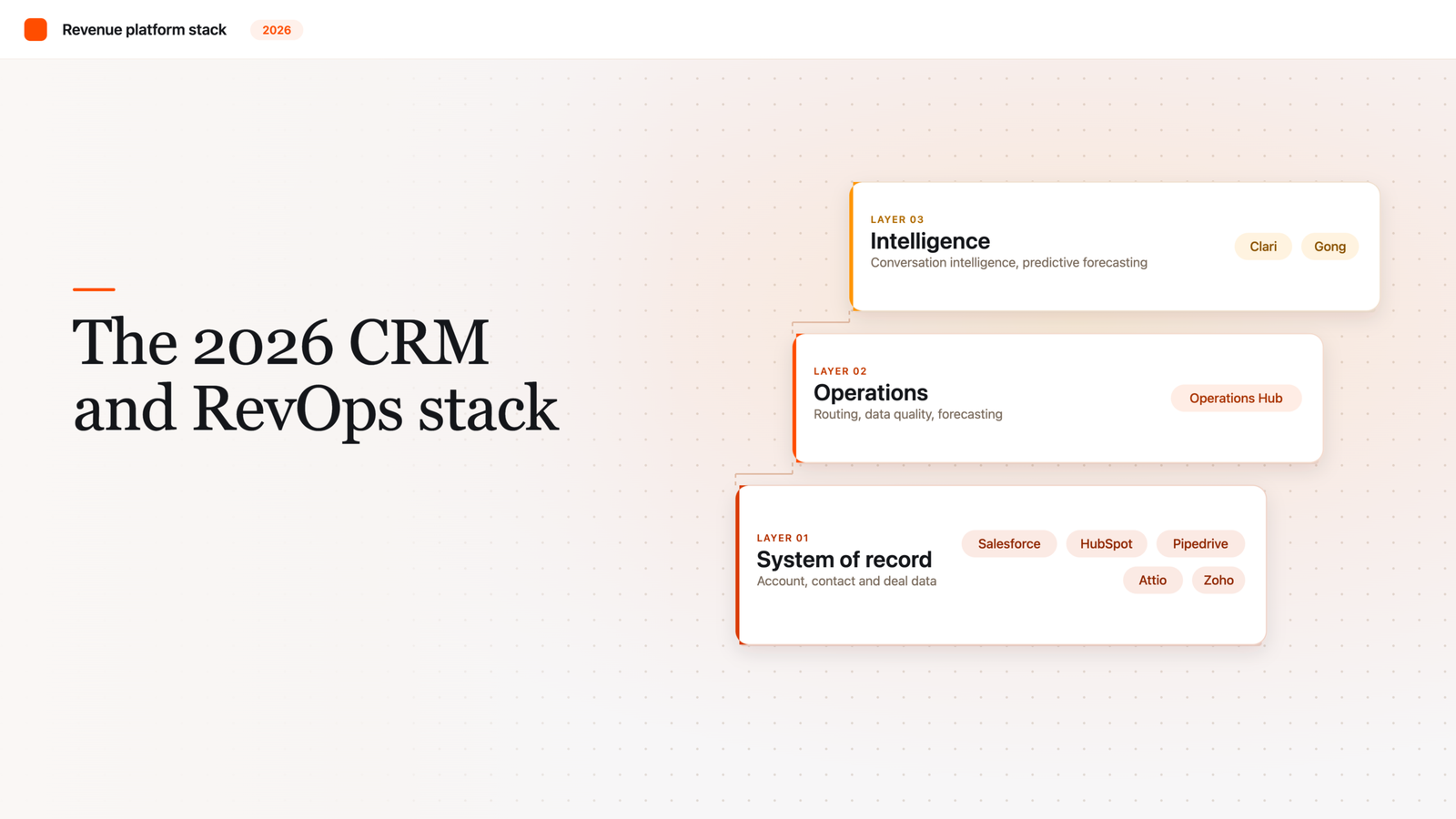
    When people say “CRM platform,” they’re usually describing a stack with three distinct layers:

    1. System of record: the core CRM (Salesforce, HubSpot, Pipedrive, Attio, Zoho) that stores account, contact, and deal data.
    2. Operations layer: tools that sit on top to manage routing, data quality, forecasting, and workflow automation.
    3. Intelligence layer: AI-driven tools for conversation intelligence, signal-based selling, and predictive forecasting.

    Most vendors now compete to own more than one layer, which is why platform comparisons have gotten more complex than a simple feature checklist.

    Platform Comparison at a Glance

    Platform Best For Watch Out For
    Salesforce Complex, multi-product enterprises needing deep customization Implementation cost and admin overhead
    HubSpot Mid-market SaaS wanting CRM + marketing + ops in one suite Costs scale quickly as contact volume grows
    Pipedrive / Attio Lean sales-led teams wanting speed over depth Fewer native RevOps and forecasting features
    Zoho Cost-conscious teams needing broad functionality Less polished UX, smaller partner ecosystem
    Clari / Gong (layered on CRM) Teams that need forecasting and conversation intelligence, not a CRM replacement Additional cost and integration overhead

    How to Match a Platform to Your Growth Stage

    The right stack depends less on brand reputation and more on where your revenue team actually is:

    • Pre-Series A: A lightweight CRM (Pipedrive, Attio, or HubSpot’s free/starter tier) is usually enough. Don’t buy a RevOps layer before you have repeatable process to operationalize.
    • Series A to B, scaling GTM: This is where most teams add an operations layer. Lead routing, forecasting, and reporting typically outgrow spreadsheets and native CRM reporting around this stage.
    • Series C and beyond: Multi-product, multi-region GTM usually justifies Salesforce’s customization depth, paired with dedicated intelligence-layer tools.

    Questions to Ask Before You Commit

    1. Which layer (system of record, operations, or intelligence) is this actually solving for, and do we already own a tool that covers it?
    2. What does data migration and integration actually cost, in time and dollars, not just license price?
    3. Will this platform still fit at 3x our current headcount, or are we buying for today’s team size only?
    4. Who owns admin and configuration internally, and do they have the bandwidth to maintain it?

    The Platform Is Only as Good as the Operating Model Around It

    No CRM or RevOps platform fixes misalignment between sales and marketing on its own. It just gives you the infrastructure to enforce alignment once you’ve defined it. The teams getting the most value from their 2026 stack are the ones who nailed process and definitions first, then chose tooling to support it, rather than the reverse.

    Frequently Asked Questions

    What’s the difference between a CRM and a RevOps platform?

    A CRM is the system of record: it stores account, contact, and deal data. A RevOps platform (or RevOps layer) sits on top of or alongside the CRM to handle lead routing, forecasting, reporting, and data hygiene across sales, marketing, and customer success. Many teams need both, not one instead of the other.

    Do I need a separate RevOps layer if I already have a CRM?

    Not always. Early-stage teams with simple, low-volume pipelines can often rely on native CRM reporting and manual process. A dedicated RevOps layer typically becomes worth the investment once lead volume, headcount, or reporting complexity outgrows what the CRM handles natively, usually around Series A to B.

    Which CRM is best for early-stage SaaS companies?

    Lightweight, fast-to-implement tools like Pipedrive, Attio, or HubSpot’s starter tier are usually the right fit pre-Series A. The priority at this stage is speed and low overhead, not deep customization or a full RevOps layer.

    How much does implementing a RevOps stack typically cost?

    Costs vary widely based on team size, data volume, and how many systems need to integrate, but license price is rarely the biggest cost. Implementation time, data migration, and ongoing admin work usually add up to more than the subscription fee itself, which is why total cost of ownership matters more than sticker price when comparing platforms.

    When should a SaaS company move from HubSpot to Salesforce?

    This shift usually makes sense when a company moves into multi-product or multi-region go-to-market motions that require deeper customization than HubSpot supports, or when contact volume growth makes HubSpot’s pricing model less cost-effective than Salesforce’s structure. It’s rarely worth making the switch before that complexity actually exists.

    What’s the biggest mistake SaaS teams make when choosing a CRM or RevOps stack?

    Buying tooling before defining process. A platform can’t fix misaligned sales and marketing definitions or an undefined lead lifecycle on its own. Teams that get the most value from their stack define their process and shared definitions first, then choose tools to support it, rather than expecting the software to create alignment for them.

  • How to Choose a SaaS CRM for Automation

    How to Choose a SaaS CRM for Automation

    As B2B teams get leaner and buyers get pickier, more of the revenue engine is running on software. Sales reps are expected to cover more accounts. Marketers are expected to prove pipeline, not just clicks. And the tool sitting in the middle of all of it, your CRM, is either multiplying your team’s effort or quietly draining it.

    That’s why the CRM decision has quietly become an automation decision. You’re not just buying a database of contacts anymore. You’re choosing the system that will route your leads, trigger your follow-ups, sync your marketing and sales data, and tell you what’s actually working.

    Get it right, and a five-person team can operate like fifteen. Get it wrong, and you’ll spend the next two years paying for workarounds, duct-tape integrations, and a sales team that lives in spreadsheets anyway.

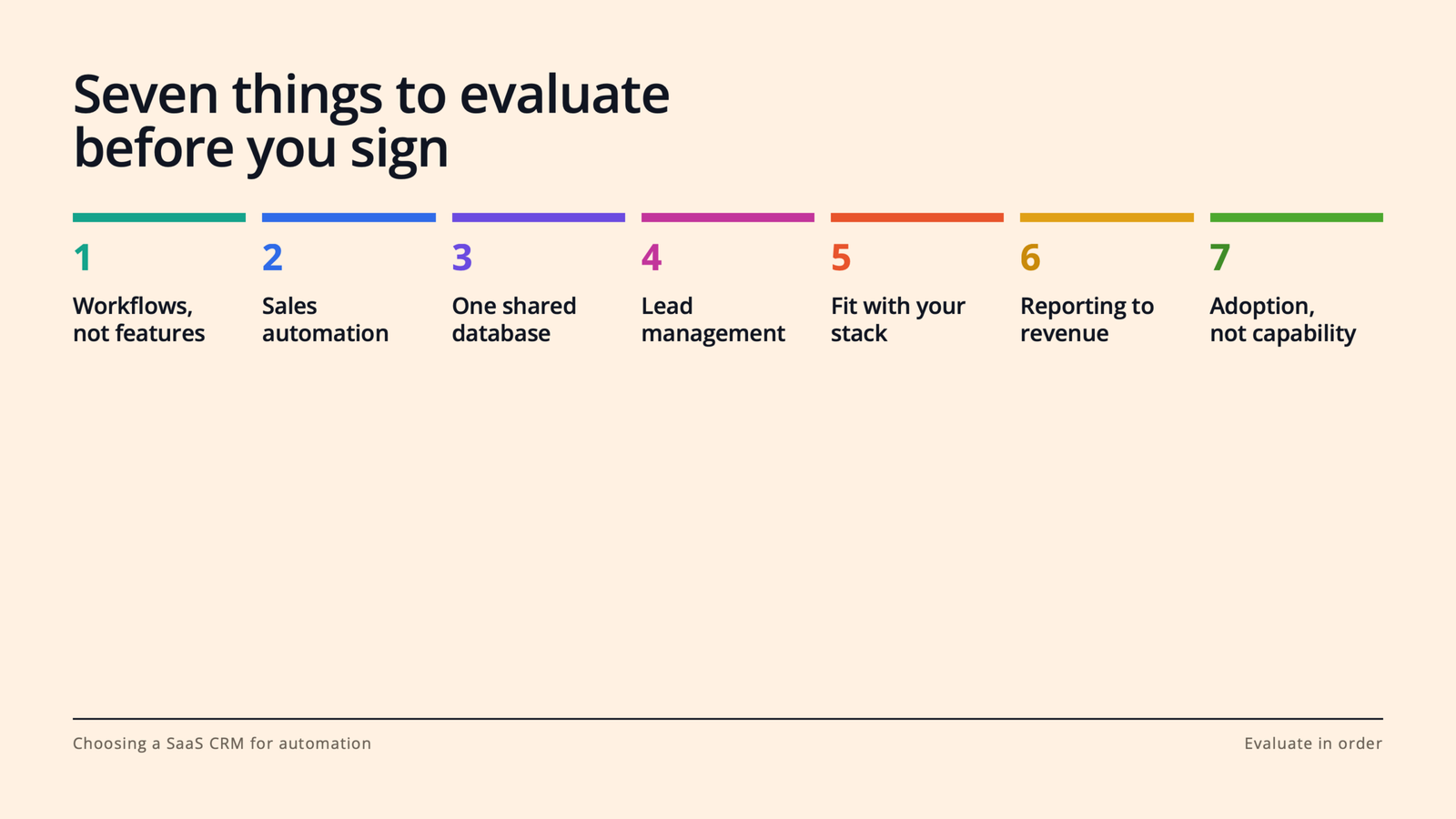
    In this guide, we’ll walk through what a SaaS CRM actually needs to do for a modern revenue team, and the seven things to evaluate before you sign anything.

    What is a SaaS CRM, and why does automation change the buying criteria?

    What is a SaaS CRM? A SaaS CRM is customer relationship management software delivered in the cloud on a subscription basis. No servers to maintain, no versions to install; you log in, your data lives centrally, and updates ship continuously. For most B2B teams, it’s the system of record for every contact, company, deal, and conversation.

    Why does automation change how you should buy one? Because the value of modern CRM platforms no longer comes from storing information. It comes from acting on it. The best platforms watch for signals (a form fill, a stalled deal, a pricing-page visit) and do something useful without a human lifting a finger: assign the lead, send the follow-up, alert the rep, update the forecast.

    That means the old evaluation checklist (“Can it hold our contacts? Can we build a pipeline view?”) is table stakes. The real questions are about workflows. Which brings us to the list.

    1. Start with the workflows you want to automate, not the feature list.

    Every CRM vendor will hand you a feature grid with 200 rows of checkmarks. Ignore it, at least at first.

    Instead, sit down with your sales and marketing leads and write out the five to ten workflows that eat the most time or leak the most revenue today. For most B2B SaaS teams, the list looks something like this: routing inbound leads to the right rep, following up on demo requests within minutes, nurturing leads that aren’t ready to buy, reminding reps when deals go quiet, and handing off closed-won customers to onboarding.

    Now evaluate every CRM against that list. Can it run each workflow natively? How many clicks does it take to build? Does it require an admin, a consultant, or (worst case) a developer?

    This flips the power dynamic in the sales process. You’re no longer being sold features; you’re testing the product against your actual business. Vendors that are a good fit will love this exercise. Vendors that aren’t will get vague. That vagueness is data.

    2. Look for sales automation that removes admin work, not judgment.

    Here’s a useful rule of thumb: good sales automation takes the robot work away from humans. Bad sales automation tries to take the human work away from humans.

    The robot work is everything your reps do that a machine should be doing: logging emails and calls, creating tasks, updating deal stages, scheduling meetings, sending the third polite “just bumping this” follow-up. Research on sales productivity has found reps spend well under half their time actually selling, and admin is the biggest culprit. Every hour of it you automate goes straight back into conversations with buyers.

    So when you evaluate CRM platforms, look for automatic activity logging (email and calendar sync that just works), sequences or cadences for multi-step follow-up, meeting scheduling links, and workflow triggers like “if a deal hasn’t been touched in 10 days, create a task and notify the owner.”

    Then watch for the trap: automation that sends generic, robotic outreach at scale. Your buyers can smell it, and it burns your domain reputation and your brand at the same time. The platform should make personalization faster (templates with smart tokens, AI-assisted drafts a rep can edit), not make it optional.

    3. Make sure marketing automation and sales live on the same database.

    This is the single biggest structural decision in the whole evaluation, and it’s the one teams most often get wrong.

    Plenty of companies buy a CRM for sales and a separate marketing automation tool for email, forms, and nurturing, then wire the two together with a connector. On paper, it works. In practice, you’ve just created two versions of the truth. A lead updates their job title in one system and not the other. Marketing thinks a lead is nurturing; sales already closed them. Attribution reports disagree with pipeline reports, and now your Monday revenue meeting is a debate about whose numbers are right.

    Mistrust and miscommunication flare. Efficiency tanks.

    The alternative is a platform where marketing automation and the sales CRM share one contact record. When a prospect opens an email, visits your pricing page, or fills out a form, the rep sees it in the same timeline where they log calls. When sales disqualifies a lead, marketing’s nurture logic knows instantly.

    If you do end up with separate tools (sometimes there are good reasons), scrutinize the sync: Is it real-time and two-way, or a nightly batch job? What happens on conflicts? Who owns field mappings? Ask to see it working, not just a slide about it.

    4. Get specific about lead management: capture, routing, scoring, and lifecycle.

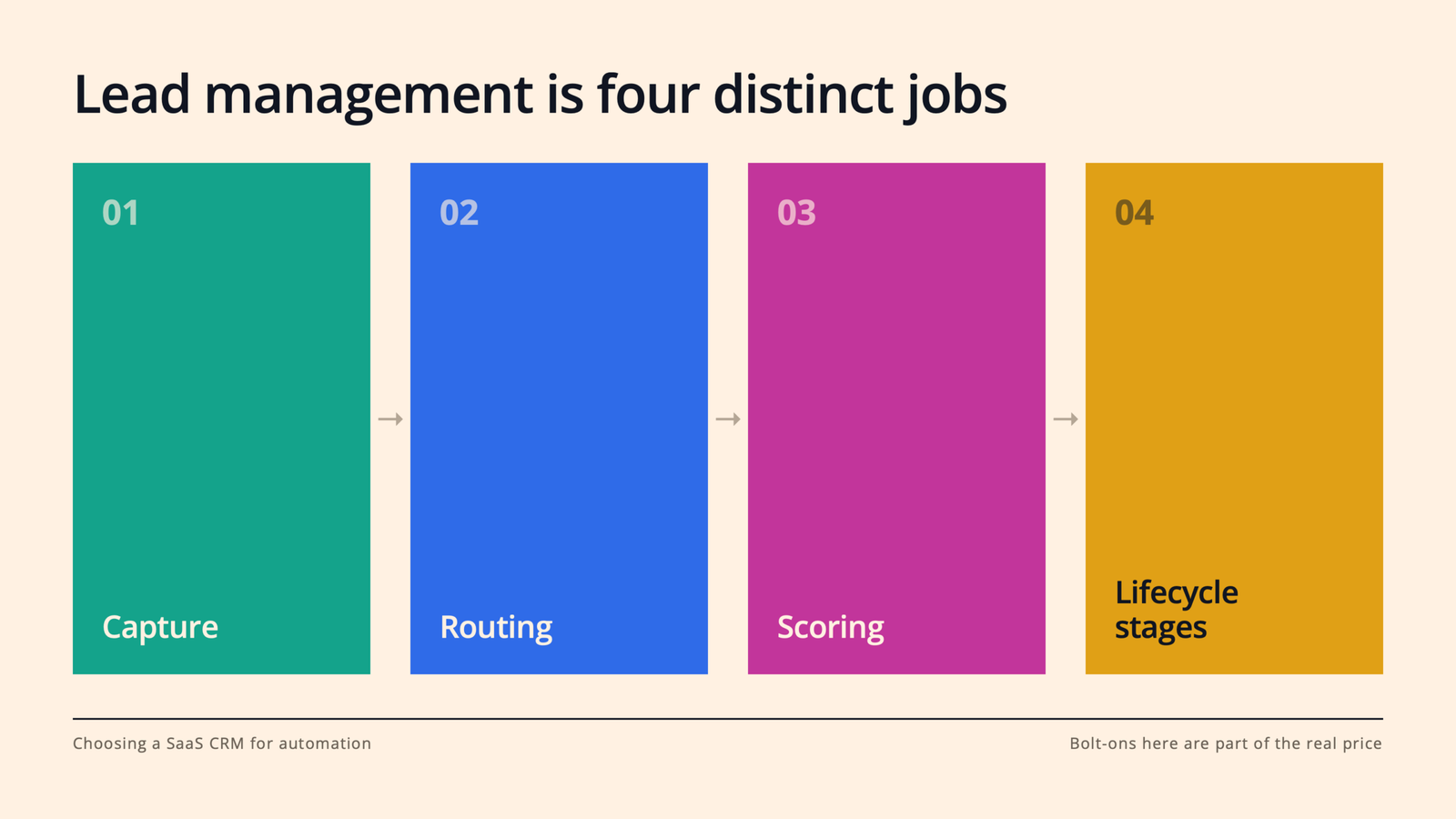
    “Lead management” is one of those phrases that appears on every vendor’s website and means something different at every company. Pin it down. A CRM worth buying should handle four distinct jobs:

    Capture. Forms, chat, meeting links, and ad integrations (think LinkedIn Lead Gen Forms) that feed leads into the CRM automatically, with source data attached.

    Routing. Rules that assign leads instantly by territory, segment, or round-robin. Speed matters enormously here; the odds of connecting with a lead drop off a cliff within the first hour, so “a rep will get to it tomorrow” is a revenue leak, not a process.

    Scoring and prioritization. The ability to rank leads on fit (does this match our ICP?) and behavior (what have they actually done?), so reps work the best leads first instead of the newest.

    Lifecycle stages. A shared definition of subscriber, lead, MQL, SQL, opportunity, and customer that both marketing and sales agree on, enforced by the system rather than by tribal knowledge.

    If a platform makes you bolt on third-party tools for two or three of these, factor that into the real price.

    5. Audit how it fits your existing stack.

    Your CRM will not live alone. It has to play nicely with your email and calendar, your data warehouse, your support desk, your billing system, and whatever else your team already depends on, whether that’s Slack, Snowflake, Stripe, or a homegrown product database.

    Three questions to ask every vendor:

    Does it integrate natively with our core tools? Native integrations are maintained by the vendor and tend to be sturdier than anything held together by middleware.

    How good is the API? Even if you never plan to touch it, a well-documented API is your escape hatch for the use case you haven’t thought of yet.

    What does the ecosystem look like? A healthy app marketplace means that when you adopt a new tool in two years, the connector probably already exists, for the low price of free ninety-nine (or at least without a services engagement).

    One more thing: ask about data portability on the way out. A vendor confident in their product will make exporting easy. A vendor relying on lock-in will not, and that tells you something.

    6. Demand reporting that connects marketing activity to revenue.

    Automation without measurement is just motion. The whole point of putting sales and marketing on one platform is that you can finally answer the questions that matter: Which campaigns create pipeline, not just leads? Where do deals stall? Which rep behaviors correlate with wins? What’s our real cost per opportunity by channel?

    In your evaluation, don’t settle for the demo dashboard (it’s always gorgeous). Bring three reports your leadership team actually asks for today, and ask the vendor to build them live with sample data. You’ll learn more in that 20 minutes than in the rest of the sales cycle combined.

    And check the AI story here, too. The current generation of CRM platforms is adding forecasting, deal-risk signals, and natural-language reporting. You don’t need all of it on day one, but you do want a vendor that’s clearly investing in it.

    7. Weigh adoption as heavily as capability.

    Here’s the uncomfortable truth about CRM projects: the most common failure mode isn’t missing features. It’s a sales team that won’t use the thing.

    A CRM only automates well if the data going in is clean and complete, and that only happens when reps want to live in it. So in your trial, put actual reps (not just ops) in the product for a week. Watch where they hesitate. Count the clicks to log a call or update a deal. Ask them, honestly, whether they’d use it without being nagged.

    Then look at the operational side of adoption: How long is implementation, really? Do you need a certified admin or an agency to make changes? What does onboarding and support cost? And how does pricing scale as you add seats, contacts, and automation volume? A platform that’s affordable at 10 seats and punishing at 50 is a decision you’ll have to unmake later, mid-growth, when you can least afford the disruption.

    Final thoughts

    Choosing a SaaS CRM for automation isn’t really a software decision. It’s a decision about how your revenue team will work for the next three to five years: how fast leads get touched, how aligned marketing and sales stay, and how much of your team’s week goes to selling instead of admin.

    So start where we started. Write down the workflows that matter, put two or three CRM platforms through a real trial against them, and let your reps and your reports cast the deciding votes.

    The teams that win with automation aren’t the ones with the longest feature list. They’re the ones whose system quietly handles the busywork so the humans can do the part humans are great at: building relationships and closing deals. Pick the platform that makes that your default, and you won’t just keep up with where B2B buying is going. You’ll be ready for it.

  • What’s the Best CRM for a Scaling SaaS Startup? The 4 Walls You’ll Hit First

    What’s the Best CRM for a Scaling SaaS Startup? The 4 Walls You’ll Hit First

    Ask a room full of SaaS founders which CRM they use and you’ll get a room full of different answers. Ask them which CRM they started with, and you’ll get an even more interesting one, because almost nobody scales on the system they signed up for at five employees.

    That’s not a failure of research. It’s the nature of the problem. Early on, a CRM is basically shared memory: a place to keep contacts and deals so nothing falls through the cracks. But somewhere between 20 and 100 people, the job changes. Your CRM stops being a filing cabinet and starts being the operating system for your entire go-to-market motion, running your sales automation, your marketing automation, your lead management, your reporting, all of it.

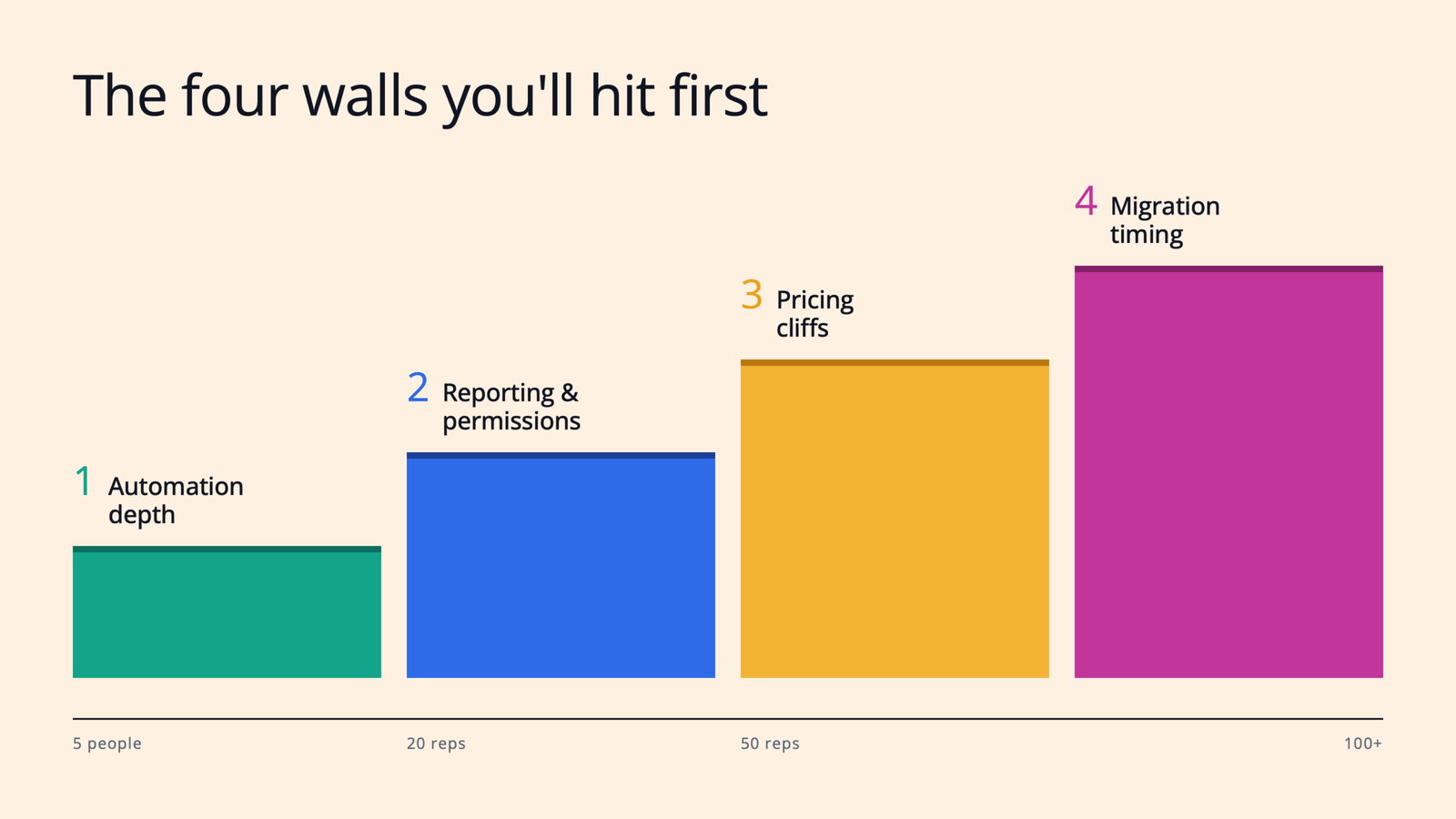
    Here’s the thing, though: teams almost never outgrow CRM platforms because of missing features. They outgrow them because they slam into one of four walls. If you know where those walls are before you hit them, you can pick a platform (and a migration moment) with your eyes open.

    Let’s walk through all four.

    1. You’ll hit the automation-depth wall first.

    In the early days, “automation” means an email sequence and maybe a Slack alert when a demo gets booked. That’s genuinely enough. But as pipeline volume grows, the cracks show up fast.

    Suddenly you need real lead management: routing rules that assign inbound leads by territory or segment in seconds, not whenever someone checks the shared inbox. Lead scoring, so reps work your best-fit accounts first instead of the newest ones. Lifecycle stages (lead, MQL, SQL, opportunity) that marketing and sales both actually respect, enforced by the system rather than by tribal knowledge.

    This is where lightweight, startup-friendly tools quietly tap out, and where you feel the difference between a contact database and true sales automation. The tell is simple: if building a new workflow requires a workaround, a third-party tool, or a Zapier chain someone has to babysit, you’re already leaning on the wall.

    What to do about it: Before you evaluate anything, write down the ten workflows that eat the most rep time or leak the most revenue. Then make every vendor build two of them live in a demo.

    2. Reporting and permissions will sneak up on you.

    This is the wall nobody sees coming, because it has nothing to do with day-one requirements.

    The moment you hire your second sales manager, everything changes. Now you need team-level pipeline views. Field-level permissions, so an SDR can’t accidentally rewrite deal amounts. Forecast roll-ups by team. Attribution reporting your CFO won’t laugh out of the room. Custom objects for the things that make your business your business, like product usage or billing events.

    And here’s the uncomfortable pattern across nearly every vendor: this is exactly the stuff that gets paywalled. The features that make customer relationship management work for a team of teams almost always live two pricing tiers above where you started.

    What to do about it: When you’re comparing CRM platforms, don’t read the pricing page for the plan you’re buying. Read it for the plan two tiers up, because that’s the one your 18-months-from-now self will need. If the reporting and permission features you’ll require at 50 reps only exist on an enterprise tier with a “contact sales” button, factor that into the real cost today.

    3. Pricing cliffs won’t hurt you if you model them before you sign.

    Every scaling team eventually learns that CRM pricing isn’t a line, it’s a staircase, and some of the steps are steep.

    You’ve probably heard the war stories. The jump from a starter tier to a professional tier that multiplies your bill overnight. The platform that looks affordable per seat until you realize you need a full-time admin or a consultant to actually run it. The contact-based pricing that quietly punishes you for the thing marketing worked hardest to build: a big database.

    None of this makes those platforms bad. It makes them priced for a future you may or may not grow into. The mistake isn’t paying more as you scale; that’s normal. The mistake is being surprised.

    What to do about it: Model your total cost at 3x your current headcount and 5x your current contact volume, including admin time, onboarding fees, and the tier that unlocks the automation and reporting from walls one and two. Do this for your top two or three finalists side by side. It’s thirty unglamorous minutes in a spreadsheet, and it can save you an entire mid-growth migration.

    4. Migration timing matters more than tool choice.

    Here’s the take that surprises most founders: when you switch matters as much as what you switch to.

    Every quarter you wait past the breaking point, you accumulate data debt. Duplicate contacts. Deals with fields half-filled. A marketing automation tool synced to your CRM through a connector that mostly works, holding two versions of the truth that mostly agree. Each of those is survivable on its own. Together, they turn your eventual migration from a weekend project into a quarter-long slog, right when your pipeline can least afford the disruption.

    The signals that it’s time are surprisingly consistent: you’ve hired (or are about to hire) a second sales manager. You’re crossing 15 to 20 reps. Marketing and sales are debating whose numbers are right in the Monday revenue meeting. Or your ops person spends more time maintaining syncs and spreadsheets than improving the process.

    What to do about it: Migrate before you think you need to. Pick a quiet stretch of the quarter, appoint one owner, clean your data before it moves (not after), and run the old and new systems in parallel for two to four weeks. Boring? Absolutely. But boring migrations are the good kind.

    So… which CRM is actually “best”?

    If you were hoping for one name, here’s the honest answer: the best SaaS CRM is the one whose walls you won’t hit for the next two to three years, at a price you can see coming.

    For some teams, that’s an all-in-one platform where sales and marketing automation share a single database, so lead management and attribution just work without a sync to babysit. For others, it’s a heavyweight system with deep customization, plus the ops headcount to match. For a seed-stage team, it might genuinely be the lightweight tool everyone loves using, with a calendar reminder to revisit the decision at 15 reps.

    The point is that “best” is a question about your walls, not about logos.

    Final thoughts

    Scaling a SaaS company means your CRM decision is never really finished; it’s a decision you revisit as the company changes shape. But you don’t have to be caught off guard.

    So here’s your first step: this week, grab your sales and marketing leads for 45 minutes and pressure-test your current setup against the four walls. Where’s your automation straining? What reporting will you need at your next headcount milestone? Where are the pricing cliffs on your current contract? And what would a calm, boring migration look like if you started it a quarter early?

    Do that, and you won’t just pick a better platform. You’ll be the team that saw the wall coming and stepped around it, while everyone else was still comparing feature grids.

  • 7 CRM Factors for Midmarket SaaS Teams in 2026

    7 CRM Factors for Midmarket SaaS Teams in 2026

    As B2B teams get leaner and buyers get pickier, more of the revenue engine is running on software. Sales reps are expected to cover more accounts. Marketers are expected to prove pipeline, not just clicks. And the tool sitting in the middle of all of it, your CRM, is either multiplying your team’s effort or quietly draining it.

    That’s why the CRM decision has quietly become an automation decision. You’re not just buying a database of contacts anymore. You’re choosing the system that will route your leads, trigger your follow-ups, sync your marketing and sales data, and tell you what’s actually working.

    Get it right, and a five-person team can operate like fifteen. Get it wrong, and you’ll spend the next two years paying for workarounds, duct-tape integrations, and a sales team that lives in spreadsheets anyway.

    In this guide, we’ll walk through what a SaaS CRM actually needs to do for a modern revenue team, and the seven things to evaluate before you sign anything.

    What is a SaaS CRM, and why does automation change the buying criteria?

    What is a SaaS CRM? A SaaS CRM is customer relationship management software delivered in the cloud on a subscription basis. No servers to maintain, no versions to install; you log in, your data lives centrally, and updates ship continuously. For most B2B teams, it’s the system of record for every contact, company, deal, and conversation.

    Why does automation change how you should buy one? Because the value of modern CRM platforms no longer comes from storing information. It comes from acting on it. The best platforms watch for signals (a form fill, a stalled deal, a pricing-page visit) and do something useful without a human lifting a finger: assign the lead, send the follow-up, alert the rep, update the forecast.

    That means the old evaluation checklist (“Can it hold our contacts? Can we build a pipeline view?”) is table stakes. The real questions are about workflows. Which brings us to the list.

    1. Start with the workflows you want to automate, not the feature list.

    Every CRM vendor will hand you a feature grid with 200 rows of checkmarks. Ignore it, at least at first.

    Instead, sit down with your sales and marketing leads and write out the five to ten workflows that eat the most time or leak the most revenue today. For most B2B SaaS teams, the list looks something like this: routing inbound leads to the right rep, following up on demo requests within minutes, nurturing leads that aren’t ready to buy, reminding reps when deals go quiet, and handing off closed-won customers to onboarding.

    Now evaluate every CRM against that list. Can it run each workflow natively? How many clicks does it take to build? Does it require an admin, a consultant, or (worst case) a developer?

    This flips the power dynamic in the sales process. You’re no longer being sold features; you’re testing the product against your actual business. Vendors that are a good fit will love this exercise. Vendors that aren’t will get vague. That vagueness is data.

    2. Look for sales automation that removes admin work, not judgment.

    Here’s a useful rule of thumb: good sales automation takes the robot work away from humans. Bad sales automation tries to take the human work away from humans.

    The robot work is everything your reps do that a machine should be doing: logging emails and calls, creating tasks, updating deal stages, scheduling meetings, sending the third polite “just bumping this” follow-up. Research on sales productivity has found reps spend well under half their time actually selling, and admin is the biggest culprit. Every hour of it you automate goes straight back into conversations with buyers.

    So when you evaluate CRM platforms, look for automatic activity logging (email and calendar sync that just works), sequences or cadences for multi-step follow-up, meeting scheduling links, and workflow triggers like “if a deal hasn’t been touched in 10 days, create a task and notify the owner.”

    Then watch for the trap: automation that sends generic, robotic outreach at scale. Your buyers can smell it, and it burns your domain reputation and your brand at the same time. The platform should make personalization faster (templates with smart tokens, AI-assisted drafts a rep can edit), not make it optional.

    3. Make sure marketing automation and sales live on the same database.

    This is the single biggest structural decision in the whole evaluation, and it’s the one teams most often get wrong.

    Plenty of companies buy a CRM for sales and a separate marketing automation tool for email, forms, and nurturing, then wire the two together with a connector. On paper, it works. In practice, you’ve just created two versions of the truth. A lead updates their job title in one system and not the other. Marketing thinks a lead is nurturing; sales already closed them. Attribution reports disagree with pipeline reports, and now your Monday revenue meeting is a debate about whose numbers are right.

    Mistrust and miscommunication flare. Efficiency tanks.

    The alternative is a platform where marketing automation and the sales CRM share one contact record. When a prospect opens an email, visits your pricing page, or fills out a form, the rep sees it in the same timeline where they log calls. When sales disqualifies a lead, marketing’s nurture logic knows instantly.

    If you do end up with separate tools (sometimes there are good reasons), scrutinize the sync: Is it real-time and two-way, or a nightly batch job? What happens on conflicts? Who owns field mappings? Ask to see it working, not just a slide about it.

    4. Get specific about lead management: capture, routing, scoring, and lifecycle.

    “Lead management” is one of those phrases that appears on every vendor’s website and means something different at every company. Pin it down. A CRM worth buying should handle four distinct jobs:

    Capture. Forms, chat, meeting links, and ad integrations (think LinkedIn Lead Gen Forms) that feed leads into the CRM automatically, with source data attached.

    Routing. Rules that assign leads instantly by territory, segment, or round-robin. Speed matters enormously here; the odds of connecting with a lead drop off a cliff within the first hour, so “a rep will get to it tomorrow” is a revenue leak, not a process.

    Scoring and prioritization. The ability to rank leads on fit (does this match our ICP?) and behavior (what have they actually done?), so reps work the best leads first instead of the newest.

    Lifecycle stages. A shared definition of subscriber, lead, MQL, SQL, opportunity, and customer that both marketing and sales agree on, enforced by the system rather than by tribal knowledge.

    If a platform makes you bolt on third-party tools for two or three of these, factor that into the real price.

    5. Audit how it fits your existing stack.

    Your CRM will not live alone. It has to play nicely with your email and calendar, your data warehouse, your support desk, your billing system, and whatever else your team already depends on, whether that’s Slack, Snowflake, Stripe, or a homegrown product database.

    Three questions to ask every vendor:

    Does it integrate natively with our core tools? Native integrations are maintained by the vendor and tend to be sturdier than anything held together by middleware.

    How good is the API? Even if you never plan to touch it, a well-documented API is your escape hatch for the use case you haven’t thought of yet.

    What does the ecosystem look like? A healthy app marketplace means that when you adopt a new tool in two years, the connector probably already exists, for the low price of free ninety-nine (or at least without a services engagement).

    One more thing: ask about data portability on the way out. A vendor confident in their product will make exporting easy. A vendor relying on lock-in will not, and that tells you something.

    6. Demand reporting that connects marketing activity to revenue.

    Automation without measurement is just motion. The whole point of putting sales and marketing on one platform is that you can finally answer the questions that matter: Which campaigns create pipeline, not just leads? Where do deals stall? Which rep behaviors correlate with wins? What’s our real cost per opportunity by channel?

    In your evaluation, don’t settle for the demo dashboard (it’s always gorgeous). Bring three reports your leadership team actually asks for today, and ask the vendor to build them live with sample data. You’ll learn more in that 20 minutes than in the rest of the sales cycle combined.

    And check the AI story here, too. The current generation of CRM platforms is adding forecasting, deal-risk signals, and natural-language reporting. You don’t need all of it on day one, but you do want a vendor that’s clearly investing in it.

    7. Weigh adoption as heavily as capability.

    Here’s the uncomfortable truth about CRM projects: the most common failure mode isn’t missing features. It’s a sales team that won’t use the thing.

    A CRM only automates well if the data going in is clean and complete, and that only happens when reps want to live in it. So in your trial, put actual reps (not just ops) in the product for a week. Watch where they hesitate. Count the clicks to log a call or update a deal. Ask them, honestly, whether they’d use it without being nagged.

    Then look at the operational side of adoption: How long is implementation, really? Do you need a certified admin or an agency to make changes? What does onboarding and support cost? And how does pricing scale as you add seats, contacts, and automation volume? A platform that’s affordable at 10 seats and punishing at 50 is a decision you’ll have to unmake later, mid-growth, when you can least afford the disruption.

    Final thoughts

    Choosing a SaaS CRM for automation isn’t really a software decision. It’s a decision about how your revenue team will work for the next three to five years: how fast leads get touched, how aligned marketing and sales stay, and how much of your team’s week goes to selling instead of admin.

    So start where we started. Write down the workflows that matter, put two or three CRM platforms through a real trial against them, and let your reps and your reports cast the deciding votes.

    The teams that win with automation aren’t the ones with the longest feature list. They’re the ones whose system quietly handles the busywork so the humans can do the part humans are great at: building relationships and closing deals. Pick the platform that makes that your default, and you won’t just keep up with where B2B buying is going. You’ll be ready for it.