Which AI tools actually help B2B SaaS companies automate revenue workflows?
The honest answer in 2026 is a specific short list, Clari and Aviso for forecasting, Gong and Chorus for conversation intelligence, LeanData for lead routing, and a handful of others, each solving one workflow well rather than one platform solving everything. That distinction matters more than it sounds, because Salesloft’s 2026 Revenue Benchmark found every surveyed revenue organization already uses AI somewhere in the revenue process, yet only 20.6% describe their deployment as production-ready with measurable outcomes, with the gap traced back to CRM data hygiene and deal visibility, not a lack of access to tools. This guide looks at the AI platforms genuinely changing how SaaS revenue teams forecast, prioritize, and sell, organized by the specific workflow each one improves, and maps named tools to concrete use cases so you’re not left guessing which one fits your stack.
Where AI Is Actually Delivering Value in Revenue Workflows
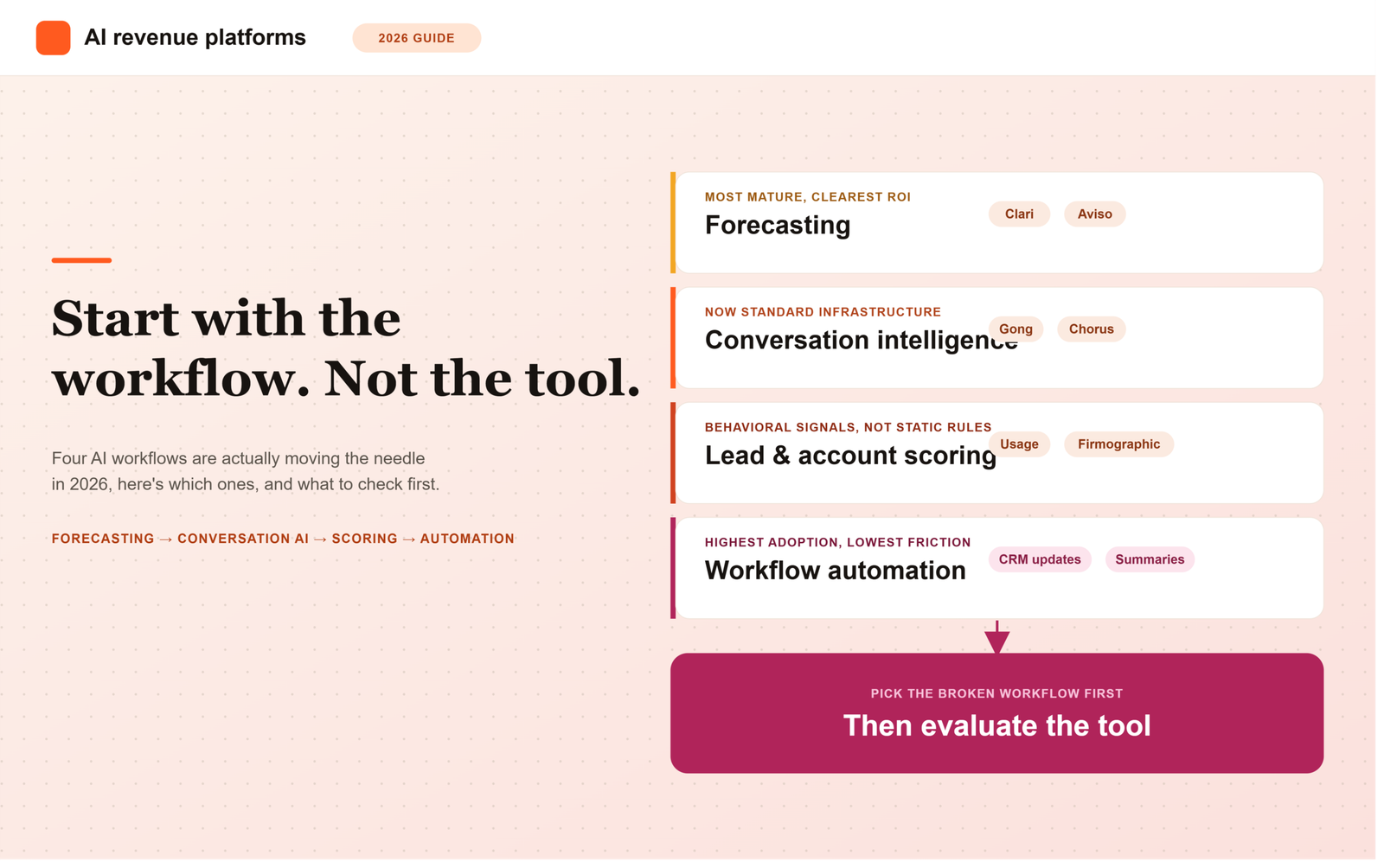
Not every part of the revenue process benefits equally from AI. The clearest wins in 2026 cluster around four workflows:
- Forecasting: predictive models that reduce reliance on rep-reported deal confidence
- Conversation intelligence: analyzing sales calls for risk signals, competitor mentions, and coaching opportunities
- Lead and account prioritization: scoring based on behavioral and firmographic signals rather than static rules
- Workflow automation: drafting follow-ups, updating CRM fields, and summarizing account activity automatically
Tool Comparison: Which Platform Fits Which Team
The table below compares eight of the most commonly evaluated platforms across the workflows above, so you can see fit and tradeoffs side by side before reading the workflow breakdowns that follow.
| Tool | Primary Workflow | Best-Fit Team Size | CRM Integration | Pricing Model | Main Limitation |
|---|---|---|---|---|---|
| Clari | Forecasting and revenue intelligence | Mid-market to enterprise | Native, deep Salesforce integration | Per-user annual license | Significant setup effort; less cost-effective below a few dozen reps |
| Gong | Conversation intelligence | Mid-market to enterprise | Native with Salesforce, HubSpot, and major CRMs | Per-user annual license | Cost scales quickly with headcount; needs call volume to justify spend |
| HubSpot (Breeze AI) | CRM-native AI across forecasting, scoring, and admin automation | SMB to mid-market | Native, built into the CRM itself | Tiered subscription, AI features bundled or add-on by tier | Less specialized and configurable than standalone tools in any one workflow |
| Salesforce (Einstein / Agentforce) | CRM-native AI across forecasting, scoring, and admin automation | Mid-market to enterprise | Native, built into the CRM itself | Tiered subscription, often a paid add-on above core license | Requires admin expertise to configure well; add-on cost adds up |
| LeanData | Lead and account routing | Mid-market to enterprise | Deep, primarily Salesforce-centric | Per-user or platform license | Weaker fit for HubSpot-only stacks without a Salesforce backbone |
| Syncari | Data unification and CRM data quality | Mid-market to enterprise | Connects across CRMs, data warehouses, and point tools | Usage-based platform pricing | Solves the data layer, not rep-facing workflow directly; needs technical setup |
| Outreach | Outbound sales engagement automation | Mid-market to enterprise | Native with Salesforce and HubSpot | Per-user annual license | Built for sequencing and engagement, not a forecasting or CI replacement |
| Apollo | Data enrichment and outbound automation | SMB to mid-market | Integrates with major CRMs | Per-user or credit-based pricing | Enrichment data quality varies by region and industry; lighter analytics than dedicated CI tools |
Forecasting: Where AI Has Matured the Most
AI-driven forecasting tools (Clari, Aviso, and similar platforms) now pull signal from CRM activity, email and calendar engagement, and historical win-rate patterns to produce forecasts that are frequently more accurate than manager roll-ups based purely on rep judgment. For revenue leaders reporting to a board, this category delivers some of the clearest ROI of any AI investment in the stack.
Conversation Intelligence: From Nice-to-Have to Standard
Tools like Gong and Chorus have moved from “premium add-on” to close to standard infrastructure for any team running more than a handful of reps. The real value in 2026 isn’t just call recording. It’s automated risk flagging (competitor mentions, pricing objections, stalled momentum) surfaced directly into deal records without a manager having to listen to every call.
Lead and Account Scoring: Behavioral Signals Over Static Rules
Older lead scoring models relied on static point systems (job title +10, company size +5). AI-driven scoring now weighs actual behavioral patterns, such as which pages someone visited or how usage compares to accounts that historically converted or expanded, producing meaningfully better prioritization for both sales and customer success teams.
Workflow Automation: Time Given Back to Reps
AI-assisted CRM updates, meeting summaries, and follow-up drafting have quietly become one of the highest-adoption AI use cases, simply because they save reps hours per week on administrative work without requiring a change in how they sell.
Which AI Tools Fit Each Revenue Workflow
The four workflows above map to specific tools worth shortlisting, and two additional workflows, lead routing and data enrichment, are common enough at B2B SaaS companies that they deserve their own breakdown.
Forecasting
Clari and Aviso remain the two most commonly shortlisted standalone forecasting platforms, both pulling from CRM activity and engagement signals to produce a probability-weighted forecast. HubSpot and Salesforce both offer native forecasting AI (Breeze and Einstein respectively) that works reasonably well for simpler, single-motion sales processes, but teams running multiple segments or a hybrid PLG-plus-sales motion tend to outgrow the native version and move to a standalone tool.
Conversation Intelligence
Gong and Chorus dominate this category, and the choice between them usually comes down to CRM integration depth and existing contract relationships rather than a meaningful capability gap. Teams under roughly ten reps rarely see proportional ROI here, since a manager can often still listen to most calls directly at that volume.
Lead Routing
LeanData is the most established standalone tool here, particularly for Salesforce-centric stacks needing complex routing logic across territories, product lines, or partner channels. Teams on HubSpot alone can often get sufficient routing logic from HubSpot’s native workflow automation without adding a separate tool, unless the routing rules involve genuinely complex, multi-variable logic.
Data Enrichment
Apollo combines enrichment with outbound engagement in one platform, which suits smaller teams wanting a single tool rather than a stitched stack. Syncari sits a layer deeper, focused on unifying and cleaning data across multiple systems rather than enriching individual contact records, which matters more once a company is running several connected tools that all need to agree on the same customer data.
Outbound Automation
Outreach remains the more enterprise-oriented sequencing platform, with deeper reporting and native integration into larger CRM deployments. Apollo tends to fit smaller or mid-market teams better, since it bundles enrichment and outbound sequencing together at a lower overall cost than running Outreach alongside a separate enrichment tool.
CRM Admin Automation
This is where native CRM AI genuinely competes with standalone tools. HubSpot’s Breeze and Salesforce’s Einstein and Agentforce both handle CRM field updates, meeting summaries, and follow-up drafting reasonably well without adding a separate vendor to the stack, which is often the more sensible starting point before evaluating a standalone workflow automation tool.
Evaluation Framework for AI Revenue Platforms
| Criteria | What to Look For |
|---|---|
| Data foundation | Does it require clean CRM data to work, or can it function with messy inputs? |
| Explainability | Can it show why it made a prediction, not just the output? |
| Integration depth | Does it read and write back to your CRM natively, or require manual syncing? |
| Adoption friction | Does it change how reps work day-to-day, or fit into existing habits? |
| Proven ROI | Can the vendor show a measurable before/after from a comparable customer? |
Common Mistakes When Adopting AI Revenue Tools
- Buying a forecasting AI tool before CRM data hygiene is good enough for it to learn from
- Rolling out conversation intelligence without a clear coaching process to act on the insights
- Treating AI scoring as a replacement for, rather than an input to, sales judgment
- Adding tools faster than the team can actually adopt them into daily workflow
Start With the Workflow, Not the Tool
The SaaS teams getting the most value from AI in 2026 didn’t start by shopping for “an AI platform.” They started by identifying a specific workflow, such as forecast accuracy, call coaching, or lead prioritization, that was clearly broken, and then evaluated AI tools specifically against fixing that problem. Platform-first shopping tends to produce expensive tools that never get fully adopted.
Frequently Asked Questions
What AI tools are best for RevOps teams?
It depends on which workflow is broken. Clari or Aviso for forecasting, Gong or Chorus for conversation intelligence, and LeanData for lead routing are the most commonly shortlisted standalone tools, while Syncari fits teams whose core problem is fragmented or inconsistent CRM data rather than any single front-line workflow.
Do these tools work with HubSpot or Salesforce?
Most of the platforms covered here, Clari, Gong, Outreach, and Apollo among them, offer native integrations with both HubSpot and Salesforce. LeanData is the exception worth flagging, since its routing logic is built primarily around Salesforce and tends to be a weaker fit for HubSpot-only stacks.
Should B2B SaaS teams buy one platform or multiple tools?
Most established teams end up with multiple specialized tools rather than one platform doing everything, since a standalone tool built for one workflow, like Gong for conversation intelligence, typically outperforms a CRM’s native version of that same feature. The exception is CRM admin automation, where HubSpot’s Breeze or Salesforce’s Einstein often cover enough ground natively that adding a separate tool isn’t worth the cost until the team hits real limitations.
What’s the difference between an AI CRM feature and a standalone AI revenue platform?
AI CRM features are built directly into your existing CRM tier, handling basics like lead scoring or simple forecasting. Standalone AI revenue platforms (Clari, Gong, Chorus, and similar tools) sit alongside the CRM and go deeper into one specific workflow, like forecasting or conversation intelligence, usually with more accuracy and configurability than the CRM’s native version.
Do we need clean CRM data before adopting AI forecasting tools?
Yes. AI forecasting models learn from historical CRM activity and win-rate patterns, so messy or inconsistent data produces unreliable predictions. Most teams should prioritize basic data hygiene before investing in AI forecasting, or the tool will simply automate bad guesses faster.
Is conversation intelligence worth it for a small sales team?
It depends on team size and deal complexity. Conversation intelligence tends to deliver the most value once a team has enough reps and call volume that a manager can no longer realistically listen to every call. Very small teams may get more immediate value from forecasting or workflow automation tools first.
How is AI-driven lead scoring different from traditional lead scoring?
Traditional lead scoring uses static rules, such as fixed points for job title or company size. AI-driven scoring instead weighs actual behavioral signals, like page visits or product usage patterns, compared against accounts that historically converted or expanded, which typically produces more accurate prioritization.
What’s the biggest risk when adopting AI revenue tools too quickly?
Adopting tools faster than the team can actually integrate them into daily workflow. A forecasting tool, a conversation intelligence platform, and a scoring engine added all at once, without a clear process for acting on each one’s output, often leads to low adoption and wasted spend rather than better decisions.
Should AI scoring replace sales judgment entirely?
No. AI scoring works best as an input to sales judgment, not a replacement for it. Reps and managers still bring context that behavioral and firmographic data alone can’t capture, so the most effective teams treat AI scores as a prioritization aid rather than a final decision-maker.
Leave a Reply